


Most traders think the forex market is some modern invention cooked up by bankers in the 90s.

David van der Merwe
Trader Pasar Berkembang ·  South Africa
☕ 11 mnt baca
Yang akan Anda pelajari:
Most traders think the forex market is some modern invention cooked up by bankers in the 90s. They're dead wrong. The truth is, the forces that shaped forex are centuries old, and understanding them is the only way to see why the market moves the way it does today. From Florentine bankers to Nixon's shock decision, the history of forex is a story of power, panic, and profit. I'll show you how this ancient game was built, and more importantly, how that history dictates every single trade you place from Johannesburg or Cape Town.
Let's get one thing straight: nobody 'invented' forex one afternoon. It evolved, painfully slowly, from pure necessity. Think about it. Around the 6th century BC in Babylon, you didn't buy bread with coins. You traded your goat for it. That's the original barter system. But what if the baker didn't want a goat? You needed a middleman, a common measure of value. That's where commodities like salt and spices came in (hence 'salary' coming from 'salt').
Eventually, they figured out gold was pretty handy. It was rare, durable, and everyone wanted it. The first gold coins were a game-changer, but they were heavy. Carrying a sack of gold across continents to buy silk in China was a mugger's dream. So, the first real 'forex' dealers emerged: merchant bankers. The most famous were the Medici family in 15th century Florence. They set up banks in different countries. A textile merchant in London could deposit pounds with the Medici, get a letter of credit, and walk into their branch in Venice to withdraw lire. They even kept two sets of books: 'nostro' (our account with them) and 'vostro' (their account with us). Sound familiar? It's the ancestor of modern interbank accounting.

Example: Imagine a Medici banker's spread. They might buy Venetian Lire at 0.95 Florins and sell them at 1.05 Florins. That 0.10 Florin difference? That's their profit, and the world's first documented forex spread. Some things never change.
The key takeaway here isn't about dates. It's that forex was born from trade friction. The need to move value across borders safely and efficiently created the entire system. That core function - facilitating global trade - is still the bedrock of the market, even with all the speculative noise we add today.
For a long time, the world ran on a simple idea: money should be worth something real. England made it official in 1819 with the gold standard, and by the 1870s, most major powers had followed. Your paper note could, in theory, be exchanged for a fixed amount of gold at the bank. This created incredible stability. Exchange rates were basically fixed. Trading currencies for profit was a boring affair for specialists.
Then came the wars. World War I broke the system, but they tried to patch it back together. The real blueprint for the modern world was drawn up in 1944 at a hotel in Bretton Woods, New Hampshire. With Europe in ruins, 44 countries decided to peg their currencies not to gold, but to the US dollar. And the dollar? It was pegged to gold at $35 an ounce. The US, holding most of the world's gold, became the central bank of the planet.
This worked... until it didn't. By the late 1960s, America was spending massively on the Vietnam War and social programs. They were printing more dollars than they had gold to back. Foreign governments, like France's Charles de Gaulle, got nervous and started demanding gold for their dollar reserves. The US gold vaults were draining fast.
Then, on a Sunday night in August 1971, President Richard Nixon went on TV and dropped the bomb. He 'temporarily' suspended the dollar's convertibility into gold. It was the financial equivalent of tearing up the rulebook. The Bretton Woods system was dead. By 1973, the major currencies were set free to 'float' against each other. Their value would now be determined by supply and demand in an open market.

Warning: This is the single most important event in modern forex history. Before 1971, governments controlled the price. After 1971, the market did. Every volatile swing, every trend you try to catch, exists because of this moment. When you look at a EUR/USD chart, you're looking at a direct result of Nixon's decision.

💡 Tips Winston
The market's deepest memory is of stability (the gold standard). Every major panic is a fleeting scream against that memory. The trend is usually back to calm. Trade the panic, but plan for the calm to return.
“Trading USD/ZAR with a standard lot size is like using a sledgehammer to crack a nut - you'll destroy the nut, the table, and probably your own hand.”
So we had a free-floating market in the 70s. But who could trade it? Not you. It was a club for giant banks, corporations, and governments. They traded over the phone in what's called the interbank market. The 'price' was whatever two bankers agreed on after a shout across a dealing room. It was opaque, slow, and required millions just to get a seat at the table.
The 1990s changed everything. The internet. Software companies built platforms that could stream live prices. Retail brokers realized they could 'bucket' smaller trades from individuals and hedge them in the larger interbank market. Suddenly, in 1996 or so, you didn't need to be Salomon Brothers. You could trade from your desktop in Sandton with a few thousand Rand.
This democratization had a dark side, of course. Unregulated brokers popped up everywhere. But it also created the market we know today: a 24-hour, globally connected, incredibly liquid beast. The average daily turnover is now over $7.5 trillion. For perspective, that's more than the entire annual GDP of South Africa... every single day.
Here’s the kicker for us in South Africa. Our time zone (GMT+2) is perfect. The London session (our 10am-7pm) is the most liquid. We can trade the open, have lunch, and catch the New York overlap without pulling all-nighters. The technology built in the 90s made our local market participation possible. Brokers like Exness and XM built bridges that let our ZAR deposits access global liquidity pools. The market wasn't made for us, but technology opened the door.
This is where history meets your bank account. In SA, the forex watchdog is the Financial Sector Conduct Authority (FSCA). They took over from the old FSB in 2018. Their job is to stop scams, ensure brokers have enough capital, and keep the market fair. If you're trading with an FSCA-licensed broker, you've got some recourse if things go south.
But here's the messy truth I've learned the hard way: regulation is a floor, not a ceiling. An FSCA license means the broker meets minimum standards. It doesn't guarantee they'll have the tightest spreads or the best execution when news hits. I once had a stop-loss on USD/ZAR with a perfectly reputable, regulated broker. When local political news spiked volatility, my stop was filled 15 pips away from my price. The broker was 'regulated,' but their liquidity provider screwed me. The FSCA can't prevent that.
The Offshore Question
Can you use offshore brokers? Technically, yes. Many South Africans do. But ask yourself this: when you have a withdrawal problem, do you want to call an 0861 number in Johannesburg or try to get ahold of a support desk in Cyprus at 2 AM? I've done both. The local route is less stressful. Depositing and withdrawing in ZAR is seamless with an FSCA broker. With an offshore one, you're dealing with international SWIFT fees, which can be R500 a pop, and your bank might slap on a 2-3% conversion fee. It eats your profits fast.

Pro Tip: Always, always check the FSCA's website for the broker's license number. Don't just trust the logo on their homepage. I got lazy once with a flashy new broker advertising 'FSCA regulation.' The license was pending, not approved. I dodged a bullet.
The local market is huge and growing. We've got over 190,000 active traders. Daily volumes are in the billions of dollars. This size gives us clout. Regulated brokers compete for our business, which drives down costs. You can find raw spread accounts with commissions as low as $5 per lot, and minimum deposits from as little as R150 (though I'd never recommend starting that low).
💡 Tips Winston
Your broker's liquidity provider is your silent partner. If they are slow or predatory, your brilliant strategy is worthless. Test execution speed in a demo during high volatility. A 50ms delay can be the difference between profit and a [margin call](/en/glossary/margin-call).
“Regulation is a safety net, not a trampoline. It catches you when you fall from a scam, but it won't propel you to profits.”
Let's talk numbers, because history is fine, but your bottom line is what matters. Your costs are your biggest enemy after your own psychology.
Spreads: This is your main fee. For majors like EUR/USD, expect 0.6 to 0.9 pips on a standard commission-free account. If you're a volume trader, an ECN/RAW account with a commission is cheaper. I switched to a raw spread account years ago. My EUR/USD spread is often 0.1 pips, but I pay $7 per lot round turn. If I trade 5 lots a day, that's $35 in commissions. It only makes sense if you're trading size.
The ZAR Pairs: This is our home turf. Trading USD/ZAR? Don't expect 1-pip spreads. They're wider because the liquidity isn't as deep as EUR/USD. A good spread might be 50-80 pips. Yes, you read that right. But remember, a pip in USD/ZAR is worth about R0.01, not the standard $10 per lot. You need to use a position size calculator religiously here. I once blew up a small account by not adjusting my lot size for USD/ZAR's wider spread and different pip value. A 50-pip spread on a standard lot would be a R500 loss the second you opened the trade.
Overnight Fees (Swaps): Holding a trade overnight? You'll pay or earn a swap. It's based on the interest rate difference between the two currencies. With SA's high interest rates, if you're selling the ZAR (like in a EUR/ZAR trade), you'll often pay a hefty negative swap. I learned this holding a gold (XAU/USD) short position over a weekend once. The three-day swap charge wiped out two days of paper profits.
Real Broker Snapshot (2025):
| Broker | FSCA Regulated | Min. Deposit (Approx.) | Avg. EUR/USD Spread | Key Note for SA Traders |
|---|---|---|---|---|
| Exness | Yes | $10 (R~185) | 0.0 pips (Raw) | High use offered, popular for scalping. |
| XM | Yes | $5 (R~90) | 0.8 pips (Std) | Low entry, good for beginners testing strategies. |
| IC Markets | Yes | $200 (R~3,700) | 0.1 pips (Raw) | Excellent execution, my go-to for large orders. |
| Pepperstone | Yes | $0 (R0) | 0.1 pips (Raw) | Great platform choice, strong on analytics. |
My advice? Start with at least R5,000. With R1,500, a single 30-pip loss on a mini lot is 20% of your capital. The psychology is impossible. The market's history gave you access. Your job is to manage the costs it throws at you.
💡 Tips Winston
The swap fee isn't a minor cost; it's the ghost of interest rate differentials past. On a 1-lot EUR/ZAR short position, a negative swap can cost you over R100 per night. That's R3,000 a month for standing still. Always check the swap before holding over Wednesday.
Okay, so we know who made forex and how it works here. How does that make you a better trader tomorrow?
- Respect the Central Banks: They are the direct descendants of the gold standard and Bretton Woods. When the South African Reserve Bank (SARB) announces an interest rate decision, it's moving the modern version of the gold peg. That's raw power. Trade around these events with extreme caution, or better yet, stay out. I've seen more accounts blown on SARB news days than any other.
- Liquidity is King: The market was built for the big players. Your job is to follow their flow. The most liquid times (London open, NY-London overlap) are when the 'real' market - the heirs to the Medici bank - is most active. That's when spreads are tightest and your orders get filled best. Trading USD/ZAR at 2 AM local time? You're dealing with thin, weird liquidity and wide spreads.
- It's a Market of Relationships: The interbank market is still a network of trust. Your broker's relationship with its liquidity providers determines your fill quality. That's why a broker's reputation matters more than a slightly lower spread. A 0.1-pip cheaper spread means nothing if your stop-loss gets hunted because your broker's LP is trash.
- Adapt Your Style: The 24-hour, electronic market enabled scalping and high-frequency trading. But it also still rewards patience. Long-term swing trading based on interest rate differentials (the core of the swap) is a direct play on the modern floating system. Understand what part of forex's evolution you're actually trading.
The biggest lesson? The market wasn't created to be fair or to make you rich. It was created to solve a practical problem (moving value). It's a machine. Your edge comes from understanding the mechanics of that machine, not fighting them. Use the tools it provides - like the RSI or MACD to gauge momentum - but never forget you're playing in a system built by bankers, for bankers. Your goal is to take your small, smart slice from the endless river of money they built.
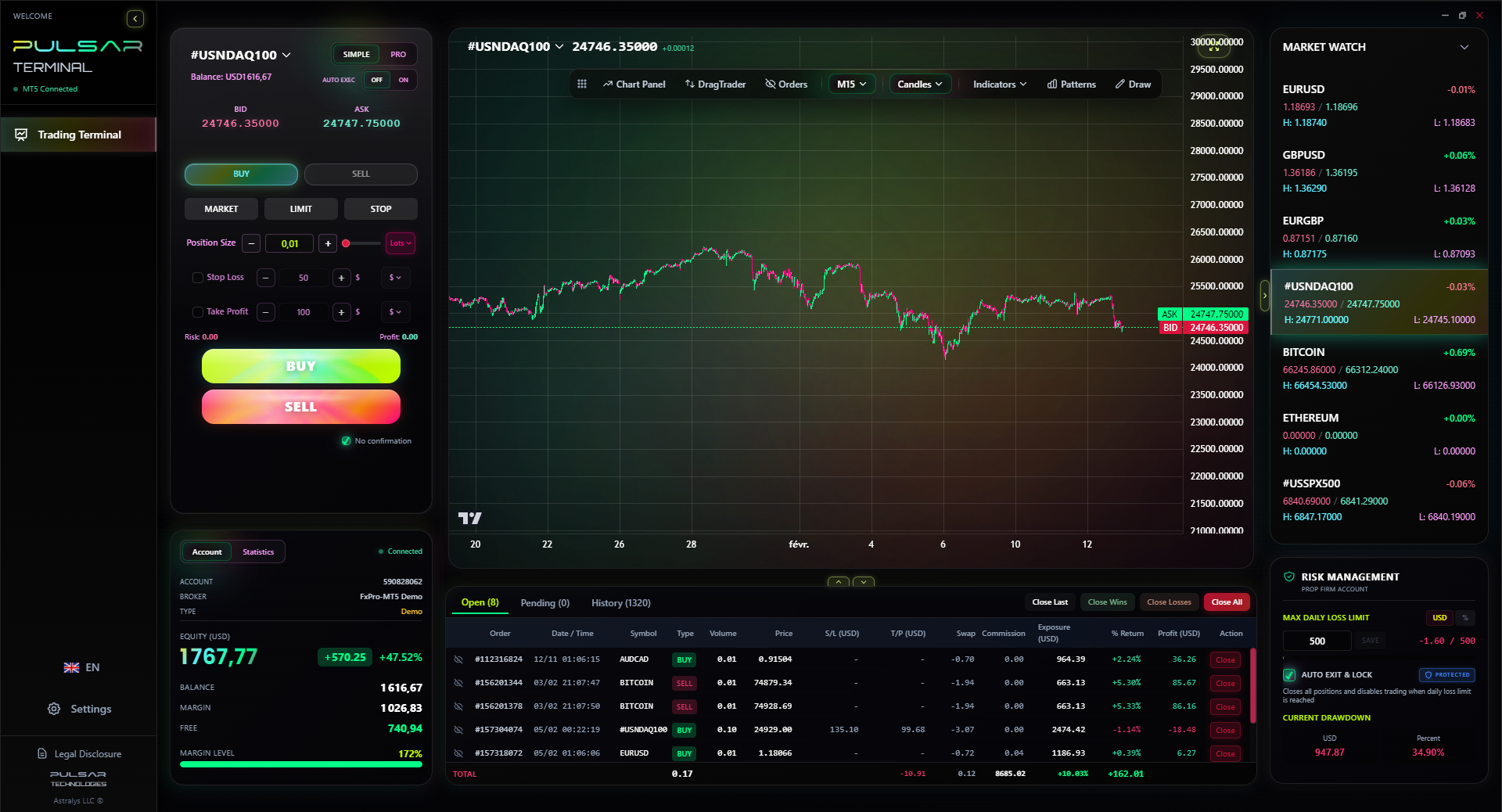
Managing multiple trades and complex orders across different sessions is what the modern market demands, and a tool like Pulsar Terminal automates this directly on your MT5 platform.
Pulsar Terminal
Alat MT5 all-in-one: order drag-and-drop, multi-TP/SL, trailing stop, grid trading, Volume Profile, dan perlindungan prop firm. Digunakan 1.000+ trader setiap hari.
FAQ
Q1Who actually invented the forex market?
No single person invented it. It evolved from ancient barter systems. Key milestones were set by merchant families like the Medicis in the 1400s (creating early banking networks), the formal adoption of the gold standard in the 1800s, and the political decision by US President Richard Nixon in 1971 to end the gold-backed dollar system, which unleashed the free-floating market we trade today.
Q2Is forex trading legal in South Africa?
Yes, absolutely. It's legal and regulated. You must trade through a broker licensed by the Financial Sector Conduct Authority (FSCA). Always verify the broker's FSCA license number on the regulator's website before depositing any money.
Q3What is the best broker for South African forex traders?
There's no single 'best' broker. It depends on your style. For low costs and scalping, look at FSCA-regulated brokers like Exness or IC Markets for raw spreads. For beginners, XM offers a very low minimum deposit. Always prioritize FSCA regulation, ZAR deposit/withdrawal options, and test their customer support with questions before you fund an account.
Q4Why are spreads on USD/ZAR so wide?
Spreads are based on liquidity - how easily an asset can be bought or sold. The South African Rand (ZAR) is an emerging market currency. It has less daily trading volume than majors like the Euro or US Dollar, so the bid-ask gap is wider. A 50-80 pip spread on USD/ZAR is normal. Remember to adjust your position size because the pip value is different.
Q5How much money do I need to start trading forex in South Africa?
While some brokers let you start with R150 or less, that's a trap. You can't manage risk or psychology with that. A realistic minimum to learn properly is R5,000. For serious trading where a single loss won't cripple you, aim for R20,000+. This allows for sensible position sizing and surviving the inevitable drawdowns.
Q6What was the Bretton Woods system?
It was the global financial system set up in 1944 where other countries' currencies were pegged to the US Dollar, and the Dollar was pegged to gold. It created stability but collapsed in 1971 when the US couldn't back its dollars with gold anymore. Its end marked the birth of the modern, volatile, free-floating forex market we trade.
Q7Can I use international brokers instead of South African ones?
You can, but I don't recommend it for most traders. While offshore brokers might offer enticing bonuses, using an FSCA-regulated broker means easier ZAR deposits/withdrawals (no hefty SWIFT fees), local customer support in your time zone, and direct regulatory protection under South African law if something goes wrong.
Pelajaran Prof. Winston
Poin Penting:
- ✓Forex evolved from trade, not speculation. Align with its commercial flow.
- ✓The 1971 float created all modern volatility. Your edge lives in that chaos.
- ✓SA's FSCA is your first line of defense, not your edge.
- ✓A 50-pip spread on USD/ZAR requires a 90% smaller position than EUR/USD.
Seberapa bermanfaat artikel ini?
Klik bintang untuk menilai
Wawasan Trading Mingguan
Analisis & strategi mingguan gratis. Tanpa spam.
Tentang Penulis
David van der Merwe
Trader Pasar Berkembang
Trader berbasis Johannesburg dengan 11 tahun di mata uang pasar berkembang. Spesialis pasangan ZAR, trading berregulasi FSCA, dan analisis pasar Afrika Selatan.
Komentar
Peringatan Risiko
Perdagangan instrumen keuangan mengandung risiko signifikan dan mungkin tidak cocok untuk semua investor. Kinerja masa lalu tidak menjamin hasil di masa depan. Konten ini hanya untuk tujuan edukasi dan tidak boleh dianggap sebagai nasihat investasi. Selalu lakukan riset Anda sendiri sebelum trading.
Anda mungkin juga suka

Cara Trading Forex Sukses: 7 Prinsip dari Trader Profesional
Cara trading forex sukses dengan 7 prinsip trader pro: manajemen modal, disiplin, journal trading, backtest. Data nyata, bukan janji profit palsu.
Jam Trading Forex Terbaik untuk Trader Indonesia: Panduan Lengkap dengan Tabel Waktu
Panduan jam trading forex untuk trader Indonesia. Tabel 4 sesi dunia, jam emas 20:00-00:00, sesi mana yang harus dihindari. Data akurat + tips dari trader berpengalaman.
Top 5 Sàn Forex Uy Tín Nhất 2026: Review Jujur dari Trader Indonesia
Top 5 sàn forex uy tín 2026 untuk trader Indonesia. Review jujur: spread, deposit, withdraw, dukungan lokal. Exness, XM, IC Markets & lebih.
Dapatkan Pulsar Terminal
Semua kalkulator ini terintegrasi dalam Pulsar Terminal dengan data real-time dari akun MT5 Anda.
Dapatkan Pulsar Terminal