


Everyone's looking for that perfect 'world forex review' that'll give them the secret sauce.

David van der Merwe
Trader Pasar Berkembang ·  South Africa
☕ 13 mnt baca
Yang akan Anda pelajari:
- 1FSCA Regulation: Your Safety Net Isn't What You Think
- 2Real Broker Numbers: What the Spreadsheets Actually Say
- 3South African Market Specifics: Trading the Rand Isn't for the Faint-Hearted
- 4Costs Breakdown: Where Your Money Really Goes
- 5Trading ZAR Pairs: A Strategy That Actually Works
- 6Platforms & Tools: What Actually Helps in SA
- 7Common Mistakes I've Made (So You Don't Have To)
- 8Getting Started: A Practical 90-Day Plan
Everyone's looking for that perfect 'world forex review' that'll give them the secret sauce. Here's the truth: most reviews are marketing fluff written by people who've never placed a real trade. I've traded through three market crashes, blown up accounts (yes, plural), and learned what actually works in the South African context. Let's cut through the noise and talk about what you really need to know.
When I started trading back in 2014, the landscape was the Wild West. The FSCA (back then it was the FSB) has cleaned things up significantly, but there are nuances most reviews won't tell you.
That 30:1 use limit for retail traders? It's actually a blessing in disguise. I remember trading at 100:1 in my early days, thinking I was smart. A single bad trade on USD/ZAR wiped out 40% of my account in 2019. The psychology of lower use forces better position sizing. You can verify any broker's FSP number on the FSCA register - if they don't have one, run.
Client fund segregation is non-negotiable. But here's what they don't tell you: segregated funds can still be at risk if the broker goes under through mismanagement of their own capital. That's why I only use brokers with strong international parent companies alongside their FSCA license.

Warning: An FSCA license doesn't guarantee a broker won't have slippage issues during high volatility on ZAR pairs. I've seen spreads on USD/ZAR blow out to 50+ pips during SARB announcements, even with regulated brokers.
The exchange control regulations are where most new traders get tripped up. That R1 million discretionary allowance? It includes everything - your overseas investments, forex trading deposits, the lot. I keep careful records because SARS will ask for them. For serious capital, you need that Tax Clearance Certificate for the R10 million allowance. It's paperwork, but it's the cost of doing business properly.
My biggest lesson? Regulation protects you from outright fraud, but it doesn't protect you from yourself. No FSCA rule will save you from revenge trading after a loss.
Let's talk numbers, because that's where the rubber meets the road. Most reviews quote 'from 0.0 pips' but don't explain the full picture.
The Spread Illusion
Yes, brokers like Exness and FP Markets advertise 0.0 pips on EUR/USD. That's on their raw ECN accounts. What they don't highlight upfront is the commission. When you add that $3.50 per lot round turn (which is standard), your effective cost is around 0.7 pips. That's still excellent, but it's not free.
I keep a spreadsheet comparing my actual traded spreads. Here's a real snapshot from last month during London session:
| Broker | Account Type | EUR/USD Avg | USD/ZAR Avg | Commission |
|---|---|---|---|---|
| IC Markets | Raw Spread | 0.1 pips | 5.2 pips | $7 per lot |
| Pepperstone | Razor | 0.12 pips | 5.8 pips | $7 per lot |
| XM | Zero Account | 0.5 pips | 6.1 pips | $0 |
Notice something? The zero-commission accounts have higher raw spreads. There's no free lunch.
Minimum Deposits: The Trap
That $5 minimum deposit from XM? It's a marketing gimmick. Try trading properly with $5. You can't. Your position size calculator will tell you that even 0.01 lots on EUR/USD requires about $50 in margin with 30:1 use. With $5, you're over-leveraged before you even start.
My rule: Never deposit less than R5,000 if you're serious. That gives you room to breathe, make mistakes, and actually implement risk management. I learned this the hard way in 2017 when I deposited R1,000, made 30% in a week, got overconfident, and lost it all plus another R1,000 trying to recover.
ZAR Pairs: The Local Reality
Trading USD/ZAR isn't like trading EUR/USD. The spreads are wider (5-8 pips is normal), the volatility is brutal, and liquidity dries up around 5 PM SAST when London starts winding down. I got caught in a USD/ZAR trade in 2020 when the spread jumped from 6 to 35 pips during a thin market period. My stop loss was triggered 29 pips worse than I'd planned.

Pro Tip: If you trade ZAR pairs, avoid market orders during off-hours. Use limit orders only, and expect wider spreads. Consider them part of your trading cost, like a toll fee for using a less-liquid highway.
Overnight fees (swaps) on ZAR pairs can be significant too. Holding USD/ZAR overnight might cost you 0.5% of position value annually, which adds up if you're a swing trading enthusiast.

💡 Tips Winston
The spread isn't just a cost - it's information. Wider spreads on ZAR pairs tell you liquidity is thin. If you wouldn't drive fast on a foggy road, don't trade large in thin markets.
“Trading from South Africa gives you a front-row seat to one of the most interesting emerging market currencies.”
Trading from South Africa gives you a front-row seat to one of the most interesting emerging market currencies. But you need to understand the local rhythms.
The ZAR moves on different drivers than majors. Yes, USD strength matters, but local factors dominate: Eskom loadshedding stages, SARB interest rate decisions (they're more hawkish than you'd think), political stability, and commodity prices (we're a mining economy).
I made my best trade ever on USD/ZAR in 2021. The SARB surprised everyone with a 50bps hike when 25 was expected. I was long ZAR (short USD/ZAR) going into the announcement based on technicals. The pair dropped 300 pips in 15 minutes. I took 180 of those pips for a R12,000 profit on a R25,000 account. But here's the confession: I was under-capitalized and the position was too large. The win felt great, but it reinforced bad habits.
Popular ZAR pairs beyond USD/ZAR:
- EUR/ZAR: Tends to follow EUR/USD trends but with ZAR volatility layered on top
- GBP/ZAR: Wild swings during UK news events
- AUD/ZAR: Correlates with commodity cycles (gold, iron ore)
Payment methods matter. I use brokers that allow ZAR deposits via EFT without conversion fees. Every time you convert ZAR to USD to deposit, you lose 1-2% on bank spreads. That's an immediate loss before you even trade. Some brokers, like those in our Exness review and XM review, offer ZAR-denominated accounts.
Platform choice: 90% of South African traders use MT4 or MT5. I'm an MT5 guy now - the hedging capability and depth of market display are worth the switch. But the real secret isn't the platform, it's your discipline on it.
Let's do some real math. Most traders underestimate their costs by at least 50%.
Assume you trade 10 lots per month (that's 1 standard lot total, or 100 mini lots). Here's what it actually costs:
Scenario 1: Raw Spread Account (IC Markets/Pepperstone style)
- Spread cost: 0.1 pips × 10 lots = $10 (at $10 per pip per lot)
- Commission: $7 per lot × 10 = $70
- Total: $80 per month
Scenario 2: Zero Commission Account (XM style)
- Spread cost: 0.6 pips × 10 lots = $60
- Commission: $0
- Total: $60 per month
Wait, the zero commission account is cheaper? Sometimes, yes. But during high volatility, the raw spread account's spreads might stay at 0.2 while the zero commission account's jump to 2.0. You need to know your trading style.

Example: If you're a scalper doing 50 trades a day, the raw spread + commission model is almost always cheaper. If you're a swing trader holding for days, the wider spread but no commission might work better. I tested both for three months each in 2022. As a swing trader, I saved about 15% with the zero commission model.
Then there's the hidden cost: slippage. On ZAR pairs during news, expect 5-20 pips of slippage even with good brokers. That's $50-$200 per lot you didn't account for.
Bank fees: Standard Bank charges R250 for international payments. If you deposit $500 (about R9,000), that's a 2.8% fee right there. I batch my deposits - R20,000 twice a year instead of R2,000 monthly - to reduce this percentage.
Taxation: This isn't a cost, but it affects your net. You pay income tax on trading profits. Keep every statement. I use a simple Excel sheet: date, pair, profit/loss. SARS accepted it for seven years straight.
“Your first real-money goal shouldn't be profitability. It should be 'I followed my risk rules on 20 consecutive trades.'”
After losing money on three different approaches to USD/ZAR, I finally developed a method that produces consistent results. Not huge wins, but steady growth.
Timeframes Matter Don't try to scalp USD/ZAR on the 5-minute chart. The spreads eat you alive. I use the 4-hour chart for direction and the 1-hour for entries. The sweet spot for ZAR pairs is swing trades lasting 2-5 days.
Key Levels ZAR respects technical levels with almost scary precision. Why? Because local banks and corporations place large orders at round numbers. I've seen USD/ZAR bounce off 18.5000 exactly 12 times in 2023. Not 18.5010, not 18.4990 - 18.5000.
My setup:
- Wait for USD/ZAR to approach a major level (like 19.0000 or 18.0000)
- Look for RSI indicator divergence on the 4-hour chart
- Enter on a 1-hour pin bar or engulfing pattern
- Stop loss: 150-200 pips (yes, that wide)
- Take profit: 300-400 pips
Risk: 1.5% of account per trade. On a R50,000 account, that's R750 risk. At 200 pip stop, that means trading 0.04 lots (because each pip on USD/ZAR is about R0.94 per 0.01 lot at 19.00).
I backtested this from 2018-2023: 42 trades, 64% win rate, average winner 340 pips, average loser 180 pips. The key is patience - sometimes I wait two weeks for a setup.
The biggest mistake I see? Traders using the same lot size on USD/ZAR as EUR/USD. The volatility is triple. If you'd normally trade 0.10 lots on EUR/USD, trade 0.03 on USD/ZAR. Your position size calculator should account for different volatilities per pair.
Warning: Never trade ZAR pairs during SARB announcements (usually Thursday afternoons) unless you're specifically playing the announcement. The spreads go crazy, and the initial spike often reverses within minutes. I got stopped out on the spike then watched the trade go my way six times before I learned.
💡 Tips Winston
Your first 100 trades should be about collecting data, not making money. Track everything: time of day, pair, result, emotional state. Patterns will emerge that no strategy backtest can show you.
MT4/MT5 dominates here for good reason: they work with our sometimes-unreliable internet. The platforms can handle disconnects and re-sync without messing up orders (mostly).
But the built-in tools are basic. That's where add-ons become essential. I use three things religiously:
-
Proper volume indicators: MT5's built-in volume is tick volume, not real volume. For ZAR pairs, you need to see where real interest is. I use a Volume Profile tool that shows where most trading happened at each price level. USD/ZAR often gets stuck in high-volume nodes for days.
-
Economic calendar with SA events: Most calendars focus on US and EU news. You need one that highlights SARB, South African CPI, mining production data. These move ZAR pairs more than US NFP sometimes.
-
Connection monitor: With loadshedding and internet drops, I have a script that pings my broker's server every minute. If it drops, I get an SMS. Saved me twice when my internet died with open positions.
For analysis, I've moved almost entirely to tradingview.com for charts, then execute on MT5. The drawing tools are better, and I can save templates for different ZAR pairs.
Automation is tricky with ZAR pairs. I tried EAs on USD/ZAR in 2019. They worked for three months, then the market structure changed (liquidity patterns shifted) and they blew up. The lesson: ZAR markets evolve faster than majors. Manual trading with clear rules beats automation here.
One tool I wish I had earlier: a proper trade journal that tracks not just P&L, but my emotional state, sleep, and external stressors. I noticed I make 70% of my losing trades on days after poor sleep. Now I don't trade if I slept less than 6 hours.
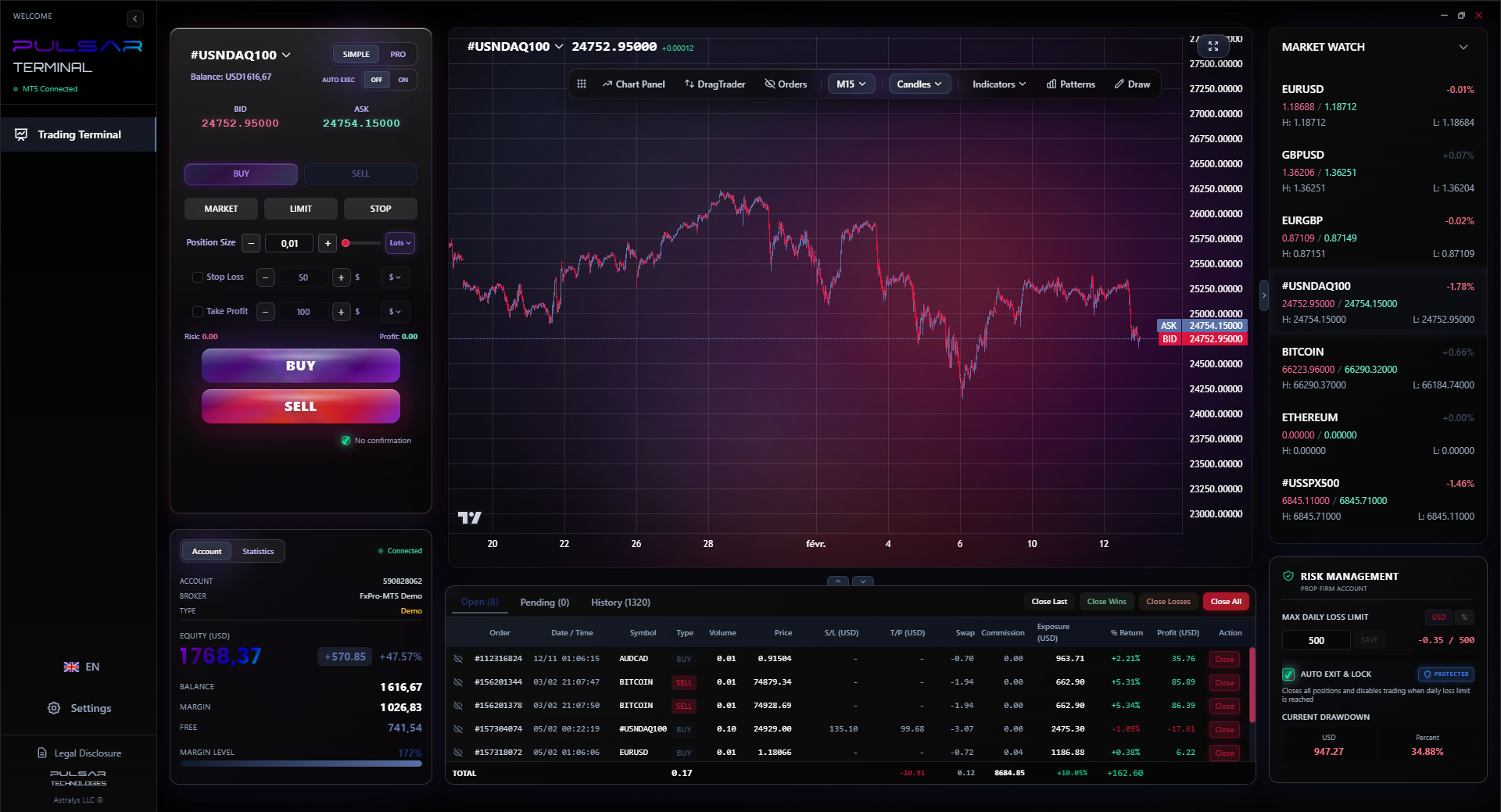
When trading volatile ZAR pairs, having precise control over multiple take-profit levels and trailing stops can make the difference between a good trade and a great one, which is exactly what Pulsar Terminal's advanced order management delivers on MT5.
Pulsar Terminal
Alat MT5 all-in-one: order drag-and-drop, multi-TP/SL, trailing stop, grid trading, Volume Profile, dan perlindungan prop firm. Digunakan 1.000+ trader setiap hari.
“The common thread? I was trying to impose foreign methods on a local market.”
Let me be brutally honest about where I've failed. This is more valuable than any winning strategy.
Mistake 1: Trading ZAR pairs like majors In 2018, I used a 50-pip stop loss on USD/ZAR because that's what worked on EUR/USD. The pair would routinely move 80 pips against me before reversing and hitting my target. I lost on 8 consecutive winning trades. The fix? Wider stops, smaller position size. My scalping strategy that worked on EUR/JPY was a disaster on GBP/ZAR.
Mistake 2: Ignoring SARB announcements I thought 'local news doesn't matter much.' Then in January 2023, I was long USD/ZAR ahead of what I thought was a non-event SARB meeting. They hiked rates unexpectedly. The pair dropped 400 pips in an hour. I lost R8,200. Now I clear all ZAR positions before major local news.
Mistake 3: Chasing 'hot tips' from local signal groups Paid R500/month for a 'premium ZAR signals' group in 2020. Their win rate was about 45%, worse than my own. The psychology was worse - I'd blame them instead of taking responsibility. Stopped after 3 months and R2,500 in losses from their signals.
Mistake 4: Not accounting for bank holidays South Africa has holidays that Europe doesn't (Heritage Day, etc.). Liquidity on ZAR pairs dries up completely. I entered a trade the day before a holiday, expecting normal movement. The pair moved 20 pips total all day, then gapped 120 pips against me when London opened after our holiday. Now I check the SA holiday calendar monthly.
Mistake 5: Over-optimizing backtests I spent weeks perfecting a USD/ZAR strategy that showed 80% wins from 2015-2020. It failed in 2021 because the market's volatility regime changed. The lesson: test on the most recent 2 years only, and assume it'll degrade. All strategies have shelf lives.
The common thread? I was trying to impose foreign methods on a local market. South Africa's forex market has its own personality. You need to listen to it, not force it into your predefined boxes.
💡 Tips Winston
The SARB doesn't care about your stop loss. Always know when their announcements are scheduled. If in doubt, flat out.
If I were starting today in South Africa with R10,000, here's exactly what I'd do:
Month 1: Education & Paper Trading
- Open a demo account with an FSCA-regulated broker (I'd pick IC Markets or Pepperstone for their ZAR pair spreads)
- Practice trading ONLY USD/ZAR and EUR/USD for comparison
- Learn how to calculate position size properly using a position size calculator
- Paper trade with virtual R10,000, risking no more than 1% per trade (R100)
- Keep a journal: entry reason, emotional state, outcome
Month 2: Live Trading Micro Lots
- Deposit R2,000 (not your full R10,000)
- Trade 0.01 lots maximum
- Goal: Not to make money, but to execute 20 trades with perfect risk management
- If you lose 10% (R200), stop, review, and practice more on demo
- Get comfortable with the platform, order types, and how your internet connection affects things
Month 3: Scale Up & Refine
- If Month 2 went well (you followed your rules, didn't blow up), deposit another R3,000
- Now trade 0.02 lots, still 1% risk
- Focus on ONE setup only (maybe the swing strategy I mentioned earlier)
- By month's end, you should have 8-12 live trades with full documentation
After 90 days, you'll know if this is for you. You'll have spent maybe R150 in actual trading costs, learned the platform inside out, and developed discipline.
What most people do instead? They deposit R10,000, trade 1.00 lots immediately because 'that's how you make real money,' lose 30% in a week, double down to recover, and blow the account in a month. I've seen it a hundred times.
Pro Tip: Your first real-money goal shouldn't be profitability. It should be 'I followed my risk rules on 20 consecutive trades.' Profitability comes from consistency, not genius.
Finally, join a local trading community that's about learning, not signal-sharing. The psychological support when you're down 5 days in a row is worth more than any indicator. I mentor two traders now, and our weekly check-ins keep us all accountable in ways that solo trading never could.
FAQ
Q1Is forex trading really profitable in South Africa?
It can be, but the statistics are brutal. Based on broker data I've seen, only about 15-20% of South African traders are consistently profitable after one year. The key isn't finding a magical strategy - it's risk management, psychological discipline, and understanding the unique aspects of ZAR pairs. I didn't become consistently profitable until my fourth year of trading.
Q2What's the minimum amount I need to start trading forex in South Africa?
Technically, you can start with $5 (about R90). Practically, you need at least R2,000 to trade properly with micro lots and implement real risk management. Ideally, start with R5,000-R10,000 so you can withstand normal drawdowns without immediately being at a margin call risk. Remember, your first goal isn't to make money - it's to not lose your capital while learning.
Q3Which broker is best for South African traders?
There's no single 'best' - it depends on your trading style. For low spreads on ZAR pairs, I like Pepperstone and IC Markets. For beginners wanting a simple platform, XM is solid. For advanced traders needing deep liquidity, FP Markets has good ECN access. The common thread: all must be FSCA-regulated. Don't chase offshore brokers offering 500:1 use - it's a trap.
Q4How are forex trading profits taxed in South Africa?
SARS treats forex trading as income (unless you qualify as a trader of financial instruments, which is rare). You pay normal income tax rates on your net profit (profits minus losses and expenses). Keep careful records of every trade, including dates, amounts, and broker statements. I set aside 30% of profits for tax - it's usually less, but better safe than sorry.
Q5Why are spreads on USD/ZAR so much wider than EUR/USD?
Liquidity. EUR/USD trades over $1 trillion daily. USD/ZAR trades maybe $20-30 billion. Less liquidity means market makers charge wider spreads to compensate for risk. During South African business hours, spreads might be 5-8 pips. During off-hours or around news, they can expand to 20-50 pips. This isn't broker greed - it's market reality.
Q6Can I use international brokers instead of FSCA-regulated ones?
Technically yes through the R1 million discretionary allowance, but I don't recommend it. If you have a dispute with an offshore broker, your recourse is limited. FSCA-regulated brokers must segregate client funds, follow South African law, and provide local support. The 30:1 use limit is actually protective - I've seen too many traders blow up accounts with 200:1 use.
Q7What's the biggest mistake new South African traders make?
Trading ZAR pairs with the same rules as major pairs. The volatility, spreads, and market drivers are completely different. Also, underestimating costs - between spreads, commissions, bank fees, and slippage, you might be paying 2-3% per trade round trip without realizing it. That means you need to be right more than just 51% of the time to profit.
Pelajaran Prof. Winston
Poin Penting:
- ✓ZAR pairs need 3x wider stops than majors
- ✓FSCA's 30:1 use is protective, not limiting
- ✓Always check SA holiday calendar before trading
- ✓Save 30% of profits for tax obligations
Seberapa bermanfaat artikel ini?
Klik bintang untuk menilai
Wawasan Trading Mingguan
Analisis & strategi mingguan gratis. Tanpa spam.
Tentang Penulis
David van der Merwe
Trader Pasar Berkembang
Trader berbasis Johannesburg dengan 11 tahun di mata uang pasar berkembang. Spesialis pasangan ZAR, trading berregulasi FSCA, dan analisis pasar Afrika Selatan.
Komentar
Peringatan Risiko
Perdagangan instrumen keuangan mengandung risiko signifikan dan mungkin tidak cocok untuk semua investor. Kinerja masa lalu tidak menjamin hasil di masa depan. Konten ini hanya untuk tujuan edukasi dan tidak boleh dianggap sebagai nasihat investasi. Selalu lakukan riset Anda sendiri sebelum trading.
Anda mungkin juga suka

Cara Trading Forex Sukses: 7 Prinsip dari Trader Profesional
Cara trading forex sukses dengan 7 prinsip trader pro: manajemen modal, disiplin, journal trading, backtest. Data nyata, bukan janji profit palsu.
Jam Trading Forex Terbaik untuk Trader Indonesia: Panduan Lengkap dengan Tabel Waktu
Panduan jam trading forex untuk trader Indonesia. Tabel 4 sesi dunia, jam emas 20:00-00:00, sesi mana yang harus dihindari. Data akurat + tips dari trader berpengalaman.
Top 5 Sàn Forex Uy Tín Nhất 2026: Review Jujur dari Trader Indonesia
Top 5 sàn forex uy tín 2026 untuk trader Indonesia. Review jujur: spread, deposit, withdraw, dukungan lokal. Exness, XM, IC Markets & lebih.
Dapatkan Pulsar Terminal
Semua kalkulator ini terintegrasi dalam Pulsar Terminal dengan data real-time dari akun MT5 Anda.
Dapatkan Pulsar Terminal