


Thinking about trading the AUD/USD pair from South Africa? You're looking at one of the most interesting, volatile, and tradeable majors out there.

David van der Merwe
Trader dei Mercati Emergenti ·  South Africa
☕ 12 min di lettura
Cosa imparerai:
- 1Why Trade the AUD/USD? Meet the 'Aussie'
- 2The SA Rulebook: Regulations, use & Real Costs
- 3Picking a Broker in South Africa: AUD/USD Focus
- 4Trading the Aussie: A Practical Strategy Mix
- 5The Rand in the Room: Local Currency Impact & Risks
- 6Common Mistakes SA Traders Make on AUD/USD
- 7Your First Steps: A Practical Plan
Thinking about trading the AUD/USD pair from South Africa? You're looking at one of the most interesting, volatile, and tradeable majors out there. But between our local regulations, the Rand's influence, and the pair's unique personality, it's not as simple as just buying and selling. I've traded this pair for over a decade, made some great calls, and blown up an account or two learning its quirks. Let's break down exactly how to approach AUD/USD forex trading from right here in SA.
The AUD/USD, nicknamed the 'Aussie,' is more than just a currency pair. It's a direct reflection of global risk sentiment and commodity cycles. For us in South Africa, that's incredibly useful.
Australia is a massive exporter of raw materials: iron ore, coal, natural gas. When China's economy is humming (buying those commodities), the Aussie dollar tends to strengthen. When global markets get scared and run to the safety of the US dollar, the Aussie often falls. It acts like a commodity currency with a PhD in risk sensitivity.
This gives you clear, fundamental drivers to watch. I don't just stare at charts all day. I keep one eye on the iron ore price and another on the S&P 500. If both are rising, I'm generally looking for long opportunities on the AUD/USD. It's a pair that rewards you for paying attention to the real world.

Example: In early 2021, iron ore prices were soaring past $200/tonne on strong Chinese demand. The AUD/USD rallied from around 0.7600 to nearly 0.8000 in a few months. That's a 400-pip move driven by a single, tangible factor.
Contrast this with the Euro, which can get bogged down in complex political drama. The Aussie's logic is often refreshingly simple: commodities up, risk on = Aussie up. It's a fantastic pair for swing trading these broader themes.

💡 Consiglio di Winston
The AUD/USD doesn't care about your opinion. It cares about iron ore prices and the S&P 500. Trade what you see in those charts, not what you feel.
“Trading the AUD/USD without watching iron ore prices is like driving blindfolded.”
Before you place a single trade, you need to understand the local landscape. Trading is legal, but it's tightly governed.
The Financial Sector Conduct Authority (FSCA) is your watchdog. Any broker you use must have an FSP license from them. Check their public register. Don't take the broker's word for it. This rule exists to protect you, ensuring client funds are segregated and the broker plays fair.
The 30:1 use Cap
This is the big one. Since 2021, the FSCA has capped use for retail traders at 30:1. You might see international brokers advertising 500:1, but if they're properly serving South African clients, they must enforce the 30:1 limit on your account.
Is this a bad thing? Honestly, no. It probably saved me early in my career. At 30:1, a 3.3% move against you wipes out your margin. That's still risky, but it forces you to size your positions sensibly. I once lost R15,000 on a single AUD/USD trade using 100:1 use overseas. The move wasn't huge, but my position was enormous. The 30:1 cap makes that kind of disaster harder to engineer. Always use a position size calculator.
What It Really Costs to Trade
Your main costs are the spread and commission. For AUD/USD, you want a broker with tight, consistent pricing.
Let's talk real numbers from our market. A good raw/ECN account from a broker like IC Markets or Pepperstone might offer an AUD/USD spread of 0.35 pips, plus a commission of $3.50 per standard lot per side. On a standard lot (100,000 units), that's $7 round turn. On a mini lot (10,000 units), it's about $0.70.

Warning: Beware of 'zero spread' accounts that hide huge commissions. The 'effective spread' (spread + commission cost in pips) is what matters. Always calculate the total cost per trade.
Swap rates (overnight financing) also matter if you hold trades for more than a day. The AUD has historically had a higher interest rate than the USD, so for years, you'd earn a small daily credit for holding a long position. That can change with central bank policy, so always check your broker's swap sheet.
“The 30:1 use cap probably saved me early in my career. It forces you to size your positions sensibly.”
You need a broker that's not just FSCA-regulated, but also competitive on the specific pair you want to trade. Here’s what to scrutinize.
AUD/USD Spreads & Commissions: This is your bread and butter. Don't just look at the advertised spread. Check live accounts at different times, especially during the Asian/London overlap (around 9-11 AM our time) when AUD/USD liquidity is highest. I've seen spreads vary from 0.2 pips on a raw account to 1.8 pips on a standard account. That difference eats directly into your profit.
| Broker Type | Typical AUD/USD Spread | Commission (per standard lot) | Best For... |
|---|---|---|---|
| Raw/ECN Account | 0.2 - 0.5 pips | $3 - $7 per side | Active traders, scalping strategy |
| Standard Account | 1.2 - 1.8 pips | $0 | Beginners, longer-term swings |
ZAR Accounts & Deposits: This is a huge local advantage. Brokers like XM or Exness offer ZAR-denominated accounts. Why does this matter? If you deposit R10,000 and your broker converts it to USD at their marked-up rate, you might start with only $520 instead of $530. A ZAR account avoids that hidden fee. Your profit and loss are in Rand, making tax time with SARS much simpler.
Platform & Execution: You want MT4/MT5. Most local traders use it, and the community support is vast. More importantly, check for slippage on news events. A good broker will have minimal slippage on stable spreads. A bad one will widen the spread massively or give you terrible fills. I tested this by placing small market orders during RBA (Reserve Bank of Australia) announcements. The difference between brokers was shocking.
My personal preference leans towards the raw accounts from IC Markets or Pepperstone for AUD/USD. The consistency is worth the small commission.
💡 Consiglio di Winston
A 30:1 use cap is a gift, not a restriction. It's the government forcing you to use a seatbelt. The crash still hurts, but you're more likely to walk away.
“The 30:1 use cap probably saved me early in my career. It forces you to size your positions sensibly.”
You can't just throw a random indicator on the AUD/USD and hope. Its personality demands a specific approach.
The Fundamental Anchor
Your primary filter should be global risk sentiment. Is the market in 'risk-on' or 'risk-off' mode?
- Risk-On (AUD Strengthens): Rising stock markets (S&P 500), strong commodity prices (iron ore, copper), positive Chinese economic data.
- Risk-Off (AUD Weakens): Stock market sell-offs, falling commodities, safe-haven flows into the US dollar and Japanese Yen.
I start my day checking the ASX 200 (Australian index), iron ore prices, and the S&P 500 futures. This tells me the likely directional bias before I even look at a chart.
Technical Timing with Key Levels
Once you have a bias, use technicals to find your entry. The AUD/USD respects technical levels beautifully.
- Support & Resistance: Horizontal levels from previous daily/weekly highs and lows are gold. The pair often tests and reacts at these spots.
- The 200 EMA: On the 4-hour and daily charts, the 200-period Exponential Moving Average is a major trend filter. Price above it suggests a broader uptrend, favouring buy setups.
- Simple Momentum: I pair this with the RSI indicator. Looking for RSI to move above 30 from below in an uptrend (bullish momentum returning) or below 70 from above in a downtrend.
A Real Trade Example: In November 2023, the market was risk-on. Iron ore was climbing. The AUD/USD had pulled back to a major support zone at 0.6350, which was also near the 200 EMA on the daily chart. The RSI dipped near 40 but didn't break below 30. That was the confluence: fundamental bias up, key technical support holding. I went long at 0.6360. I set my stop loss at 0.6280 (80 pips, respecting the swing low). I took half profit at 0.6480 (+120 pips) and let the rest run as the trend continued. That's the blueprint.

Pro Tip: AUD/USD is most active during the Asian session (2 AM - 11 AM SAST) and the London/Asian overlap. Don't expect big moves during quiet New York afternoons. Plan your trading hours around its liquidity.
“Your brilliant forex win can be eroded by our own currency's movement. The ZAR/USD rate is your silent partner.”
Here's the thing many guides miss: you're a South African trading a USD-based pair, with expenses in Rand. The ZAR/USD rate is your silent partner in every trade.
Scenario: You make a 500 pip profit on AUD/USD, which is $5,000 on a standard lot. Fantastic. But if the Rand has strengthened 10% against the Dollar during your trade, when you convert that $5,000 back to ZAR, you get significantly less. Your brilliant forex win can be eroded by our own currency's movement.
The Solution: This is another strong argument for a ZAR-denominated trading account. Your profit/loss is finalized in Rand the moment you close the trade. The broker handles the underlying currency conversion. It removes a layer of uncertainty from your P&L calculation.
Tax and SARS
Yes, you have to pay tax. Profits from forex trading are considered income, not capital gains, by SARS. You must declare it. Keep careful records: a trade journal with dates, entry/exit prices, profit/loss in Rand, and broker statements. A good broker will provide annual tax certificates. It's a hassle, but non-compliance is a much bigger headache.
The Biggest Risk: Yourself
With the FSCA's 30:1 use cap, the broker-related risks are lowered. The main risk now is your own psychology. The AUD/USD can have vicious, news-driven spikes. A surprise dovish turn from the RBA or a sudden China growth scare can move it 50-100 pips in minutes. If you're over-leveraged, that's a margin call.
My rule: never risk more than 1-2% of your account on a single AUD/USD trade. It's a volatile pair. It needs space to breathe. I learned this after getting stopped out on a correct long-term view because a short-term news spike was larger than my tight stop. The trade idea was right, but my risk management was wrong.
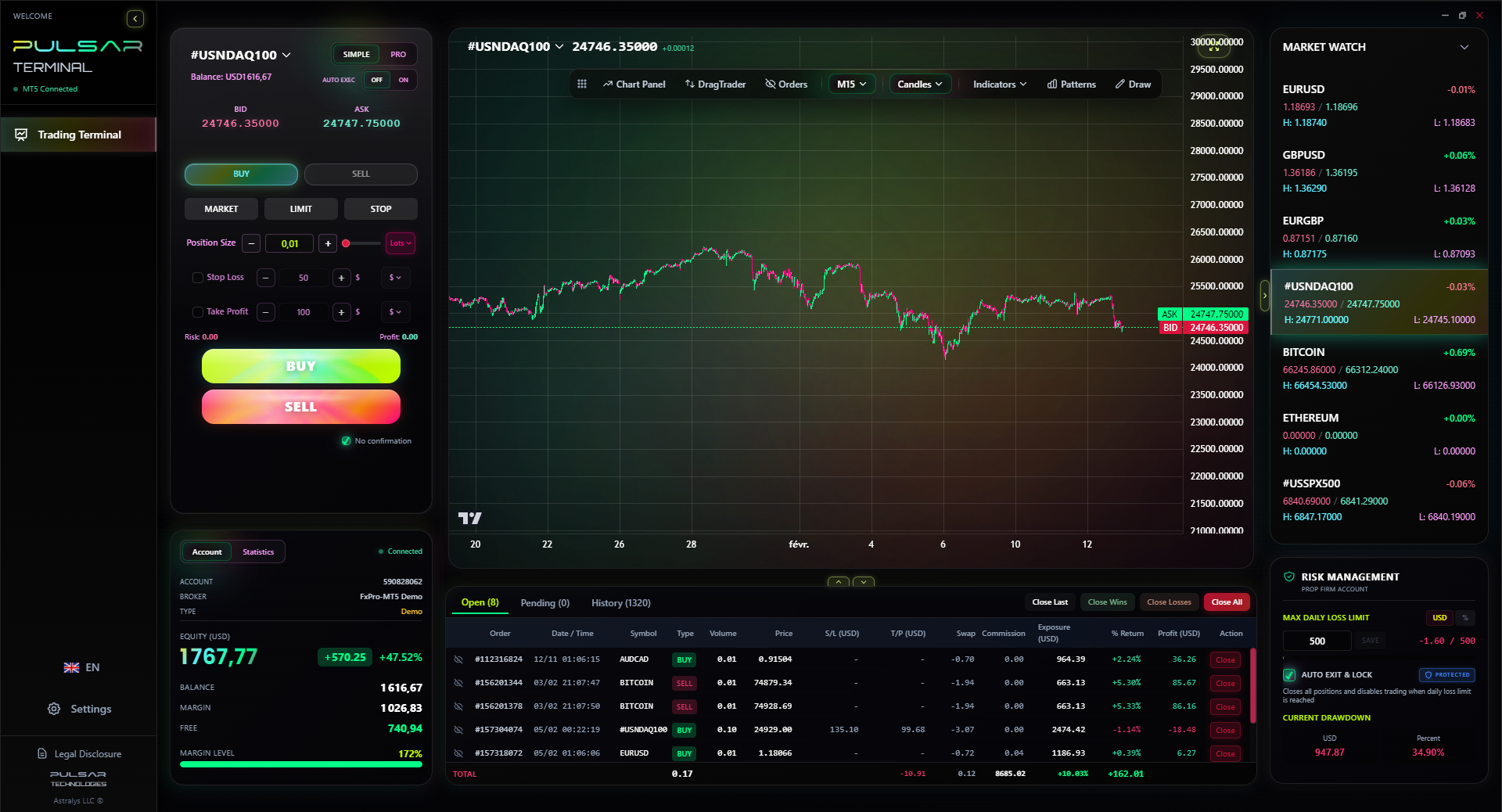
Managing multiple take-profit levels and trailing stops on volatile pairs like AUD/USD is much simpler with a tool that automates it directly on your MT5 platform.
Pulsar Terminal
Lo strumento MT5 tutto-in-uno: ordini drag-and-drop, multi-TP/SL, trailing stop, grid trading, Volume Profile e protezione prop firm. Usato da oltre 1.000 trader ogni giorno.
“Your brilliant forex win can be eroded by our own currency's movement. The ZAR/USD rate is your silent partner.”
Let me save you some money and frustration by sharing where I and others have gone wrong.
1. Ignoring Commodity Data: Trading the Aussie without watching the monthly Chinese PMI (Purchasing Managers' Index) or iron ore prices is like driving blindfolded. I once took a short position just before a blockbuster Chinese industrial production report. The data smashed expectations, commodities rallied, and the AUD/USD ripped 70 pips against me in seconds. Lesson learned: know the economic calendar.
2. Chasing During London Fix: The AUD/USD often experiences a surge of volatility around the 4 PM London fix (6 PM SAST). It's tempting to jump in. This is usually liquidity-driven noise, not a new trend. I've been whipsawed too many times. Wait for the dust to settle (30-60 minutes) before assessing the price action.
3. Misunderstanding the 'Carry Trade': For years, traders would buy AUD/USD just to earn the positive swap (interest rate differential). This is a dangerous strategy on its own. If the price falls 200 pips, the tiny daily swap credit won't save you. The swap should be a small bonus on a trade you like for directional reasons, not the primary reason.
4. Using USD-Based Risk Calculations with a ZAR Account: If your account is in Rand, but you're calculating your position size based on USD pip values, you're making an error. You must calculate your risk in Rand, based on your account balance in Rand. A position size calculator that allows you to set your account currency is essential.
5. Overcomplicating the Charts: The AUD/USD responds well to clean price action. I used to clutter my charts with a dozen indicators. Now, it's just price, a couple of key moving averages, horizontal lines, and maybe the MACD indicator for confluence. More tools often lead to more confusion, not clarity.
💡 Consiglio di Winston
Your first profitable month trading the Aussie is a milestone. Your first profitable *quarter* is the beginning of evidence. Don't confuse luck with skill.
“More tools often lead to more confusion, not clarity. The AUD/USD responds well to clean price action.”
Alright, let's put this all together into an action plan.
Step 1: Education & Demo. Don't deposit real money yet. Pick a broker with a good demo platform (like Pepperstone or IC Markets). Practice trading AUD/USD for at least a month. Test the strategies. Get a feel for its rhythm during different sessions. Paper trade the fundamental drivers: pretend you saw strong Chinese data, how would the pair react?
Step 2: Broker Setup. Choose an FSCA-regulated broker. Strongly consider a ZAR account to simplify deposits, withdrawals, and taxes. Decide between a standard account (no commission, higher spread) or a raw account (low spread, plus commission). For active trading, the raw account is almost always cheaper in the long run.
Step 3: Fund & Size Smartly. Start with an amount you can afford to lose completely. I mean it. Use the 30:1 use as a maximum, not a target. Start by trading 0.01 lots (a micro lot). Your goal isn't to make R10,000 in a week; it's to make 10 good, disciplined trades in a row.
Step 4: Plan Your Trade. Before you click buy or sell, write down:
- The fundamental bias (risk-on/off? commodity trend?).
- The key technical level you're trading from (support/resistance, 200 EMA).
- Your exact entry, stop loss (1-2% of account risk), and take-profit levels.
Step 5: Review Religiously. At the end of each week, review your trades. Why did the winners work? Why did the losers fail? Was it your analysis, or was your risk management poor? This review process is what turns a losing trader into a breakeven one, and a breakeven trader into a profitable one.
The AUD/USD is a fantastic teacher. It's liquid, moves on clear logic, and offers great opportunities. But it demands respect for its volatility and a disciplined approach to risk. From one SA trader to another, take it slow, focus on the process over the profit, and you might just find it becomes your favourite pair to trade.
FAQ
Q1What is the best time of day to trade AUD/USD from South Africa?
The most active and liquid times are during the Asian trading session (2:00 AM - 11:00 AM SAST) and the overlap between the Asian and London sessions (9:00 AM - 11:00 AM SAST). This is when Australian economic data is released and liquidity is highest. The New York session can be quieter for this specific pair.
Q2Do I pay tax on my AUD/USD forex profits in South Africa?
Yes. The South African Revenue Service (SARS) views profits from forex trading as taxable income. You must declare these profits on your annual tax return. It's crucial to keep detailed records of all your trades, including broker statements that show your profit and loss in Rand.
Q3Can I use use higher than 30:1 in South Africa?
No, not legally through an FSCA-regulated broker. Since 2021, the FSCA has imposed a maximum use limit of 30:1 for retail forex traders. Any broker properly licensed to operate here must enforce this limit on your account. Brokers advertising higher use are likely not compliant with SA regulations.
Q4Should I open a USD or ZAR trading account?
For most South African traders, a ZAR-denominated account is simpler and better. It eliminates currency conversion fees on deposits and withdrawals, and your profit/loss is immediately clear in Rand, making record-keeping for SARS much easier. The trading performance is identical.
Q5What is a typical spread for AUD/USD with a good SA broker?
It depends on the account type. On a standard commission-free account, expect average spreads between 1.2 and 1.8 pips. On a raw or ECN account (where you pay a commission), you can often get spreads as low as 0.2 to 0.5 pips. Always look at the 'effective spread' (spread + commission cost) for a true cost comparison.
Q6What's the most important economic data to watch for AUD/USD?
Prioritize: 1) Chinese economic data (PMI, GDP, Industrial Production), 2) Australian employment data and CPI inflation, 3) Statements from the Reserve Bank of Australia (RBA), and 4) Global commodity prices, especially iron ore and copper. These are the core drivers of the pair's value.
Q7Is AUD/USD good for beginner traders?
It can be, but with caution. Its movements are often driven by understandable fundamentals (commodities, China), which is a plus. However, it is quite volatile. Beginners should start with very small position sizes (micro lots), use a demo account first, and always use a stop loss. Its volatility can punish mistakes quickly.
Lezione del Prof. Winston
Punti chiave:
- ✓Anchor your AUD/USD bias in iron ore and the S&P 500.
- ✓The FSCA's 30:1 use is a risk-management tool, not a limit.
- ✓A ZAR account simplifies taxes and protects from Rand volatility.
- ✓Never risk more than 2% on the volatile Aussie.
- ✓Wait 60 minutes after the London fix for the real move.
Quanto è stato utile questo articolo?
Clicca su una stella
Analisi Trading Settimanali
Analisi e strategie settimanali gratuite. Nessuno spam.
Sull'autore
David van der Merwe
Trader dei Mercati Emergenti
Trader con base a Johannesburg con 11 anni di esperienza nelle valute dei mercati emergenti. Specializzato in coppie ZAR, trading regolamentato dalla FSCA e analisi del mercato sudafricano.
Commenti
Avviso di rischio
Il trading di strumenti finanziari comporta rischi significativi e potrebbe non essere adatto a tutti gli investitori. Le performance passate non garantiscono risultati futuri. Questo contenuto è fornito solo a scopo educativo e non deve essere considerato un consiglio di investimento. Conduci sempre le tue ricerche prima di fare trading.
Potrebbe interessarti anche

Cara Trading Forex Sukses: 7 Prinsip dari Trader Profesional
Cara trading forex sukses dengan 7 prinsip trader pro: manajemen modal, disiplin, journal trading, backtest. Data nyata, bukan janji profit palsu.
Jam Trading Forex Terbaik untuk Trader Indonesia: Panduan Lengkap dengan Tabel Waktu
Panduan jam trading forex untuk trader Indonesia. Tabel 4 sesi dunia, jam emas 20:00-00:00, sesi mana yang harus dihindari. Data akurat + tips dari trader berpengalaman.
Top 5 Sàn Forex Uy Tín Nhất 2026: Review Jujur dari Trader Indonesia
Top 5 sàn forex uy tín 2026 untuk trader Indonesia. Review jujur: spread, deposit, withdraw, dukungan lokal. Exness, XM, IC Markets & lebih.
Scarica Pulsar Terminal
Tutti questi calcolatori sono integrati in Pulsar Terminal con dati in tempo reale dal tuo conto MT5.
Scarica Pulsar Terminal