


Here's a hard truth most trading 'gurus' in Lagos won't tell you: over 80% of new forex traders lose their first deposit within six months.

Olumide Adeyemi
Pioniere del Trading in Africa Occidentale ·  Nigeria
☕ 10 min di lettura
Cosa imparerai:
- 1What Even Is a Trading Strategy? (It's Not What You Think)
- 2Strategy 1: Trend Following (The "Go With the Flow" Method)
- 3Strategy 2: Range Trading (Buy Low, Sell High in a Box)
- 4Strategy 3: Breakout Trading (Catching the Big Move)
- 5Strategy 4: A Simple Scalping Framework
- 6Strategy 5: Trading the News (Handling Volatility)
- 7How to Choose and Test Your Strategy
Here's a hard truth most trading 'gurus' in Lagos won't tell you: over 80% of new forex traders lose their first deposit within six months. They chase signals, over-use, and treat the market like a casino. The difference between them and the profitable 20% isn't a secret indicator. It's a simple, repeatable strategy. This guide breaks down the basic forex trading strategies that have kept me in the game for over a decade, adapted for the unique challenges - and opportunities - we face trading from Nigeria.
A trading strategy isn't a magical crystal ball. It's a rulebook you write for yourself before the market opens. It answers three questions: When do I get in? When do I get out with a profit? When do I get out with a loss? Without answers, you're just gambling with your Naira. I learned this the hard way. Back in 2018, I blew a $500 account in two weeks because I had no plan. I'd see a move on GBP/USD, jump in, panic when it reversed, and cut the loss only to watch it bounce back. Emotion drove every decision. A real strategy removes emotion. It turns trading from a stressful reaction into a boring, mechanical process. That's the goal: boring consistency.
The Core Components
Every basic forex trading strategy needs these four pillars:
- A Trigger: The specific condition that tells you to enter a trade. This could be a moving average crossover, a RSI indicator reading, or a price breaking a key level.
- Entry Rules: Exactly how you enter. Market order? Limit order? What's your position size? (Always use a position size calculator, seriously).
- Exit Rules (Take Profit): Your predefined profit target. This could be a fixed number of pips, a key resistance level, or a trailing stop.
- Exit Rules (Stop Loss): Your non-negotiable safety net. This is the most important rule. Placing your stop loss is the first thing you do after entering a trade.

Warning: If you find yourself moving your stop loss further away because a trade is going against you, you've abandoned your strategy. You're now hoping, not trading. This is the fastest path to a margin call.

💡 Consiglio di Winston
A strategy is only as good as your ability to follow it on a bad day. The journal isn't for your wins; it's for understanding why you broke your rules on your losses.
This is the classic. The idea is simple: find a currency pair that's clearly moving in one direction and jump on board. In Nigeria, with our volatile Naira, trends in pairs like USD/NGN (though often restricted) or EUR/USD can be powerful. The trick is confirming the trend isn't just a temporary blip.
How I Do It: I use two simple tools: a 50-period and a 200-period Exponential Moving Average (EMA) on the 4-hour chart. My rule is brutally simple:
- Uptrend Trigger: Price is above both the 50 and 200 EMA, and the 50 EMA is above the 200 EMA (called a 'Golden Cross'). I only look for buy opportunities.
- Downtrend Trigger: Price is below both EMAs, and the 50 EMA is below the 200 EMA ('Death Cross'). I only look for sell opportunities.
I wait for the price to pull back to the 50 EMA and show signs of bouncing off it (like a small bullish candlestick pattern for an uptrend). That's my entry. My stop loss goes just below the most recent swing low (for a buy) or above the swing high (for a sell).
Real Trade Example: In early 2025, EUR/USD was in a solid uptrend on the 4H chart. Price pulled back to the 50 EMA near 1.0850. I entered a buy order at 1.0855. Placed my stop loss at 1.0820 (35 pips risk). My take profit was set at 1.0950, near the previous high. The trade ran for about two days and hit my target for a 95-pip gain. I used a 0.5% risk per trade, so that was a solid win. The key was patience - waiting for the pullback, not chasing the price as it raced up.

Pro Tip: On trending pairs like XAU/USD (Gold), this strategy works well. But in a ranging market, it will give you false signals and stop you out repeatedly. Know the market environment first.
“A trading strategy isn't a magical crystal ball. It's a rulebook you write for yourself before the market opens.”
Markets trend only about 30% of the time. The other 70%, they're moving sideways in a range. This is where trend followers get chopped up, and range traders thrive. You identify clear support (the floor) and resistance (the ceiling) and trade the bounces.
The Setup: Look for a currency pair that has tested a high and a low at least twice, creating a horizontal channel. EUR/USD often does this before big news events.
- Buy Trigger: Price touches or comes very close to the identified support level and shows signs of rejecting it (e.g., a bullish pin bar or engulfing candle).
- Sell Trigger: Price touches resistance and shows rejection (bearish pin bar).
Your stop loss goes just outside the range. If buying at support, place your stop below it. Your take profit target is the opposite side of the range.
My Mistake to Avoid: I once traded a range on GBP/JPY. Bought perfectly at support, profit was sailing towards resistance. Greed kicked in. I removed my take profit, convinced it would 'break out.' It didn't. It reversed and hit my stop loss, turning a winning trade into a loser. I broke my own rule. Now, I take 70-80% of my profit at resistance and let a tiny portion run with a breakeven stop, just in case. Tools that help manage multiple take-profit levels are a lifesaver for this approach.
When a currency pair finally escapes its range, it can make a powerful, sustained move. Breakout trading is about catching that initial burst of momentum. This strategy requires quick execution and the stomach to trade against the crowd's initial doubt.
The Classic Method:
- Identify a strong consolidation range (like the one from Strategy 2).
- Place a buy stop order a few pips above the resistance, and a sell stop order a few pips below the support.
- Whichever order gets triggered, you're in. Cancel the other order.
Your stop loss goes back inside the range, and your take profit is typically measured by the height of the range. If the range was 50 pips tall, you project a 50-pip move from the breakout point.
The Nigerian Reality Check: Breakouts fail often - it's called a 'false breakout.' The price squeezes out, triggers all the orders, and then slams back into the range. To filter these, I only trade breakouts that occur with a clear increase in trading volume (you can see this with volume indicators) or after a major economic news release that provides a fundamental reason for the move. A quiet breakout on low volume is a trap more often than not.

Example: A pair ranges between 1.1200 (support) and 1.1250 (resistance) for days. The range height is 50 pips. You place a buy stop at 1.1255. It triggers. You place a stop loss at 1.1225 (back inside the range) and a take profit at 1.1305 (50 pips above breakout). Your risk is 30 pips for a 50-pip target.
💡 Consiglio di Winston
If you're constantly watching your open P&L, your position size is too large. Size down until you can walk away from the screen after placing a trade.
“The biggest edge you have isn't a strategy; it's your discipline. The strategy is just the map.”
Scalping is about taking many small profits throughout the day. It's intense, requires focus, and is heavily impacted by your broker's spread. You need a broker with razor-thin spreads and fast execution, like IC Markets or Pepperstone. Don't even try this with a broker that has wide, variable spreads.
My 5-Minute Scalp Setup: I use the 5-minute chart for entries and the 1-hour chart to determine the broader direction (I only scalp in the direction of the 1H trend). My tools are a 20-period EMA and the MACD indicator (standard settings).
- Long Scalp: 1H trend is up. On the 5-min chart, price pulls back to the 20 EMA. I wait for the MACD histogram to turn back up from below the zero line. That's my buy signal.
- Short Scalp: The opposite.
I aim for 10-15 pips per trade. My stop loss is tight, usually 5-7 pips. The win rate needs to be high because the risk/reward is often 1:1 or 1:2. I never hold a scalp through major news. The goal is to be in and out before the market even thinks about reversing on you.
Honest Limitation: Scalping is a grind. It's mentally exhausting. I made maybe $50-$100 on a good day, but the stress was immense. For most Nigerian traders starting out, I'd recommend swing trading on higher timeframes. It's less stressful and gives you time to think.
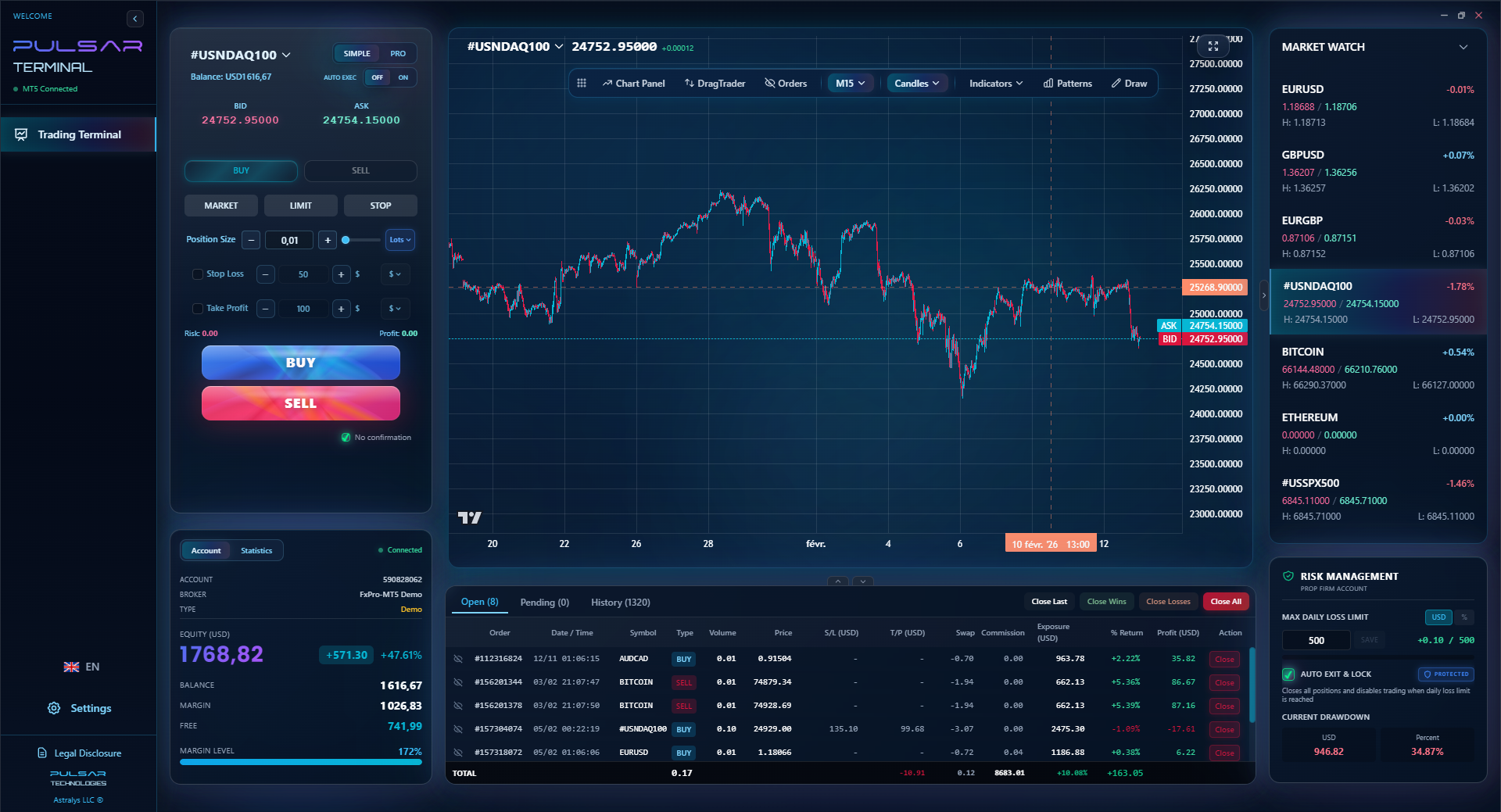
Managing multiple take-profit levels and tight stop losses for strategies like scalping or range trading is far easier with a tool that lets you drag and modify orders directly on your chart.
Pulsar Terminal
Lo strumento MT5 tutto-in-uno: ordini drag-and-drop, multi-TP/SL, trailing stop, grid trading, Volume Profile e protezione prop firm. Usato da oltre 1.000 trader ogni giorno.
Economic news (like US Non-Farm Payrolls, inflation data, or CBN announcements) causes massive, instant volatility. You can make a month's profit in minutes, or lose your account just as fast.
The Only Safe Way for Beginners: Don't try to trade the initial spike. It's a lottery. The method I use is the 'wait and see' approach.
- Know when high-impact news is scheduled (use an economic calendar).
- Have NO open positions 15 minutes before the release.
- After the news hits, wait 15-30 minutes for the initial panic to settle.
- Analyze the new price level. Has it broken a major technical level with conviction? That new direction often has momentum for the next few hours.
Trade the reaction to the news, not the news itself. The initial move is often a 'knee-jerk' that reverses. Let the big banks and algos fight it out first, then follow the clear winner. This requires patience, but it's far safer than guessing which way the number will jump.
Managing Naira-Related Volatility
Trading from Nigeria adds a layer. When there's local economic uncertainty or CBN policy rumors, liquidity in Naira pairs can dry up, and spreads can widen dramatically. If you're trading international pairs like EUR/USD, this affects you less directly, but be aware that local internet instability during tense periods can be a real risk. Always have a hard stop loss in place in case you get disconnected.
“If you find yourself moving your stop loss further away because a trade is going against you, you've abandoned your strategy. You're now hoping, not trading.”
You now have five basic forex trading strategies. Don't use all five at once. You'll spread yourself too thin and master none.
Step 1: Pick One. Are you patient and only check charts once a day? Choose Trend Following or Range Trading. Are you an adrenaline junkie with fast internet? Maybe try Scalping (with caution). Match the strategy to your personality and schedule.
Step 2: Test It Relentlessly (Don't Use Real Money). Open a demo account with a broker like XM or Exness. Trade your chosen strategy for at least 100 trades. Record every single trade in a journal: entry, exit, reason, emotional state. This data is gold.
Step 3: Analyze the Cold, Hard Numbers. After 100 trades, calculate:
- Win Rate: What percentage were winners?
- Average Win vs. Average Loss: What's your profit factor?
- Largest Drawdown: What was your biggest losing streak?
If the strategy is profitable on demo over 100 trades, you've proven it works in theory. Now you must prove you can execute it under the pressure of real money. Start with a tiny live account. Risk no more than 0.5% per trade. If you can be consistent for another 50 trades, then you can consider scaling up slowly.
The biggest edge you have isn't a strategy; it's your discipline. The strategy is just the map. Your discipline is the engine that gets you to the destination.
FAQ
Q1Which basic forex trading strategy is best for a complete beginner in Nigeria?
Start with Trend Following on the 4-hour chart. It's slower, teaches patience, and forces you to understand market structure. Avoid scalping and news trading initially - they're fast and unforgiving.
Q2How much money do I need to start with these strategies?
You can start with as little as $50-$100 with a micro account, but it's more about risk management. With $100, risking 0.5% per trade means you can only risk 50 cents. A single pip move will be tiny. A more practical start is $200-$500, which allows for sensible position sizing while you learn.
Q3How do I deal with high spreads from Nigerian brokers?
Many local brokers have wide spreads. The solution is to use a reputable international broker with a low-latency server near you (like in London or South Africa). Brokers like IC Markets or Pepperstone offer raw spreads from 0.0 pips on major pairs. Always check the typical spread on the pair you want to trade before committing to a broker.
Q4Can I combine these strategies?
Yes, but not simultaneously on the same trade. You might use a higher timeframe (like daily) to identify the overall trend (Strategy 1), and then use a range trading approach (Strategy 2) on the 4-hour chart to find precise entries in the direction of that trend. This is called multi-timeframe analysis.
Q5How many pairs should I trade as a beginner?
One or two. Master EUR/USD first. It's the most liquid, has the tightest spreads, and moves in clear trends and ranges. Adding too many pairs leads to confusion and sloppy analysis.
Q6What's the most common mistake beginners make with these strategies?
Abandoning the strategy after 2-3 losses. No strategy wins 100% of the time. A strategy with a 60% win rate will still have losing streaks of 4-5 trades. If you switch strategies every time you hit a loss, you'll never know if any of them actually work. Stick to your tested plan for at least 20-30 trades before judging it.
Lezione del Prof. Winston
Punti chiave:
- ✓Test any strategy for 100 demo trades before using real money.
- ✓Never risk more than 1% of your account on a single trade.
- ✓Trend following fails in ranging markets 70% of the time.
- ✓Your first profit target should be for 70-80% of your position.
Quanto è stato utile questo articolo?
Clicca su una stella
Analisi Trading Settimanali
Analisi e strategie settimanali gratuite. Nessuno spam.
Sull'autore
Olumide Adeyemi
Pioniere del Trading in Africa Occidentale
Uno degli educatori di trading forex più attivi in Nigeria. 8 anni di esperienza di trading da Lagos. Specializzato in strategie a basso capitale e sfide prop firm per trader africani.
Commenti
Avviso di rischio
Il trading di strumenti finanziari comporta rischi significativi e potrebbe non essere adatto a tutti gli investitori. Le performance passate non garantiscono risultati futuri. Questo contenuto è fornito solo a scopo educativo e non deve essere considerato un consiglio di investimento. Conduci sempre le tue ricerche prima di fare trading.
Potrebbe interessarti anche

Cara Trading Forex Sukses: 7 Prinsip dari Trader Profesional
Cara trading forex sukses dengan 7 prinsip trader pro: manajemen modal, disiplin, journal trading, backtest. Data nyata, bukan janji profit palsu.
Jam Trading Forex Terbaik untuk Trader Indonesia: Panduan Lengkap dengan Tabel Waktu
Panduan jam trading forex untuk trader Indonesia. Tabel 4 sesi dunia, jam emas 20:00-00:00, sesi mana yang harus dihindari. Data akurat + tips dari trader berpengalaman.
Top 5 Sàn Forex Uy Tín Nhất 2026: Review Jujur dari Trader Indonesia
Top 5 sàn forex uy tín 2026 untuk trader Indonesia. Review jujur: spread, deposit, withdraw, dukungan lokal. Exness, XM, IC Markets & lebih.
Scarica Pulsar Terminal
Tutti questi calcolatori sono integrati in Pulsar Terminal con dati in tempo reale dal tuo conto MT5.
Scarica Pulsar Terminal