


Let's clear something up right away.

David van der Merwe
Trader dei Mercati Emergenti ·  South Africa
☕ 10 min di lettura
Cosa imparerai:
- 1What Exactly Is the Belly System Forex?
- 2The Rules and How to Set It Up on MT4/MT5
- 3What It Really Costs to Trade This System in South Africa
- 4Choosing an FSCA-Regulated Broker: Your Safety Net
- 5A Practical Trade Example: From Signal to Exit
- 6Common Mistakes (I've Made Them All)
- 7How to Integrate the Belly System Into Your Trading Plan
Let's clear something up right away. If you're searching for the 'belly system forex' expecting a secret, get-rich-quick code, you're going to be disappointed. I was too, about a decade ago. What you'll find instead is a decent, rules-based approach to reading price action that can work if you treat it like a tool, not a prophecy. It's popular here because it runs on the platforms we all use - MT4 and MT5. This guide will strip away the hype, show you exactly how it works with our local brokers, and tell you why understanding the 'belly' of a candle is only half the battle.
The Belly System isn't some mystical indicator you download. It's a visual trading methodology. The core idea is simple: you focus on the body of a candlestick (the 'belly' between the open and close) and ignore the wicks (or shadows) for your initial signal. The logic is that the body shows where the price actually settled, representing the real battle between buyers and sellers, while wicks are just rejected price excursions.
It's almost always paired with classic indicators like the MACD indicator and RSI indicator for confirmation. You're looking for the candle's body to break a key level - like support or resistance - while your indicators line up in the same direction. For example, a strong bullish candle (big green body) closing above a resistance line, with the MACD crossing up and the RSI moving out of oversold territory. That's the classic Belly System signal.

Warning: A common mistake is taking every big-bodied candle as a signal. I've blown trades doing that. The context - where it happens on the chart - is everything. A big green candle after a massive rally is often a trap, not an invitation.

💡 Consiglio di Winston
The 'belly' tells you who won the round. The trend on the higher timeframe tells you who's winning the fight. Always bet on the fighter ahead on points.
The Basic Trading Rules
There's no single holy rulebook, but most Belly System traders follow a similar checklist. For a BUY signal:
- Identify the Level: Find a clear area of support or resistance on your chart.
- Watch the Belly: Wait for a candle to close with a strong body (relative to recent candles) ABOVE that resistance level. The wicks can dip below, but the close must be convincingly above.
- Get Confirmation: Check your MACD. Is the histogram turning positive or is there a bullish crossover? Check your RSI. Is it above 50 or rising from below 30?
- Enter: Place a buy order a few pips above the high of that breakout candle.
- Manage Risk: Your stop-loss goes below the low of the breakout candle or below the support level that was broken. Your take-profit target is often set at a 1:1.5 or 1:2 risk-to-reward ratio.
Reverse this for SELL signals.
Setting It Up on Your Platform
This is the easy part. On MT4 or MT5, which you'll get from brokers like Exness, IC Markets, or XM:
- Open a chart for your preferred pair (EUR/USD is a common test subject).
- Add your MACD (default settings: 12, 26, 9) and RSI (default period: 14) from the 'Insert' > 'Indicators' menu.
- Use the horizontal line tool to mark your support and resistance levels.
- That's it. The 'system' is just you applying these rules. There's no magic EA, which is actually good - it forces you to learn to read the chart.

Pro Tip: Don't clutter your chart. Just candles, two indicators, and your levels. I used to have 5 indicators running, and all the conflicting signals just paralyzed me. Simplicity wins.
“The Belly System provides a clear framework for entries, but your exit strategy and money management do the heavy lifting.”
The strategy is free, but executing it isn't. You need to understand the costs, because a winning trade can become a loser after fees. Trading the Belly System often involves waiting for clear breaks, which might mean fewer trades than a scalping strategy. But each trade still carries costs.
Here’s the breakdown with a South African lens:
| Cost Type | What It Is | Typical Range in SA | Impact on Belly System Trading |
|---|---|---|---|
| Spread | Difference between buy/sell price. Your first hurdle. | 0.8 - 1.6 pips on EUR/USD (Standard Acc). 0.0 pips + commission on ECN. | Crucial. A breakout needs to move past the spread to be valid. Use a broker with tight spreads. |
| Commission | Fee per lot traded (common on ECN accounts). | $3 - $7 per standard lot (100k units). | Affects your position size calculator results. A $5 commission on a 1-lot trade is 5 pips on EUR/USD. |
| Swap Fee | Charge/credit for holding overnight. | Varies by pair & direction. Check broker's schedule. | If your breakout becomes a multi-day swing trading hold, swaps matter. Can erode profits. |
| Funding Fees | Depositing/withdrawing in ZAR. | Often free for EFTs. E-wallets (Skrill/Neteller) may have fees. | Factor this into your start-up capital. It's a sunk cost. |
My own lesson? In 2019, I was trading a USD/ZAR breakout system similar to the Belly method. I was using a broker with a 5-pip spread on the pair. I'd get a perfect signal, enter, and the price would just sit there, churning, before finally failing. I was getting stopped out by the spread alone. I switched to a tighter-spread broker and immediately saw an improvement in my edge. The system didn't change. My costs did.
This is non-negotiable. The Belly System, or any system, is useless if your broker isn't legit. In South Africa, the Financial Sector Conduct Authority (FSCA) is our watchdog. Trading with an unregulated broker is like playing soccer with a ball that the other team can deflate whenever they want.
An FSCA license means:
- Your money is segregated. It's held in separate bank accounts, not used to fund the broker's office parties.
- There's a complaints process. If something goes wrong, you have a local regulatory body to approach.
- use is capped for retail clients (often around 1:30 for majors). This feels limiting, but it protects you from a catastrophic margin call after one bad trade.
Brokers like Pepperstone (via their SA entity), IG, and FP Markets hold FSCA licenses. Always double-check the broker's FSP number on the FSCA website. I learned this the hard way early on, depositing with a flashy offshore broker that later 'had technical issues' with withdrawals. I never saw that R5,000 again.
When evaluating a broker for this kind of trading, look for:
- FSCA Regulation: The absolute first box to tick.
- MT4/MT5 Availability: The Belly System is designed for these platforms.
- Low, Transparent Costs: Tight spreads on the pairs you'll trade (like EUR/USD or XAU/USD).
- Reliable Execution: You need your orders filled at the price you see, especially on breakouts.
💡 Consiglio di Winston
A breakout is only valid if the market can afford the rent. If the price slides back inside the level within 2-3 candles, you were evicted. Get out.
“A realistic win rate with good risk management might be 50-60%. That's why your profit on winners must be bigger than your loss on losers.”
Let's walk through a real scenario I traded last year on EUR/USD. This will make the theory concrete.
The Setup (1-Hour Chart):
- EUR/USD had been bouncing between 1.0850 (support) and 1.0950 (resistance) for two days.
- I drew my horizontal line at 1.0950.
- The MACD was hovering around zero, and the RSI was near 50. Nothing dramatic.
The Signal:
- A bullish candle opened at 1.0945 and closed at 1.0968. The body was 23 pips - substantially bigger than the recent candles. It closed clearly above my 1.0950 resistance. The wick was small.
- I looked at my indicators: The MACD histogram had just ticked into positive territory. The RSI crossed above 55.
- This was a textbook Belly System buy signal.
The Execution:
- I decided to risk 0.5% of my account. My position size calculator told me that with a stop-loss at 1.0930 (below the candle's low), my risk was 38 pips. To risk R500, my position size was roughly a mini lot (0.1 standard lots).
- I entered a buy limit order at 1.0970 (a few pips above the close).
- Stop-Loss: 1.0930.
- Take-Profit: I set two targets. First at 1.1010 (40 pips, 1:1 R:R) and a second at 1.1050 (80 pips).
The Result: The price shot up, hit my first target, and I closed half my position, banking R400. I moved my stop-loss on the remainder to breakeven. The price then retraced, hit my breakeven stop, and I was out. Total gain: R400. Not a home run, but a clean, professional trade where I followed my plan. The system gave me the signal; my money management defined the outcome.

Example: Risk = R500. Risk in pips = 38. Pip value for 0.1 lots on EUR/USD ≈ R1.50. Position size = Risk / (Pips at Risk * Pip Value) = 500 / (38 * 1.5) ≈ 8.77 micro lots. I rounded to a 0.1 mini lot for simplicity.
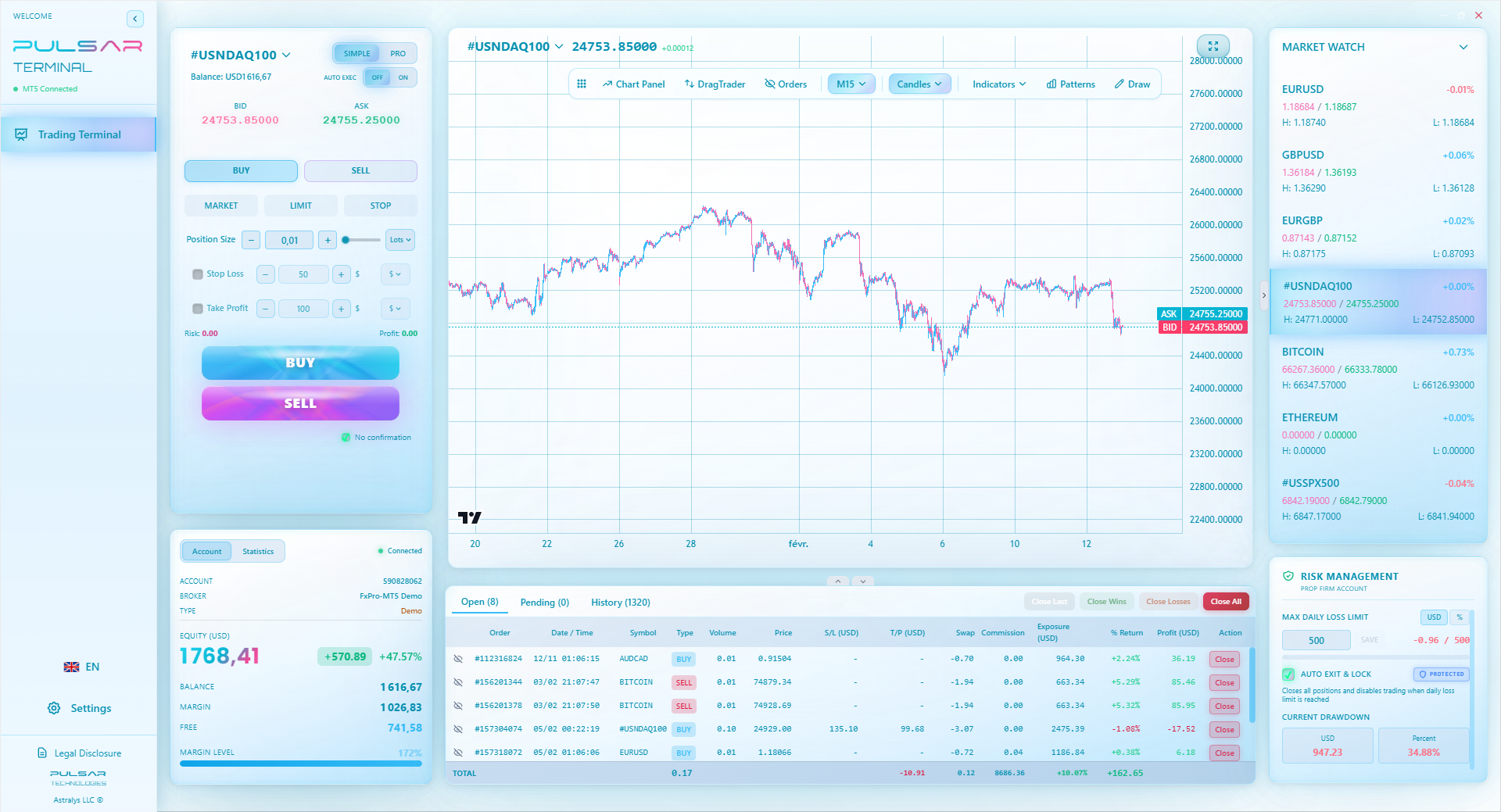
Managing multi-target trades and moving stops to breakeven, like in the example trade, is seamless with Pulsar Terminal's drag-and-drop order tools on MT5.
Pulsar Terminal
Lo strumento MT5 tutto-in-uno: ordini drag-and-drop, multi-TP/SL, trailing stop, grid trading, Volume Profile e protezione prop firm. Usato da oltre 1.000 trader ogni giorno.
The Belly System is simple, which is why it's easy to get sloppy. Here are the pitfalls that have cost me money:
1. Chasing the Belly: You see a massive candle forming and FOMO in before it closes. What if it's a 'shooting star' with a long wick that closes back down? You must wait for the close. The close is the only fact you have.
2. Ignoring the Trend: Taking a Belly buy signal in a strong, established downtrend is fighting the current. The system works best when the breakout aligns with a higher timeframe trend. I once took three losing buy signals in a row on a crashing XAU/USD chart because the 4-hour chart was screaming down. I was too zoomed in.
3. Poor Risk Placement: Placing your stop-loss too tight, just on the other side of the breakout candle. Smart money often runs stops before continuing the move. Give your trade room to breathe by placing the stop beyond a recent swing low/high.
4. Overcomplicating It: Adding more indicators, more lines, more rules. If you need 10 conditions to be met, you'll never trade. The power is in the clarity of the core rule: a strong-bodied break of a level with basic momentum confirmation.
The biggest mistake? Believing the system has a 90% win rate. It doesn't. A realistic win rate with good risk management might be 50-60%. That's why your profit on winners must be bigger than your loss on losers. That's the real 'secret'.
💡 Consiglio di Winston
Your first profit target should always cover your spread and commission. Anything after that is a bonus. Never let a winning trade turn into a loser.
“Trading with an unregulated broker is like playing soccer with a ball that the other team can deflate whenever they want.”
The Belly System shouldn't be your entire plan. It should be a chapter in it. Here's how to make it work long-term.
1. Define Your Scope: Will you use it for day trades on the 15-minute chart? For swing captures on the 4-hour? I use it primarily on the 1-hour and 4-hour charts for swings. It's too slow for my scalping strategy and too noisy on the 5-minute.
2. Pair Selection: It works best on liquid pairs with clear trends and ranges. EUR/USD, GBP/USD, USD/JPY are ideal. Avoid exotic pairs where spreads are wide and moves are erratic.
3. Combine with Market Context: Before you even look for a Belly signal, check the higher timeframe. Is the daily chart bullish? Then only look for buy signals on pullbacks. This one filter will improve your results dramatically.
4. Journal Religiously: For every Belly System trade, note: the pair, timeframe, candle body size, indicator readings, your entry/exit, and most importantly, your emotional state. Did you hesitate? Did you override your stop? My journal showed me I was terrible at taking sell signals - I had a psychological bias for 'buying' - so I had to work on that.
Think of the Belly System as a reliable wrench in your toolbox. You wouldn't use a wrench to hammer a nail. Don't use this system in market conditions it wasn't built for, like low-volatility, news-less consolidation phases where false breakouts are the norm.
FAQ
Q1Is the Belly System Forex profitable?
It can be, but not by itself. No trading system is inherently profitable. Profitability comes from you - your discipline, risk management, and ability to filter good signals from bad ones. The Belly System provides a clear framework for entries, but your exit strategy and money management do the heavy lifting.
Q2What is the best timeframe for the Belly System?
It's most reliable on the 1-hour and 4-hour charts. These timeframes smooth out market noise and provide clearer support/resistance levels. On lower timeframes (like 5 or 15 minutes), false breakouts are too common. On the daily chart, signals are rare but high-quality.
Q3Can I use the Belly System with other indicators besides MACD and RSI?
Absolutely. The core is the candlestick body break. Some traders use the Stochastic or the Awesome Oscillator for confirmation. The key is to not add too many. If you add three momentum indicators, they'll often just tell you the same thing and clutter your screen. Stick to one or two confirmers.
Q4What's the minimum deposit needed to start trading this system in South Africa?
You can start with very little. Some FSCA-regulated brokers like XM offer minimum deposits as low as $5 (about R80). However, with a small deposit, your position sizing will be tiny, and you'll be very limited. A more practical start for testing the system with real, but managed, risk is around R2,000 to R5,000.
Q5How do I know if a breakout is 'strong' enough?
Compare the breakout candle's body to the bodies of the last 5-10 candles. It should be noticeably larger. There's no fixed pip size. On EUR/USD, a 15-pip body might be strong in a quiet market, while in a volatile session, it might need to be 30+ pips. It's about relative size, not an absolute number.
Q6Does the Belly System work on gold (XAU/USD)?
Yes, but be cautious. Gold is more volatile and prone to sharp, news-driven spikes that can create false breakouts. The candle bodies can be huge ($20+), so your stop-losses need to be wider, and thus your position size smaller. It requires more patience and a steadier hand. Check our dedicated XAU/USD guide for more on trading gold.
Lezione del Prof. Winston
Punti chiave:
- ✓Wait for the candle to CLOSE. The close is the only fact.
- ✓Align your signal with the higher timeframe trend. Fight the current, drown.
- ✓Your stop-loss must be beyond the obvious swing point. Protect from stop-hunts.
- ✓A 1:2 risk-to-reward ratio turns a 50% win rate into profit.
Quanto è stato utile questo articolo?
Clicca su una stella
Analisi Trading Settimanali
Analisi e strategie settimanali gratuite. Nessuno spam.
Sull'autore
David van der Merwe
Trader dei Mercati Emergenti
Trader con base a Johannesburg con 11 anni di esperienza nelle valute dei mercati emergenti. Specializzato in coppie ZAR, trading regolamentato dalla FSCA e analisi del mercato sudafricano.
Commenti
Avviso di rischio
Il trading di strumenti finanziari comporta rischi significativi e potrebbe non essere adatto a tutti gli investitori. Le performance passate non garantiscono risultati futuri. Questo contenuto è fornito solo a scopo educativo e non deve essere considerato un consiglio di investimento. Conduci sempre le tue ricerche prima di fare trading.
Potrebbe interessarti anche

Cara Trading Forex Sukses: 7 Prinsip dari Trader Profesional
Cara trading forex sukses dengan 7 prinsip trader pro: manajemen modal, disiplin, journal trading, backtest. Data nyata, bukan janji profit palsu.
Jam Trading Forex Terbaik untuk Trader Indonesia: Panduan Lengkap dengan Tabel Waktu
Panduan jam trading forex untuk trader Indonesia. Tabel 4 sesi dunia, jam emas 20:00-00:00, sesi mana yang harus dihindari. Data akurat + tips dari trader berpengalaman.
Top 5 Sàn Forex Uy Tín Nhất 2026: Review Jujur dari Trader Indonesia
Top 5 sàn forex uy tín 2026 untuk trader Indonesia. Review jujur: spread, deposit, withdraw, dukungan lokal. Exness, XM, IC Markets & lebih.
Scarica Pulsar Terminal
Tutti questi calcolatori sono integrati in Pulsar Terminal con dati in tempo reale dal tuo conto MT5.
Scarica Pulsar Terminal