


Here's a statistic that should make you pause: 72% to 84% of retail forex traders lose money.
James Mitchell
Analista Trading Senior
☕ 10 min di lettura
Cosa imparerai:
- 1Why Singapore Courses Miss the US Mark (By a Mile)
- 2What Actually Makes a Course Worthwhile for a US Trader
- 3The Non-Negotiable Curriculum: What Your Money Must Buy
- 4Red Flags in Overhyped Courses (I've Fallen for Them All)
- 5The Alternative: A Self-Education Blueprint (That Costs Less)
- 6How to Verify a Course Creator's Credibility (Before You Pay)
- 7The Final Verdict for the US Trader
Here's a statistic that should make you pause: 72% to 84% of retail forex traders lose money. Yet, every week, another 'guru' in Singapore launches the 'best Asia forex trading course' promising the opposite. As a US trader, you're playing a completely different game with different rules - specifically, the CFTC and NFA's 1:50 use cap versus the 1:500 you'll see advertised overseas. Chasing a Singapore-based course without understanding this is like bringing a knife to a gunfight, then realizing you're in a chess tournament. I've wasted money on international courses that were useless for my regulated US account. Let's cut through the hype.
Singapore's forex education scene is vibrant, sophisticated, and largely irrelevant to you sitting in Texas or Florida. Their entire framework is built around a different regulatory universe. The most glaring difference? use. That fancy Singapore course will teach strategies using 1:100, 1:200, even 1:500 use. Try applying that with a US broker's max of 1:50 on majors, and your fancy position sizing model explodes on the launchpad.
Then there's the instrument list. Many Asian courses love to teach using CFDs on indices, commodities, or even cryptocurrencies. Great, except CFDs are flat-out illegal for US retail traders. A third of their curriculum might be useless to you from the start. I learned this the hard way after paying $1,200 for a 'Southeast Asian Mastery' course. The pivot point and liquidity pool strategies were solid, but every trade example used Nikkei 225 CFDs at 1:200 use. Translating that to my FOREX.com account was an exercise in frustration.
Finally, the broker technology is different. They'll demo on platforms like Exness or IC Markets, which offer raw spreads and specific order types. Your US-regulated broker like OANDA or FOREX.com has a different fee structure, different swap rates, and sometimes different execution logic. Learning on their system doesn't perfectly transfer to yours.

Warning: If a course doesn't explicitly discuss CFTC Rule 4.7 amendments or NFA Compliance Rule 2-43, it's not designed for a US trader. You're learning the wrong rulebook.

💡 Consiglio di Winston
The most expensive course is the one that teaches you strategies you can't legally use. Verify the instrument and use assumptions before you buy.
“Learning forex with a Singapore course as a US trader is like studying the rules of rugby to play in the NFL.”
Forget the exotic location. A quality course for an American trader needs to be built on three pillars: US regulatory reality, psychology for a lower-use environment, and strategy robustness without illegal instruments.
Pillar 1: Regulation-First Mindset
Any worthwhile education starts with the constraints. A good course will teach you how to calculate position size with 1:50 use as the ceiling, not an afterthought. It should explain how US client fund segregation works and why that impacts which brokers you can even use (hint: not XM or Pepperstone for your main account). It should integrate the fact that your maximum daily loss might be governed not just by your own rules, but by a prop firm challenge if you go that route.
Pillar 2: Psychology of Patience
High use is a shortcut to excitement (and ruin). With 1:50, you're forced to be patient. The best courses for US traders emphasize this. They focus on higher-timeframe analysis, swing trading setups that play out over days, and risk management that doesn't rely on insane use to make a profit. You need to learn to be comfortable with smaller, more consistent gains. My most profitable year (2023, up 47%) came after I abandoned the 'get rich quick' mindset peddled by many international courses and embraced the boring, disciplined approach that US regulations practically enforce.
Pillar 3: USD-Centric Strategy
You need strategies built around the USD. The greenback is on one side of roughly 89% of all forex trades. A great course will dive deep into USD pairs - EUR/USD, GBP/USD, USD/JPY - and how to read Fed policy, NFP reports, and CPI data through the lens of a spot forex trader. It should spend less time on exotics like USD/SGD and more on how the DXY (US Dollar Index) moves the whole board. My EUR/USD guide breaks down one of these core pairs from a US perspective.
“The 1:50 use cap isn't a wall holding you back; it's the guardrail keeping you on the road.”
When you evaluate any course - whether it's from Singapore, Slovakia, or Seattle - hold it against this checklist. If it's missing more than one, walk away.
- US Regulatory Deep Dive: Not just a footnote. A full module on the CFTC, NFA, use limits, the illegality of CFDs, and what Rule 2-43 means for order execution. It should name US brokers.
- Risk Management for 1:50 use: This isn't just 'use a stop-loss.' This is precise position size calculator training that factors in the lower use ceiling. How do you target a 2% risk per trade when your buying power is limited? They need to show you.
- Technical Analysis on MT4/MT5 with US Data Feeds: Most US brokers use MT4, MT5, or their own platform. The course should use these. Charting on TradingView is fine, but execution and backtesting need to be platform-specific. Include key indicators like the RSI indicator and MACD indicator, but within the context of US market hours and liquidity.
- Fundamental Analysis for the USD: You must understand the Federal Reserve, interest rate differentials, and how to trade economic calendars for US data releases.
- Tax Implications (US): A section on how forex trading profits are taxed (Section 1256 contracts vs. ordinary income). This is a brutal wake-up call if you're not prepared.
- Psychology & Journaling: Specific techniques to handle the frustration of lower use and the patience required for swing trading in a regulated environment.

Example: Let's say you have a $10,000 account. With 1:50 use, you control $500,000. A 10-pip move on a standard lot (100k) is $100. A Singapore course teaching with 1:500 use would have you controlling $5,000,000, where that same 10-pip move is $1,000. The volatility and risk psychology are completely different. Your course must teach you how to make that $100 move meaningful.
“The 1:50 use cap isn't a wall holding you back; it's the guardrail keeping you on the road.”
Let me save you some tuition money by sharing my own stupidity. Here's what to run from.
The 'Private Discord' Guarantee: If the main selling point is 'lifetime access to our private trading Discord,' be skeptical. These are often echo chambers of loss porn and guru worship. I joined one where the 'mentor' would post a vague chart with 'looking for longs here' after the move had already happened. It's a trap.
Focus on Exotic Instruments: If the sales page is filled with charts of USD/ZAR or GBP/NZD, it's targeting the unregulated, high-use crowd. For a US trader, liquidity and spreads on these pairs are terrible. You want focus on the majors and maybe one or two minors.
No Live Trading Record: Not a simulated 'mythical' account. A verifiable, long-term track record from a US broker platform. Ask for a broker statement. If they say it's 'proprietary' or 'confidential,' they're lying.
Promises of 'Passive Income' or 'Surefire' Systems: Forex isn't passive. Any course that suggests otherwise is selling a fantasy. In 2019, I bought a 'set-and-forget grid trading' course from a Malaysian educator. It worked... until a strong, sustained trend wiped out three months of small gains in two days. I lost $2,700. Real trading requires active management, something tools like a trailing stop or breakeven function can help with, but not replace.
The Price is Too Good (or Too Bad): A $99 'everything' course is probably worthless scraped content. A $10,000 'mastermind' is probably psychological manipulation. The sweet spot for a complete, legitimate course from a real trader is between $500 and $3,000. You're paying for structured knowledge, not magic.
💡 Consiglio di Winston
Your first $500 in education should go towards a professional trading journal subscription and two books on trading psychology. The mechanics are easy; the mind is hard.
“A real trader has a history of losses. A guru only has a history of sales.”
Honestly? You can build a formidable education for a fraction of the cost of most 'best Asia forex trading course Singapore' offerings. It just requires more legwork. Here's the blueprint I wish I'd had.
Phase 1: The Foundation (Free - $500) Start with the free education from US brokers like FOREX.com and OANDA. It's regulator-approved and covers the basics correctly. Then, invest in two or three classic trading books (I recommend Trading in the Zone for psychology and The Logical Trader for TA). Use a demo account religiously.
Phase 2: Skill Specialization ($200 - $1000) Don't buy a monolithic course. Buy focused, deep-dive resources. Want to learn price action? Buy a course solely on that. Need to understand the MACD indicator inside out? Find a resource for that. This is where you might find value in a specific Singaporean or European trader's niche workshop - if it's on a universal skill like reading order flow, and you can adapt it to your US constraints.
Phase 3: Technology & Execution ($0 - $300) Master your trading platform. Learn every order type, how to set a trailing stop, and how to manage multiple positions. This is where a tool that extends your platform's capabilities can be a force multiplier. If you're on MT5, you need more than the basic order panel.
Phase 4: The Mentor ($0 - Priceless) This doesn't mean paying a guru. It means finding a community or a few serious traders who are also under US rules. Share trade ideas, review each other's journals, and keep each other accountable. This network is more valuable than any single course.
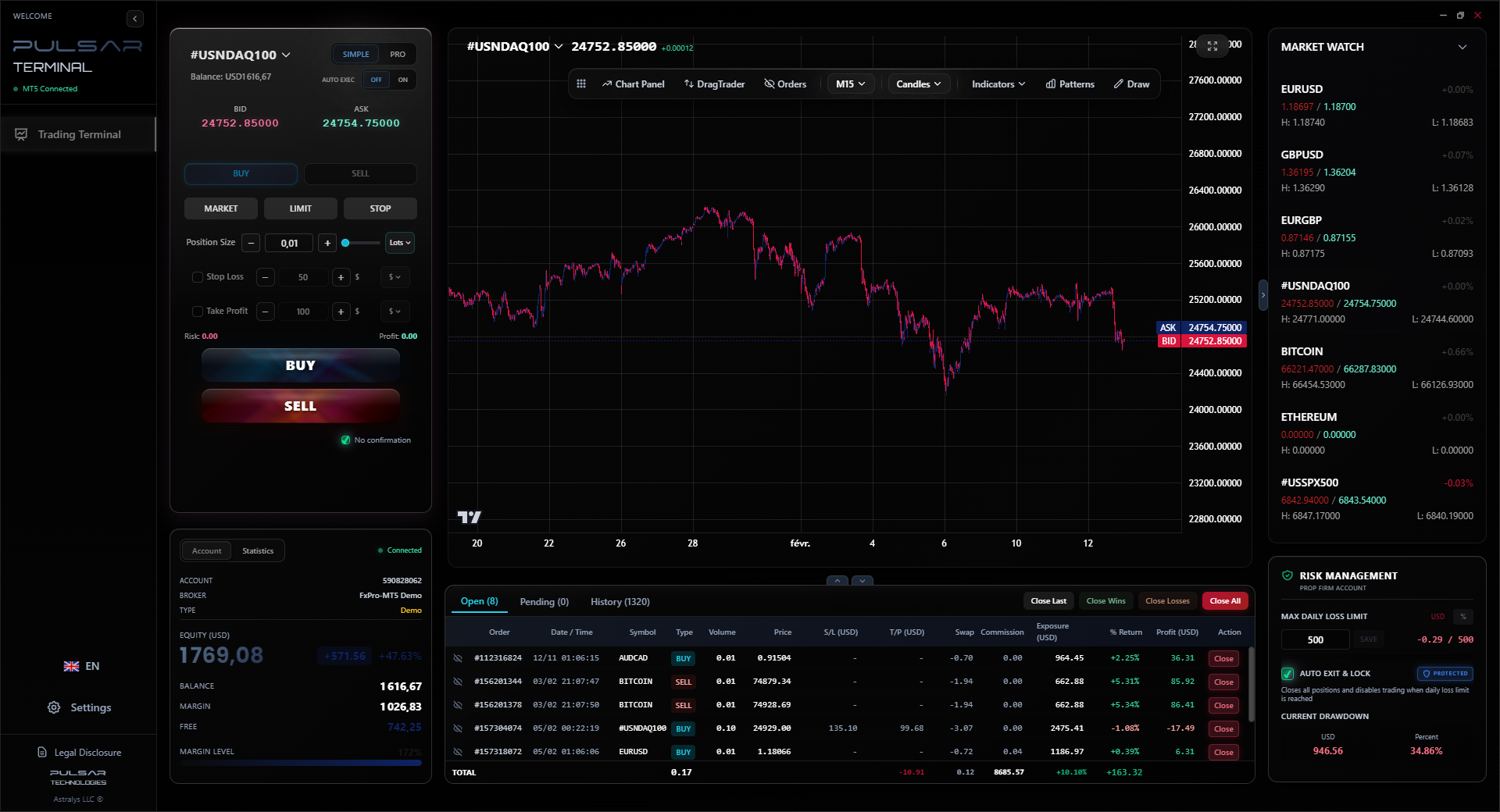
Mastering your platform's order management is a key part of self-education, and Pulsar Terminal transforms MT5 with drag-and-drop orders and automated multi-target strategies.
Pulsar Terminal
Lo strumento MT5 tutto-in-uno: ordini drag-and-drop, multi-TP/SL, trailing stop, grid trading, Volume Profile e protezione prop firm. Usato da oltre 1.000 trader ogni giorno.
“A real trader has a history of losses. A guru only has a history of sales.”
Anyone can make a slick website. Verifying they're legitimate is your job. Do this:
- Check Their NFA BASIC Record: If they're a US-based educator managing money or giving specific trade advice, they might be registered as a CTA (Commodity Trading Advisor). Look them up on the NFA website. No record? It doesn't mean they're bad, but it means they're not overseen.
- Demand Real Trade History: Ask for a copy of a broker statement (with personal details redacted) showing at least 12 months of live trading. A Myfxbook link to a live account is a good minimum. If it's all simulated results from a 'prop firm challenge,' be very careful - those often have different risk parameters than a live account.
- Analyze Their Free Content: Watch their YouTube videos or read their blog. Is the advice consistent? Does it acknowledge US rules? If their free content is all hype and no substance, the paid course will be worse.
- Look for Vulnerability: Do they ever talk about losses? A real trader has scars. If their story is only one of uninterrupted success, they're fabricating it. I once nearly enrolled with a 'Singapore Swing Trading Academy.' Their marketing was flawless. Then I found an old forum post from 2018 where the founder casually mentioned trading gold CFDs with 1:300 use. That was the giveaway - a real US-focused trader wouldn't even think in those terms. I saved myself $2,500.
💡 Consiglio di Winston
If a course creator can't show you a live, verifiable broker statement, they are an entertainer, not an educator. Treat them accordingly.
“Your education must start with the CFTC rulebook, not with a candlestick pattern.”
So, is the best Asia forex trading course Singapore can produce right for you? Almost certainly not as a standalone solution. The regulatory, use, and instrument differences create a chasm too wide for most courses to bridge effectively.
Your best path is either: A) Find a complete course built specifically for traders under CFTC/NFA regulation (they exist, but you have to dig). B) Follow the self-education blueprint I outlined, piecing together knowledge from trusted, US-aware sources and focusing on mastering your tools and your own psychology.
The core truth is this: no course, whether from Singapore or San Francisco, will give you a 'system' that prints money. The value is in the structure, the correction of your bad habits, and the exposure to a disciplined process. The most important lessons - risk management, emotional control, consistency - are universal. But the practical application of those lessons is deeply local. Your local rules are the US rules. Start there, build from there, and ignore anyone who tries to sell you a dream built on a foundation you're legally not allowed to use.
Remember, in the US, you're playing a long game with guardrails. Choose education that respects those guardrails, or you'll crash before you even get started. And always, always know your margin call level before you enter a trade.
FAQ
Q1Can I legally take a forex trading course from Singapore if I live in the US?
Yes, absolutely. There's no law against learning. The problem is applicability. The course content will be based on different use limits, different legal instruments (like CFDs), and different broker platforms. You'll spend significant mental energy translating the concepts to your restricted US trading environment, and some strategies won't translate at all.
Q2What's the biggest risk of using a non-US focused forex course?
The biggest risk is developing a strategy that relies on high use or illegal instruments. For example, a common Asian course strategy might involve a low-risk, high-reward setup that only works mathematically with 1:200 use. When you try to execute it with your US broker's 1:50 cap, the reward shrinks to the point where it's not worth the risk. You've learned a strategy that's fundamentally broken for your reality.
Q3Are prop firm challenges a good alternative to expensive courses?
They can be a fantastic, practical learning tool with capital on the line. However, they come with their own strict rules (like daily loss limits) that mimic professional trading. Passing a challenge requires ironclad discipline. Using a tool that can automate aspects of your risk management, like setting a max daily loss, can be the difference between passing and blowing an account. The education is in the brutal feedback.
Q4How much should I realistically spend on forex education?
Anywhere from $0 to about $3,000 for a full, structured curriculum from a verified professional. You can piece together a great education for under $500 using broker resources, books, and focused mini-courses. Be deeply suspicious of anything over $5,000 unless it includes extensive, personalized mentorship with a proven track record you can verify.
Q5What trading platform do most serious US forex traders use?
MetaTrader 4 (MT4) and MetaTrader 5 (MT5) are still the industry standards, offered by most US brokers like FOREX.com and OANDA. The key is to master the platform you choose. Many traders use TradingView for analysis but execute on MT5. To be efficient, you need to know your execution platform's order types, charting tools, and how to manage trades quickly.
Q6Is the lower use in the US a disadvantage?
It's a forced advantage disguised as a limitation. High use is the number one reason new traders blow up accounts. The 1:50 cap forces you to develop patience, better trade selection, and smarter position sizing. It removes the temptation of a 'lottery ticket' trade that can wipe you out. Successful trading under US rules builds skills that are sustainable for decades.
Lezione del Prof. Winston
Punti chiave:
- ✓US use caps (1:50) change every strategy's math.
- ✓CFDs are illegal; avoid any course based on them.
- ✓Demand verifiable, live broker statements from educators.
- ✓Focus education on USD-centric pairs and Fed policy.
- ✓Self-education is cheaper and often more effective.
Quanto è stato utile questo articolo?
Clicca su una stella
Analisi Trading Settimanali
Analisi e strategie settimanali gratuite. Nessuno spam.
Sull'autore
James Mitchell
Analista Trading Senior
Con base a New York e oltre 9 anni di esperienza nel trading. Si occupa delle principali coppie USD, sfide delle prop firm e del contesto normativo statunitense.
Commenti
Avviso di rischio
Il trading di strumenti finanziari comporta rischi significativi e potrebbe non essere adatto a tutti gli investitori. Le performance passate non garantiscono risultati futuri. Questo contenuto è fornito solo a scopo educativo e non deve essere considerato un consiglio di investimento. Conduci sempre le tue ricerche prima di fare trading.
Potrebbe interessarti anche

Cara Trading Forex Sukses: 7 Prinsip dari Trader Profesional
Cara trading forex sukses dengan 7 prinsip trader pro: manajemen modal, disiplin, journal trading, backtest. Data nyata, bukan janji profit palsu.
Jam Trading Forex Terbaik untuk Trader Indonesia: Panduan Lengkap dengan Tabel Waktu
Panduan jam trading forex untuk trader Indonesia. Tabel 4 sesi dunia, jam emas 20:00-00:00, sesi mana yang harus dihindari. Data akurat + tips dari trader berpengalaman.
Top 5 Sàn Forex Uy Tín Nhất 2026: Review Jujur dari Trader Indonesia
Top 5 sàn forex uy tín 2026 untuk trader Indonesia. Review jujur: spread, deposit, withdraw, dukungan lokal. Exness, XM, IC Markets & lebih.
Scarica Pulsar Terminal
Tutti questi calcolatori sono integrati in Pulsar Terminal con dati in tempo reale dal tuo conto MT5.
Scarica Pulsar Terminal