


You're looking for the best broker for forex trading in Nigeria, right? Let me guess: you've seen the ads promising insane use and instant riches.

Olumide Adeyemi
Pioniere del Trading in Africa Occidentale ·  Nigeria
☕ 11 min di lettura
Cosa imparerai:
- 1Why Your Broker Choice Matters More Than Your Strategy
- 2The Nigerian Context: Regulations, Taxes, and Reality
- 3Breaking Down Real Costs: Spreads, Commissions, and More
- 4Top Broker Candidates for Nigerian Traders
- 5Key Features to Compare Side-by-Side
- 6My Personal Experience and Recommendation
- 7Final Checklist Before You Deposit
You're looking for the best broker for forex trading in Nigeria, right? Let me guess: you've seen the ads promising insane use and instant riches. The truth is, your broker isn't just a platform; it's your business partner. A bad one will steal from you through hidden fees, freeze your withdrawals, or vanish with your capital. I've seen it happen. In Nigeria's unique market, where local regulation is thin and international options are many, picking the right partner is your first and most critical trade. Let's cut through the noise.
I lost $1,200 in 2015 not from a bad trade, but from a bad broker. The spread on EUR/USD would mysteriously widen from 1.5 to 5 pips the second I entered a position. My stop-loss was triggered prematurely during minor volatility spikes that other platforms didn't even register. That experience taught me a hard lesson: you can have the world's best scalping strategy, but if your broker is working against you, you're finished before you start.
For Nigerian traders, this is amplified. We're often dealing with brokers regulated offshore. Your safety net isn't the SEC Nigeria, it's the Financial Conduct Authority (FCA) in the UK or the Australian Securities and Investments Commission (ASIC). A broker's primary regulator is the single most important line item on their website. Ignore it at your peril.
Your broker also dictates your real cost of doing business. That's not just the advertised spread. It's the commission, the overnight swap rates (which can be brutal on carry trades), the inactivity fees, and the deposit/withdrawal charges. A broker with tight spreads but a $30 wire transfer fee is robbing you silently.

Warning: A broker offering you 1:2000 use under an offshore license isn't doing you a favor. They're handing you a loaded gun with the safety off. High use is the fastest way to a margin call. It's a marketing tool, not a trading tool.
Let's be clear about the legal landscape. Forex trading is legal for you as an individual. However, the local regulatory framework for retail forex is, to put it politely, underdeveloped. The Central Bank of Nigeria (CBN) and SEC Nigeria aren't closely watching your MetaTrader 4 account. This means you are self-regulating.
The Tax Man Cometh
This is non-negotiable. The Federal Inland Revenue Service (FIRS) expects a 10% capital gains tax on your gross trading profits. I set aside 10% of every profitable withdrawal into a separate account. When the time comes, you have it ready. Trying to hide forex income is a fool's errand, especially as payment processors and banks improve reporting.
Funding Your Account: The Practical Hurdle
The CBN has made it clear you can't use the official foreign exchange windows for speculative trading. This pushes you towards alternative payment methods. This is where a broker's local adaptability is tested. The best broker for forex trading in Nigeria isn't just the cheapest on spreads; it's the one that lets you fund and withdraw in Naira seamlessly, with local partners.
You'll rely on bank transfers, cards, and e-wallets like Neteller and Skrill. Some brokers have integrated local processors like Interswitch. Look for brokers that don't charge deposit fees on your end (they often absorb it) and have a clear, published list of withdrawal fees. A three-day withdrawal process is standard; three weeks is a red flag.

Pro Tip: Always do a small test withdrawal before you commit large capital to any broker. If they delay or complicate a $50 withdrawal, imagine what they'll do with $5,000.

💡 Consiglio di Winston
A broker's customer service is best tested on a Friday evening. If they're slow then, they'll be useless when you really need them.
“Your broker isn't just a platform; it's your business partner. A bad one will steal from you through hidden fees.”
Forget the headline numbers. You need to calculate your cost per trade. Here’s the math that matters.
Scenario: Trading 1 standard lot (100,000 units) of EUR/USD.
| Account Type | Avg. Spread | Commission (per round lot) | Total Cost per Trade |
|---|---|---|---|
| Standard Account | 0.9 pips | $0 | $9.00 (0.9 x $10 per pip) |
| ECN/Raw Account | 0.1 pips | $7.00 | $8.00 (0.1 x $10 + $7) |
Note: $10 per pip is the approximate value for EUR/USD with a standard lot.
See that? The raw account with a commission can sometimes be cheaper than the "zero spread" marketing hype. But it depends on your trade size. For micro lots, the standard account is usually cheaper. For larger volumes, ECN wins.
My own trading shifted when I moved to a true ECN broker. On my main account, I use FP Markets or Pepperstone for their raw pricing. The transparency is worth it. I know my exact cost: spread + $6.50 commission. No surprises.
Other hidden costs:
- Swap Rates: Holding a EUR/USD buy position overnight might pay you $2 or cost you $5 per lot. It changes daily. If you're a swing trader holding for days, this adds up.
- Currency Conversion Fees: If your account is in USD but you deposit in Naira, the broker's bank gives a poor exchange rate. Sometimes funding in USD via a domiciliary account is cheaper in the long run.
- Inactivity Fees: $10-$15 per month after 3-6 months of no trading. Read the fine print.

Example: You make 20 trades a month, average size 0.5 lots. On a standard account (0.9 pip cost): 20 trades * 0.5 lots * $9 cost = $90/month in pure spread cost. On an ECN (0.1 pip + $7): (20 * 0.5 * $1) + (20 * 0.5 * $7) = $10 + $70 = $80/month. The ECN saves you $10, but only if your trade count is high.
Based on regulation, cost structures acceptable to Nigerian clients, and local feedback, here are the main contenders. I'm excluding brokers that are difficult to fund from Nigeria.
1. The Low-Cost ECN Specialists These are for serious, active traders who value execution speed and transparent pricing.
- Pepperstone (CMA Kenya Regulation): Offers 1:400 use for Nigerian clients under their Kenyan entity. Their Razor account has raw spreads and low commissions. Minimum deposit is $0. Their platform stability is excellent.
- FP Markets (ASIC Regulation): Another top-tier ECN. Raw spreads from 0.0 pips, $6 commission per lot. $100 min deposit. Their Iress platform is a powerful alternative to MT4/5.
- IC Markets (ASIC/CySEC): A giant in the ECN space. Consistently tight spreads, $7 round turn commission. Very popular with algorithmic traders.
2. The All-Rounders with Local Presence These brokers often have better Naira payment processing and local support.
- Exness (FCA/CySEC): Hugely popular here for a reason. They offer accounts with raw spreads (0.1-0.2 pips on majors) and have invested in local payment solutions. Their unlimited use offers (under offshore entities) are dangerous, but their standard accounts are solid.
- XM (CySEC/ASIC): Offers a wide range of account types, including micro accounts. Good educational resources for beginners. use up to 1:1000 under their global entity.
- HFM (FSCA): Offers Naira-denominated accounts, which is a massive plus. You can see your balance in NGN, eliminating conversion mental math. Some accounts have no minimum deposit.
3. The User-Friendly Platforms
- AvaTrade (BVI FSC): Regulated across multiple tiers. Known for user-friendly platforms like AvaTradeGo and copy trading. use up to 1:400 for Nigerian clients. Higher spreads but no commissions, simpler for beginners.
Warning: A broker being "popular" in Nigeria doesn't automatically make it good. Popularity can be bought with aggressive affiliate marketing promising deposits bonuses (which often come with impossible withdrawal terms). Focus on the fundamentals, not the hype.
💡 Consiglio di Winston
The 'minimum deposit' is a marketing tool. The real minimum is the amount needed to trade your strategy without being obliterated by the spread as a percentage of your account. For most, that's at least $200.
“High use is the fastest way to a margin call. It's a marketing tool, not a trading tool.”
Don't just pick a name. Make a spreadsheet. Compare these points for your final 2-3 choices.
| Feature | What to Look For | Why It Matters to You |
|---|---|---|
| Primary Regulation | FCA, ASIC, CySEC, CMA Kenya. Avoid unregulated or poorly respected island regulators. | This is your fund safety. It determines use caps and client money protection. |
| Average EUR/USD Spread | Check during London & NY sessions on a live demo. Don't trust the website's "from" number. | This is a major part of your transaction cost. |
| Commission per Lot | $6-$7 per 100k round turn is standard for ECN. | The other part of your transaction cost. |
| NGN Deposit/Withdrawal | Methods available (Bank Transfer, Cards, E-wallets). Fees (Broker's side and your bank's side). Processing time. | This is your lifeline. If funding is a headache, you won't trade consistently. |
| use Offered | 1:100 to 1:500 is more than enough. Anything higher is a risk flag. | Controls your margin and risk per trade. Use a position size calculator to manage it. |
| Platform | MT4/MT5 is standard. Check if they offer cTrader or proprietary platforms. | You need stable, familiar software. MT5 is better for hedging and more instruments. |
| Instruments | Forex pairs (including NGN?), Commodities (Gold, Oil), Indices, Crypto. | Do you want to trade XAU/USD or just EUR/USD? |
| Customer Support | Live chat response time. Do they have a Nigerian phone number or local office? | When you have a withdrawal issue at 10 PM, you need help. |
My process? I open a demo account with my shortlist. I watch the spreads at market open. I test their order execution with market and pending orders. I even contact their support with a random question to test response time and knowledge.
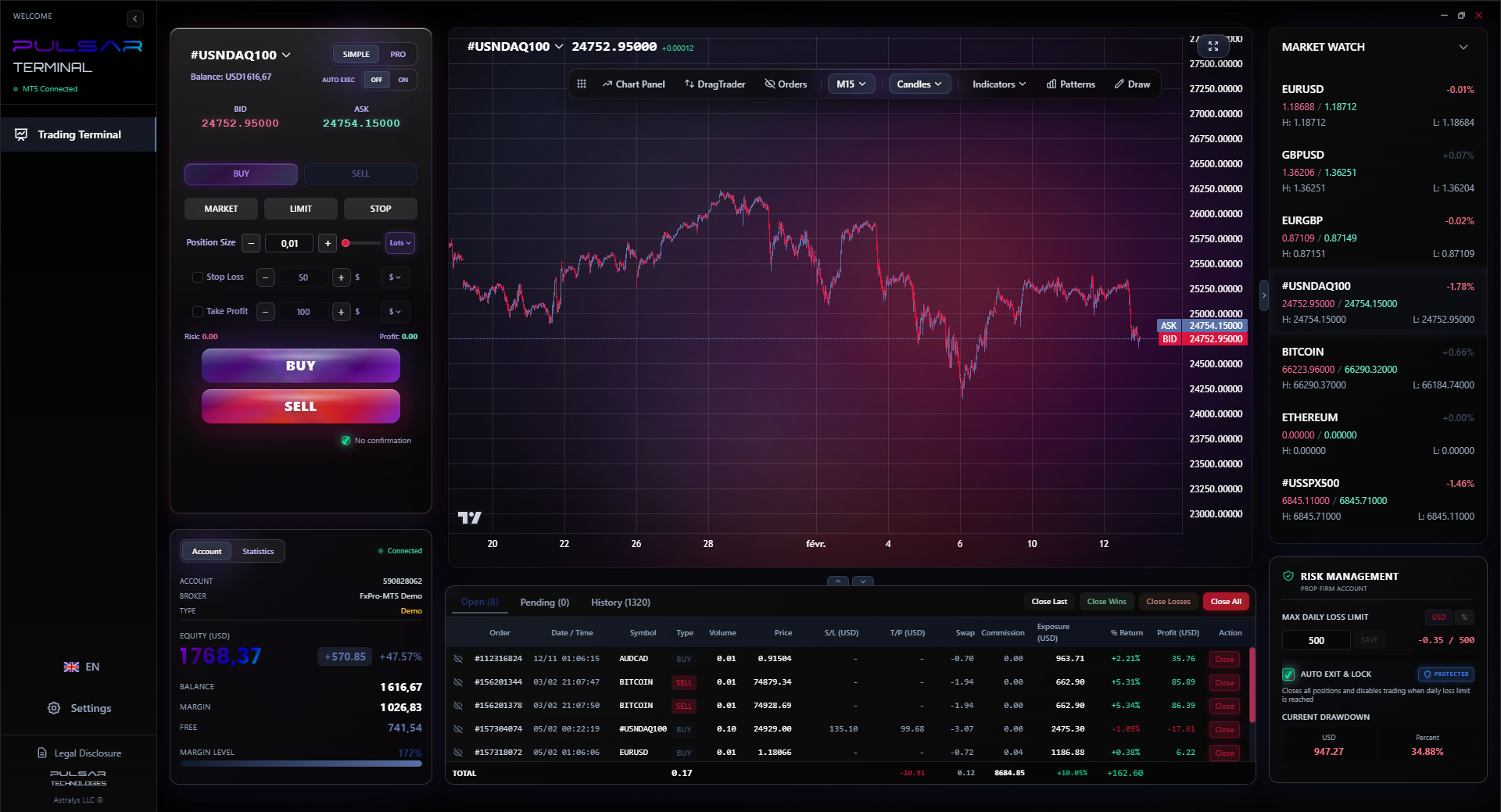
Once you've chosen a broker on MT5, managing complex trades and risk manually is a chore. Pulsar Terminal automates trailing stops, partial closures, and prop firm rules directly on your charts.
Pulsar Terminal
Lo strumento MT5 tutto-in-uno: ordini drag-and-drop, multi-TP/SL, trailing stop, grid trading, Volume Profile e protezione prop firm. Usato da oltre 1.000 trader ogni giorno.
I've traded with four different brokers over 12 years from Nigeria. Here's the raw data.
Broker A (2012-2015): Offshore regulated. As mentioned, lost $1,200 to terrible execution and slippage. Withdrawal took 11 business days. Verdict: Bad.
Broker B (2016-2019): Well-regulated (ASIC). Costs were fair. The problem? Funding. Every bank transfer from my Nigerian bank took 5-7 days and incurred a $25 fee on my end. It killed my ability to react to opportunities. I made a net profit of about $4,500 over three years, but the funding friction was a constant stress. Verdict: Good broker, wrong fit for my location.
Broker C (2020-Present): My main ECN broker (I use Pepperstone's CMA entity). Raw spreads on EUR/USD are routinely 0.1-0.2. I fund via Skrill, which deposits in minutes. A withdrawal to my Skrill wallet hits in under 4 hours. My cost per trade is predictable. In 2023, I placed 347 trades. My total explicit costs (commissions + estimated spread cost) were $2,118. My net profit was $8,950. The costs were clear, and the process was smooth. Verdict: The right partner.
For a beginner, I'd point you towards Exness or XM. Not because they're the absolute cheapest, but because they've made the on-ramp for Nigerians smooth. Naira funding works, support understands local issues, and you can start small. Your first goal isn't to minimize cost; it's to learn without technical headaches.
For an active trader with capital above $1,000, the ECN route (Pepperstone, FP Markets, IC Markets) is unquestionably better. The lower costs compound over hundreds of trades. You need to be comfortable with a commission-based model and you must have reliable funding method (like Skrill or a domiciliary account transfer).
There is no single best broker for forex trading. There's only the best broker for you, right now, based on your experience, capital, and trading style.
💡 Consiglio di Winston
If you wouldn't walk into their physical office and hand them cash, don't do it online. Regulation is that office.
“The search for the best broker ends when you find one that feels boringly reliable. The excitement should be in your trades.”
Before you type in your card details, run through this list.
- Regulation Check: Have you verified the broker's primary regulating body for Nigerian clients on the regulator's own website?
- Demo Test: Have you traded on their demo during high volatility (like London open) to see real spreads and execution?
- Funding/Withdrawal Test: Have you contacted support to get in writing the exact fees and timeline for a NGN withdrawal to your specific bank?
- Cost Calculation: Have you used your average trade size and frequency to calculate whether a standard or ECN account is cheaper for YOU?
- use Setting: Have you manually set your account use to a sane level (like 1:100) instead of taking the default maximum?
- Tax Plan: Have you set up a simple system to track your profits for the 10% FIRS tax?
If you can't get clear answers to points 1 and 3, walk away. There are plenty of fish in the sea. Your capital is your ammunition. Don't hand it over to a shady outpost.
The search for the best broker for forex trading ends when you find one that feels boringly reliable. The excitement should be in your analysis and your trades, not in wondering if your money will arrive. Now go do your homework.
FAQ
Q1Is forex trading legal and taxed in Nigeria?
Yes, it's legal for individuals. And yes, you must pay tax. The Federal Inland Revenue Service (FIRS) levies a 10% capital gains tax on your gross trading profits. Keep your statements clean.
Q2Can I use a broker regulated outside Nigeria?
Absolutely, and you should. Most Nigerian traders use brokers regulated in jurisdictions like Australia (ASIC), the UK (FCA), Cyprus (CySEC), or Kenya (CMA). These offer stronger client fund protection than the current local framework.
Q3What's better for a beginner: a standard or ECN account?
Start with a standard (no commission) account. Your trade volumes will be low, so the higher spread won't hurt much, and it's simpler. Your focus should be on learning, not optimizing cents on commission. Once you're consistently trading larger sizes (e.g., 0.5 lots+ per trade), then re-evaluate.
Q4What is the best payment method to fund my account from Nigeria?
E-wallets like Skrill or Neteller are often fastest and have reasonable conversion rates. Bank transfers are reliable but can be slow (3-5 days). Some brokers have integrated local payment processors. Always check both the broker's fee AND any fee your bank or e-wallet will charge.
Q5Why do brokers offer different use to Nigerian clients?
use limits are set by the regulator that covers your specific account. A broker's EU entity (under ESMA) might offer only 1:30. Their offshore entity (like in the BVI or Seychelles) can offer 1:500 or more. They direct Nigerian clients to the higher-use entity because it's what's requested, but it's not necessarily safer.
Q6How do I know if a broker's spreads are honest?
Don't look at the 'from' number on their website. Open a free demo account. Watch the live spread on the EUR/USD during the active London and New York trading sessions. Note the typical spread and any massive widening during news events. That's the real number.
Q7I have a small account ($100-$500). Which broker is best?
Look for brokers with micro or cent accounts (like XM or FBS) or those with a $0-$10 minimum deposit (like Exness or Pepperstone). Prioritize brokers that allow tiny position sizes (0.01 lots) so you can manage risk properly. A position size calculator is essential here.
Lezione del Prof. Winston
Punti chiave:
- ✓Primary regulation is your #1 filter for safety.
- ✓Calculate your all-in cost per trade: spread + commission + fees.
- ✓Test funding & withdrawal with a small amount first.
- ✓Set use to 1:100 or less, regardless of what's offered.
- ✓Always account for the 10% Nigerian capital gains tax.
Quanto è stato utile questo articolo?
Clicca su una stella
Analisi Trading Settimanali
Analisi e strategie settimanali gratuite. Nessuno spam.
Sull'autore
Olumide Adeyemi
Pioniere del Trading in Africa Occidentale
Uno degli educatori di trading forex più attivi in Nigeria. 8 anni di esperienza di trading da Lagos. Specializzato in strategie a basso capitale e sfide prop firm per trader africani.
Commenti
Avviso di rischio
Il trading di strumenti finanziari comporta rischi significativi e potrebbe non essere adatto a tutti gli investitori. Le performance passate non garantiscono risultati futuri. Questo contenuto è fornito solo a scopo educativo e non deve essere considerato un consiglio di investimento. Conduci sempre le tue ricerche prima di fare trading.
Potrebbe interessarti anche

Cara Trading Forex Sukses: 7 Prinsip dari Trader Profesional
Cara trading forex sukses dengan 7 prinsip trader pro: manajemen modal, disiplin, journal trading, backtest. Data nyata, bukan janji profit palsu.
Jam Trading Forex Terbaik untuk Trader Indonesia: Panduan Lengkap dengan Tabel Waktu
Panduan jam trading forex untuk trader Indonesia. Tabel 4 sesi dunia, jam emas 20:00-00:00, sesi mana yang harus dihindari. Data akurat + tips dari trader berpengalaman.
Top 5 Sàn Forex Uy Tín Nhất 2026: Review Jujur dari Trader Indonesia
Top 5 sàn forex uy tín 2026 untuk trader Indonesia. Review jujur: spread, deposit, withdraw, dukungan lokal. Exness, XM, IC Markets & lebih.
Scarica Pulsar Terminal
Tutti questi calcolatori sono integrati in Pulsar Terminal con dati in tempo reale dal tuo conto MT5.
Scarica Pulsar Terminal