


Let's get one thing straight: the biggest mistake a South African beginner makes is picking a broker based on who has the flashiest ads on the rugby broadcast.

David van der Merwe
Trader dei Mercati Emergenti ·  South Africa
☕ 11 min di lettura
Cosa imparerai:
- 1Why FSCA Regulation is Your First and Last Filter
- 2The Real Costs: It's More Than Just the Spread
- 3Broker Breakdown: Who Actually Makes Sense for Beginners?
- 4What to Look For Beyond the Logo
- 5The Rands and Sense: How Much Capital Do You Actually Need?
- 6Pitfalls I Fell Into (So You Don't Have To)
- 7Your Action Plan: From Zero to First Trade in 7 Days
Let's get one thing straight: the biggest mistake a South African beginner makes is picking a broker based on who has the flashiest ads on the rugby broadcast. You're not looking for a casino; you're looking for a trustworthy, regulated platform where you can learn without getting fleeced. I've seen too many guys blow their first deposit because they signed up for '2000:1 use' from some offshore bucket shop. This guide will set the record straight on what really matters: FSCA regulation, real costs in Rands, and which brokers actually help you learn instead of just taking your money.
Forget everything else for a second. If the broker isn't licensed by the Financial Sector Conduct Authority (FSCA), walk away. This isn't a suggestion; it's the rule. The FSCA is our local watchdog, and their license means your broker has to play by a strict set of rules designed to protect you.
What does that actually mean for you? First, client fund segregation. Your money is held in separate accounts from the broker's operating funds. If they go belly-up (it happens), your capital isn't part of their bankruptcy estate. Second, they have to be transparent about fees, risks, and use. No more hidden charges buried in page 87 of the terms.
Most importantly for beginners, the FSCA enforces a maximum use cap of 30:1 for retail traders. I know, some offshore brokers dangle 500:1 or even 2000:1 like a shiny lure. That's a trap. High use amplifies losses just as fast as gains. Starting with 30:1 forces you to learn proper position size calculator discipline from day one. It might feel restrictive, but it's a safety net.

Warning: An FSCA license number should be prominently displayed on the broker's website. Don't just take their word for it. Go to the FSCA's official website and verify the license yourself. It takes two minutes and could save you thousands.
Brokers love to advertise 'tight spreads!' and 'zero commissions!'. It's marketing speak. You always pay to trade. Your job is to understand exactly how.
The Spread (Your Main Cost)
This is the difference between the buy and sell price. It's how most 'commission-free' brokers make money. For a major pair like EUR/USD, a good spread for a beginner account might be 0.8 to 1.5 pips. On a ZAR pair like USD/ZAR, spreads are naturally wider due to lower liquidity - expect 40-80 pips. That's normal.
Commissions
Some brokers, especially those offering 'raw' or ECN pricing, charge a commission per lot traded instead of widening the spread. For example, a broker might charge $3 per side ($6 round turn) on a standard lot. This can be cheaper overall if you're trading larger sizes, but for a beginner with a small account, a simple, predictable spread is often easier to manage.
The Hidden Killers: Swap Fees & Payment Charges
Hold a position overnight? You'll pay or earn a swap fee (also called a rollover). These rates change daily and can eat into profits on longer-term trades. Always check the swap rate before holding a trade over Wednesday night (when triple charges often apply).
Then there's funding your account. If your broker doesn't offer a ZAR account, you'll get whacked with your bank's currency conversion fee every time you deposit or withdraw. Always look for a broker that offers local ZAR bank accounts or supports popular local payment methods like Ozow or SID Instant EFT to avoid these fees.

Example: Let's say you buy 1 mini lot (0.1) of EUR/USD with a 1.2 pip spread. Your cost to enter that trade is 1.2 pips * $1 (per pip on a mini lot) = $1.20. If you hold it for 3 nights with a -$0.50 daily swap, that's another $1.50. Your total cost just to break even is now $2.70. See how it adds up?

💡 Consiglio di Winston
Your first R10,000 is tuition, not capital. Expect to pay it to the market for your education. If you get some back, consider it a scholarship.
“High use is a debt you owe to the market, payable immediately on a losing trade.”
Based on regulation, costs, platform usability, and educational support, here are my top picks. I'm ignoring the offshore cowboys.
| Broker | Why It's Good for Beginners | Key Number for SA Traders | The Catch |
|---|---|---|---|
| IG | The gold standard for education. Their IG Academy app is phenomenal. Platform is clean and intuitive. FSCA regulated. | Min. deposit ~$50 (≈R900). | Can be more expensive on spreads than pure discount brokers. |
| XM Group | Extremely low barrier to entry. FSCA regulated, offers a $5 minimum deposit. Huge library of educational videos and webinars. | Min. deposit $5 (≈R90). Spreads from 0.8 pips. | The ultra-low minimum can encourage undercapitalization. Don't start with just $5. |
| AvaTrade | Excellent for hands-off beginners interested in copy trading. Offers fixed spreads (good for budgeting). User-friendly platforms. | Min. deposit $100 (≈R1800). FSCA regulated. | Fixed spreads are wider than variable spreads in calm markets. |
| Tickmill | For the beginner who's cost-conscious from the start. the best raw pricing available to retail traders here. | Avg. EUR/USD spread 0.11 pips + $3 commission. Min. deposit $100. | The raw account (best pricing) requires understanding commissions. Their standard account is simpler. |
A quick note on HFM, which offers a zero-deposit account: it's FSCA regulated, which is good. But starting with zero can create bad habits. You need skin in the game, even if it's just R500, to take the learning process seriously.
My personal story? I funded my first live account with R5,000 at a broker that's long since gone under (lesson learned). I chose them because they had a 'free VPS' offer. I lost R3,200 in two weeks because their spreads widened massively during news events, and I had no idea what a margin call was. I was trading on hope, not a plan. Don't be me.
Regulation and costs are table stakes. These features are what separate a good beginner broker from a great one.
Demo Account That Doesn't Expire: You need to practice for months, not 30 days. A proper, unlimited demo account with virtual funds is non-negotiable. Test everything: order execution, platform tools, how it feels to lose virtual money.
Educational Content in Plain English (or Afrikaans/Zulu): Look for webinars, courses, and articles that explain concepts clearly. Does it feel like they're teaching you, or just selling you on trading more? IG and XM are standout here.
Platform Choice & Usability: MetaTrader 4/5 is the industry standard for a reason. It's ubiquitous, stable, and there's a tutorial for everything online. Some brokers like IG have their own excellent platforms. Avoid brokers that only offer some clunky, proprietary web platform you've never heard of.
Customer Support That Answers the Phone: Try their live chat or phone line before you deposit. Ask a basic question like 'How do I calculate my position size?' If you can't get a clear, patient answer in a reasonable time, imagine what it'll be like when you have real money on the line and a technical issue.
Local Payment Support: As mentioned, this saves you money. Does the broker have a local South African bank account for deposits? Do they support instant EFT? If funding and withdrawing is a hassle, you'll dread it.
💡 Consiglio di Winston
Spend twice as long testing a broker's withdrawal process on a demo as you do testing their deposit process. That's where the truth comes out.
“The best beginner broker isn't the one with the biggest bonus, but the one that survives your worst trading week.”
This is where most beginners get it catastrophically wrong. Just because a broker like XM lets you start with $5 (R90) doesn't mean you should.
Let's do the math. Say you open a standard account with R500. With 30:1 use, your total buying power is R15,000. That sounds great, right? Wrong. If you trade a standard lot (R100,000 position), a 5-pip move against you on EUR/USD is about R50. That's 10% of your entire account gone in seconds. You'll be in a margin call faster than you can say 'volatility'.
Here's my blunt advice, forged from losing real money:
- Absolute Minimum to Learn Live: R1,500 - R2,500. This lets you trade micro lots (0.01) with sensible risk. A 20-pip stop-loss on a micro lot might risk R20, or about 1% of your account. That's manageable.
- Realistic Starting Capital for Serious Learning: R5,000 - R20,000. This is the sweet spot. With R10,000, you can trade mini lots (0.1) and still keep your risk per trade at a sane 1-2% (R100-R200). It's enough money for you to care about the outcomes, which is crucial for learning emotional control.
I started my first serious account with R15,000. My third trade ever was a swing trading play on GBP/JPY. I went long at 150.80 with a 50-pip stop, risking R250. I held it for four days, watched it dip into the red, and closed it at 151.50 for a R140 profit. The profit was small, but the lesson was huge: I followed my plan, managed my emotions, and survived. That R140 felt better than any lottery win because I earned it with discipline.
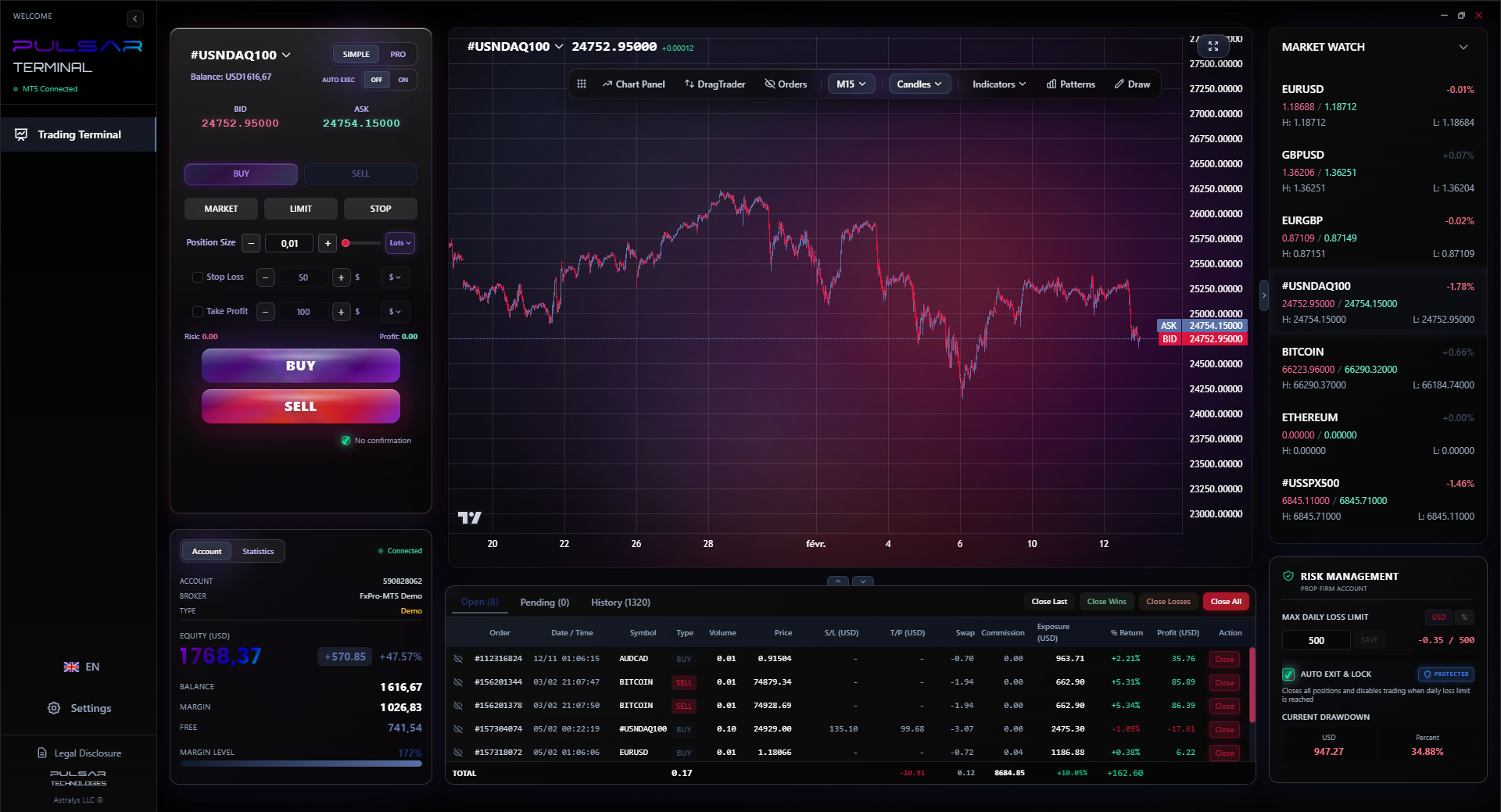
Managing risk on multiple trades is a core skill, and tools like Pulsar Terminal let you set and automate stop-losses, take-profits, and trailing stops across all your positions directly from your MT5 chart.
Pulsar Terminal
Lo strumento MT5 tutto-in-uno: ordini drag-and-drop, multi-TP/SL, trailing stop, grid trading, Volume Profile e protezione prop firm. Usato da oltre 1.000 trader ogni giorno.
Let's talk about the ugly side, the stuff no broker will put in their brochure.
Chasing Bonuses: If a broker offers a 100% deposit bonus, run. These bonuses always come with insane withdrawal conditions (trade 10,000 lots before you can touch your own money!). They're designed to lock you in and make you trade more, not to help you.
Over-trading Because of Low Minimums: A $5 minimum can make trading feel like a game. You'll be tempted to open 10 micro-lot positions just because you can. This destroys any sense of strategy. Trade your plan, not your balance.
Ignoring the Platform During News: I learned this the hard way with my first broker. I was long on EUR/USD during a high-impact US news release. The spread, normally 1.2 pips, blew out to 25 pips instantly. My stop-loss was triggered at a horrific price, and I lost double what I'd planned. Now, I either close positions before major news or use a broker known for stable execution during volatility, like Pepperstone or IC Markets.
Not Understanding the Tax Implications: In South Africa, your forex trading profits are taxable. The South African Revenue Service (SARS) views it as income. Keep a detailed log of all your trades - entries, exits, profits, losses. Talk to a tax consultant who understands trading. It's boring, but getting a nasty tax bill you didn't expect is worse.

Pro Tip: Before you go live, simulate a 50% drawdown on your demo account. Lose half of your virtual money on purpose (through simulated bad trades). If your reaction is to double down on risk to get it back, you're not ready. If your reaction is to review your journal, tighten your risk, and trade smaller, you're on the right path.
💡 Consiglio di Winston
If a trading strategy sounds too complicated to explain to a 10-year-old, it's too complicated to trade with real money. Start simple.
“R5,000 in capital traded with a 1% risk rule teaches you more than R500 traded with a 10% gamble.”
- Pick Two Brokers: From the list above, choose two that fit your needs (e.g., IG for education, XM for low cost). Open a demo account with both.
- Learn One Thing: Don't try to learn everything. In your first week, just learn how to place a market order, a limit order, and set a stop-loss and take-profit. Use the broker's tutorials.
- Paper Trade One Setup: Pick one simple strategy. Maybe buying when price pulls back to a moving average. Execute that same setup 10 times on your demo account. Journal every trade: why you took it, your emotion, the outcome.
- Test Support & Funding: Contact both brokers' support with a question. Try a simulated deposit using their local payment method to see the process.
- Choose & Fund: Pick the broker where the platform felt most intuitive and support was helpful. Deposit your planned starting capital (aim for at least R5,000).
- Go Live, Tiny: For your first 10 live trades, trade micro lots (0.01) only. Your goal is not to make money. Your goal is to execute your plan perfectly and manage the psychological pressure of real money.
- Review & Scale: After 10 micro-lot trades, review your journal. If you followed your rules 80% of the time, consider moving to mini lots (0.1). If not, stay on micros.
The best forex broker for beginners in South Africa isn't the one with the highest use or biggest bonus. It's the regulated, transparent partner that gives you the tools to learn and doesn't get in your way while you make your inevitable beginner mistakes. Choose wisely, start small, and focus on the process, not the profit. The profits will come later.
FAQ
Q1Is forex trading legal and safe in South Africa?
Yes, it's completely legal and regulated by the Financial Sector Conduct Authority (FSCA). The 'safety' depends entirely on you using an FSCA-licensed broker. This ensures client money segregation, fair pricing, and a legal recourse if something goes wrong. Trading itself is always risky, but the environment can be safe and regulated.
Q2What is the minimum amount I need to start forex trading in South Africa?
Technically, some brokers accept as little as R90 ($5). Realistically, I advise a minimum of R1,500 to trade micro lots safely. For a serious start where you can properly manage risk and learn effectively, aim for R5,000 to R20,000. Starting with too little is one of the fastest ways to blow your account.
Q3Can I use MT4 or MT5 with South African brokers?
Absolutely. Most reputable FSCA-regulated brokers, like FP Markets and Tickmill, offer full access to both MetaTrader 4 and MetaTrader 5. MT4/5 is the global standard, and you should be wary of any broker that doesn't offer it.
Q4How are my forex trading profits taxed in South Africa?
SARS treats forex trading profits as income, not capital gains. You must declare your net profit (total profits minus total losses) in your annual tax return. It's crucial to keep detailed, accurate records of every single trade. Consult with a tax professional familiar with trading income.
Q5What's better for a beginner: a standard account or an ECN/raw account?
Start with a standard, commission-free account. The spreads are slightly wider, but the costs are simple and baked in. An ECN/Raw account has tighter spreads but charges a commission per trade. This adds complexity to your profit/loss calculations. Learn to walk (and be profitable) on a standard account before you try to run on a raw one.
Q6Which currency pairs should a South African beginner trade first?
Stick to the major pairs: EUR/USD, GBP/USD, USD/JPY. They have the lowest spreads and highest liquidity, meaning your orders get filled quickly at predictable prices. Avoid the exotic pairs like USD/ZAR or USD/TRY at the beginning. Their wild spreads and volatility are a beginner's nightmare.
Q7Can I lose more money than I deposit?
With a properly regulated FSCA broker offering retail accounts, you should have 'negative balance protection.' This means you cannot lose more than the funds in your account. However, during extreme market gaps (like a major news event), there is a theoretical risk. This is another key reason to always use a stop-loss order on every single trade.
Lezione del Prof. Winston
Punti chiave:
- ✓FSCA regulation is your non-negotiable first filter.
- ✓Real starting capital is R5,000+, not R90.
- ✓Costs are spreads, swaps, and payment fees - add them all up.
- ✓Your first 100 trades are for learning, not earning.
- ✓Always verify the broker's license yourself on the FSCA website.
Quanto è stato utile questo articolo?
Clicca su una stella
Analisi Trading Settimanali
Analisi e strategie settimanali gratuite. Nessuno spam.
Sull'autore
David van der Merwe
Trader dei Mercati Emergenti
Trader con base a Johannesburg con 11 anni di esperienza nelle valute dei mercati emergenti. Specializzato in coppie ZAR, trading regolamentato dalla FSCA e analisi del mercato sudafricano.
Commenti
Avviso di rischio
Il trading di strumenti finanziari comporta rischi significativi e potrebbe non essere adatto a tutti gli investitori. Le performance passate non garantiscono risultati futuri. Questo contenuto è fornito solo a scopo educativo e non deve essere considerato un consiglio di investimento. Conduci sempre le tue ricerche prima di fare trading.
Potrebbe interessarti anche

Cara Trading Forex Sukses: 7 Prinsip dari Trader Profesional
Cara trading forex sukses dengan 7 prinsip trader pro: manajemen modal, disiplin, journal trading, backtest. Data nyata, bukan janji profit palsu.
Jam Trading Forex Terbaik untuk Trader Indonesia: Panduan Lengkap dengan Tabel Waktu
Panduan jam trading forex untuk trader Indonesia. Tabel 4 sesi dunia, jam emas 20:00-00:00, sesi mana yang harus dihindari. Data akurat + tips dari trader berpengalaman.
Top 5 Sàn Forex Uy Tín Nhất 2026: Review Jujur dari Trader Indonesia
Top 5 sàn forex uy tín 2026 untuk trader Indonesia. Review jujur: spread, deposit, withdraw, dukungan lokal. Exness, XM, IC Markets & lebih.
Scarica Pulsar Terminal
Tutti questi calcolatori sono integrati in Pulsar Terminal con dati in tempo reale dal tuo conto MT5.
Scarica Pulsar Terminal