


Most traders searching for the 'best forex broker for MT5' are looking for the wrong thing.

David van der Merwe
Trader dei Mercati Emergenti ·  South Africa
☕ 11 min di lettura
Cosa imparerai:
- 1Why MT5 Actually Matters (And It's Not Just Hype)
- 2FSCA Regulation: Your Only Real Safety Net
- 3The Real Costs: Spreads, Commissions, and the ZAR Trap
- 4Head-to-Head: MT5 Brokers for South Africans
- 5Getting Your Money In and Out: The RAND Reality
- 6use & Risk: Why 30:1 is Your Friend
- 7Your Final Checklist Before You Sign Up
Most traders searching for the 'best forex broker for MT5' are looking for the wrong thing. They want the lowest spreads or the highest use, thinking that's the key to profits. I've blown accounts chasing those shiny objects. The real key isn't the broker's marketing; it's how their structure aligns with the harsh realities of the South African market and your own psychology. Let's cut through the noise and find a broker that helps you survive, not just one that promises the moon.
Look, MT4 was a legend. But MetaQuotes has stopped selling new licenses for it. The future, whether we like it or not, is MT5. For South African traders, this shift is more than just an update. It's about access.
MT5 is a multi-asset platform. You can trade forex, yes, but also JSE equities (as CFDs), commodities, and even cryptocurrencies from one place. For a market like ours, where diversifying beyond the Rand is a smart move, that's a big deal. The built-in economic calendar and deeper market depth are genuine upgrades for your analysis.
But here's the catch I learned the hard way: a powerful platform is a double-edged sword. When I first got MT5, I went overboard. I had 15 charts open, 10 indicators on each, and was placing trades based on sheer confusion. The platform didn't make me a better trader; it just gave me more rope to hang myself. The best forex broker for MT5 isn't the one with the flashiest version; it's the one that provides a stable, fast connection to the liquidity that makes those advanced features actually useful.

Example: My old broker's MT5 server was based in Europe. On my Telkom line, I had a consistent 180ms latency. Switching to a broker with a local server (like some FSCA-regulated ones have) cut that to under 40ms. In scalping, that's the difference between a fill and a requote.
The real question is: what are you going to do with all that power? More complexity usually leads to more mistakes. Start simple, even on the advanced platform. A clean chart with price action and volume tells you more than a dozen lagging indicators ever will.
I get it. Offshore brokers offer use of 1:1000. It's tempting. I funded an offshore account in 2020, lured by that very promise. Six weeks later, a "technical error" wiped out a R5,000 position during a news event. My emails went unanswered. There was no FSCA to call, no ombudsman. I was just another statistic.
The Financial Sector Conduct Authority (FSCA) isn't perfect, but it's the only regulator in South Africa that gives you a fighting chance. An FSCA license means they've met minimum capital requirements (often millions of Rand), they must segregate your client funds from their operating money, and they are subject to local audits.
What FSCA Regulation Actually Gets You
First, it gets you access to ZAR-based accounts. This is huge. If your account is in Dollars and you deposit in Rands, you're taking a hidden forex hit on every transaction. A 1% conversion fee doesn't sound like much until you're making multiple deposits a year. It silently erodes your capital.
Second, it gives you use limits. The FSCA caps retail use at 30:1 for major forex pairs. You might see this as a restriction. I see it as a forced risk management tool. When I was with that offshore broker at 1:500 use, I blew a R2,000 account in two trades because the position size felt "small." The use made it massive. The 30:1 rule forces discipline. If you need more use than that to make your strategy work, your strategy is the problem, not the regulator.

Warning: Some brokers are dual-regulated. They might have an FSCA entity and an offshore entity. When you sign up, you must be absolutely certain you are opening an account under their FSCA license (FSP number). If you're automatically placed under their global brand, you forfeit local protection. Always check your account agreement.
A broker like Tickmill or FP Markets with a solid FSCA presence isn't just a regulatory box ticked. It means they are committed to the South African market, they'll likely have local support, and your money isn't just vanishing into a Caribbean shell company.

💡 Consiglio di Winston
A broker is a utility, not a strategy. Your profitability comes from your edge and discipline, not their 0.1 pip lower spread. Optimize for reliability, not just cost.
“The FSCA's 30:1 use limit isn't a restriction; it's a forced risk management tool that saves traders from themselves.”
Brokers advertise "spreads from 0.0 pips!" What they don't put in the headline is the rest of the sentence: "...plus a $15 round-turn commission per lot." You must look at the total cost of trading.
For active traders, especially those using a scalping strategy, this is make-or-break. Let me give you a real example from my trading journal.
Trade: EUR/USD, 1 standard lot (100,000 units).
- Broker A ("Raw Spread" Account): Spread = 0.1 pips. Commission = $7 per lot, per side. Total cost to open and close: $14 + (0.1 pip value ~$1) = ~$15.
- Broker B ("Standard" Account): Spread = 1.5 pips. Commission = $0. Total cost: 1.5 pips value = $15.
On the surface, cost is identical. But the execution is different. The Raw account's tiny spread means your entry price is almost exactly where you clicked. The Standard account's wider spread means you're already 1.5 pips in the red the second your trade opens. For a scalper aiming for 5-10 pips, that's a massive handicap.
The Hidden ZAR Tax
This is the silent killer for South Africans. If your broker doesn't offer a true ZAR account, you face two conversion fees:
- Your bank's fee to convert your deposit to USD/EUR.
- The broker's internal conversion fee on any profit/loss when you withdraw.
I once had a R20,000 profit turn into R19,400 by the time it hit my FNB account due to poor exchange rates and fees. That's a R600 loss on a winning trade. Always use a broker that offers a ZAR wallet or account. It eliminates this entire variable. Brokers like Exness and HFM have done this well for the local market.
Use a position size calculator that lets you input both the spread and commission. That's your true cost per trade. If that cost is more than 10-15% of your average profit target, your strategy is probably not viable in the long run.
Here’s a blunt comparison based on my experience and constant monitoring. This isn't about who has the prettiest website.
| Broker | FSCA Regulated? | Key MT5 Offering for ZA | Real Cost Focus | My Experience Notes |
|---|---|---|---|---|
| Tickmill | Yes (FSP 49464) | Raw & Classic Accs. ZAR deposits. | Raw: 0.1 pip + $6/lot. Solid all-rounder. | Reliable execution. Local support is responsive. A safe, professional choice. |
| FP Markets | Yes | True ECN, spreads from 0.0. ZAR funding. | Raw: 0.0 pip + $7/lot. For serious volume. | Their MT5 bridge to liquidity is excellent. Low latency. Best for algo traders. |
| Exness | Yes (FSP 51024) | ZAR accounts, low min deposit (R170~). | Standard: Wider spread, no commission. | Easy for beginners. Withdrawals to SA bank accounts are very fast. |
| IC Markets | Yes (via global entity) | cTrader & MT5. Popular for raw spreads. | Raw: 0.0 pip + $7/lot. Very competitive. | Not primarily FSCA-focused, but a top-tier global broker that accepts ZA clients. |
| HFM | Yes | Multiple MT5 acc types, including Zero Spread. | Zero: 0.0 pip + $9/lot. Premium: 1.5 pip, no comm. | Strong local presence. Good for both new and experienced traders. |
My Take: If you're starting out and value simplicity and local service, Exness or HFM's standard accounts are a sensible start. The costs are baked into the spread, so it's easy to understand. If you're trading larger volumes or swing trading with precise entries, the raw/ECN accounts from FP Markets or Tickmill are worth the extra complexity. The lower spread gives your trade room to breathe immediately.
Avoid getting sucked into the "which broker has the absolute lowest cost?" vortex. The difference between $6 and $7 per lot commission is meaningless if the broker's execution is slow or they re-quote you during the London open. Reliability is cheaper than a cheap broker that fails you.
“Your goal is to find a broker whose flaws you can live with, not a perfect one that doesn't exist.”
This is where many "top" international brokers fall flat for South Africans. You need to know how you'll get paid.
The gold standard is a direct EFT (Electronic Funds Transfer) into a South African bank account, in Rands, within 24-48 hours. Brokers like Exness, HFM, and Tickmill have this nailed. You log in, request a withdrawal to your FNB/Standard Bank/ABSA account, and it arrives. No intermediary currencies, no 5-day waits.

Pro Tip: Before you fund a broker, do a test withdrawal of a small amount. The true test of a broker isn't how easy it is to give them money, but how easy it is to get it back. If they make withdrawals difficult, walk away immediately.
Beware of "free deposit" promotions that only apply to international credit cards. Your South African bank will likely charge you a foreign currency conversion fee (often 2-3%) on top of the Visa/Mastercard rate. That R10,000 deposit just cost you R300 before you placed a single trade. Local EFT is almost always the cheapest and fastest method.
I made the mistake of using a credit card deposit with an international broker years ago. When I withdrew my profits, the reversal to my card took 14 business days and the exchange rate movement wiped out another R500. Never again. Stick to local bank transfer methods with an FSCA-regulated entity.
💡 Consiglio di Winston
The ease of withdrawal is the purest measure of a broker's integrity. If they make it hard to get a small amount out on a demo, imagine your profits.
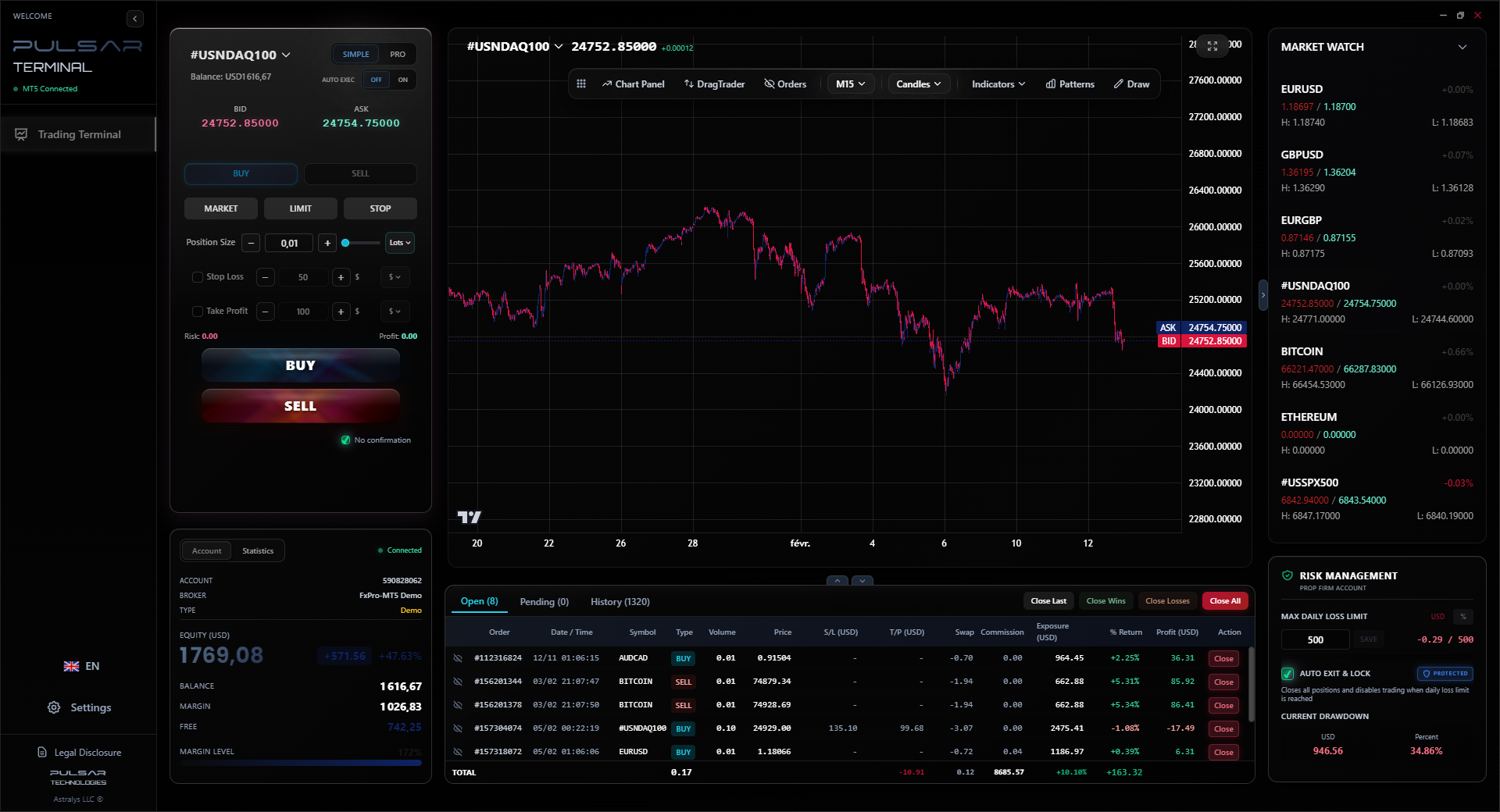
Managing complex trades and risk on MT5 is easier with tools that automate your strategy rules, like setting multiple take-profit levels or trailing stops.
Pulsar Terminal
Lo strumento MT5 tutto-in-uno: ordini drag-and-drop, multi-TP/SL, trailing stop, grid trading, Volume Profile e protezione prop firm. Usato da oltre 1.000 trader ogni giorno.
I need to be brutally honest here. The number one reason traders in South Africa blow up their accounts is misusing use. We see the adverts for 1:1000, we think we're missing out, and we chase it.
Here's a math lesson I paid for: On a standard lot of EUR/USD (R2,000,000+ notional value at current rates), a 1:1000 use means you only need about R2,000 in margin. A 10-pip move against you is a R1,000 loss. That's 50% of your margin gone in a tiny market fluctuation. You'll get a margin call before you can blink.
The FSCA's 30:1 limit changes that math. For the same standard lot, you'd need about R66,000 in margin. Now, that same 10-pip move is a R1,000 loss, but it's only about 1.5% of your margin. You have room to breathe, to think, to manage the trade.
The FSCA didn't impose this limit to annoy you. They did it because they saw the piles of blown-up accounts. They did it to protect you from yourself. If you find yourself frustrated by the 30:1 limit, it's a glaring sign that your position sizing is too aggressive. Use a calculator, risk 1-2% of your account per trade, and the use becomes almost irrelevant. Your survival rate will skyrocket.
I promise you, no successful trader I've ever met attributes their success to high use. They attribute it to strict risk management, which high use directly destroys.
“A better trading platform doesn't stop you from crashing if you're speeding and not looking at the road.”
Don't just click 'Open Account.' Do this first:
- Verify the FSP Number: Go to the FSCA's website and search for the broker's Financial Services Provider number. Make sure it's active and in good standing.
- Open a Demo Account on MT5: This is non-negotiable. Test the platform's speed, the spreads during your preferred trading hours (London open, US open), and the execution. Try to place a few market orders during volatile times. Do you get re-quotes?
- Read the Fee Schedule: Find the PDF. Don't rely on the marketing page. Look for: commission per lot, overnight swap rates, inactivity fees, and withdrawal fees.
- Contact Support: Ask them a specific question via live chat or email. "What are your EFT withdrawal processing times for ZAR accounts?" See how long they take to respond and if the answer is clear. This is a preview of your experience if you have a real problem.
- Check the Minimum Deposit: It should be an amount you are completely willing to lose. If the minimum is R5,000 and that stresses you out, it's too high. Start smaller. You can always add funds later.
Your goal isn't to find a perfect broker. It doesn't exist. Your goal is to find a broker whose flaws you can live with, and whose strengths match your trading style. For most South Africans, that means FSCA-regulated, ZAR accounts, reliable local withdrawals, and an MT5 offering that doesn't just exist, but performs.
Remember, the broker is just the conduit. They provide the highway. You're the driver. A better highway doesn't stop you from crashing if you're speeding and not looking at the road. Choose a safe, reliable highway, then focus 95% of your energy on your own driving skills.
FAQ
Q1Can I use an international broker with MT5 if they offer higher use?
Technically, yes. But you forfeit all FSCA protections, including segregated funds with local banks, use limits, and a local dispute resolution process. Your funds are subject to the laws of another country (often Cyprus or the Seychelles). The higher use is a trap for most retail traders, dramatically increasing your risk of a total loss. It's not worth it.
Q2What is the minimum deposit for the best MT5 brokers in South Africa?
It varies widely. Brokers like Exness can have minimums as low as R170 ($10 equivalent). Others like FP Markets or Tickmill might require R1,700-R2,500 ($100-$150). The 'best' broker isn't the one with the lowest minimum; it's the one with the right balance of cost, regulation, and features for your trading level. Start with a demo account first, regardless.
Q3Are there any hidden fees with ZAR accounts?
The main fee to watch is the spread or commission, which is never hidden but often misunderstood. Some brokers might add a small premium to the interbank exchange rate when converting profits/losses if your ZAR account is actually a 'wallet' behind a USD trading account. True ZAR-denominated trading accounts avoid this. Always ask: 'Is my trade executed and accounted for directly in Rands, or is it converted from USD?'
Q4Is MT5 really better than MT4 for forex?
For pure forex, MT4 is still perfectly capable. However, MT5 has a more strong back-testing engine, more timeframes, and better handling of partial order fills. More importantly, it's the future. All development from MetaQuotes is on MT5. If you're starting new, learn MT5. If you have years of custom MT4 indicators, the switch might be painful, but it's inevitable.
Q5How do I know if a broker's MT5 execution is good?
Test it on a demo during high volatility (like at 10:00 AM SAST when London is fully open). Place market orders on major pairs like EUR/USD. You want instant execution at or very near the price you saw. If you get frequent 're-quotes' (a pop-up asking you to accept a new price) or 'off quotes' errors, their liquidity connection is poor. That will cost you real money.
Q6Do all FSCA brokers offer negative balance protection?
It is a requirement under FSCA's conduct standards for over-the-counter derivatives like forex CFDs. This means you cannot lose more than the funds in your account. However, you must confirm this is stated in your client agreement. This is a critical protection that offshore brokers may not provide.
Lezione del Prof. Winston
Punti chiave:
- ✓FSCA regulation is non-negotiable for fund safety.
- ✓True cost is Spread + Commission + Currency Conversion.
- ✓ZAR accounts eliminate hidden forex tax on profits.
- ✓Test withdrawal speed before making a large deposit.
- ✓use above 30:1 is a risk accelerator, not a profit tool.
Quanto è stato utile questo articolo?
Clicca su una stella
Analisi Trading Settimanali
Analisi e strategie settimanali gratuite. Nessuno spam.
Sull'autore
David van der Merwe
Trader dei Mercati Emergenti
Trader con base a Johannesburg con 11 anni di esperienza nelle valute dei mercati emergenti. Specializzato in coppie ZAR, trading regolamentato dalla FSCA e analisi del mercato sudafricano.
Commenti
Avviso di rischio
Il trading di strumenti finanziari comporta rischi significativi e potrebbe non essere adatto a tutti gli investitori. Le performance passate non garantiscono risultati futuri. Questo contenuto è fornito solo a scopo educativo e non deve essere considerato un consiglio di investimento. Conduci sempre le tue ricerche prima di fare trading.
Potrebbe interessarti anche

Cara Trading Forex Sukses: 7 Prinsip dari Trader Profesional
Cara trading forex sukses dengan 7 prinsip trader pro: manajemen modal, disiplin, journal trading, backtest. Data nyata, bukan janji profit palsu.
Jam Trading Forex Terbaik untuk Trader Indonesia: Panduan Lengkap dengan Tabel Waktu
Panduan jam trading forex untuk trader Indonesia. Tabel 4 sesi dunia, jam emas 20:00-00:00, sesi mana yang harus dihindari. Data akurat + tips dari trader berpengalaman.
Top 5 Sàn Forex Uy Tín Nhất 2026: Review Jujur dari Trader Indonesia
Top 5 sàn forex uy tín 2026 untuk trader Indonesia. Review jujur: spread, deposit, withdraw, dukungan lokal. Exness, XM, IC Markets & lebih.
Scarica Pulsar Terminal
Tutti questi calcolatori sono integrati in Pulsar Terminal con dati in tempo reale dal tuo conto MT5.
Scarica Pulsar Terminal