


Here's a statistic that should make you pause: over 90% of traders who sign up for a deposit bonus offer will never meet the conditions to withdraw a single cent of profit from it.

David van der Merwe
Trader dei Mercati Emergenti ·  South Africa
☕ 11 min di lettura
Cosa imparerai:
Here's a statistic that should make you pause: over 90% of traders who sign up for a deposit bonus offer will never meet the conditions to withdraw a single cent of profit from it. The broker's marketing team isn't stupid; they've done the math. In South Africa, where the FSCA keeps a watchful eye, the game is slightly fairer, but you still need to know the rules. I've traded with these bonuses, lost money because of them, and occasionally made them work. This isn't a list of shiny offers; it's a guide to using use-boosting tools without getting your account locked.
Let's cut through the hype. A deposit bonus is not free money. It's a conditional credit that increases your buying power, but it comes with strings so tight they could strangle your account. The primary goal for the broker is to keep you trading longer, generating more spreads and commissions. Your goal should be to use that extra margin intelligently, not get dazzled by a bigger number on your screen.
In South Africa, the FSCA mandates transparency. You won't see the wild '500% bonus' offers from shady offshore outfits here. The offers are more restrained, usually 20% to 100%. But the devil is always in the details - the trading volume requirements. A typical condition might be: "Trade 30 times the bonus amount in volume before withdrawal." For a $100 bonus, that's $3,000 in trade volume. Sounds easy? It's a trap if your position size calculator isn't your best friend.
I learned this the hard way early on. I took a 50% bonus on a $1,000 deposit with a now-defunct broker. I turned that $1,500 buying power into a nice $300 profit on a few EUR/USD swings. Went to withdraw, and got hit with the volume requirement fine print. To release my profit, I had to trade 25 times the bonus value. That meant $12,500 in volume. In a panic to hit the target, I overtraded, blew through my profit, and triggered a margin call. Lost the original deposit too. The bonus didn't cause the loss, but my ignorance of its terms absolutely did.

💡 Consiglio di Winston
Treat a bonus like nitrous oxide in a car. It gives a short, powerful boost. But if you hit it when you're not pointed straight down the track, you'll just crash faster.
“A deposit bonus is a conditional credit with strings so tight they could strangle your account.”
Trading with an FSCA-licensed broker in South Africa isn't just a recommendation; it's your first line of defense. The FSCA doesn't mess around. They enforce client money segregation, so your funds are (theoretically) safe if the broker goes under. More importantly for bonus hunters, they crack down on misleading promotions.
The 30:1 use Cap
This is the big one. Since 2021, retail traders with FSCA brokers are capped at 30:1 on major forex pairs. This changes the bonus game completely. An offshore broker might offer you 100:1 use plus a 100% bonus, letting you control a monstrous position with a tiny deposit. An FSCA broker can't do that. Their bonus effectively works within this safer use framework. It's less exciting, but it prevents you from blowing up your account in two seconds. For scalping, this cap can feel restrictive, but for swing trading, it's often more than enough.
Transparency is Non-Negotiable
An FSCA-regulated broker must clearly state all bonus terms: the withdrawal conditions, the time limits, which trades count (some exclude hedging), and what happens if you try to withdraw before meeting conditions. You can't claim you didn't know. This forces brokers like XM and AvaTrade to structure their South African offers more fairly than their global ones. It's why you see more "cashback" programs and structured promotions rather than just a raw bonus slapped on your deposit.

Warning: Just because a broker is popular in South Africa doesn't mean it's FSCA-regulated. Some big international names serve SA clients under other licenses (like CySEC). Your money might be safe, but you forfeit local legal recourse and are subject to that regulator's use rules, not the FSCA's.
“The 'No Deposit Bonus' is the only truly risk-free offer in this entire game.”
Here’s my breakdown of brokers who consistently offer viable promotions to South African traders. I'm judging them on the combination of their bonus offer, their overall reliability, and their suitability for the local market.
| Broker | My Take on Their Bonus | Key Detail for SA Traders | Best For |
|---|---|---|---|
| XM | The most consistent. $30 No-Deposit (verify ID) + up to 50% deposit bonus. | Strong FSCA presence. Terms are clear. The no-deposit bonus is a great way to test their platform. | Beginners wanting to test the waters. |
| HFM (HotForex) | Often runs a 100% deposit bonus. High volume requirements, but platform is solid. | Also FSCA-regulated. Offers ZAR accounts, which is a huge plus to avoid conversion fees. | Traders who want a local currency account and can handle the volume terms. |
| FBS | Aggressive with promotions ($140 no-deposit, 100% deposit bonus). Popular globally. | Not primarily FSCA-regulated (uses CySEC). This means higher potential use but less local oversight. | Traders comfortable with an international broker seeking maximum bonus value. |
| AvaTrade | 20% first deposit bonus, up to $10k. More conservative. | Strongly FSCA-regulated. Offers fixed spreads, which can be a blessing during news events. | Risk-averse traders who value stability over huge bonus percentages. |
| Exness | Doesn't do traditional deposit bonuses much. Focuses on a cashback program. | FSCA-regulated. Their model is low spreads (often 0.0 pips) with a commission. The cashback can be better than a bonus for high-volume traders. | Scalpers and high-frequency traders. |

Pro Tip: The 'No Deposit Bonus' is the only truly risk-free offer. You won't get rich from $30, but it's a fantastic tool to test a broker's execution speed, platform, and customer service without risking your own capital. Just expect stringent verification before you can withdraw any winnings.
My personal experience with IC Markets (not in the table as they rarely do deposit bonuses) taught me that sometimes the best 'bonus' is a broker with rock-bottom costs and flawless execution. Saving $3 per lot on commissions can outweigh a 50% bonus with high spreads.
“The 'No Deposit Bonus' is the only truly risk-free offer in this entire game.”
This is the part most guides ignore. Getting the bonus is easy. Keeping the profits is the skill. Here's the battle plan, forged from my own mistakes.
Step 1: The Terms of Service (TOS) Autopsy. Before you deposit a single Rand, find the bonus TOS. Print it. Highlight three things: 1) The volume requirement (e.g., 30x bonus amount). 2) The time limit (often 30-90 days). 3) Any restricted strategies (like locking profits with opposite trades).
Step 2: Recalculate Your Position Size. This is critical. The bonus increases your account balance for margin purposes, but you must not let it inflate your risk per trade. Ignore the bonus amount in your balance when calculating risk. If you normally risk 1% of your real $1,000 deposit ($10), keep risking $10. The bonus gives you a buffer, not a license to risk 1% of $1,500. Use your position size calculator based on your deposit alone.
Step 3: Plan for the Volume. Let's say you need $3,000 in volume. Don't try to hit this in three giant trades. You'll be gambling. Break it down. If your standard trade size is 0.1 lots (a $10,000 position), each trade gives you $10 in volume. You'd need 300 such trades. This forces you into a higher-frequency strategy than you might be used to. This is where a solid scalping or short-term swing plan, using tools like the RSI indicator for overbought/oversold levels, becomes a mechanical necessity, not a choice.
Step 4: Withdraw Early, If Possible. Some brokers allow partial withdrawal of profits once a portion of the volume is met. Do it. Get your initial deposit out. Now you're playing with house money. The psychological relief is enormous.

Example: You deposit R1,500 (≈$100) with AvaTrade for a 20% bonus ($20). You need 25x bonus volume to withdraw profits: $500. You trade 0.01 lots on EUR/USD. Each pip move = $0.10. You need 50 trades of 0.01 lots to hit the volume. Your mission is to make small, consistent gains over those 50 trades without blowing your risk parameters.
💡 Consiglio di Winston
The most valuable bonus isn't a cash credit. It's a broker with sub-0.5 pip spreads on EUR/USD and instant order execution. That saves you money on every single trade.
“Your decision should be 80% based on the broker's core offering, and 20% on the bonus. Get that backwards, and you'll become a statistic.”
Not all bonus offers are created equal. Some are predatory. Here are the red flags that should have you closing the browser tab.
- Unrealistically High Bonuses (200%+): If it sounds too good to be true, it is. The volume requirements will be impossible, or the broker is unregulated and will find another reason to deny your withdrawal.
- Vague or Hidden Terms: If you have to dig through three levels of FAQ to find the conditions, walk away. A reputable broker like Pepperstone (who doesn't focus on bonuses) is upfront about all costs.
- "The Bonus is Withdrawable!" This is the biggest lie in the business. The credit is almost never withdrawable. Only the profits you make using it might be, after conditions. Any ad claiming otherwise is deceptive.
- Restrictions on Profitable Strategies: Some TOS will void the bonus if you use arbitrage, hedging, or expert advisors (EAs). Read carefully if you're a systematic trader.
- Pressure to Deposit More to 'Unlock' the Bonus: A classic scam tactic. Your initial bonus is locked until you make a second, larger deposit.
I fell for the vague terms flag once. The bonus was advertised as "simple conditions." Turns out, only trades held for over 2 minutes counted toward the volume. My scalping strategy, where I held for 30-90 seconds, was useless. I traded for a week thinking I was nearing the target, only to find my progress was zero.
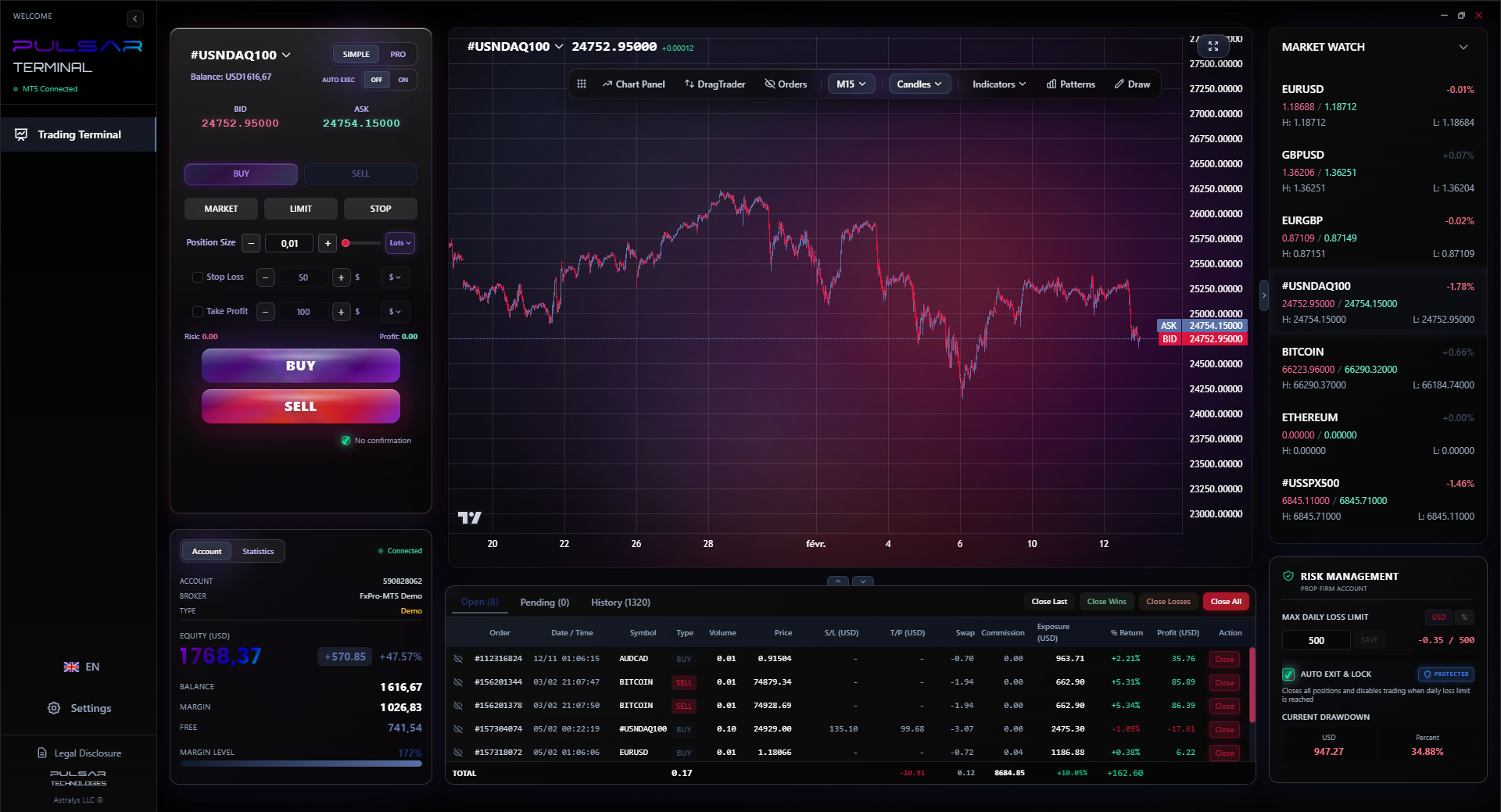
Hitting complex bonus volume targets requires precise, disciplined trade management, which is exactly what Pulsar Terminal's drag-and-drop order and multi-TP/SL tools are built for.
Pulsar Terminal
Lo strumento MT5 tutto-in-uno: ordini drag-and-drop, multi-TP/SL, trailing stop, grid trading, Volume Profile e protezione prop firm. Usato da oltre 1.000 trader ogni giorno.
“Your decision should be 80% based on the broker's core offering, and 20% on the bonus. Get that backwards, and you'll become a statistic.”
Trading from South Africa isn't the same as trading from London or New York. These local factors directly impact how you should use a bonus.
ZAR Accounts: This is a game-changer. Depositing and withdrawing in Rands with a broker like HFM eliminates the bank's foreign exchange fees and spread. When calculating your bonus and risk, everything is in your home currency. No more wondering if a USD strengthening is eating your profits.
Local Payment Methods: Look for brokers supporting instant EFTs (like Ozow, SiD), FNB, or other local bank transfers. Deposits are instant, and withdrawals are often within 24 hours. Crypto is also a fast, low-cost option with many brokers now.
Trading Sessions: Your most volatile, liquid hours are the London/New York overlap, from around 3 PM to 7 PM SAST. This is when you'll get the tightest spreads and best chance to execute your volume requirement efficiently. Trying to hit your bonus volume trading the dead Asian session with wide spreads is a sure way to lose money.
Tax Implications: SARS views forex trading as speculative, meaning profits are subject to Capital Gains Tax. Keep careful records of all your trades, especially bonus-related ones. The bonus credit itself isn't taxable income, but the profits you generate from it are.
“Sometimes the best bonus is a broker with rock-bottom costs and flawless execution.”
So, after 12 years, do I use deposit bonuses? Sometimes, but selectively.
Use a bonus if:
- You are a disciplined, high-frequency trader with a proven strategy that can generate the required volume without increasing risk.
- You are using it as a use buffer on a small account, strictly adhering to position sizing.
- You want to test a new broker with their no-deposit offer.
- The broker is top-tier (FSCA or equivalent) and the terms are transparent.
Skip the bonus and go with a raw cost broker if:
- You are a beginner. The added complexity is a distraction from learning.
- You are a low-frequency swing or position trader. You'll never hit the volume requirements.
- You value the absolute lowest trading costs (spread + commission) above all else. Brokers like IC Markets or Pepperstone excel here.
- The terms give you a bad feeling. Trust your gut.
, the best forex brokers with deposit bonus are the ones that are already the best brokers, period. The bonus is a temporary feature, not a core reason to choose them. Your decision should be 80% based on their regulation, spreads, execution, and platform, and 20% on the bonus offer. Get that backwards, and you'll become another statistic in the broker's profitable 90%.
FAQ
Q1Can I withdraw the deposit bonus money itself?
Almost never. The bonus credit is not cash. It's margin power. You can only withdraw profits you generate from trading with that bonus, and only after meeting the broker's specific trading volume requirements. Anyone who tells you otherwise is lying.
Q2Is a 100% deposit bonus better than a 50% bonus?
Not necessarily. A 100% bonus will have much higher trading volume requirements to unlock profits. It also tempts you to take oversized risks. A smaller bonus with more achievable terms is often the smarter, more profitable choice in the long run.
Q3Are forex trading bonuses taxable in South Africa?
The bonus credit itself is not considered taxable income by SARS. However, any profits you make from trading with that bonus are subject to Capital Gains Tax (CGT) as part of your overall trading profits. Keep detailed records.
Q4What's the catch with a 'No Deposit Bonus'?
You must complete rigorous account verification (ID, proof of address) before you can withdraw. The trading volume requirement to withdraw profits is usually very high relative to the bonus size (e.g., trade 5 lots to withdraw from a $30 bonus). It's designed to get you to deposit real money.
Q5Can I use a bonus with a prop firm challenge?
Almost no prop firm allows external deposit bonuses during their evaluation phase. It would distort your risk metrics. The 'bonus' with a prop firm is the funded account itself. Managing the strict daily loss limits is the real challenge, where a tool like Pulsar Terminal's auto-breakeven feature can be a lifesaver.
Q6Do all FSCA brokers offer deposit bonuses?
No. Many reputable FSCA brokers, like IG or Standard Bank's ForexPlus, do not focus on deposit bonuses. They compete on trust, research, and platform quality instead. A lack of a bonus is not a red flag; it's often a sign of a broker targeting serious, long-term traders.
Lezione del Prof. Winston
Punti chiave:
- ✓Read the bonus Terms of Service like your life depends on it.
- ✓Recalculate position size using only your real deposited capital.
- ✓Target brokers with ZAR accounts to kill currency conversion fees.
- ✓Never choose a broker solely for its bonus offer.
Quanto è stato utile questo articolo?
Clicca su una stella
Analisi Trading Settimanali
Analisi e strategie settimanali gratuite. Nessuno spam.
Sull'autore
David van der Merwe
Trader dei Mercati Emergenti
Trader con base a Johannesburg con 11 anni di esperienza nelle valute dei mercati emergenti. Specializzato in coppie ZAR, trading regolamentato dalla FSCA e analisi del mercato sudafricano.
Commenti
Avviso di rischio
Il trading di strumenti finanziari comporta rischi significativi e potrebbe non essere adatto a tutti gli investitori. Le performance passate non garantiscono risultati futuri. Questo contenuto è fornito solo a scopo educativo e non deve essere considerato un consiglio di investimento. Conduci sempre le tue ricerche prima di fare trading.
Potrebbe interessarti anche

Cara Trading Forex Sukses: 7 Prinsip dari Trader Profesional
Cara trading forex sukses dengan 7 prinsip trader pro: manajemen modal, disiplin, journal trading, backtest. Data nyata, bukan janji profit palsu.
Jam Trading Forex Terbaik untuk Trader Indonesia: Panduan Lengkap dengan Tabel Waktu
Panduan jam trading forex untuk trader Indonesia. Tabel 4 sesi dunia, jam emas 20:00-00:00, sesi mana yang harus dihindari. Data akurat + tips dari trader berpengalaman.
Top 5 Sàn Forex Uy Tín Nhất 2026: Review Jujur dari Trader Indonesia
Top 5 sàn forex uy tín 2026 untuk trader Indonesia. Review jujur: spread, deposit, withdraw, dukungan lokal. Exness, XM, IC Markets & lebih.
Scarica Pulsar Terminal
Tutti questi calcolatori sono integrati in Pulsar Terminal con dati in tempo reale dal tuo conto MT5.
Scarica Pulsar Terminal