


I remember my first 'successful' scalp.

Olumide Adeyemi
Pioniere del Trading in Africa Occidentale ·  Nigeria
☕ 11 min di lettura
Cosa imparerai:
- 1What Actually Makes a Pair 'Good' for Scalping?
- 2The Top Forex Pairs for Scalping (Ranked)
- 3Timing is Everything: When to Hit the Button
- 4A Scalping Strategy That Doesn't Rely on Luck
- 5The Scalper's Risk Management: Your Only Lifeline
- 6Choosing Your Weapons: Broker & Platform Must-Haves
- 7Mistakes I Made So You Don't Have To
- 8Getting Started as a Nigerian Scalper: A Practical Roadmap
I remember my first 'successful' scalp. EUR/USD, a 5-pip gain in 90 seconds. I felt like a genius. Then I did the math. After the 1.2-pip spread from my broker, that 5-pip win was really 3.8 pips. My position size was tiny, scared money. I made $3.80. The next trade, chasing that feeling, I ignored a widening spread during London open, got filled at a terrible price, and gave back $15 in a heartbeat. That's the scalper's reality. Picking the right pair isn't about magic, it's about cold, hard arithmetic and avoiding the traps that turn small gains into guaranteed losses.
Forget what you've heard about 'fast-moving' pairs. Speed kills the undisciplined scalper. A good scalping pair is defined by three measurable things: liquidity, tight spreads, and predictable volatility.
Liquidity means there are enough buyers and sellers at any given moment to fill your order instantly at the price you see. This is non-negotiable. Slippage - where you get filled 2 or 3 pips away from your click - will destroy a scalping strategy built on 5-10 pip targets. The major currency pairs, those with the US Dollar (USD), have this in spades.
The Spread is Your Enemy Number One
Your first trade every single day is against the spread. If you're aiming for a 7-pip profit, but the spread is 3 pips, you're already 3 pips in the hole. You need a 3-pip move just to break even. Therefore, the best forex pairs to scalp consistently have the tightest spreads. During peak market hours (London and New York overlap), you'll see spreads on majors like EUR/USD often below 1 pip on a good ECN/RAW account from brokers like IC Markets or Pepperstone.

Warning: Never scalp exotic pairs (like USD/NGN if your broker even offers it) or minor pairs with wide spreads. A 15-pip spread means you need a monumental move just to see green. It's a rigged game.
Predictable volatility is the final piece. You need the pair to move enough to capture pips, but not so erratically that stop losses get hunted by random spikes. Pairs like GBP/JPY move a lot, but their volatility can be chaotic, especially during news. For a new scalper, that's a minefield.

💡 Consiglio di Winston
Your first profit target as a scalper should be 'breakeven plus spread.' Move your stop to entry once you're up a few pips. This turns a risky bet into a free trade with upside.
Based on spread consistency, liquidity, and manageable volatility, here’s my ranked list. I’ve scalped all of these for hundreds of hours.
- EUR/USD: The king. The most liquid market in the world. Spreads are routinely under 1 pip on good accounts. Its movements during the European and US sessions are often clean and technical, respecting key levels. It's my go-to for any scalping strategy because the cost of doing business is lowest. The EUR/USD guide dives deeper into its personality.
- USD/JPY: A close second. Incredibly tight spreads and deep liquidity. It tends to trend well and responds cleanly to US Treasury yield movements. Be mindful of Tokyo session intervention risk by the Bank of Japan, but that’s usually telegraphed.
- GBP/USD: Offers more pip movement per hour than EUR/USD, which can be attractive. However, the spread is usually 1-2 pips wider, and it’s more prone to sudden, news-driven spikes ("Cable spikes"). You need faster reflexes.
- AUD/USD & USD/CAD: These are solid during their respective regional sessions (Asia for AUD, US/Canada for CAD). Spreads are good, but be aware of their direct ties to commodity prices (iron ore, oil). A sudden oil headline can send USD/CAD gapping.

Example: Let's say you have a $1,000 account and risk 1% ($10) per trade. On EUR/USD with a 0.9 pip spread, your effective cost is about $0.90 on a standard lot (100k units). On GBP/JPY with a 3-pip spread, that cost is $3.00. You start every GBP/JPY trade $2.10 further in the red. Over 100 trades, that's $210 vanished before you even had a chance.
| Pair | Avg. Spread (ECN Account) | Volatility (Avg. Daily Range) | Best Session for Scalping |
|---|---|---|---|
| EUR/USD | 0.7 - 1.2 pips | 70-100 pips | London & NY Overlap |
| USD/JPY | 0.8 - 1.5 pips | 60-90 pips | Tokyo Open, NY Session |
| GBP/USD | 1.5 - 2.5 pips | 100-130 pips | London Session |
| AUD/USD | 1.2 - 2.0 pips | 50-80 pips | Asian Session |
Gold (XAU/USD) is a special case. It's not a forex pair, but many scalpers love it. The volatility is high, and spreads can be tight (30-50 cents = 3-5 pips). However, the margin requirements are higher, and moves can be explosive. I only recommend it once you're very comfortable. Check the XAU/USD guide for specifics.
“Your first trade every single day is against the spread. If it's 3 pips wide, you start 3 pips in the hole.”
Scalping a dead market is like trying to sprint in quicksand. You'll exhaust yourself for nothing. Liquidity and volatility are not constant throughout the 24-hour day.
The golden hours are during market overlaps, when two major financial centers are open. The most important one for the best forex pairs to scalp is the London and New York overlap, from 1:00 PM to 4:00 PM WAT (8 AM to 11 AM EST). This is when volume peaks. Spreads are at their absolute tightest, and price action is most likely to follow technical patterns with conviction.
The Asian session (Tokyo/Hong Kong/Singapore open, roughly 1:00 AM to 9:00 AM WAT) is good for pairs like USD/JPY and AUD/USD. The London session alone (8:00 AM to 4:00 PM WAT) is excellent for EUR/USD and GBP/USD.

Pro Tip: Avoid scalping in the first and last 30 minutes of any major session. That's when spreads often widen as liquidity providers adjust their books. Also, never, ever scalp during major news events like NFP or CPI releases. The spreads will balloon to 10-20 pips or more, and slippage will guarantee you a bad fill.
Here’s a simple, price-action based framework I’ve used. It requires patience, not adrenaline.
- Identify the Intraday Trend: Use a 5-minute or 15-minute chart, but first look at the 1-hour chart. Is price consistently making higher highs and higher lows (uptrend)? Or the opposite? Only take scalps in the direction of the 1-hour trend. This stacks probability in your favor.
- Wait for a Retracement to a Key Level: In an uptrend, wait for price to pull back to a visible support level. This could be a previous resistance-turned-support, a moving average (like the 20 EMA), or the day's pivot point. Don't chase.
- Look for a Rejection Candle: At that support level, watch for a price action signal - a bullish engulfing candle, a pin bar (hammer), or simply a strong bullish candle closing above the support. This is your potential trigger.
- Enter with a Tight Stop: Your entry is at the break of that rejection candle's high. Place your stop loss just below the low of that candle or below the support level. This should be a tight stop, typically 5-10 pips.
- Take Profit at the Next Obvious Level: Your target is the next recent swing high or a clear resistance level. Aim for a risk-to-reward of at least 1:1.5. If your stop is 7 pips, aim for 10-11 pips.
I don't rely on lagging indicators like MACD or RSI for entry signals in scalping. By the time they cross, the move is often half over. I use them for confluence - like not taking a long scalp if the RSI on the 15-minute is above 80 and showing divergence.
💡 Consiglio di Winston
If you can't instantly state your exact maximum loss in Naira before clicking 'buy,' you have no business being in the trade. Know your exit before your entry.
“They fail because they focus on profits instead of process. They treat it like gambling, not a probabilistic business.”
This is where 90% of scalpers fail. They get addicted to the action and size up after a few wins. Let me tell you a story. I had a great week, turned $500 into $750. Got cocky. Next Monday, I took a standard EUR/USD scalp, but doubled my lot size. A rogue piece of news hit, price spiked 8 pips against me in a second, hit my stop, and took out $80. In one trade, I gave back over 30% of my weekly profit. I felt sick. It was a brutal lesson in position sizing.
Your rules must be ironclad:
- Risk per Trade: Never, ever risk more than 1% of your account equity on a single scalp. For a $1,000 account, that's $10. Use a position size calculator every single time. Don't guess.
- Daily Loss Limit: Once you're down 2-3% for the day, you stop. Turn off the platform. Your judgment is impaired. This is critical for passing prop firm challenges where daily drawdown limits are strict.
- Profit Target: Have a daily profit target (e.g., 3-5%). When you hit it, take 50% of your position off or stop trading. Greed will make you give it all back.
- Trading Frequency: Don't force trades. 2-3 high-quality set-ups a day are better than 10 mediocre, reactive trades. Overtrading kills accounts through death by a thousand cuts (and spreads).
Your broker is a business partner. A bad one will scalp you.
You need a broker that offers:
- True ECN/RAW Accounts: These provide direct market access and the tightest spreads. You pay a small commission per trade, but the spread is often raw, starting from 0.0 pips. This is cheaper overall for scalping. Look at reviews for Exness (good for local deposits in Nigeria), IC Markets, or Pepperstone.
- Fast & Reliable Execution: Look for brokers boasting "under 30ms execution." Slippage should be minimal. Read real user reviews, not just the marketing.
- No Restrictions on Scalping: Some brokers forbid scalping or use 'last look' execution to reject profitable quick trades. Ensure their policy explicitly allows it.
For platforms, MetaTrader 4/5 is the standard. Its one-click trading plugin is essential. But the native MT5 interface for managing trades can be clunky.
This is where tools built for traders who need speed and precision come in. Having a streamlined interface for placing orders, setting multiple take-profits, and moving stops to breakeven without clicking through menus can mean the difference between a filled order and a missed opportunity.
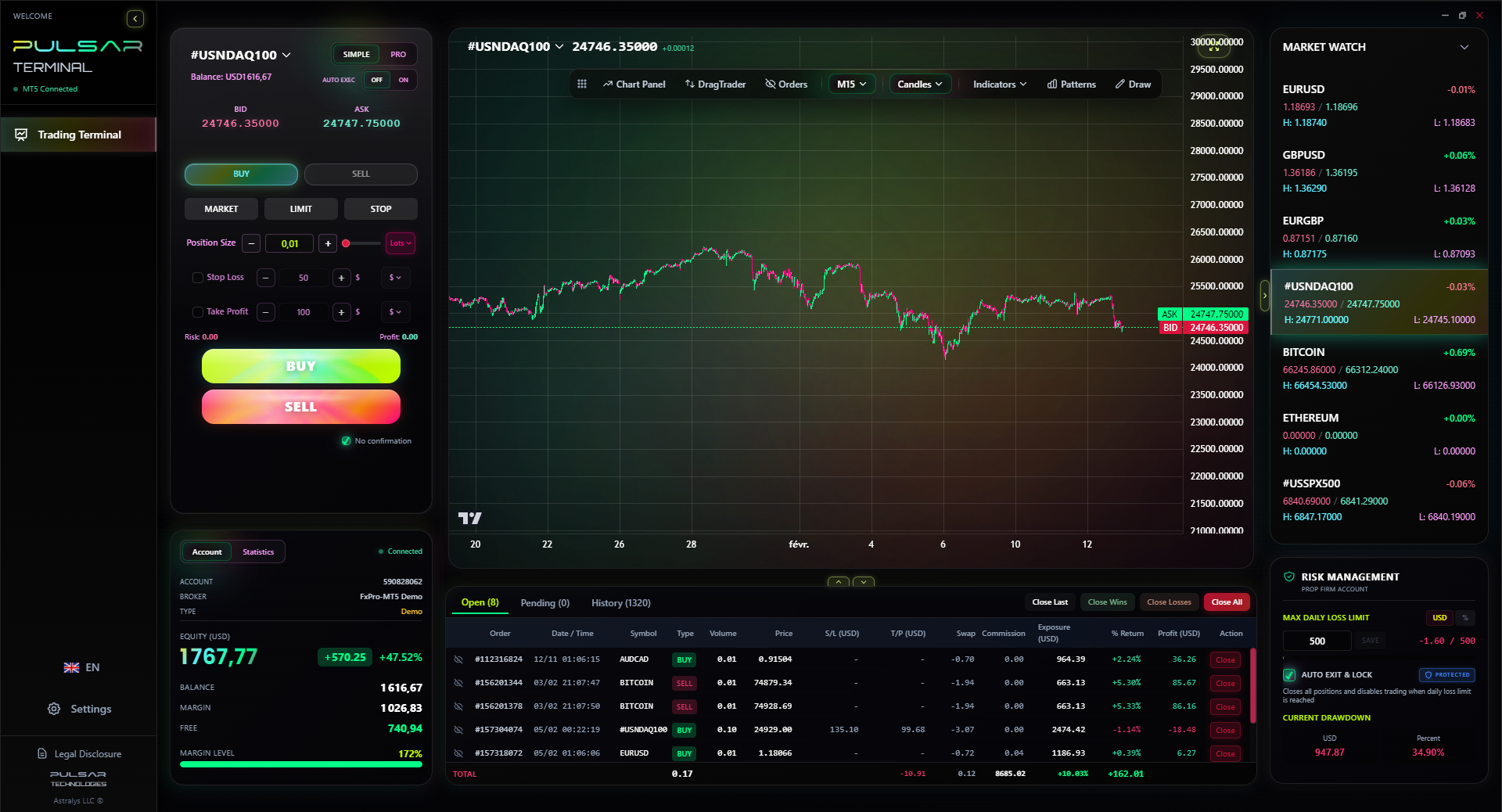
When scalping, speed and precision in order management are critical, and tools like Pulsar Terminal provide a drag-and-drop interface for MT5 to set multi-level take-profits and stop-losses faster than the native platform allows.
Pulsar Terminal
Lo strumento MT5 tutto-in-uno: ordini drag-and-drop, multi-TP/SL, trailing stop, grid trading, Volume Profile e protezione prop firm. Usato da oltre 1.000 trader ogni giorno.
“After two consecutive losses, walk away for an hour. The market will still be there.”
Let's be brutally honest.
Chasing the Market: You see EUR/USD rip 15 pips. You FOMO in, entering at the worst price, right before a pullback. Your stop gets hit instantly. Wait for the pullback, always.
Ignoring the Economic Calendar: I once scalped GBP/USD 5 minutes before a Bank of England speech. The spread widened from 1.8 to 12 pips as I entered. I was negative the second I clicked. Always know what's scheduled.
Moving Your Stop Loss Further Away: This is the account killer. "It'll come back," you say. It rarely does. Your stop is there for a reason. Respect it. A bad scalp that costs you 1% is a lesson. Letting it run to a 5% loss is a catastrophe.
Scalping While Tired or Emotional: After a loss, the urge to 'get it back now' is overwhelming. That's when you take terrible trades. After two consecutive losses, walk away for an hour. The market will still be there.
Not Accounting for All Costs: Remember, it's not just the spread. If you're on a commission account, factor that in. A 0.7 pip spread + $3.50 commission per lot round turn is your true cost. If your average scalp only nets 5 pips, that's a huge chunk gone.
💡 Consiglio di Winston
Record your screen for an hour of trading. Watch it back. You'll be horrified at the missed cues and emotional ticks you didn't notice in the moment. It's the cheapest coaching you'll ever get.
- Open a Demo Account: Don't touch real money. Pick a broker from our reviews like XM or IC Markets and practice on their demo for at least two months. Your goal isn't to make fake money, it's to execute your plan flawlessly 100 times in a row.
- Start with One Pair: Master EUR/USD. Learn its rhythm at 8 AM WAT, at 1 PM WAT. Know what a normal 5-minute candle looks like.
- Fund with Money You Can Lose: When you go live, start small. A $200-500 account is enough to feel the psychological pressure but not ruin you. Use a broker that accepts local bank transfers or cards.
- Journal Religiously: For every trade, screenshot the chart. Write down: entry/exit, pips gained/lost, reason for entry, emotional state. Review weekly. Your journal will tell you your truth.
- Scale Up Slowly: Only increase your position size after 3 consecutive months of profitability. Not weeks, months. Consistency is the only proof that matters.
Scalping can be a way to generate income, but it's a profession, not a lottery. It demands discipline, extreme patience, and a ruthless focus on the math. Pick the best forex pairs to scalp, master their timing, and guard your capital like your life depends on it. Because in trading, your financial life does.
FAQ
Q1What is the absolute best forex pair for beginners to start scalping?
EUR/USD, no question. It has the tightest average spreads, the deepest liquidity (minimizing slippage), and its movements during the London and New York sessions are generally the most predictable for practicing price action strategies. It's the lowest-cost environment to learn in.
Q2How many pips should a scalper aim for per trade?
Aim for a target that makes sense relative to your stop loss and the pair's noise. For majors like EUR/USD, a 7-12 pip profit target with a 5-8 pip stop loss is realistic. The key is the risk-to-reward ratio. Aim for at least 1:1.5. Don't fall into the trap of aiming for 5 pips while using a 10-pip stop - you'd need an 80% win rate just to break even.
Q3Can I scalp forex successfully in Nigeria with a small account?
Yes, but you must be hyper-aware of costs. A small account (e.g., $200) means your position sizes will be tiny (micro or nano lots). The spread and potential commission will eat a larger percentage of your gains. It's possible, but it's an even steeper learning curve. Focus on perfecting your strategy on a demo first, then start with the smallest possible live size.
Q4Is scalping better than swing trading for Nigerians?
It depends on your personality and schedule. Swing trading requires less screen time, holding trades for days, and can be better if you have a full-time job. Scalping requires intense focus for short bursts, often during specific hours (like London afternoon). If you can't commit to being glued to the screen during peak volatility, scalping will be very difficult.
Q5Why do most forex scalpers fail?
They fail because they focus on profits instead of process. They ignore the math of spreads and commissions, they overtrade to chase action, they move stop losses, and they let emotions dictate decisions. They treat it like gambling, not a probabilistic business with strict cost controls.
Q6What time is best for scalping in Nigeria?
The prime time is 1:00 PM to 4:00 PM West Africa Time (WAT). This is when the London and New York sessions overlap, creating the highest liquidity and tightest spreads. The London session alone (8:00 AM - 4:00 PM WAT) is also very active for pairs like EUR/USD and GBP/USD.
Lezione del Prof. Winston
Punti chiave:
- ✓EUR/USD & USD/JPY offer the tightest spreads (<1.5 pips).
- ✓Only scalp during peak session overlaps (1-4 PM WAT).
- ✓Never risk more than 1% of your account per scalp.
- ✓Aim for a minimum 1:1.5 risk-to-reward ratio.
- ✓The spread is a fixed cost; factor it into every target.
Quanto è stato utile questo articolo?
Clicca su una stella
Analisi Trading Settimanali
Analisi e strategie settimanali gratuite. Nessuno spam.
Sull'autore
Olumide Adeyemi
Pioniere del Trading in Africa Occidentale
Uno degli educatori di trading forex più attivi in Nigeria. 8 anni di esperienza di trading da Lagos. Specializzato in strategie a basso capitale e sfide prop firm per trader africani.
Commenti
Avviso di rischio
Il trading di strumenti finanziari comporta rischi significativi e potrebbe non essere adatto a tutti gli investitori. Le performance passate non garantiscono risultati futuri. Questo contenuto è fornito solo a scopo educativo e non deve essere considerato un consiglio di investimento. Conduci sempre le tue ricerche prima di fare trading.
Potrebbe interessarti anche

Cara Trading Forex Sukses: 7 Prinsip dari Trader Profesional
Cara trading forex sukses dengan 7 prinsip trader pro: manajemen modal, disiplin, journal trading, backtest. Data nyata, bukan janji profit palsu.
Jam Trading Forex Terbaik untuk Trader Indonesia: Panduan Lengkap dengan Tabel Waktu
Panduan jam trading forex untuk trader Indonesia. Tabel 4 sesi dunia, jam emas 20:00-00:00, sesi mana yang harus dihindari. Data akurat + tips dari trader berpengalaman.
Top 5 Sàn Forex Uy Tín Nhất 2026: Review Jujur dari Trader Indonesia
Top 5 sàn forex uy tín 2026 untuk trader Indonesia. Review jujur: spread, deposit, withdraw, dukungan lokal. Exness, XM, IC Markets & lebih.
Scarica Pulsar Terminal
Tutti questi calcolatori sono integrati in Pulsar Terminal con dati in tempo reale dal tuo conto MT5.
Scarica Pulsar Terminal