


I stared at the screen, my AUD $249 evaluation fee for a 'FunderPro-like' challenge gone in 48 hours.

Sarah Collins
Stratega di Trading ·  Australia
☕ 12 min di lettura
Cosa imparerai:
- 1What Exactly Is a Prop Firm (And Why Does Australia Have a Unique Angle?)
- 2What to Actually Look For (Beyond the Flashy Payout %)
- 3The Real Contenders: Prop Firms That Get Aussie Attention
- 4The Brutal Maths: Fees, Pass Rates, and Your Actual ROI
- 5A Tactical Guide to Actually Passing the Challenge
- 6Red Flags: How to Spot a Shady Operation
- 7You Passed. Now What? The Funded Account Reality

I stared at the screen, my AUD $249 evaluation fee for a 'FunderPro-like' challenge gone in 48 hours. It was October 2023, and a rogue AUD/JPY trade had just violated the 5% daily loss limit. The platform auto-liquidated my simulated account. That sting, that moment of watching capital you don't technically own evaporate, taught me more about prop firms than any glossy sales page ever could. The hunt for the best prop firm like FunderPro isn't about who offers the biggest number; it's about finding a structure that doesn't break your strategy before you even start.
Let's cut through the hype. A proprietary trading firm gives you a pile of their money to trade. You pass their test (the 'challenge' or 'evaluation'), prove you can follow rules, and then you get a funded account. Your profit is split, usually 80/20 in your favour. You blow up, you lose your shot, but not your personal savings (beyond the evaluation fee).
In Australia, this whole scene sits in a fascinating grey zone. ASIC, our regulator, is watching closely. Their famous 2021 use restrictions (30:1 on major FX pairs) apply to retail brokers you deposit with, not to prop firms using their own capital for evaluations. This is the critical loophole. It means prop firms can legally offer you use that local retail brokers can't, like 1:100. That's a massive draw.
But here's the local advantage we often overlook: our timezone. Waking up in Sydney or Melbourne, you catch the tail end of the US session, the full Asian session, and then the London open hits in our late afternoon/early evening. It's a gift for certain strategies, especially if you're into scalping strategy on overlapping sessions. A good prop firm will give you the platform and stability to exploit that.

Warning: Just because a firm isn't ASIC-regulated doesn't mean it's a scam. The business model is different. But it does mean you need to do your homework on their legitimacy, payout history, and terms. ASIC's planned surveillance for 2024/25 tells you this market is on their radar.
My early mistake? I chased the highest use like a rookie. 1:100 on a volatile pair with a tight daily drawdown is a recipe for a quick exit. I learned to treat the offered use as a ceiling, not a target.

💡 Consiglio di Winston
Treat the evaluation fee as tuition, not an investment. If you learn why you failed, it's the cheapest market education you'll ever get.
“The hunt for the best prop firm isn't about who offers the biggest number; it's about finding a structure that doesn't break your strategy before you even start.”
Everyone looks at the profit split first. I get it. But focusing solely on that 90% or 100% is how you get stung. Here’s what matters in practice, especially for us down under.
The Rulebook is Your Bible: This is non-negotiable. You must understand the drawdown rules inside out.
- Maximum Drawdown: Often 10% from the starting balance. Hit it, account gone.
- Daily Drawdown: This is the silent killer. Usually 4-6%. It’s calculated from the previous day's closing balance or the starting balance. A bad morning can end your day before London even opens.
- Consistency Rules: Some firms require no single day's profit to be more than, say, 30% of your total profit target. This stops you from gambling on one trade.
Payouts in AUD: This seems obvious, but you'd be surprised. Many firms default to USD. Check if they support AUD bank transfers or stablecoins (USDT) without murderous conversion fees. Firms like Atlas Funded specifically mention AUD support. That $2,000 profit is a lot less sweet after $50 in bank fees and a poor exchange rate.
Platform & Instruments: You want MT4/MT5 or cTrader. It's what we know. Check if they offer the pairs you trade. If you're a XAU/USD specialist, make sure gold is there with decent spreads. Also, verify trading hours. Some firms restrict major news events.
Realistic Scaling: The promise of scaling from $50k to $200k is great. Read the fine print. Is it automatic after hitting profit milestones? Or is it a vague 'we may offer'? A clear, transparent scaling plan is a sign of a serious firm.

Pro Tip: Simulate the rules on your personal account first. Take your last 3 months of trades. Apply the prop firm's daily loss limit. Would you have blown up? I did this and found my worst losing day was 3.8%. A firm with a 4% daily limit would have been okay; a 3.5% limit would have failed me. This test is useful.
“I've spent over $1,500 on various challenge fees. Only one has led to a funded account. That's a 6.6% pass rate for me.”
Based on trading circles, payout threads, and my own experience (good and bad), here are the firms that consistently come up for Australians looking for something like FunderPro's flexible model. Remember, 'best' depends entirely on your style.
| Firm | Key Appeal for Aussies | One Big Catch |
|---|---|---|
| FTMO | The gold standard. Reliable payouts, strong reputation, up to $400k. | Higher evaluation fees. Their 10% profit target in Phase 1 is tough in choppy markets. |
| FundedNext | Popular for its 'Stellar' challenge with a 1-step evaluation. Good for swing trading with no daily drawdown (only max). | Can be slower to scale compared to others. |
| The5ers | Great scaling plan. You can start small and grow methodically. Their 'High-Stakes' program goes up to $4M. | Their rules can be complex. Really understand their 'balance vs. equity' drawdown calculation. |
| RebelsFunding | Very competitive pricing, low-cost evaluations. Offers a 'Loyalty Program' for fee discounts. | Being a newer firm, their long-term track record is still being established. |
| Fundedprime | Local flavour. Melbourne-based, partnered with Aussie broker Eightcap. Feels closer to home. | Smaller maximum allocation ($250k) than some global giants. |
| AlphaCapital | High profit splits (up to 90%), straightforward 1-phase challenge. | use is lower on indices, which might affect certain strategies. |
My personal experience? I passed a $50,000 challenge with The5ers in early 2024. Their model suited my slower, more analytical style. But I failed an FTMO challenge twice because my then-strategy couldn't handle the pressure of their specific 10% target without taking on too much risk. The firm wasn't wrong; my approach for their rules was.

Example: Let's talk real numbers. Say you pass a $100,000 challenge. You make a 10% profit, or $10,000, in your first funded month. At an 80/20 split, you get $8,000. Minus any fees, that's a life-changing month for most. But remember, that 10% profit target during the evaluation? With a 5% max daily loss, you're trying to make 10% without ever having a single day that loses more than 5%. It forces discipline, fast.
“I've spent over $1,500 on various challenge fees. Only one has led to a funded account. That's a 6.6% pass rate for me.”
This is where dreams meet a spreadsheet. Let's be brutally honest.
Evaluation Fees: They range from AUD $80 to over $1,000. A $249 fee for a $100k account sounds cheap. It is. But it's a sunk cost the second you hit 'buy'. I've spent over $1,500 on various challenge fees over two years. Only one has led to a consistently funded account. That's a 6.6% pass rate for me, mirroring the industry's grim 5-10% average.
The Hidden Cost of Rules: Your trading style has a 'fee' imposed by the rules. A 4% daily drawdown on a $100k account means you cannot lose more than $4,000 in a day. If your usual position size calculator output for a trade has a potential loss of $2,000, you can only take two such trades a day max. This changes everything.
Profit Targets: An 8-10% target isn't just a number. It's a pace. To hit 10% in 30 days, you need a consistent ~0.33% return per day. That's actually huge. Compounding works, but so does pressure.
My Costly Lesson: I once bought a 'two-phase' challenge. Phase 1 target: 10%. Phase 2 target: 5%. I blasted through Phase 1 in a week during a strong trend. Got overconfident. In Phase 2, I gave back 4% in a single day on a poorly managed EUR/USD trade, breaching the daily loss. $349 fee, gone. I'd focused on the total 15% target, not the daily risk gates in between.
The ROI calculation isn't just (Potential Profit) / (Fee). It's (Probability of Passing * Potential Profit) / (Fee + Opportunity Cost of Your Time). That probability is low. It makes choosing the right firm - one whose rules fit you - a paramount financial decision.
💡 Consiglio di Winston
Your first funded account trade should be 50% of your usual size. You need to re-calibrate your brain to the new reality of trading real firm capital.

“In a challenge, emotion is your biggest enemy. Automating your exit strategy removes half the battle.”
Forget trading for a second. You're now a project manager, and the project is 'Pass the Evaluation'. Your strategy must be built around their constraints.
Phase 1: Survival
Your only goal here is not to hit the daily drawdown. I'm serious. Don't even think about the profit target for the first week. Trade tiny. 0.5% risk per trade max. Use your position size calculator religiously. Your job is to get a feel for the platform's execution, the spreads during your session, and to build a small buffer. A 2-3% buffer early on is a massive psychological relief.
Phase 2: The Grind
Now you chip away. This is where tools become critical. If your strategy uses the MACD indicator or RSI indicator, stick to it. No experimenting. The market will tempt you with 'sure things'. Ignore them.
Automation is your friend. Setting multiple take-profits and a trailing stop can lock in gains while you sleep through other sessions. Managing this manually on MT5 is clunky.
Pro Tip: This is where a tool like Pulsar Terminal shines. Being able to drag and drop a trade with a pre-set 3-tier take-profit and a trailing stop automates your entire risk/reward plan. In a challenge, emotion is your biggest enemy. Automating the exit removes half the battle.
The Mental Game
You will have losing days. The rule is to stop trading the second you're near the daily loss limit. Close the platform. Go for a walk. The challenge gives you 30 days, but it only requires 10% profit. You have time. I failed my first two attempts because I tried to make back a daily loss immediately, which always, always leads to a margin call in this context.
Track everything. Not just P&L, but your adherence to rules. Did you almost breach the daily drawdown? Note why. Was the spread definition wider than expected at your entry? Log it. This log is your blueprint for the funded account.
Passing a prop firm challenge demands flawless execution of your risk rules, something Pulsar Terminal automates with its one-click order templates and trailing stop features on MT5.
Pulsar Terminal
Lo strumento MT5 tutto-in-uno: ordini drag-and-drop, multi-TP/SL, trailing stop, grid trading, Volume Profile e protezione prop firm. Usato da oltre 1.000 trader ogni giorno.
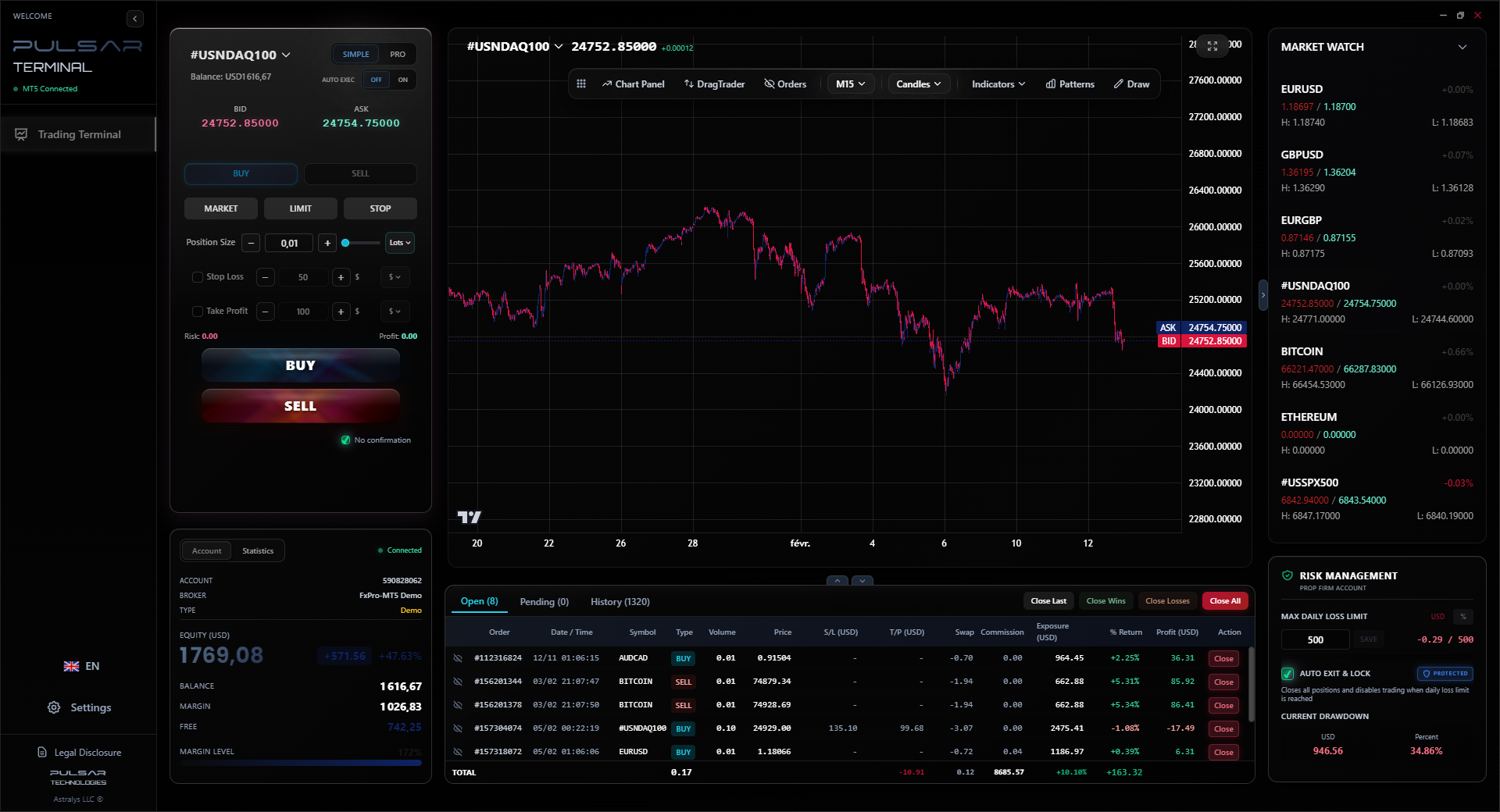
“In a challenge, emotion is your biggest enemy. Automating your exit strategy removes half the battle.”
The prop firm space has fantastic companies and outright predators. Here’s what should make you click away.
- Guaranteed Payouts or 'Insider' Strategies: If they promise you'll pass or sell you a 'secret indicator', run. It's a scam.
- Unrealistic Profit Splits: 100% profit splits forever? Be skeptical. Read the terms. Often it's 100% of the first $10k, then it drops. Or there are high monthly subscription fees instead.
- No Clear Payout Proof: A reputable firm has a track record. Look for independent YouTube payout reviews, threads on forums like Aussie Stock Forums, or Trustpilot reviews. Not just the glowing testimonials on their site.
- Vague or Constantly Changing Rules: The rules should be crystal clear and static. If they're amended mid-challenge without notice, that's a major red flag.
- Poor or Non-Existent Customer Support: Test them before you pay. Send a question about their rules. If it takes a week to get a copy-pasted answer, imagine trying to get a payout.
- The Broker Connection is Obscure: Most firms use a well-known broker like Eightcap, IC Markets, or Pepperstone for execution. If you can't find out who the underlying broker is, or it's some unknown entity, be very wary. Your trades need to be in a real liquidity pool.
A quick sense check: search the firm's name + 'review' + 'Australia'. Read the negative reviews. Are they about tough rules (normal) or about not getting paid (catastrophic)?
I once nearly signed up for a firm offering a $500k account for a $99 fee. The underlying 'broker' was their own proprietary platform with no external data feed. It smelled wrong. I walked away. Months later, forum posts confirmed it was a bucket shop - prices were made up.
“You're not trading to hit a target anymore. You're trading to grow an asset and get paid consistently. Welcome to the job.”
Congratulations are in order. But the game changes. The pressure should lessen, but the responsibility skyrockets. This is now a professional engagement.
The First Payout: This is the moment of truth. Request a small payout first, even if you're entitled to more. Confirm the process, the speed, the fees. Firms like BrightFunded or Crypto Fund Trader boast 4-24 hour payouts in crypto. Test it. My first payout from The5ers via USDT took 36 hours. The relief was palpable.
Trading Psychology Shifts: You're no longer trading to hit a target. You're trading to grow an asset and get paid consistently. This requires a different mindset. The greed to 'make back last month's losses' in one trade is a quick path to giving back the account.
Risk Management is Everything: You have more capital, so your position size in dollar terms will be larger. This magnifies every mistake. That 10-pip stop on the EUR/USD guide that used to cost you $100 might now cost $1,000. Your risk-per-trade percentage must stay identical, or even decrease.
The Relationship: You are a contractor to the firm. Act professionally. Keep records. Communicate if you have issues with the platform. I know a trader who lost a profitable trade due to a platform glitch on Exness review (the prop firm's broker). Because he had a screenshot and a calm, professional email trail, the firm credited his account. Anger gets you nowhere.
The ultimate goal? To turn this into a steady business income. That means consistent, boring, rule-based trading. The thrill of the challenge is over. Welcome to the job.

FAQ
Q1Are prop firms like FunderPro legal in Australia?
Yes, they operate legally. They fall outside direct ASIC regulation because they're not managing client deposits for investment; they're running evaluation programs with their own capital. However, ASIC is actively monitoring the sector, and you should always verify a firm's legitimacy independently.
Q2What's the single biggest mistake traders make in prop firm challenges?
Over-trading to hit the profit target. They see they need 10% and try to get it in a week, taking oversized risks. This almost always triggers the daily drawdown limit. The key is to trade small initially, build a buffer, and grind it out patiently over the full evaluation period.
Q3Can I use my existing EA or trading bot on a prop firm account?
It depends entirely on the firm's rules. Many allow EAs and automated trading, but some restrict them during the evaluation phase or ban certain types (like high-frequency arbitrage bots). You must check their FAQ or terms of service before assuming your strategy is allowed.
Q4How are taxes handled on prop firm profits in Australia?
The profits you receive are considered personal income. You are responsible for declaring them to the ATO. The prop firm will not withhold tax for you. It's wise to consult with an Australian accountant familiar with trading income to ensure you're compliant, especially with international payouts.
Q5Is it better to start with a small or large evaluation account?
Start small. A $10k or $25k account has a much lower fee. Use it to learn the firm's rules, platform, and payout process without a huge upfront cost. The scaling plans are there for a reason. Prove you can manage the small account consistently, then scale up using the firm's capital, not your own via bigger fees.
Q6Do prop firms affect my credit score or require a credit check?
No. You are not borrowing money. You are paying for an evaluation service. There is no credit facility, so no credit check is involved. Your only financial risk is the one-time evaluation fee.
Lezione del Prof. Winston
Punti chiave:
- ✓Simulate prop firm rules on your history first.
- ✓Daily drawdown, not profit target, is your primary limit.
- ✓Start with the smallest, cheapest challenge.
- ✓Your first payout request should be small and early.
Quanto è stato utile questo articolo?
Clicca su una stella
Analisi Trading Settimanali
Analisi e strategie settimanali gratuite. Nessuno spam.
Sull'autore
Sarah Collins
Stratega di Trading
Strategista di trading con base a Londra e 12 anni nei mercati finanziari. Ex analista presso un broker della City di Londra. Copre coppie GBP, mercati europei e trading regolamentato dalla FCA.
Commenti
Avviso di rischio
Il trading di strumenti finanziari comporta rischi significativi e potrebbe non essere adatto a tutti gli investitori. Le performance passate non garantiscono risultati futuri. Questo contenuto è fornito solo a scopo educativo e non deve essere considerato un consiglio di investimento. Conduci sempre le tue ricerche prima di fare trading.
Potrebbe interessarti anche

Cara Trading Forex Sukses: 7 Prinsip dari Trader Profesional
Cara trading forex sukses dengan 7 prinsip trader pro: manajemen modal, disiplin, journal trading, backtest. Data nyata, bukan janji profit palsu.
Jam Trading Forex Terbaik untuk Trader Indonesia: Panduan Lengkap dengan Tabel Waktu
Panduan jam trading forex untuk trader Indonesia. Tabel 4 sesi dunia, jam emas 20:00-00:00, sesi mana yang harus dihindari. Data akurat + tips dari trader berpengalaman.
Top 5 Sàn Forex Uy Tín Nhất 2026: Review Jujur dari Trader Indonesia
Top 5 sàn forex uy tín 2026 untuk trader Indonesia. Review jujur: spread, deposit, withdraw, dukungan lokal. Exness, XM, IC Markets & lebih.
Scarica Pulsar Terminal
Tutti questi calcolatori sono integrati in Pulsar Terminal con dati in tempo reale dal tuo conto MT5.
Scarica Pulsar Terminal