


Let's be real.

Sarah Collins
Stratega di Trading ·  Australia
☕ 12 min di lettura
Cosa imparerai:
- 1What Exactly Is a Prop Firm? (And How It Works Here)
- 2The Rules That Will Make or Break You
- 3The Australian Legal Reality: What You're Really Signing Up For
- 4Comparing the Contenders (Beyond the Marketing)
- 5How to Pick the Best Prop Firm for YOUR Trading Style
- 6The Ugly Truth About Fees, Taxes, and Getting Paid
- 7Red Flags: How to Spot a Bad Prop Firm
- 8Your Action Plan: Finding Your Best Prop Firm
Let's be real. Most guides on finding the best prop firm read like they were written by the firms themselves. They'll tell you to 'compare profit splits' and 'read the rules,' but they skip the brutal truth: over 99% of traders fail these challenges. I've blown my share of evaluation accounts and learned the hard way what separates a good opportunity from a cleverly designed fee trap. This isn't about listing every firm. It's about giving you the framework to find the one that actually fits your trading style and has a fair shot at paying you real money.
A proprietary trading firm, or prop firm, gives you capital to trade if you can prove you're profitable. You're not depositing your own money to trade with. Instead, you pay a one-time fee (usually between $80 and $1000 AUD) to take a trading challenge. Pass that, and you get a funded account where you keep a large chunk of the profits - typically 80% or more.
Here's the crucial bit for Aussies: most prop firms aren't ASIC-regulated brokers. They get around it by calling your fee a 'performance evaluation cost,' not an investment. They trade with their own capital, not client money. This means you don't get the same protections as you would with an IC Markets review or Pepperstone review. Your rights fall under Australian Consumer Law, not the strict financial services rules. It's a legal grey area that's getting more scrutiny. ASIC has been watching these firms since 2024 and by 2026, we might see some real regulation. For now, it's the wild west.

Warning: That 'funded account' isn't a bank transfer into your name. You're trading on a simulated account that mirrors the firm's real trades. If you hit their rules, they pay you from their profits. It's a performance-based contract, not asset ownership.
This is where most traders get smoked. You might be a great trader, but if you don't understand these rules inside out, you'll fail. They're designed to test discipline, not just profitability.
Profit Target
This is the goal you need to hit to pass the evaluation. It's usually 8-10% of the starting balance. Sounds easy? It's not. You have a time limit (often 30 days) and you're trading under a microscope. A 10% target means on a $50,000 account, you need to make $5,000. That requires consistent, controlled wins.
Drawdown: The Silent Killer
There are two types, and both will end your challenge if you breach them.
- Maximum Drawdown (5-10%): This is your overall loss limit from the starting balance or your highest equity point. If you start with $100,000 and have a 10% max drawdown, your account is dead if your equity hits $90,000.
- Daily Drawdown (3-6%): This is the loss you're allowed in a single day. It's usually calculated from the previous day's closing balance. This rule stops you from revenge trading after a bad loss.
I learned this the painful way. On a $25k challenge with a 5% daily drawdown, I was down $800 (3.2%) on a bad EUR/USD trade. Instead of stopping, I doubled down trying to get back to breakeven. I hit the daily limit and lost the entire fee in one afternoon. The rule did its job: it exposed my lack of discipline.
Time Limits & Consistency
Most challenges have a minimum trading day requirement (like 5-10 days). You can't just make the 10% profit in one lucky trade. They want to see you can trade consistently over time. This is where a solid swing trading or scalping strategy framework is essential.

💡 Consiglio di Winston
Your first prop challenge fee is tuition, not a ticket. Budget for at least two failures before you expect to pass. The lessons from those failures are what you're really buying.
“Over 99% of traders fail these challenges. The rules test discipline, not just profitability.”
This is the part most blogs gloss over. When you hand over your evaluation fee, what are you actually buying?
You are not a client of a financial service. You are a customer of a performance evaluation service. This distinction is everything. It means the firm's main obligation is to provide you with the challenge platform and pay out if you succeed, as per their terms. It does not mean they have a fiduciary duty to you.
Your protections come from the Australian Consumer Law (ACL). This law says the firm can't engage in misleading or deceptive conduct. Their marketing must be accurate. If they advertise a 90% payout rate but only 1% of traders get paid, that could be a problem. Their terms and conditions must also be fair.
What does this mean for you? You must read the Terms of Service. I mean, actually read them. Look for:
- Payout Terms: How often can you request a payout? (Usually bi-weekly or monthly). What's the minimum payout amount?
- Account Termination: What can get your funded account revoked besides breaking drawdown? Some have rules against 'over-trading' or using certain news strategies.
- Fee Clauses: Is your evaluation fee refundable under any conditions?
There's one exception: N P Financials. They're an ASIC-regulated prop firm with an AFSL. They're the real deal, but their model and requirements are different from the common challenge-style firms. They represent what the industry might look like if ASIC tightens the rules in 2026.
Let's cut through the hype. Here’s a blunt comparison of some popular options for Aussie traders, based on their rules as of now. Remember, these can change.
| Firm (Example) | Evaluation Fee (AUD approx) | Profit Target | Max Drawdown | Daily Drawdown | Key Aussie Consideration |
|---|---|---|---|---|---|
| FTMO (Global Leader) | $500+ for $100k | 10% (2-phase) | 10% | 5% | Not Aussie-focused, but reliable payouts. Fees are high. |
| The5%ers | $400+ for $100k | 6% then 6% | 5% from high | 4% daily loss | Lower targets, but tighter drawdown. Good for conservative traders. |
| DNA Funded | $49 for $5k | 8% (1-step) | 6% | 5% | Very low entry cost. Good for testing strategies with small capital. |
| Goat Funded Trader | Varies | 8% (1-step) | 10% | 5% | High use (1:100 forex). Offers scaling to $2M. |
| SabioTrade | Free (with review) | Varies | Varies | Varies | Unique model. Get a $20k account for a video review. Risk is your time, not cash. |
My experience? I started with a low-cost firm like DNA Funded. The $49 fee felt like a cheap lesson. I failed twice. But losing $98 taught me more about my emotional control than any demo account ever did. When I finally passed a challenge, it was with a firm whose rules matched my slow-and-steady swing trading style, not the one with the flashiest ads.

Pro Tip: Don't start with your dream $100k account. Buy the smallest, cheapest challenge a firm offers. Use it to learn their platform, their rule quirks, and to see if your strategy fits. Consider that fee tuition, not an investment.
“When a prop firm pays you, that income is likely taxable in Australia. The ATO doesn't care if the money came from London or cyberspace.”
The best prop firm isn't the one with the highest profit split. It's the one whose rules are an invisible fit for how you trade.
If you're a scalper or day trader: You need a firm with low spreads and commissions, because those costs eat into your small, frequent profits. Look for firms that partner with good brokers. You also need a reasonable daily drawdown. If your style has frequent small losses, a 3% daily limit might be too tight. A 5% buffer gives you room to breathe.
If you're a swing trader or position trader: You hold trades for days or weeks. Your main enemy is the maximum drawdown, not the daily. You need a firm with a generous max drawdown (10% is good). Time limits on the challenge can be a problem too - can you hit a 10% target in 30 days if you only take 2-3 trades a month? Maybe not. Look for firms with longer challenge periods or no strict time limit.
The use Trap: Some firms offer huge use like 1:100 on forex. This is a double-edged sword. Yes, it amplifies gains. But it also amplifies losses and will burn through your drawdown frighteningly fast. If you're not an expert in managing use and using a strict position size calculator, avoid high-use accounts. The ASIC's 30:1 use cap for retail clients exists for a reason - most people misuse high use.
Here's a personal rule: I never use more than 5x the effective use of my strategy in a prop challenge. If my stop loss would normally risk 2% of my account, I size my position so that even with the firm's high available use, my risk stays at 2%. The use is there, but I pretend it's not.
💡 Consiglio di Winston
If the firm's rules don't immediately make sense to you, you haven't read them carefully enough. Print them out. Highlight the drawdown calculations. They are the battlefield.
Let's talk money. The real money.
The Fee Structure: You pay to play. That $200 challenge fee is gone whether you pass or fail. Think of it as the price of a very intense trading seminar. Some firms offer 'free retries' or discounts if you fail close to the target - these are worth looking for.
Profit Splits: 80/20 is standard, 90/10 is great. But remember, this is split on the net profit. If you make $10,000 and have $500 in commissions, your split is on $9,500. Always factor in trading costs.
Getting Paid in Australia: This is a logistical headache. Most firms are overseas.
- Bank Transfer (Wire): The old-school way. It works, but you'll pay international wire fees ($20-$30) and it takes 2-5 business days. The exchange rate from USD to AUD will also cost you.
- Cryptocurrency (The Smart Way): This is how I get paid now. The firm sends USDT or USDC to my wallet in minutes. I then send it to an Australian exchange like CoinSpot, sell for AUD, and transfer to my bank. It's faster and often cheaper on fees overall. Just make sure you understand crypto basics first.
Taxes: This is critical. When a prop firm pays you, that income is likely taxable in Australia. You're providing a service (trading) and receiving payment for it. The ATO would see this as assessable income. You must declare it on your tax return. The exact treatment (as personal income vs. business income) can depend on the scale and regularity of your payouts. I'm not an accountant, but I can tell you I treat every payout as income and set aside 30-35% for tax time. Talk to a tax professional who understands trading income.

Example: You get a $5,000 AUD profit split. After exchange fees and bank charges, you might net $4,850. You should then set aside ~$1,500 for potential tax, leaving you with $3,350 of usable profit from that payout. This reality check changes the 'get rich quick' fantasy fast.
“Your first challenge should be the smallest, least expensive account the firm offers. The goal is to learn the process, not get rich.”
Not all firms are created equal. Some are poorly run. A few might be outright scams. Here's what should make you walk away.
- Unrealistic Marketing: 'Become a millionaire in months!' or '95% of traders pass!' This is nonsense. If it sounds like a lottery ad, it's probably a trap.
- Opaque or Constantly Changing Rules: The rules should be crystal clear and publicly available. If you have to email them to ask basic questions about drawdown, that's a bad sign. If they change rules on funded traders without notice, run.
- Poor Payout Reviews: Search the firm's name + 'payout' or 'withdrawal' on forums like Reddit or ForexFactory. A few complaints are normal. A consistent pattern of delayed payments, rejected withdrawals on technicalities, or ghosting customers is a massive red flag.
- No Demo or Practice Account: A reputable firm will let you test their platform and see the rules in action on a demo before you pay a cent. If they don't offer this, they're hiding something.
- Pressure to 'Scale Up' Immediately: After your first payout, some firms will aggressively push you to take a larger account with a higher fee. Be wary. Prove you can consistently earn on your current size for 6 months first.
My mistake? I once ignored bad payout reviews because the firm's profit split was 95%. I passed the challenge, made $2,100 in the first month, and requested a payout. It took 6 weeks, 15 emails, and they finally paid after I threatened to post the entire email chain online. The high split wasn't worth the stress and doubt. Reliability is worth more than an extra 5%.
💡 Consiglio di Winston
When funded, your first three trades should be 50% of your normal size. You need to re-acclimate to the psychological weight of the firm's capital. It feels different.
So, how do you actually choose? Follow this plan.
Step 1: Audit Your Trading. This is non-negotiable. Get 3-6 months of verified track record on a demo or small live account. Use a journal. What's your average win rate? Your average risk/reward? Your maximum losing streak? Your typical holding time? This data tells you what rules you need. If your worst historical drawdown is 8%, a firm with a 5% max drawdown will kill you.
Step 2: Match Rules to Your Data. Filter firms based on your audit. Swing trader with 12% max drawdown? Only look at firms with 10%+ max drawdown. Day trader with 2% average daily risk? Ensure the daily drawdown is at least 4-5%.
Step 3: Test Drive for Free. Open a demo account with 2-3 shortlisted firms. Trade your strategy on their platform for two weeks. Is the execution good? Are the spreads decent during your trading session? Does their platform have the tools you need? This step alone will eliminate bad fits.
Step 4: Start Small and Cheap. Your first challenge should be the smallest, least expensive account the firm offers. The goal is not to get funded (though that's a nice bonus). The goal is to learn the process and confirm the firm operates as advertised. Passing a $10k challenge proves you can pass a $100k one.
Step 5: Manage the Funded Account Like a Business. Once funded, the real work begins. Your goal is no longer a profit target. Your goal is consistent, rule-compliant profitability to earn payouts. Use tools to protect yourself. This is where automation is key. Setting a trailing stop or moving to breakeven manually is stressful and error-prone.
, the best prop firm is the one that feels like a silent partner. Their rules don't feel restrictive because they align with your own trading discipline. Their platform gets out of your way. And when you make money, they pay you, on time, without drama. It turns a solo pursuit into a professional venture. That's the real prize.
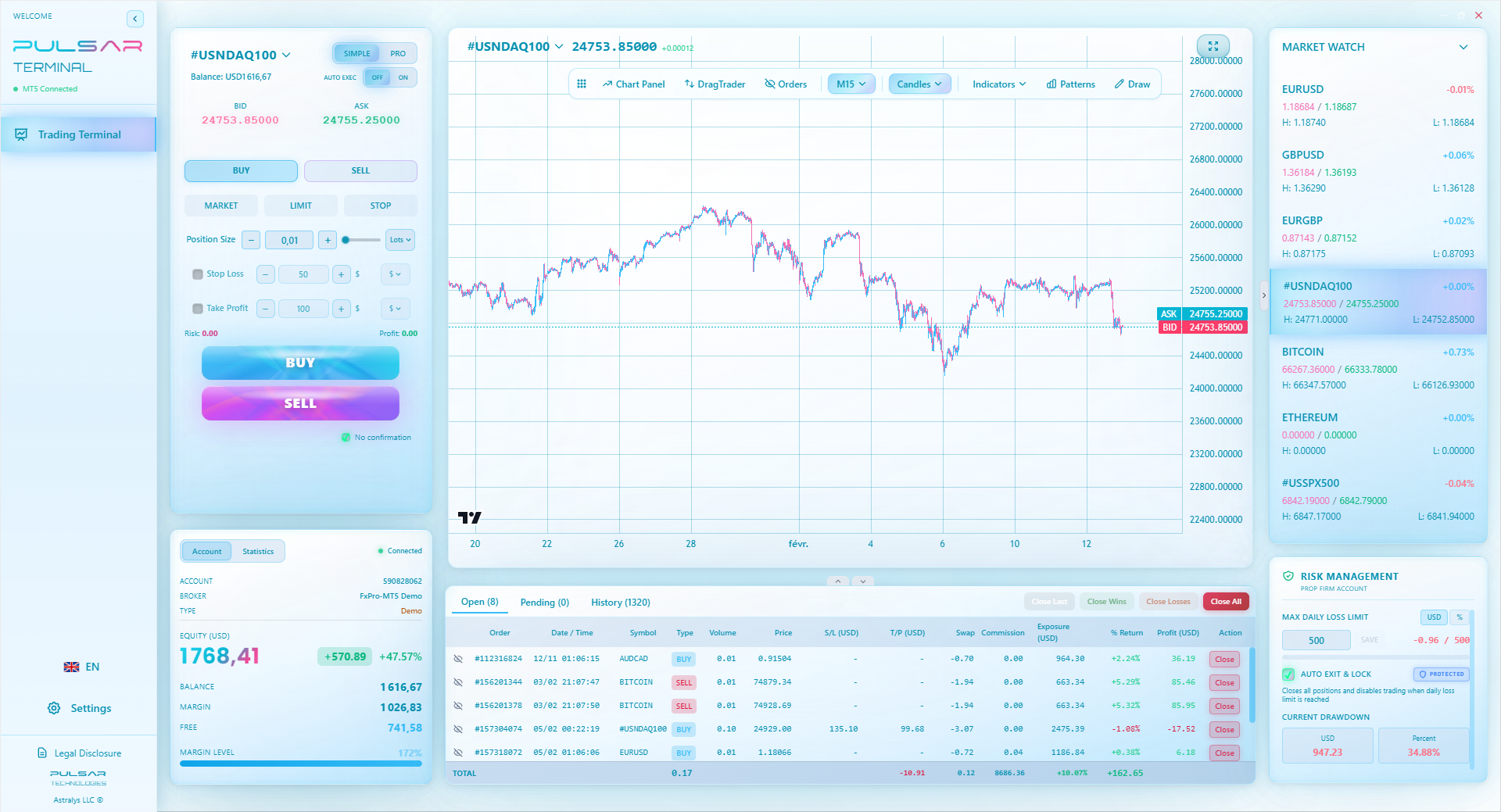
Managing a funded account requires iron-clad discipline on stops and targets, which is exactly what Pulsar Terminal automates directly within your MT5 platform.
Pulsar Terminal
Lo strumento MT5 tutto-in-uno: ordini drag-and-drop, multi-TP/SL, trailing stop, grid trading, Volume Profile e protezione prop firm. Usato da oltre 1.000 trader ogni giorno.
FAQ
Q1Are prop firms legal in Australia?
Yes, they are legal. However, most operate as performance evaluation services, not ASIC-regulated financial services. This means they don't need an Australian Financial Services License (AFSL). Your protections come from Australian Consumer Law, not specific financial regulations. The landscape is under ASIC review and could change by 2026.
Q2How much does it cost to try a prop firm challenge?
Evaluation fees in AUD typically range from as low as $49 for a small $5,000 account to over $1,000 for large $200,000+ accounts. You should consider this fee a sunk cost for education and opportunity, not an investment. Many traders need multiple attempts to pass.
Q3What is the most common reason traders fail prop firm challenges?
Violating the drawdown rules, not missing the profit target. The daily loss limit (often 3-5%) is the most common killer. Traders have one or two bad trades, then revenge trade to get back to breakeven, quickly blowing through the daily limit. It tests psychology more than strategy.
Q4Do I pay tax on prop firm profits in Australia?
Almost certainly, yes. The ATO would generally consider regular profit splits from trading a firm's capital as assessable income. You are being paid for a service (your trading skill). You must declare this income on your tax return. It's crucial to keep detailed records of all payouts and consult with a tax professional.
Q5What's better for a beginner: a prop firm or a retail broker?
Start with a reputable retail broker like IC Markets or Pepperstone using your own small capital. Prop firm rules are brutally unforgiving and expensive to fail. Use a broker to learn execution, build a strategy, and develop discipline with a real position size calculator. Once you have a proven, journaled track record of 3-6 months, then consider a prop firm to scale your capital.
Q6Which prop firm has the easiest rules?
"Easiest" is subjective and dangerous. Firms with lower profit targets (e.g., 6-8%) or no time limits can seem easier. However, they often compensate with tighter drawdown rules (e.g., 4-5%). There's no free lunch. The firm that best matches your natural trading style's volatility will feel the 'easiest' to you.
Q7How long does it take to get a payout from a prop firm?
Most firms process payouts bi-weekly or monthly. Once you request a withdrawal, expect 2-5 business days for bank transfers, or often less than 24 hours if you use cryptocurrency (like USDT). Always check the firm's specific payout schedule and processing times in their terms.
Lezione del Prof. Winston
Punti chiave:
- ✓Drawdown rules, not profit targets, eliminate most traders.
- ✓Treat your first challenge fee as educational tuition.
- ✓Match the firm's rules to your strategy's historical volatility.
- ✓Always budget 30% of payouts for potential tax.
- ✓Start with the smallest account size offered.
Quanto è stato utile questo articolo?
Clicca su una stella
Analisi Trading Settimanali
Analisi e strategie settimanali gratuite. Nessuno spam.
Sull'autore
Sarah Collins
Stratega di Trading
Strategista di trading con base a Londra e 12 anni nei mercati finanziari. Ex analista presso un broker della City di Londra. Copre coppie GBP, mercati europei e trading regolamentato dalla FCA.
Commenti
Avviso di rischio
Il trading di strumenti finanziari comporta rischi significativi e potrebbe non essere adatto a tutti gli investitori. Le performance passate non garantiscono risultati futuri. Questo contenuto è fornito solo a scopo educativo e non deve essere considerato un consiglio di investimento. Conduci sempre le tue ricerche prima di fare trading.
Potrebbe interessarti anche

Cara Trading Forex Sukses: 7 Prinsip dari Trader Profesional
Cara trading forex sukses dengan 7 prinsip trader pro: manajemen modal, disiplin, journal trading, backtest. Data nyata, bukan janji profit palsu.
Jam Trading Forex Terbaik untuk Trader Indonesia: Panduan Lengkap dengan Tabel Waktu
Panduan jam trading forex untuk trader Indonesia. Tabel 4 sesi dunia, jam emas 20:00-00:00, sesi mana yang harus dihindari. Data akurat + tips dari trader berpengalaman.
Top 5 Sàn Forex Uy Tín Nhất 2026: Review Jujur dari Trader Indonesia
Top 5 sàn forex uy tín 2026 untuk trader Indonesia. Review jujur: spread, deposit, withdraw, dukungan lokal. Exness, XM, IC Markets & lebih.
Scarica Pulsar Terminal
Tutti questi calcolatori sono integrati in Pulsar Terminal con dati in tempo reale dal tuo conto MT5.
Scarica Pulsar Terminal