


I remember staring at my screen as Nifty hovered at 22,400, completely still.

Rajesh Sharma
Analista Forex Senior ·  India
India
☕ 13 min di lettura
Cosa imparerai:
I remember staring at my screen as Nifty hovered at 22,400, completely still. It was expiry day, and I'd sold a strangle expecting movement. The market didn't budge. I watched my position bleed time value for hours, ending with a ₹8,500 loss on a trade that felt 'safe.' That's when I realized I was fighting the wrong battle. Chasing volatility when none existed. The butterfly option trading strategy became my answer - a way to profit from exactly that kind of market stillness. It's not glamorous, but in India's newly regulated F&O landscape, it might be one of the few consistently profitable plays left for retail traders.
Let's cut through the fancy terminology. A butterfly is a defined-risk options strategy that makes money when the underlying asset doesn't move much. You're betting on low volatility, or more specifically, that the price will land right at a specific point (the middle strike) at expiry.
Think of it like this: you build a small profit zone with wings on either side to limit your loss. The maximum profit is locked in if the stock or index closes exactly at the middle strike price when the options expire. Any big move up or down, and your profit shrinks, hitting a predefined maximum loss.
It's constructed using either all calls or all puts with the same expiry date. The standard structure is:
- Buy 1 lower strike (in-the-money or out-of-the-money) option
- Sell 2 middle strike (at-the-money) options
- Buy 1 higher strike (out-of-the-money) option
All strikes are equally spaced. For example, on Nifty trading at 22,500, you might use 22,400, 22,500, and 22,600 strikes.

Example: A Long Call Butterfly on Nifty
- Buy 1 Nifty 22,400 Call for ₹160
- Sell 2 Nifty 22,500 Calls for ₹90 each (₹180 total credit)
- Buy 1 Nifty 22,600 Call for ₹40 Net Premium Paid = (160 + 40) - 180 = ₹20 This ₹20 (x 50 lot size = ₹1,000) is your maximum risk. Your maximum profit occurs if Nifty expires at 22,500.
The beauty? You know your exact worst-case scenario before you even place the trade. In a market where SEBI has made unlimited-risk selling strategies incredibly capital intensive, that's a huge relief. I shifted to butterflies after one too many margin calls from naked shorts. Knowing my max loss upfront let me sleep at night.
It's crucial to understand this isn't a get-rich-quick scheme. The profit potential is capped, often representing a high percentage return on risk, but not in absolute lakhs. It's a precision instrument, not a blunt hammer.

💡 Consiglio di Winston
The market's favorite price is the one that hurts the most people. A butterfly profits when it pins at a strike where maximum pain lies for option sellers. Use open interest data to find that level.
Choosing Your Underlying
You can run a butterfly on individual stocks or indices. For beginners, I strongly recommend starting with Nifty or Bank Nifty. The liquidity is far superior, which means tighter bid-ask spreads. Trying this on a random mid-cap stock is a recipe for losing money to slippage. I learned this the hard way with a HDFC Bank butterfly where the spread cost me ₹500 before the trade even started.
Strike Selection and Spacing
This is where the art meets the science. Your middle strike is where you believe the underlying will expire. I use a combination of technical analysis - looking at key support/resistance, VWAP, and the 20-period moving average - and market sentiment.
The wing width (the distance between strikes) defines your profit zone. A 100-point wide butterfly (e.g., 22,400/22,500/22,600) has a wider profitable range but a lower peak profit. A 50-point wide butterfly has a narrower range but higher peak profit. In low volatility environments, I prefer the 50-point width for Nifty.
The Order Placement Headache
Here's the messy reality brokers don't tell you: placing a 4-legged option strategy manually is a pain. You have to enter four separate orders. If one leg doesn't fill, you're left with a risky, unbalanced position. This is where platforms like Sensibull or your broker's strategy builder are lifesavers. They let you place the entire butterfly as a single order, often with a limit on the net debit/credit.

Warning: Never leg into a butterfly. That means don't buy one option now and plan to add the others later. You'll lose the defined-risk characteristic and could end up with unlimited loss. Always enter all four legs as a single package trade.
Let's talk about the new SEBI margin rules. For a long butterfly, since you are a net buyer of options, you must pay the full premium upfront for the options you buy. The premium you receive from the ones you sell offsets this. Your margin requirement is the maximum loss of the strategy. This is a blessing compared to selling strategies. A single lot Nifty butterfly might need ₹1,000 to ₹3,000 in margin blocked. A naked short strangle in the same environment now needs over ₹1.5 lakh. The capital efficiency shift is staggering.
“The butterfly isn't a bet on direction; it's a bet on market indecision.”
This is the mechanical heart of the strategy. You must know these numbers cold.
Maximum Profit: This happens ONLY if the underlying closes exactly at the middle strike price at expiry. The formula is:
(Width of Wings - Net Premium Paid) * Lot Size
For a 100-point wide Nifty butterfly with a net debit of ₹20: Max Profit = (100 - 20) * 50 = ₹4,000.
Maximum Loss: This is simply the net premium you paid to enter the trade. In the example above, it's ₹20 * 50 = ₹1,000. This loss occurs if the underlying expires below the lowest strike or above the highest strike.
Breakeven Points: There are two.
- Upper Breakeven = Middle Strike + (Width of Wings - Net Premium)
- Lower Breakeven = Middle Strike - (Width of Wings - Net Premium)
Using our example (Middle=22,500, Width=100, Net Premium=20): Upper B/E = 22,500 + (100-20) = 22,580 Lower B/E = 22,500 - (100-20) = 22,420
If Nifty expires between 22,420 and 22,580, you make some profit. Outside that, you lose.
Here’s a comparison of two common setups:
| Aspect | 50-Point Wide Butterfly | 100-Point Wide Butterfly |
|---|---|---|
| Max Profit | Higher (per point) | Lower (per point) |
| Profit Zone | Narrower (~30-40 points) | Wider (~80-90 points) |
| Probability of Profit | Lower | Higher |
| Best For | Very low volatility, pin-point view | Moderate volatility, wider expiry range view |
I once set up a 50-point butterfly on Bank Nifty, convinced it would expire right at 48,000. It closed at 48,012. I still made a profit, but only ₹1,200 instead of the potential ₹3,500. Twelve points! That's how sensitive these can be. It taught me to use wider wings unless I had supreme confidence.
This is where many theoretical strategies die in practice. You must factor in all costs, or your neat profit calculation becomes a loss. Let's break down a realistic P&L for one Nifty butterfly lot.
Assumed Trade: Net debit of ₹25.
- Brokerage: ₹20 per order. With 4 legs, that's ₹80. On Zerodha, if you don't maintain 50% cash collateral for intraday trades (which butterflies often are, even if held to expiry), this could be ₹160 from April 2026. Use a position size calculator to factor this in.
- STT: This is the big one. Budget 2026 increased STT on options selling to 0.15%. You sell two options in a butterfly. If you sold them for a combined ₹200 premium, STT = 0.15% of ₹200 = ₹0.30 (per share). For 50 shares, that's ₹15. This is charged upfront.
- Exchange Charges & GST: Roughly another ₹5-₹10.
- Stamp Duty: Around ₹1-₹2.
Total Costs: Approximately ₹100-₹110 for the round trip.
What This Means: Your butterfly doesn't start making money until it covers this cost. In our example with a ₹25 net debit (₹1,250 total), you need about ₹2 of price movement just to break even on costs. That's an 8% hurdle on your premium. If your max profit is only ₹3,000, costs eat up over 3% of your potential.
I ignored this for my first few trades. My journal showed a ₹450 profit on a butterfly, but my account only went up by ₹320. The missing ₹130 was fees and taxes. Now, I add a "cost buffer" of at least ₹100 to my maximum loss calculation before I even consider a trade. If the risk/reward doesn't still look good, I skip it. This strict accounting is what separates hobbyists from professionals.
💡 Consiglio di Winston
Treat the cost of brokerage and taxes as part of your 'spread'. If your max profit is only 3 times your costs, the trade is barely worth the risk. Aim for a 5:1 or better ratio.
“In the new SEBI era, your best weapon is a strategy with a loss you can afford to see on your screen.”
The Perfect Setup
- Low Implied Volatility (IV): This is key. You want to buy options when IV is relatively low. Check the India VIX. If it's below 15, conditions are often favorable. High IV makes the options you buy expensive, crushing your potential profit.
- Approaching Expiry with a Clear Pinning Level: The last week before expiry, especially after SEBI reduced weekly expiries, often sees indices gravitate towards major option strike prices (like 22,500). Market makers defend these levels. Setting a butterfly at this expected pin is a classic play.
- After a Big Event: Post-Budget, post-RBI policy, post-US Fed meeting. Once the news is out and volatility collapses, the market often enters a consolidation phase. That's butterfly territory.
When to Run for the Hills
- High IV Environments: When India VIX is spiking above 20-22, you're paying too much for the long options. Your risk is the same, but your profit potential is tiny.
- Major Economic Data Due: If US CPI or RBI policy is due during your trade's lifespan, avoid it. The potential for a gap move outside your wings is too high.
- You Have a Strong Directional Bias: If you think Nifty is definitely going up, just buy a call. A butterfly will cap your upside. This is a neutral strategy, not a bullish or bearish one.
My best butterfly trade came on a Thursday before expiry. Nifty had been stuck between 22,480 and 22,520 for two days. IV was at 13. I set a 22,500 call butterfly for a ₹18 debit. It expired at 22,502. Max profit. The worst was trying to be clever before an FOMC meeting. Nifty gapped open 200 points past my upper wing. Max loss, instantly. The lesson? Respect the calendar and the volatility cycle. Tools that help you visualize support and resistance, like the Volume Profile can help identify those potential pinning levels, but never forget the macro schedule.
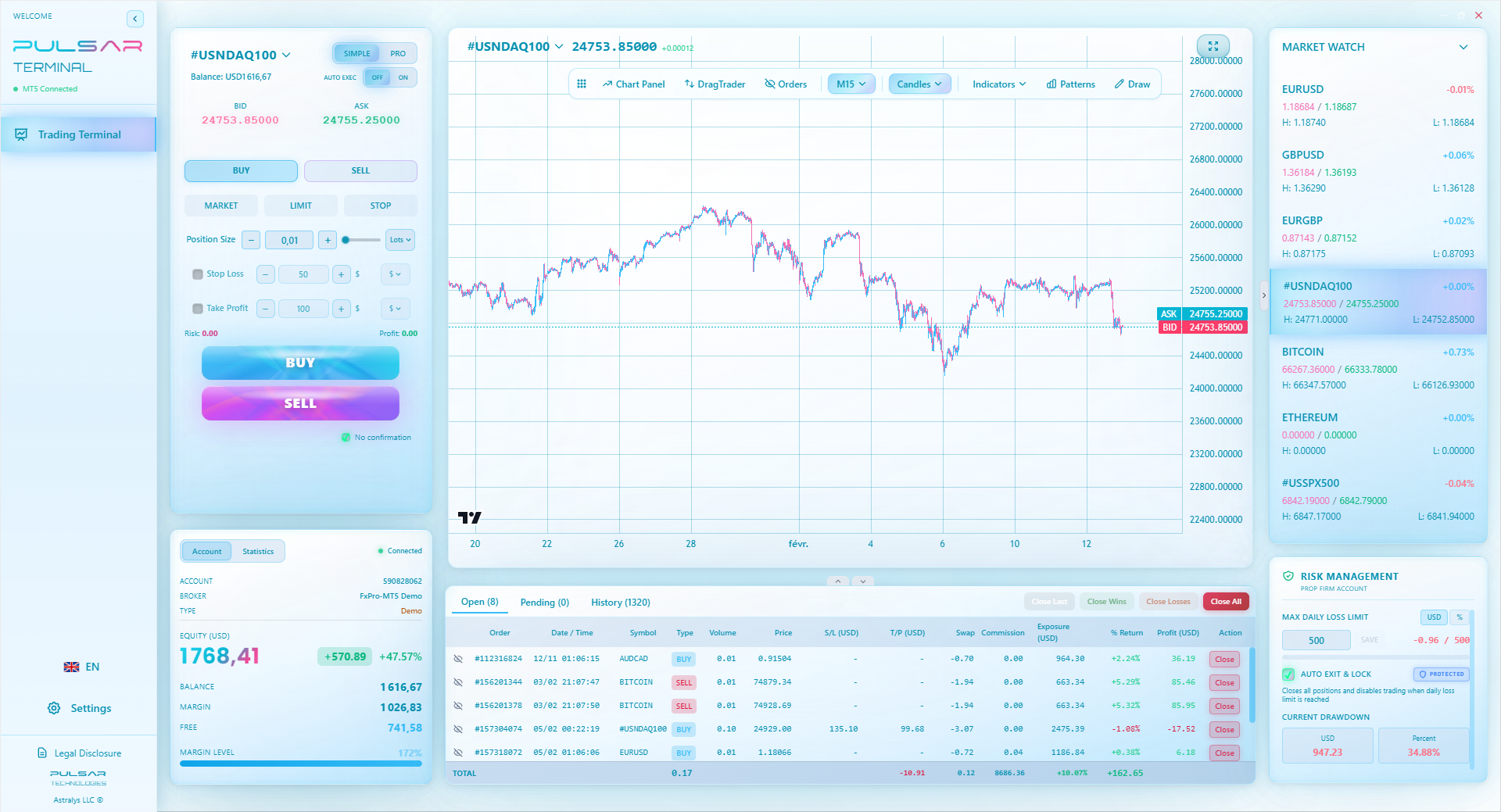
Managing multiple option legs and their breakeven points is complex, but tools like Pulsar Terminal can help visualize and manage multi-legged strategies directly on your trading platform.
Pulsar Terminal
Lo strumento MT5 tutto-in-uno: ordini drag-and-drop, multi-TP/SL, trailing stop, grid trading, Volume Profile e protezione prop firm. Usato da oltre 1.000 trader ogni giorno.
I've made most of these, so learn from my losses.
1. Ignoring Liquidity: You check the 22,500 call and it has a tight spread. But did you check the 22,400 and 22,600 calls? If those are illiquid, the market maker will punish you on the fill. Always check the bid-ask spread on all four legs. A 5-point spread on two legs can turn a profitable trade into a loser.
2. Misunderstanding the Profit Zone: Traders see the max profit and think, "As long as it's in the range, I'm good." No. The profit curve is a steep peak. You make 90% of the max profit only if it expires within 5-10 points of the middle. The rest of the "profit zone" gives you marginal returns. It's a pinning strategy, not a range strategy.
3. Holding Through Expiry: This seems logical, but it's risky. On expiry day, wild swings can happen in the last hour. If your butterfly is profitable at 3:00 PM, consider closing it. I once held a ₹3,500 profit until 3:20 PM, only to see Nifty swing 40 points and turn it into a ₹800 loss by 3:28 PM. The stress isn't worth it. Take the money and run.
4. Forgetting About Early Assignment (American Options): Indian stock options are American-style, meaning they can be exercised early. If your short call goes deep in-the-money, there's a risk of assignment. This would blow up your carefully defined risk. This is extremely rare with indices (European-style), but a real concern with single stock butterflies. Stick to Nifty and Bank Nifty to avoid this headache.
5. Overcomplicating with Adjustments: You'll read about "rolling" the wings or "transforming" the butterfly. In my experience, for retail traders in India, it's a nightmare. The commissions and slippage eat you alive. If the trade goes against you, take the defined loss and move on. Adjusting often just turns a small, planned loss into a larger, messy one.
The psychological risk is boredom. You'll set this trade and then watch nothing happen for days. The urge to scrap it and jump into a momentum trade will be strong. That's usually when the butterfly starts working. Patience isn't just a virtue here, it's the entire strategy.
💡 Consiglio di Winston
A butterfly is a waiting game. If you feel the urge to constantly check it, you've risked too much capital. Size it so you can forget it.
“Maximum profit looks great on paper, but the real skill is securing consistent gains from the steep slopes of the profit curve.”
The regulatory landscape has changed fundamentally. The old world of cheap, leveraged option selling is gone. For butterfly strategies, this is a mixed bag.
The Good News:
- Capital Efficiency: Compared to selling options, butterflies require minimal margin. Your capital can be deployed across more defined-risk trades.
- Reduced Weekly Expiries: With only one weekly expiry per index now, the market tends to focus its energy on that single expiry. This can make pinning behavior more predictable, which is great for butterflies.
- Defined Risk is King: In an environment where SEBI is terrified of unlimited retail losses, strategies with a known max loss are inherently safer and less likely to face further regulatory backlash.
The Challenges:
- Upfront Premium Payment: You must have the cash to pay for the long options immediately. No more free use. This reduces your buying power but also discourages overtrading.
- Higher STT: The 50% increase in STT on option premiums directly chips away at your profit. It makes executing smaller, marginal butterflies less attractive. You need a clearer setup to justify the trade.
- Potential for Wider Spreads: With higher contract sizes (now ₹15 lakh minimum), there are fewer participants. This could lead to wider bid-ask spreads, increasing your entry cost. It's not a huge issue yet for Nifty, but it's something to monitor.
My Adaptation: I've become more selective. I only put on 2-3 high-conviction butterflies a month now, instead of 5-6. I use wider profit targets to account for higher costs. And I absolutely avoid the temptation to turn a butterfly into a risky adjustment play if it's going south. The new rules punish improvisation and reward careful, pre-planned, capital-efficient strategies. The butterfly fits that bill perfectly.
It's a different game. The high-frequency, high-use punters are being squeezed out. That creates opportunity for those willing to use precise, patient strategies. The butterfly option trading strategy, once considered a niche advanced tactic, is now a very relevant tool for the modern Indian trader's toolkit.
FAQ
Q1Is the butterfly option strategy profitable in India?
It can be, but not in the way most traders think. It's not for making lakhs quickly. It's for consistent, smaller, risk-defined gains. Profitability depends entirely on accurate strike selection, low entry costs, and managing positions in the new high-STT, high-margin environment. It's a strategy of precision, not power.
Q2What is the maximum loss in a butterfly spread?
Your maximum loss is strictly limited to the net premium you paid to enter the entire 4-legged trade. For example, if you pay a total net debit of ₹30 per share for a Nifty butterfly, your max loss is ₹30 * 50 (lot size) = ₹1,500, plus brokerage and taxes. This loss occurs if the underlying expires outside the highest or lowest strike prices.
Q3What is the best platform to trade butterfly strategies in India?
You need a platform that allows multi-leg option orders. Zerodha Kite (integrated with Sensibull), Upstox Pro, and Dhan's dedicated options platform are excellent. Sensibull itself is a fantastic standalone tool for building and analyzing strategies like butterflies before executing them on your broker. Avoid platforms where you have to leg in manually.
Q4Should I use calls or puts for a butterfly?
For a long butterfly, the profit/loss graph is identical whether you use all calls or all puts. In practice, I usually use calls because they tend to have slightly better liquidity in the Indian market, especially for Nifty. Choose the one with the tighter bid-ask spreads for your chosen strikes.
Q5How does the butterfly strategy make money?
It profits from time decay (theta) on the two options you sold, while the cost of the options you bought is fixed. Its maximum profit is realized if the price expires exactly at the middle strike, where the two short options expire worthless and the long, outer options also expire worthless, but you keep the premium decay from the short ones minus your initial cost.
Q6Can I trade butterflies on stocks, not just Nifty?
Technically yes, but I don't recommend it for beginners. Stock options have lower liquidity, wider spreads, and are American-style (risk of early assignment). The slippage and costs can destroy the strategy's edge. Stick to highly liquid index options like Nifty and Bank Nifty to start.
Q7How has SEBI's increase in STT affected butterfly trades?
It's made them more expensive. Since a butterfly involves selling two options, you pay the increased 0.15% STT on that premium. This directly reduces your net profit. You now need a slightly more favorable move or a cheaper entry price to achieve the same return as before April 2026.
Lezione del Prof. Winston
Punti chiave:
- ✓Your max loss is your entry premium. Never forget it.
- ✓Liquidity kills more butterflies than bad predictions.
- ✓Costs (STT, brokerage) must be part of your initial math.
- ✓Trade the last hour of expiry at your own peril.
Quanto è stato utile questo articolo?
Clicca su una stella
Analisi Trading Settimanali
Analisi e strategie settimanali gratuite. Nessuno spam.
Sull'autore
Rajesh Sharma
Analista Forex Senior
Oltre 10 anni di trading sui mercati indiani e del Sud-Est asiatico. Ha iniziato con i derivati valutari del NSE prima di passare al forex internazionale. Specializzato in USD/INR e coppie dei mercati emergenti.
Commenti
Avviso di rischio
Il trading di strumenti finanziari comporta rischi significativi e potrebbe non essere adatto a tutti gli investitori. Le performance passate non garantiscono risultati futuri. Questo contenuto è fornito solo a scopo educativo e non deve essere considerato un consiglio di investimento. Conduci sempre le tue ricerche prima di fare trading.
Potrebbe interessarti anche

Cara Trading Forex Sukses: 7 Prinsip dari Trader Profesional
Cara trading forex sukses dengan 7 prinsip trader pro: manajemen modal, disiplin, journal trading, backtest. Data nyata, bukan janji profit palsu.
Jam Trading Forex Terbaik untuk Trader Indonesia: Panduan Lengkap dengan Tabel Waktu
Panduan jam trading forex untuk trader Indonesia. Tabel 4 sesi dunia, jam emas 20:00-00:00, sesi mana yang harus dihindari. Data akurat + tips dari trader berpengalaman.
Top 5 Sàn Forex Uy Tín Nhất 2026: Review Jujur dari Trader Indonesia
Top 5 sàn forex uy tín 2026 untuk trader Indonesia. Review jujur: spread, deposit, withdraw, dukungan lokal. Exness, XM, IC Markets & lebih.
Scarica Pulsar Terminal
Tutti questi calcolatori sono integrati in Pulsar Terminal con dati in tempo reale dal tuo conto MT5.
Scarica Pulsar Terminal