


Ever watched a currency pair like GBP/NGN rocket higher, only to realize you missed the move because you were waiting for a pullback that never came? I've been there, staring at the screen as price leaves me behind.

Olumide Adeyemi
Pioniere del Trading in Africa Occidentale ·  Nigeria
☕ 12 min di lettura
Cosa imparerai:
- 1What Exactly Is a Buy Stop Order?
- 2When Should a Nigerian Trader Use a Buy Stop?
- 3How to Set Up a Buy Stop Order: A Walkthrough
- 4Risks, Pitfalls & The Nigerian Context
- 5Buy Stop vs. Other Order Types: A Quick Comparison
- 6Building a Strategy Around Buy Stop Orders
- 7Choosing a Broker in Nigeria: What Matters for Buy Stops
- 8Taking It Further: Advanced Tips for the Pros
Ever watched a currency pair like GBP/NGN rocket higher, only to realize you missed the move because you were waiting for a pullback that never came? I've been there, staring at the screen as price leaves me behind. That frustration is exactly what a buy stop order is designed to solve. It's not just a fancy button on your trading platform, it's a strategic tool for entering trends and managing FOMO. For us trading in Nigeria, with the CBN's new FX Code emphasizing proper risk management, understanding tools like this is more important than ever. Let's break down exactly how a buy stop forex order works, when to use it, and the common pitfalls to avoid.
At its core, a buy stop order is an instruction you give to your broker to buy a currency pair at a price higher than the current market price. Think of it as a trap you set above the market, waiting for momentum to trigger it.
It's the opposite of a limit order, where you try to buy low. A buy stop says, "I want in, but only if the market proves it's going up by breaking through this specific level." The order sits dormant until the market's ask price hits or surpasses your specified trigger price. Then, it becomes a market order and gets filled at the next available price.

Warning: Your fill price on a buy stop is not guaranteed. In fast-moving markets, you might get filled at a worse price than your trigger level, a phenomenon called slippage. This is why understanding your broker's execution model is crucial.
I remember setting a buy stop on EUR/USD at 1.1050 when it was trading at 1.1020. Price spiked on a news event, and my order filled at 1.1057. That extra 7-pip cost ate into my potential profit right off the bat. It was a lesson in expecting, and planning for, imperfect fills.
Why would you ever want to buy high? It sounds counterintuitive, like paying more for plantain when you see the price going up. But in trading, it's about confirming direction. You're not trying to pick the bottom, you're waiting for the market to show its hand and then jumping on the trend.
You don't use a buy stop order randomly. It's a tool for specific market conditions. Here are the three main scenarios where it shines.
Catching Breakouts
This is the classic use. You identify a key resistance level on your chart - a price where the pair has tried and failed to break higher multiple times. You place your buy stop order just above that level. If price finally gathers enough strength to break through, your order is triggered, and you're positioned in the new uptrend.
For Naira pairs, this is common around psychological levels or previous highs. I once traded USD/NGN (through a CFD broker, of course, as local banks don't offer speculative trading) and placed a buy stop above a consolidation zone at 1480. The breakout happened, and the order caught a nice 150-pip move.
Adding to a Winning Position (Pyramiding)
Let's say you're in a long trade on GBP/NGN and it's moving in your favor. Instead of just sitting tight, you can use a buy stop to add another position if the trend accelerates. You might place a new buy stop order above a minor pullback high. If the uptrend resumes strongly, you add more units to your winning trade. This requires strict discipline and a solid position size calculator to avoid over-leveraging.
Trading News Volatility
Major economic announcements can cause explosive moves. If you anticipate a news release (like U.S. Non-Farm Payrolls) will be bullish for a pair, but you don't want to be in the trade during the initial volatility spike, you can set a buy stop above the pre-news range. Your trade only triggers if the market reaction is strongly positive, helping you avoid false starts.

Pro Tip: For news trading, use a buy stop with a limit. Some platforms call this a "stop-limit" order. It triggers at the stop price but only fills up to a specified limit price. This gives you more control over your maximum entry cost during chaotic news spikes.

💡 Consiglio di Winston
A buy stop above resistance is a vote of confidence in the breakout. But the market is a liar. Always demand a second opinion - a close above the level on your chosen timeframe - before you trust the move.
“A buy stop order isn't about buying low; it's about buying momentum and confirming the market has chosen a direction.”
Let's get practical. The steps are similar across most platforms like MetaTrader 4 or 5.
- Right-click on the chart of the pair you want to trade (e.g., XAU/USD) and select "Trading" then "New Order," or simply press F9.
- In the order window, change the "Type" from "Market Execution" to "Pending Order."
- Select "Buy Stop" from the pending order types.
- Set your "Price." This is the critical trigger price. Input the level you've identified from your analysis (e.g., 1.1100).
- Set your "Stop Loss" and "Take Profit" levels immediately. Never leave a pending order without these. Your stop loss should be placed below a logical support level.
- Choose an expiration. You can leave it as "GTC" (Good Till Cancelled) or set a specific date if your trade idea is time-sensitive.
- Review and click "Place."
The order will now appear on your chart as a horizontal line at your trigger price. It's not active yet. It's just waiting. I can't stress step 5 enough. I learned this the hard way early on. I set a buy stop on EUR/JPY, went to bed, and it triggered overnight. I hadn't set a stop loss. I woke up to a margin call because the pair reversed sharply. Always attach your risk management tools before the order goes live.

Example: Current EUR/USD price: 1.0850. You identify resistance at 1.0900. You set a Buy Stop at 1.0905. Stop Loss at 1.0870 (35 pips risk). Take Profit at 1.0980 (75 pip target). Your risk-reward ratio is about 1:2.1.
Buy stop orders are powerful, but they come with unique dangers, especially for traders here dealing with potential internet issues and market gaps.
1. False Breakouts (The Bull Trap): This is the #1 killer. Price spikes above your level, triggers your buy stop, and then immediately reverses, stopping you out for a loss. The market effectively "hunts" for stops placed above obvious levels. To combat this, look for breakouts with strong closing candles on a higher time frame (like the 4-hour or daily chart), not just a tiny spike on the 5-minute chart. Confluence with other indicators like the MACD indicator showing bullish momentum can help filter these.
2. Slippage & Gapping: As mentioned, during high volatility, your fill price can be worse than your trigger. For pairs involving the Naira in the unofficial market, or even major pairs during major news, gaps can occur. Your buy stop at 1.0900 could get filled at 1.0930 if the market gaps higher. This immediately puts your trade in a worse position.
3. The CBN FX Code and Risk Management: The new Nigerian FX Code, effective from late 2024, isn't about stopping retail traders like you and me from using international brokers. But its core principles - ethics, governance, and risk management - are a professional framework we should adopt. Using buy stops haphazardly, without defined stops and proper position sizing, is the opposite of good risk management. It shows you're not in control of your entries.
4. Broker Dependence: Your experience hinges on your broker's execution. A broker with slow execution or frequent requotes can turn a good buy stop strategy into a losing one. This is why choosing a reputable, well-regulated international broker with a proven track record for Nigerian clients, like IC Markets or Pepperstone, is non-negotiable. Check their policy on slippage and order execution.
💡 Consiglio di Winston
Your pending order is a soldier waiting for orders. Never send a soldier into battle without a clear retreat plan (stop loss) and a defined mission objective (take profit).
“The false breakout is the tax you pay for using buy stop orders. Your job is to make your strategy profitable enough to pay that tax and still come out ahead.”
It's easy to get confused. Here’s how a buy stop stacks up against its cousins.
| Order Type | Goal | Entry Price Relative to Market | Best For... |
|---|---|---|---|
| Buy Stop | Enter a long trade on upward momentum | Higher than current price | Breakout trading, trend confirmation. |
| Buy Limit | Enter a long trade at a better (lower) price | Lower than current price | Buying on a dip or pullback within an uptrend. |
| Sell Stop | Enter a short trade on downward momentum | Lower than current price | Breakdowns, shorting a falling market. |
| Market Order | Enter a trade immediately | At the current market price | When you need instant execution, regardless of price. |
Think of it this way: A buy limit is patient and cheap. A buy stop is aggressive and chases strength. A market order is urgent. Your choice depends entirely on your trading strategy. A scalping strategy might use more market orders for speed, while a swing trading approach relies heavily on pending orders like buy stops and limits.
A buy stop isn't a strategy by itself. It's an entry tool within a larger plan. Here’s a simple, repeatable framework you can test.
The "Confirmed Breakout" Strategy:
- Identify the Range: Find a currency pair that's been trading in a clear consolidation range or triangle pattern for a while. Let's use EUR/USD as an example.
- Mark Key Levels: Draw a clear horizontal line at the resistance of the range.
- Wait for Confirmation: Don't place the order the moment you draw the line. Wait for price to approach the resistance and show signs of strength - maybe a strong bullish candle or a bullish divergence on the RSI indicator.
- Place the Buy Stop: Set your buy stop 5-10 pips above the resistance line. This buffer helps avoid being whipsawed by a tiny spike that doesn't hold.
- Manage the Trade: Your stop loss goes below the recent swing low inside the range, or below the breakout candle. Your take profit can be set at a 1:1.5 or 1:2 risk-reward ratio, or at the next historical resistance level.
A Real Trade Example: In early 2024, GBP/JPY was consolidating between 187.00 and 188.50. I placed a buy stop at 188.65. It triggered, and I set my stop at 187.90. The pair rallied to 190.80 over the next week. The buy stop got me in cleanly after the breakout was underway, removing the emotion of chasing it.
The key is consistency. Don't use buy stops for one trade and market orders for the next on the same setup. Define your entry rules, and stick to them.
“In Nigeria's evolving market, using tools like buy stops with discipline is how you trade professionally, not just speculatively.”
Your broker can make or break your buy stop strategy. Here’s what to look for as a Nigerian trader:
1. Reliable Order Execution: This is paramount. You need a broker that executes orders quickly with minimal slippage. Look for brokers advertising "STP" or "ECN" execution models. They tend to have better order filling than market makers, especially for pending orders. Read reviews from other Nigerian traders on their experiences with order execution during London or New York sessions.
2. Naira-Friendly Deposits & Withdrawals: Can you fund your account in Naira? What are the deposit/withdrawal methods? Local bank transfer, card, or fintech apps like Opay or Moniepoint? What are the fees and processing times? A broker with seamless local deposits removes a huge headache. Some brokers, like Exness and XM, have tailored their services for the Nigerian market in this regard.
3. Regulation (The Safety Net): While the SEC Nigeria doesn't license forex brokers, you must use a broker regulated by a reputable international authority. FCA (UK), ASIC (Australia), CySEC (Cyprus), or FSCA (South Africa) are good signs. This regulation protects your funds in segregated accounts and gives you a channel for dispute resolution.
4. Platform & Tools: Does the broker offer MetaTrader 4/5? Can you easily set, modify, and track multiple pending orders? Advanced tools for managing these orders - like the ability to set a trailing stop automatically after entry - can be a huge advantage. This is where a powerful terminal that works with your MT5 can change the game.
💡 Consiglio di Winston
The most expensive lesson is the one where your buy stop fills perfectly, but you didn't calculate your position size. A 50-pip stop loss on a 5-lot trade is a very different beast than on a 0.5-lot trade. Know your numbers cold.
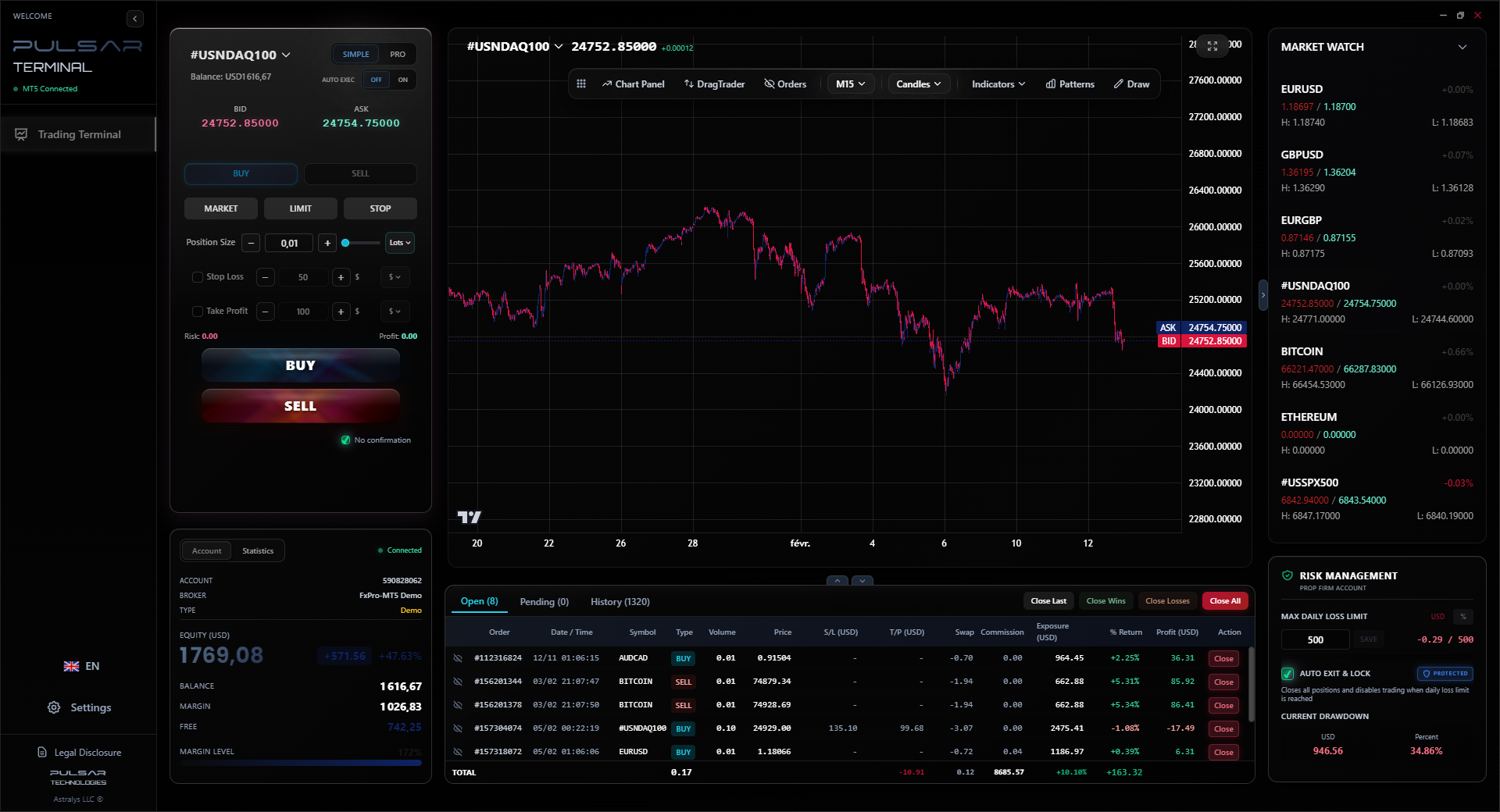
Managing multiple pending orders and setting automated trailing stops for your breakouts is complex, but tools like Pulsar Terminal simplify this directly within your MT5 platform.
Pulsar Terminal
Lo strumento MT5 tutto-in-uno: ordini drag-and-drop, multi-TP/SL, trailing stop, grid trading, Volume Profile e protezione prop firm. Usato da oltre 1.000 trader ogni giorno.
Once you're comfortable with the basics, these nuances can give you an edge.
1. Use Buy Stops for Partial Entries (Scaling In): Instead of one large buy stop order, place two or three smaller ones at progressively higher levels. This "buy stop ladder" averages your entry if the breakout is gradual and helps you get a better average price if the first trigger suffers slippage. It's a more sophisticated form of pyramiding.
2. Combine with a Stop Loss on the Other Side: This is a powerful but risky technique. You can set a buy stop above resistance AND a sell stop below support of the same range. Whichever way the market breaks, you're in. This is a pure volatility play. The trick is to size each position so that if one triggers and hits its stop loss, the loss is acceptable, and the winning trade on the other side covers it and profits. It requires precise calculation.
3. Mind the Spread: When setting your buy stop trigger price, remember the spread. If the resistance is at 1.0900 and the spread for EUR/USD is 1.2 pips, your order might trigger when the ask price hits 1.0900, but you're buying at 1.0900 + half the spread. It's a small detail, but over many trades, it adds up. Consider the spread definition and choose brokers with consistently tight spreads on your preferred pairs.
Finally, keep a journal. Note every buy stop order you place: the trigger price, the fill price (was there slippage?), the outcome, and the market condition. After 20-30 trades, you'll see patterns. You'll learn if your breakout levels are good, or if you're consistently getting caught in false breaks. That data is pure gold for refining your edge.
FAQ
Q1Is using a buy stop order legal for forex trading in Nigeria?
Yes, absolutely. There are no laws preventing individual Nigerian traders from using buy stop orders or any other trading tools with internationally regulated forex brokers. The Central Bank of Nigeria (CBN) restricts local banks from speculative forex trading, but you are free to trade through brokers regulated by bodies like the UK's FCA or ASIC in Australia. The key is to use a reputable, regulated international platform.
Q2What's the main risk of a buy stop order?
The biggest risk is the false breakout. The market triggers your order by moving above your level, then immediately reverses and hits your stop loss. This 'stop hunt' can happen frequently. To reduce this risk, look for breakouts confirmed by strong closing prices on higher timeframes (like the 4-hour or daily candle closing above the level), not just intraday spikes.
Q3Can I set a buy stop and a stop loss at the same time?
Yes, and you absolutely should. When you place the buy stop as a pending order, your trading platform will have fields for both 'Stop Loss' and 'Take Profit.' Always fill these in before placing the order. This defines your risk before the trade is even active, which is a cornerstone of professional discipline and aligns with the risk management principles of Nigeria's new FX Code.
Q4How is a buy stop different from a buy limit?
They are opposites in intent. A buy limit is set below the current market price to buy at a cheaper level (hoping for a dip). A buy stop is set above the current market price to buy once momentum is established (chasing a breakout). One tries to buy low, the other buys high to sell even higher.
Q5What happens if the market gaps above my buy stop price?
If the market opens or jumps significantly higher, bypassing your trigger price, your buy stop order will be executed at the first available price after the gap. This is known as a 'gap fill' and often results in slippage, where your entry is much worse than planned. This is a major risk when holding pending orders over weekends or during major news events.
Q6Do all brokers accept buy stop orders?
Virtually all legitimate forex brokers offering MetaTrader or similar platforms support buy stop orders. However, their execution quality varies massively. Some might deliberately cause requotes or excessive slippage on stop orders. This is why choosing a well-regulated broker known for good execution, like those we review for Nigerian traders, is critical.
Q7Can I use a buy stop for a short-term trading style like scalping?
It's possible but tricky. Scalping relies on speed, and a buy stop adds a layer of delay (waiting for the trigger). Scalpers often use market orders for instant entry. However, a scalper might use a buy stop to automatically enter a trade if price breaks a key micro-level on a 1-minute chart while they're away from the screen. It's less common but can be part of a systematic approach.
Lezione del Prof. Winston
Punti chiave:
- ✓A Buy Stop enters a long trade only when price breaks *above* a specified level.
- ✓Use it primarily for trading confirmed breakouts from ranges or consolidation.
- ✓Always attach a Stop Loss and Take Profit before the order becomes active.
- ✓Beware of false breakouts - the #1 risk with this order type.
- ✓Your broker's execution quality is critical for minimizing slippage on fills.
Quanto è stato utile questo articolo?
Clicca su una stella
Analisi Trading Settimanali
Analisi e strategie settimanali gratuite. Nessuno spam.
Sull'autore
Olumide Adeyemi
Pioniere del Trading in Africa Occidentale
Uno degli educatori di trading forex più attivi in Nigeria. 8 anni di esperienza di trading da Lagos. Specializzato in strategie a basso capitale e sfide prop firm per trader africani.
Commenti
Avviso di rischio
Il trading di strumenti finanziari comporta rischi significativi e potrebbe non essere adatto a tutti gli investitori. Le performance passate non garantiscono risultati futuri. Questo contenuto è fornito solo a scopo educativo e non deve essere considerato un consiglio di investimento. Conduci sempre le tue ricerche prima di fare trading.
Potrebbe interessarti anche

Cara Trading Forex Sukses: 7 Prinsip dari Trader Profesional
Cara trading forex sukses dengan 7 prinsip trader pro: manajemen modal, disiplin, journal trading, backtest. Data nyata, bukan janji profit palsu.
Jam Trading Forex Terbaik untuk Trader Indonesia: Panduan Lengkap dengan Tabel Waktu
Panduan jam trading forex untuk trader Indonesia. Tabel 4 sesi dunia, jam emas 20:00-00:00, sesi mana yang harus dihindari. Data akurat + tips dari trader berpengalaman.
Top 5 Sàn Forex Uy Tín Nhất 2026: Review Jujur dari Trader Indonesia
Top 5 sàn forex uy tín 2026 untuk trader Indonesia. Review jujur: spread, deposit, withdraw, dukungan lokal. Exness, XM, IC Markets & lebih.
Scarica Pulsar Terminal
Tutti questi calcolatori sono integrati in Pulsar Terminal con dati in tempo reale dal tuo conto MT5.
Scarica Pulsar Terminal