


Looking for the cheapest instant funding prop firms? I get it.

James Mitchell
Analista Trading Senior
☕ 11 min di lettura
Cosa imparerai:
- 1What 'Instant Funding' Really Means (It's Not What You Think)
- 2Comparing Costs: Fees, Splits, and the Hidden Math
- 3Firms Offering Instant Funding (A Realistic Look)
- 4The Real Reason Most Traders Fail in Instant Programs
- 5How to Survive (And Actually Benefit From) Instant Funding
- 6The Verdict: Traditional Challenge vs. Instant Funding
- 7My Final Recommendation: Skip the Search

Looking for the cheapest instant funding prop firms? I get it. The idea of paying a small fee for instant access to a six-figure account is intoxicating. But here's the brutal truth I learned the hard way: chasing the lowest price is the fastest way to lose your money. In this game, 'cheap' often means 'designed to fail.' Let's break down what 'instant funding' really costs, which firms offer it, and why your focus should be on survival, not just the entry ticket.
Instant funding sounds like a golden ticket. Skip the challenge, pass a quick review, and boom - you're trading with the firm's capital. The marketing is genius. The reality is a minefield of fine print.
These programs aren't charities. They're a calculated risk model. The firm is betting that most traders, freed from the pressure of a formal evaluation, will make emotional mistakes and lose quickly. They collect your one-time fee or first month's subscription, and you're out. The profit split only matters if you can survive.
I tried one of the earliest instant models back in 2020. Paid a $299 'activation fee' for a $50k account. I was up $1,200 in the first two days. Got cocky. On day three, I chased a losing EUR/USD guide trade, broke the daily loss limit, and was terminated before the London close. The entire experience lasted 72 hours. The firm kept my fee, and I learned that speed of access has zero correlation with longevity.

Warning: Instant funding usually comes with stricter, often hidden, risk rules. A single bad hour can end your account, with no reset or retry option. You're live from the first tick, and the margin for error is zero.
The core trade-off is simple: you exchange the prolonged stress of a challenge for the immediate, high-stakes pressure of live capital. Most traders aren't ready for that switch.

💡 Consiglio di Winston
The market doesn't care how quickly you got funded. It only cares about your next decision. Speed of access is irrelevant to your edge.

“Chasing the lowest price is the fastest way to lose your money.”
When we talk about the 'cheapest' instant funding prop firms, we have to look at total cost of ownership, not just the sign-up price. A low fee with a terrible profit split or insane rules isn't cheap, it's expensive.
Let's compare a few common structures. Note: Prices change weekly; this is about the type of cost.
| Firm Model | Example Entry Cost | Profit Split | Key Funding Rule | Real Cost Per $100k |
|---|---|---|---|---|
| One-Time Fee | $299 - $499 | 80%-90% to you | Often a strict daily loss (e.g., 5%) | The fee is sunk. You lose it if you fail. |
| Monthly Subscription | $150 - $300/month | 75%-85% to you | Must be profitable over 30 days to renew | Recurring. Can exceed a challenge fee fast. |
| Scaled Challenge | $99 'mini' challenge | 50%-70% to you | Must pass a tiny eval to get instant account | Lower upfront, but you give up half your profits. |
The Subscription Trap
The monthly model is sneaky. Let's say you pick a firm charging $200/month for a $100k instant account. You break even for three months - no profit, no loss. You've just paid $600 for the privilege of trading their capital. A traditional two-phase challenge might cost $350 once. Which is truly cheaper?
Profit Split Erosion
A 50% split is a massive drag on performance. To net $10,000, you have to generate $20,000 in gross profits. That requires taking more risk, which increases your odds of hitting a margin call. I always run the numbers through a position size calculator assuming my net profit target. A 'cheap' fee with a low split forces you to size up dangerously.

Pro Tip: Calculate your expected cost per year. (Monthly fee x 12) OR (One-time fee / expected account lifespan in months). If you don't think you'll hold the account for 6+ months, a one-time fee is rarely worth it.

“Instant funding removes the safety net. The firms know most traders' discipline evaporates without one.”
Here's a breakdown of notable players in the instant funding space. This isn't an endorsement. It's an analysis based on their published structures and my circle's experiences. You must read their current terms yourself.
1. The 'True' Instant (Post-Quick Review) Firms These firms typically have you submit a trading report or take a brief, simple test on your knowledge. They're assessing if you understand basic risk, not if you can profit.
- Typical Cost: $250 - $600 one-time fee for $50k-$100k.
- The Catch: The risk rules are king. Daily loss limits are often tight (3-5%). The 'instant' account can be gone in an instant. They rely on rapid trader turnover.
2. The Subscription-Based Platforms This is a growing model. You pay a monthly fee for direct funding. It feels like a software subscription, which lowers the psychological barrier.
- Typical Cost: $150 - $400/month per account size tier.
- The Catch: The clock is always ticking. A breakeven month still costs you the fee. It creates pressure to 'make the fee back' each month, which leads to overtrading. I know a guy who cycled through three different subscription firms in a year, spending over $2k in fees without ever taking a consistent profit payout.
3. The 'Micro-Challenge' Gatekeepers These offer a very small, cheap challenge (e.g., $99 to trade a $10k account). Once you pass, you get access to instant funding accounts at higher sizes.
- Typical Cost: Small upfront, but profit splits are lower (sometimes starting at 50/50).
- The Catch: The low challenge fee is a lure. The firm makes its real money from your reduced profit share over the long term. If you're a consistently profitable trader, this is the most expensive model by far.
Choosing between these isn't about finding the cheapest instant funding prop firms. It's about diagnosing which cost structure you're most likely to survive under. For most, the pressure of a monthly fee is a performance killer.
💡 Consiglio di Winston
If you're comparing fees down to the last dollar, you're focused on the wrong metric. The cost of a single rule violation is infinitely greater.
“Instant funding removes the safety net. The firms know most traders' discipline evaporates without one.”
It's not bad luck. It's psychology, amplified by the structure. When you bypass the challenge, you skip a crucial incubation period. That period isn't about proving you can trade - it's about proving you can follow rules under simulated pressure.
Without that filter, you're thrown into the deep end. The psychological weight of trading 'real' firm capital from day one is immense. Every pip definition movement feels heavier. This leads to two fatal errors:
- Paralysis at Breakeven: You get a small profit, say $500. Fear of losing it back makes you close early, never letting winners run. You're trading not to lose, rather than to win.
- Revenge Trading After a Loss: You hit 80% of your daily loss limit. Panic sets in. Instead of stopping, you try to 'trade back to zero' before the day ends. You take a low-probability setup, blow through the limit, and get terminated. Game over.
I made error #2. My daily loss limit was $2,500 on a $100k account. I was down $2,000 by noon on a messy XAU/USD guide move. Instead of walking away, I thought, 'I just need a quick $500 winner to get some breathing room.' I entered a crude oil trade based on a gut feeling, no plan. It went against me $300 in seconds, triggering the auto-liquidation. The silence after that was deafening.

Example: A 5% daily loss limit on a $50k account is $2,500. That sounds like a lot. But if your average spread definition and slippage cost you $50 per trade, and you make 10 nervous, scratchy trades in a day, you've already bled $500 without the market even moving. Poor execution eats your buffer fast.
Instant programs remove the safety net. The firms know most traders' discipline evaporates without one.

“For 95% of traders, the traditional challenge is the better, truly cheaper path.”
If you're still determined to try an instant account, your strategy must be defense-first. Your goal for the first month isn't profit. It's survival and acclimation.
Phase 1: The 30-Day Survival Trial
- Trade Micro Lots: Start with position sizes 1/10th of what your risk tolerance allows. On a $100k account, trade as if it's $10k. The goal is to feel the execution, the payout delays, and the platform, without meaningful P&L swings.
- Set Hard Daily Stop-Losses: Decide on a max daily loss (e.g., 1% of account, NOT the firm's 5% limit) and stick to it. Use a tool to track this in real-time.
- Limit Trade Frequency: No more than 2-3 high-conviction trades per day. Overtrading is the #1 killer in unstructured environments.
Phase 2: Building a Track Record After 30 consistent days without a major rule breach, you've proven you can operate the account. Only then should you gradually scale size toward your planned risk levels (e.g., 0.5-1% per trade).
The Tool Advantage This is where technology is non-negotiable. You need automated risk guards because your emotions will fail you.
Pro Tip: Use a trading journal religiously. For every trade, note the setup, your emotional state (nervous, confident, bored), and the outcome. After two weeks, patterns emerge. You'll see if you're revenge trading or closing winners too early. It's the cheapest performance coach you'll ever have.
Your edge in an instant account isn't a better indicator. It's superior risk management and emotional control. The firms are set up for you to fail at both.
💡 Consiglio di Winston
Your first goal with any firm capital is not to make money. It's to not lose the opportunity to make money tomorrow.
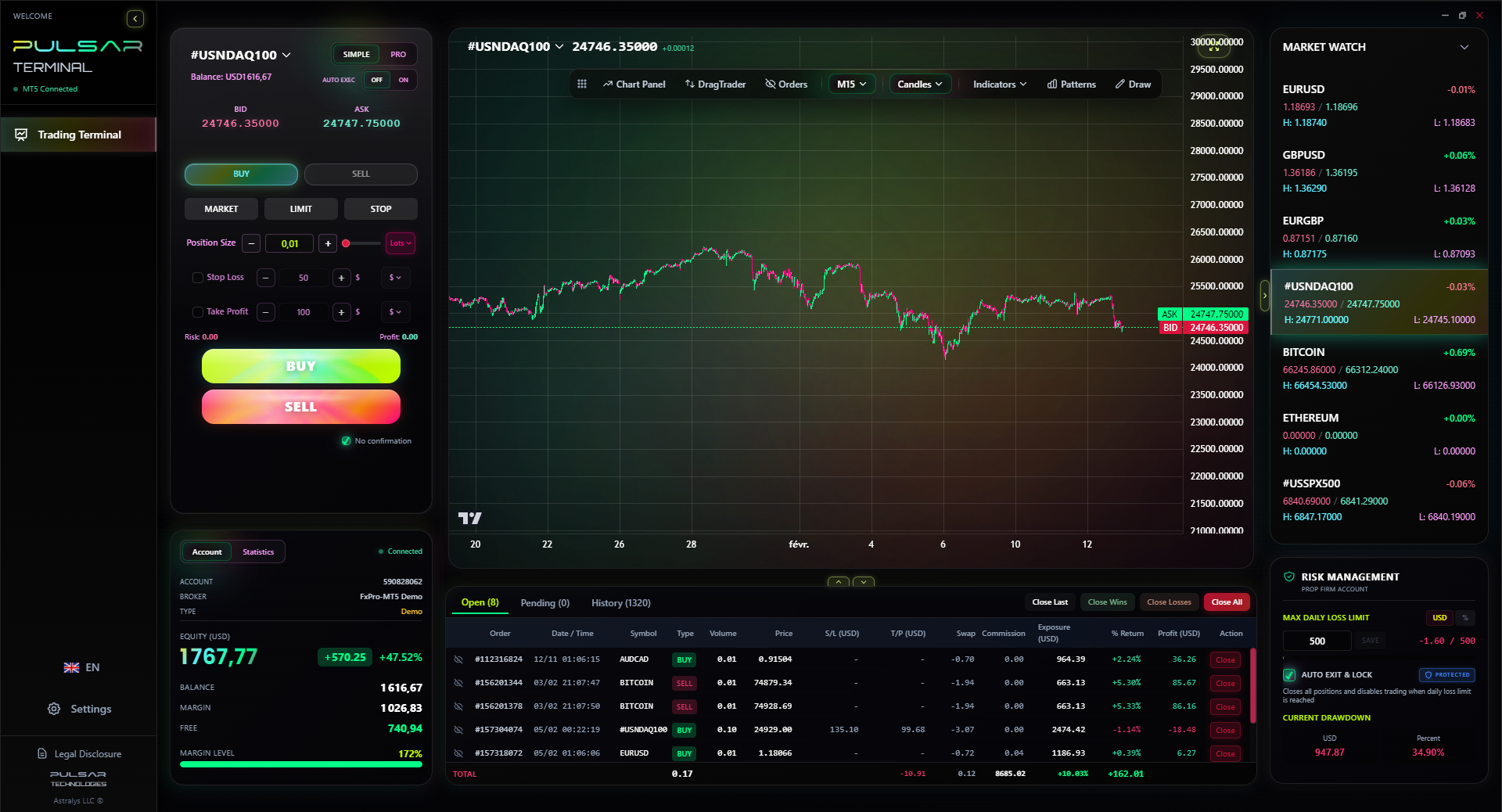
Surviving an instant funding account requires iron-clad risk management, which is exactly what Pulsar Terminal's prop firm daily loss protection and automated trade tools are built for.
Pulsar Terminal
Lo strumento MT5 tutto-in-uno: ordini drag-and-drop, multi-TP/SL, trailing stop, grid trading, Volume Profile e protezione prop firm. Usato da oltre 1.000 trader ogni giorno.
“For 95% of traders, the traditional challenge is the better, truly cheaper path.”
So, should you even look for the cheapest instant funding prop firms? Let's be blunt.
Choose a Traditional Two-Phase Challenge IF:
- You are newer to trading or lack a long, verifiable track record.
- You need the structured discipline of phase 1 and 2 to build good habits.
- You want a lower-cost, one-time shot at funding (even if it takes longer).
- You are prone to emotional decision-making under pressure.
The challenge is a simulator with consequences. It's training wheels. That's a good thing. Firms like FTMO (though not instant) popularized this for a reason: it filters for discipline. The scalping strategy that works in a demo might explode in a live instant account due to slippage. The challenge helps you find that out cheaply.
Consider an Instant Funding Program IF:
- You have a multi-year, statistically significant live track record (not demo).
- You have a rock-solid, mechanical trading plan you've followed for years.
- You view the fee as a cost of business and can afford to lose it without affecting your psychology.
- You need immediate capital access for a specific, proven strategy.
For 95% of traders, the traditional challenge is the better, truly cheaper path. It forces the discipline that the instant model assumes you already have. Most of us are kidding ourselves about that.
In the end, the 'cost' of a prop firm isn't the fee. It's the total capital you lose (your fee + your lost profits) before you either succeed or give up. By that measure, a well-chosen challenge is almost always the cheapest option.
“The 'cost' of a prop firm isn't the fee. It's the total capital you lose before you either succeed or give up.”
Stop searching for the cheapest instant funding prop firms. Start searching for the most strong, trader-friendly ruleset you can afford.
Here's my actionable advice, born from 12 years of watching traders (including myself) blow up:
- Build a Live Track Record First: Before giving any firm a dime, trade your own small capital for at least 6 months. Use a broker with low barriers like Exness review or IC Markets review for raw spreads. Prove you can be consistent with real money, real slippage, and real emotion.
- Start with a Standard Challenge: Pick a reputable firm with clear, fair rules. Treat Phase 1 as a paid internship. Your goal is to pass, not get rich. The skills you build - patience, rule-following, journaling - are worth ten times the challenge fee.
- If You Must Go Instant: Treat the first fee as a tuition payment you expect to lose. Choose a one-time fee model over a subscription for your first attempt. Trade tiny. Your only KPI for the first month is 'Did I follow my rules every single day?'
The prop firm industry sells dreams. Your job is to focus on the mechanics. The funding will come as a byproduct of execution, not as the goal. I lost nearly $5,000 in various fees and failed accounts before I internalized that. Don't be me. Be the patient, boring trader who survives long enough to get paid.
Remember, the cheapest firm is the one you don't blow up with.

FAQ
Q1What is the absolute cheapest instant funding prop firm?
As of now, some firms offer 'instant' access for as low as $99 via a micro-challenge model. However, these often come with severely reduced profit splits (as low as 50%). When you factor in the long-term cost of giving up half your profits, they are the most expensive option for a successful trader. True cost is about more than the entry fee.
Q2Can you really get funded instantly with no challenge?
Yes, but 'no challenge' doesn't mean 'no evaluation.' Most firms require a quick review of your trading knowledge or a previous track record. More importantly, you are immediately subject to strict live trading rules (daily loss limits, consistency rules). The 'challenge' happens in real-time with real capital on the line, which is psychologically harder for most.
Q3Is instant funding better for swing trading or scalping?
It can be better for swing trading strategies. Scalping in an instant account is dangerous due to the high volume of trades, which increases exposure to rule violations (like daily loss limits) and can lead to overtrading. Swing trades, with fewer entries and exits, are easier to manage under strict risk constraints.
Q4What's the biggest hidden risk with instant funding?
The psychological shift. Without the proving ground of a challenge, traders often lack the discipline for live firm capital. This leads to panic decisions, revenge trading, and rapid failure. The hidden risk isn't in the rules; it's in your own unprepared mind.
Q5Do instant funding firms have higher profit splits?
Not usually. To offset the higher risk of giving you immediate capital, many instant firms either charge higher fees or offer lower profit splits (e.g., 70-80% to you) compared to top traditional firms (which can offer 80-90%). Always read the profit split agreement before paying.
Q6Should I use a discount code for an instant funding firm?
A discount can lower your initial fee, which is fine. But never choose a firm because it has a discount code. Choose the firm with the most sustainable rules for your strategy, then look for a code. Prioritizing a 10% discount over fair rules is a classic false economy.
Lezione del Prof. Winston
Punti chiave:
- ✓Instant funding tests psychology, not strategy.
- ✓Calculate total cost, not just sign-up fee.
- ✓Your first month's goal is survival, not profit.
- ✓Traditional challenges build crucial discipline.
- ✓Overtrading is the #1 killer in instant accounts.
Quanto è stato utile questo articolo?
Clicca su una stella
Analisi Trading Settimanali
Analisi e strategie settimanali gratuite. Nessuno spam.
Sull'autore
James Mitchell
Analista Trading Senior
Con base a New York e oltre 9 anni di esperienza nel trading. Si occupa delle principali coppie USD, sfide delle prop firm e del contesto normativo statunitense.
Commenti
Avviso di rischio
Il trading di strumenti finanziari comporta rischi significativi e potrebbe non essere adatto a tutti gli investitori. Le performance passate non garantiscono risultati futuri. Questo contenuto è fornito solo a scopo educativo e non deve essere considerato un consiglio di investimento. Conduci sempre le tue ricerche prima di fare trading.
Potrebbe interessarti anche

Cara Trading Forex Sukses: 7 Prinsip dari Trader Profesional
Cara trading forex sukses dengan 7 prinsip trader pro: manajemen modal, disiplin, journal trading, backtest. Data nyata, bukan janji profit palsu.
Jam Trading Forex Terbaik untuk Trader Indonesia: Panduan Lengkap dengan Tabel Waktu
Panduan jam trading forex untuk trader Indonesia. Tabel 4 sesi dunia, jam emas 20:00-00:00, sesi mana yang harus dihindari. Data akurat + tips dari trader berpengalaman.
Top 5 Sàn Forex Uy Tín Nhất 2026: Review Jujur dari Trader Indonesia
Top 5 sàn forex uy tín 2026 untuk trader Indonesia. Review jujur: spread, deposit, withdraw, dukungan lokal. Exness, XM, IC Markets & lebih.
Scarica Pulsar Terminal
Tutti questi calcolatori sono integrati in Pulsar Terminal con dati in tempo reale dal tuo conto MT5.
Scarica Pulsar Terminal