


Here's a hard truth most trading gurus won't tell you: picking the wrong lot size is the fastest way to turn a R10,000 account into a R1,000 account, even if your trade idea was right.

David van der Merwe
Trader dei Mercati Emergenti ·  South Africa
☕ 12 min di lettura
Cosa imparerai:
Here's a hard truth most trading gurus won't tell you: picking the wrong lot size is the fastest way to turn a R10,000 account into a R1,000 account, even if your trade idea was right. I've seen it happen to mates who understood the market direction perfectly but got wiped out because their position was simply too big. In South Africa, where our rand can be volatile and broker offerings vary wildly, understanding different lot sizes in forex isn't just theory, it's survival. This guide will walk you through exactly how to use standard, mini, micro, and even nano lots to trade safely and grow your capital, not incinerate it.
Think of a lot as the amplifier for your trade. It doesn't change the melody (your analysis), but it determines how loud the music plays - and how badly it hurts your ears if it's off-key. In simple terms, a lot is a standardized contract size that determines how many units of currency you're buying or selling.
Back when I started, brokers only offered standard lots. You needed serious capital just to get in the game. These days, thanks to competition and better tech, we have options. This is fantastic for us in South Africa, because it means you can start trading with a few thousand rand and still apply proper risk management. You're not forced to risk 5% of your account on a single, massive trade just because the minimum size is too big.
The core concept is the pip value. A pip is the smallest price move a currency pair can make. How much that move costs you (or earns you) depends entirely on your lot size. Getting this relationship wrong is where new traders faceplant. I'll show you the numbers so you never have to guess again.
Let's break down each lot size with real numbers, using EUR/USD as our example pair. Remember, these pip values are for pairs where the quote currency is USD. For something like EUR/ZAR, the math is different, and I'll get to that.
Standard Lot (1.00 Lot)
This is the old-school, full-sized contract. One standard lot equals 100,000 units of the base currency.
- Pip Value: ~$10
- What it means: If EUR/USD moves 1 pip in your favor, you make about $10. If it moves 10 pips against you, you lose $100. Just like that.

Warning: Trading a full standard lot with a small South African account is like trying to park a truck in a compact car bay. With a R10,000 account and 30:1 FSCA use, a 1.00 lot on EUR/USD uses about $3,333 in margin. That's a third of your capital tied up in one trade, leaving you zero room for error. I only use these for very large accounts or specific, low-risk hedging strategies.
Mini Lot (0.10 Lot)
A mini lot is one-tenth of a standard lot, or 10,000 units.
- Pip Value: ~$1
- What it means: This is where many active retail traders live. A 50-pip stop-loss costs you $50. It's manageable. I used mini lots for years when building my account from R20,000 upwards. They give you meaningful exposure without the heart-stopping volatility of a standard lot.
Micro Lot (0.01 Lot)
A micro lot is one-tenth of a mini lot, or 1,000 units. This is the beginner's best friend and a seasoned pro's tool for fine-tuning.
- Pip Value: ~$0.10 (10 US cents)
- What it means: With a micro lot, you can practice real trading with real money without the fear of a single bad trade ruining your month. A 100-pip loss is only $10. I still use micro lots to test new strategies or to add a tiny position to an existing trade without messing up my overall risk. Most good brokers like IC Markets or Exness offer these seamlessly.
Nano Lot (0.001 Lot)
Not all brokers offer these, but a nano lot is 100 units.
- Pip Value: ~$0.01 (1 US cent)
- What it means: This is for surgical precision. If you have a R1,500 account and want to risk exactly 0.5% on a trade with a wide stop-loss, a nano lot lets you do that math perfectly. It's also brilliant for relentless forward testing. You can run a scalping strategy live for a month with nano lots and the total loss if it fails might be less than the price of a steak.

Example: Let's say you're trading GBP/USD. You buy at 1.2600 with a 0.05 lot position (5 micro lots). The price rises to 1.2650. That's a 50-pip gain. Your profit? 50 pips x $0.10 per pip per micro lot x 5 micro lots = $25. Simple, clean math.

💡 Consiglio di Winston
A trade sized correctly should let you sleep at night. If you're checking your phone every 10 minutes, your lot is too big. Cut it in half.
“Your lot size should make you slightly bored, not excited. If placing the trade gives you an adrenaline rush, your position is too big.”
This is the critical part most guides miss, and it's cost me money personally. If your trading account is denominated in South African Rand (ZAR), you have an extra layer of risk: currency conversion.
Your broker does all the profit/loss calculations in the quote currency of the pair (usually USD). Then, they convert that result into ZAR at their exchange rate to show your balance. This rate is almost never the perfect interbank rate you see on Google; there's a small mark-up.
Here’s a real example from my early days. I had a ZAR account with a broker. I took a 0.1 lot (mini lot) trade on USD/ZAR, aiming to profit from rand weakness. The trade went well, and I closed it for a $150 profit. I was thrilled. When it hit my account, it showed as R2,550. I did the math. The broker used an effective USD/ZAR rate of 17.00 to convert my profit. The market rate that day was about 16.90. That hidden spread on the conversion shaved about R15 off my win. It seems small, but over dozens of trades, it adds up.
The lesson? When you're calculating position size for a ZAR account, you must factor in that your risk in Rands will fluctuate with the USD/ZAR rate. A 1% risk today might be 1.1% tomorrow if the rand weakens sharply. It adds another variable. This is one reason I eventually switched my main trading account to USD. It simplifies everything. If you're starting with a ZAR account, just be aware of this silent partner in all your trades.
For pairs like EUR/ZAR or GBP/ZAR, the pip value is different because the quote currency is ZAR. A standard lot (100,000 units) on EUR/ZAR means each pip is worth roughly 100,000 (units) x 0.0001 (1 pip) = ZAR 10. So, a 100-pip move equals a R1,000 profit or loss. This is why you must always, always use a position size calculator before entering a trade, especially on exotic pairs.
Forget about trying to get rich on one trade. Your first job is to stay in the game. The single most important rule for choosing a lot size is the 1% Risk Rule. Never risk more than 1% of your account balance on any single trade.
Here’s the exact formula I use for every trade:
- Determine Account Risk: What's 1% of your account? For a R15,000 account, that's R150.
- Determine Trade Risk: How many pips is your stop-loss from your entry? Let's say you're buying USD/ZAR at 18.50 and your stop-loss is at 18.40. That's a 100-pip risk.
- Calculate the Pip Value in ZAR: You need to find the lot size where a 100-pip loss equals R150.
- If you trade 1 micro lot (0.01) on USD/ZAR, a 1-pip move is worth roughly ZAR 0.10.
- Therefore, a 100-pip loss on 1 micro lot = 100 x ZAR 0.10 = R10.
- Find Your Lot Size: You can afford to lose R150. R150 / R10 (loss per micro lot) = 15. You can trade 15 micro lots, or 0.15 standard lots.
This math forces discipline. On that R15k account, a sexy EUR/USD setup with a tight 20-pip stop might let you trade a 0.75 mini lot. A messy GBP/JPY trade with a 150-pip stop might only allow for 2 micro lots. The lot size serves the risk, not the other way around.

Pro Tip: Your lot size should make you slightly bored, not excited. If placing the trade gives you an adrenaline rush, your position is too big. Scale down to a micro lot until the emotional charge disappears. That's when you start thinking clearly.
This is where tools become useful. Manually calculating this for every trade is a chore. A good trading platform or a standalone tool that lets you drag a stop-loss onto the chart and automatically calculates the correct lot size to hit your 1% risk is a game-saver. It removes emotion and error from the most critical step.
💡 Consiglio di Winston
Your first profit target should always be to move your stop-loss to breakeven. Protecting capital is job one. Winning comes second.
“Discipline is choosing the lot size your calculator tells you to, not the one your gut wants.”
Let me save you some pain and money by showing you where I tripped up.
Mistake 1: Over-leveraging with Large Lots. This is the classic. In 2015, I had a R25,000 account. Gold (XAU/USD) was in a strong uptrend. I was convinced it would pull back to a key support level. I sold 1.0 standard lot (which, on gold, is massive) using high use, expecting a $15 drop. It went up $5 instead. My stop-loss was hit, and I lost over R8,000 in minutes - more than 30% of my account. I was right about the trend direction a week later, but my lot size made me a prisoner to short-term noise. I should have used a 0.1 or 0.05 lot. A smaller position would have let me survive the wiggle and potentially profit from the bigger move. You can learn more about the unique risks of trading gold in our XAU/USD guide.
Mistake 2: Not Adjusting Lot Size for Volatility. Not all pairs move the same. A 50-pip stop on EUR/USD is common. A 50-pip stop on GBP/JPY is extremely tight - it's a much wilder pair. Early on, I used the same lot size for both, thinking a 50-pip stop was a 50-pip stop. Wrong. The GBP/JPY trade would hit my stop constantly because the normal daily noise was bigger than my risk buffer. Now, I use wider stops (and thus smaller lot sizes) on volatile pairs, and tighter stops (allowing larger lot sizes) on calm pairs like EUR/USD, to keep my monetary risk constant at 1%.
Mistake 3: Scaling Up Too Fast After Wins. You have three winning trades in a row using 0.02 lots. Your account is up 6%. Feeling like a genius, you think, "I've got the touch!" and jump to a 0.10 lot on the next trade. This is how you give back all your profits plus some. Your lot size should be based on your current account balance, not your confidence level. After those wins, your account is bigger, so 1% of it is a slightly larger amount of money. You might go to 0.025 lots. Not 0.10. Discipline is everything.
These mistakes all lead to one terrible event: the margin call. When your losses eat up your usable margin, your broker starts closing your positions to prevent you from going into negative balance. It's an ugly feeling of total loss of control. Proper lot sizing is your primary defense against it.
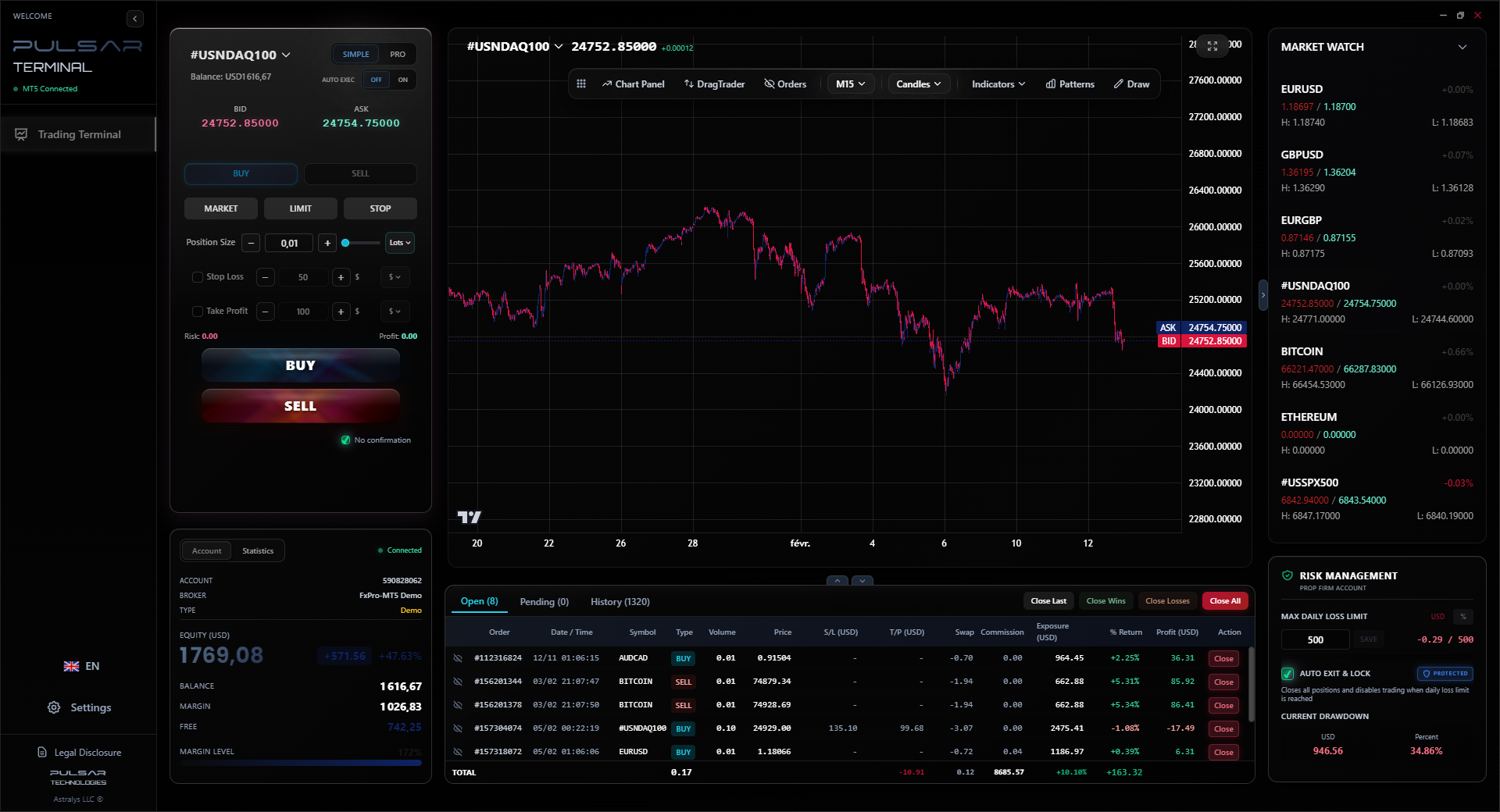
Manually calculating lot sizes for every trade is error-prone, but tools like Pulsar Terminal integrate a position size calculator directly into your MT5 charts, automating the 1% risk rule with a drag-and-drop stop-loss.
Pulsar Terminal
Lo strumento MT5 tutto-in-uno: ordini drag-and-drop, multi-TP/SL, trailing stop, grid trading, Volume Profile e protezione prop firm. Usato da oltre 1.000 trader ogni giorno.
Choosing a broker that offers flexible lot sizes is non-negotiable. Here’s what to look for in the South African market:
Regulation is Key: Always use an FSCA-regulated broker. This ensures client fund segregation and gives you a recourse if something goes wrong. Some international brokers like Pepperstone or XM also have solid reputations and accept South African clients, but understand where your money is legally held.
Account Type Matters: Brokers offer different accounts. A ‘Standard’ account might have higher spreads but no commission, and lot sizes might start at 0.01. A ‘Raw’ or ‘ECN’ account has razor-thin spreads but charges a commission per lot traded. If you're a high-volume scalping trader, the ECN account is cheaper overall. If you're a swing trading holding positions for days, the standard account might be better. Check the fine print.
Minimum Deposits & Lot Sizes:
| Broker Example | Typical Min. Deposit | Typical Min. Trade Size | Good For... |
|---|---|---|---|
| XM | $5 | 0.01 lot (Micro) | Starting with absolute minimum capital. |
| Exness | $10 | 0.01 lot | Flexible accounts, good for testing. |
| IC Markets | $200 | 0.01 lot | Serious traders wanting tight spreads. |
| Local FSCA Broker | ZAR 500+ | Often 0.1 lot (Mini) | Those who prioritize local regulation. |
My Practical Workflow:
- Analyze the chart. Find my entry, stop-loss, and take-profit levels.
- Open my calculator. I input my account size (e.g., R22,500), my risk % (1%), and the distance to my stop in pips (e.g., 45 pips).
- It gives me the lot size. The calculator tells me I need a position size of 0.14 lots to risk exactly R225.
- Place the trade. I enter 0.14 in the order window, set my stop and target, and execute.
This process takes the guesswork and emotion out. It turns trading from a gamble into a calculated business operation. The right tools that integrate this calculation directly into your charting platform are worth their weight in gold, as they prevent costly input errors during fast markets.
💡 Consiglio di Winston
The market doesn't care about your monthly bills. Never increase your lot size because you 'need to make more money this month.' That's a sure path to loss.
FAQ
Q1What is the best lot size for a beginner in South Africa?
Start with micro lots (0.01). No exceptions. With a R5,000 account, a micro lot lets you practice real risk management where a 50-pip loss only costs you about R85. It's enough money to care about, but not enough to destroy your account while you're learning. It removes the fear that clouds judgment.
Q2How does use affect my choice of lot size?
use is a double-edged sword. The FSCA caps it at 30:1 for retail traders, which is actually a good thing for beginners. It limits how much you can borrow. Your lot size determines how much of that borrowed money you actually use. High use doesn't force you to use big lots, it just allows it. The mistake is using high use and a large lot size. Always choose your lot size based on your 1% risk rule first; use is just a facility in the background.
Q3Can I trade fractions of a lot, like 0.15 or 0.75?
Absolutely. Most modern brokers offer fractional lot sizing, often down to 0.01 (a micro lot). This is essential for precise risk management. Being able to trade 0.15 lots instead of being forced to choose between 0.10 (too small) or 0.20 (too big) is a huge advantage. Always check a broker's specifications to confirm their minimum and incremental lot sizes.
Q4How do I calculate pip value for pairs like EUR/ZAR?
For any pair where ZAR is the quote currency, the formula is: (Lot Size in Units) x (1 Pip in Decimal Form). For a micro lot (1,000 units) on EUR/ZAR: 1,000 x 0.0001 = 0.1. So, one pip is worth ZAR 0.10. For a mini lot (10,000 units), it's ZAR 1.00 per pip. This is why using a position size calculator is crucial - it does this math for you instantly.
Q5Is trading nano lots (0.001) worth it?
It can be, for two specific reasons. First, for extreme precision in risk management on a very small account (under R2,000). Second, for forward-testing a new strategy with real money. If you want to test 100 trades live, doing it with nano lots might cost you R100 in total if the strategy fails, which is cheaper than any course. It's not for building wealth, but for preserving capital while learning.
Q6Do all brokers offer the same lot sizes?
No, they don't. This is a key differentiator. Some local brokers might only offer mini lots (0.10) as their smallest size. Many international brokers offer micro (0.01) and some even nano (0.001). Always check this before you fund an account. If you're starting small, micro lots are a must-have feature.
Lezione del Prof. Winston
Punti chiave:
- ✓Never risk more than 1% of your account on a single trade.
- ✓Start with micro lots (0.01) to learn without fear.
- ✓Always calculate position size *before* entering a trade.
- ✓Adjust lot size for each pair's volatility, not your confidence.
Quanto è stato utile questo articolo?
Clicca su una stella
Analisi Trading Settimanali
Analisi e strategie settimanali gratuite. Nessuno spam.
Sull'autore
David van der Merwe
Trader dei Mercati Emergenti
Trader con base a Johannesburg con 11 anni di esperienza nelle valute dei mercati emergenti. Specializzato in coppie ZAR, trading regolamentato dalla FSCA e analisi del mercato sudafricano.
Commenti
Avviso di rischio
Il trading di strumenti finanziari comporta rischi significativi e potrebbe non essere adatto a tutti gli investitori. Le performance passate non garantiscono risultati futuri. Questo contenuto è fornito solo a scopo educativo e non deve essere considerato un consiglio di investimento. Conduci sempre le tue ricerche prima di fare trading.
Potrebbe interessarti anche

Cara Trading Forex Sukses: 7 Prinsip dari Trader Profesional
Cara trading forex sukses dengan 7 prinsip trader pro: manajemen modal, disiplin, journal trading, backtest. Data nyata, bukan janji profit palsu.
Jam Trading Forex Terbaik untuk Trader Indonesia: Panduan Lengkap dengan Tabel Waktu
Panduan jam trading forex untuk trader Indonesia. Tabel 4 sesi dunia, jam emas 20:00-00:00, sesi mana yang harus dihindari. Data akurat + tips dari trader berpengalaman.
Top 5 Sàn Forex Uy Tín Nhất 2026: Review Jujur dari Trader Indonesia
Top 5 sàn forex uy tín 2026 untuk trader Indonesia. Review jujur: spread, deposit, withdraw, dukungan lokal. Exness, XM, IC Markets & lebih.
Scarica Pulsar Terminal
Tutti questi calcolatori sono integrati in Pulsar Terminal con dati in tempo reale dal tuo conto MT5.
Scarica Pulsar Terminal