


Most traders get double tops completely wrong.

David van der Merwe
Trader dei Mercati Emergenti ·  South Africa
☕ 10 min di lettura
Cosa imparerai:
- 1What Exactly Is a Double Top? It's Not What You Think
- 2How to Spot a Real Double Top (And Ignore the Fakes)
- 3The Step-by-Step Trade Plan: Entries, Stops, and Targets
- 4Trading Double Tops on ZAR Pairs: What's Different?
- 5The 3 Biggest Mistakes South African Traders Make (I've Made Them All)
- 6Leveling Up: Combining Double Tops with Other Tools
- 7How to Practice Without Risking a Cent

Most traders get double tops completely wrong. They see two peaks, short immediately, and get stopped out as the price rockets higher. I've been there, and it cost me real money. The truth is, a double top isn't just a shape on a chart; it's a story of failed momentum, and trading it successfully requires patience and a strict set of rules. In this guide, I'll show you the exact method I use to trade double tops forex patterns, specifically for our volatile South African market, so you can spot the real reversals and avoid the traps.
Forget the textbook definition for a second. A double top is a bearish reversal pattern that forms after a strong uptrend. It shows that price tried to break higher twice, failed at roughly the same level both times, and is now likely to roll over. Think of it like a boxer throwing two massive punches. The first one gets blocked. The second one gets blocked at the exact same spot. At that point, the boxer is exhausted and wide open for a counter-attack. That's the market psychology.
Here's the basic structure:
- First Peak: Price makes a new high in an uptrend.
- Retracement (The Valley): It pulls back, forming a swing low. This is often called the "neckline" area.
- Second Peak: Price rallies again but can't surpass the first high. It gets rejected at or near the same price.
- The Break: Price falls back down and breaks below the support level formed by the swing low (the neckline). This is the confirmation.
The critical mistake? Jumping in after the second peak forms. That's just guessing. The pattern is only valid after the neckline breaks. I learned this the hard way back in 2019 trading GBP/ZAR. I shorted after the second peak formed at R19.85, only to watch it consolidate and then break upwards, hitting my stop loss. The neckline never broke. It was an expensive lesson in patience.

Warning: A double top is not confirmed until the price candle closes decisively below the neckline support level. A mere wick below doesn't count. Waiting for this close will save you from countless fakeouts.
“The double top isn't confirmed until the price candle closes decisively below the neckline. A wick below doesn't count.”
Our market, with pairs like USD/ZAR and EUR/ZAR, is famous for fake moves and false patterns. You need a filter to separate the real setups from the noise.
Volume is Your Best Friend
Look at the volume profile during the pattern's formation. In a genuine double top, you should see declining volume on the second peak compared to the first. This shows weakening buying interest. The volume should then spike significantly on the break below the neckline, confirming the new selling pressure. If volume is anemic on the break, be suspicious.
Time Between Peaks Matters
If the two peaks are formed within a few candles of each other, it's likely just market noise. A more reliable pattern forms over a longer period - think days or weeks on the daily chart, or several hours on the 4-hour chart. This gives the market time to truly test and reject that price level.
The Neckline Isn't Always Flat
Don't get hung up on a perfectly horizontal neckline. Sometimes the swing low between the peaks slopes upward. That's okay. The key is that price breaks below that specific trendline, not an arbitrary horizontal level. Drawing tools in platforms like MT5 are essential for this. For more on using these tools effectively, check out our XM review which covers their MT5 offering.
Here’s a quick comparison of reliable vs. unreliable patterns:
| Feature | Reliable Double Top | Fakeout / Weak Pattern |
|---|---|---|
| Volume on 2nd Peak | Lower than 1st peak | Equal or higher |
| Breakdown Volume | High and convincing | Low, hesitant |
| Time Frame | Formed over longer period | Squished together |
| Prior Trend | Clear, sustained uptrend | Choppy, sideways action |

Pro Tip: Combine the pattern with a momentum oscillator like the RSI indicator. Look for bearish divergence - where the price makes a second high but the RSI makes a lower high. This powerfully confirms the loss of upward momentum.

💡 Consiglio di Winston
A pattern without context is just a doodle. Always ask: 'What story is the higher time frame telling?'

“Trading a double top on USD/ZAR without adjusting for volatility is like driving a F1 car with bicycle brakes.”
Let's get practical. Here's my exact checklist for entering a double top trade, using a real example from USD/ZAR.
1. Identify and Wait for the Break: You've spotted the two peaks and drawn your neckline. Now, wait. Do nothing until a 4-hour or daily candle (depending on your chart) closes below the neckline. This is your trigger.
2. Entry Point: My preferred entry is on a retest of the broken neckline. After the initial break, price often pulls back up to kiss the neckline from below (now acting as resistance) before continuing down. Entering on this retest offers a better risk-reward ratio than chasing the initial break. If the retest doesn't happen and price just tanks, I might enter a small position on a subsequent bearish candle.
3. Stop Loss Placement: This is non-negotiable. Your stop loss goes above the second peak. Why? Because if price moves above that high, the entire double top pattern is invalidated. The market is telling you it wasn't a reversal after all. Never place your stop just above the neckline; you'll get taken out by normal volatility.
4. Profit Targets: I use a measured move technique. Measure the vertical distance from the peaks down to the neckline. Then, project that same distance downward from the neckline break point. This gives you your first profit target (TP1).
Example from my journal: In April 2024, USD/ZAR formed a double top on the 4-hour chart.
- Peak Highs: R18.92
- Neckline: R18.65
- Distance: 27 cents (R18.92 - R18.65)
- Neckline Break: At R18.63
- TP1: R18.63 - 0.27 = R18.36
- Stop Loss: R18.95 (above the R18.92 peak)
The trade hit TP1 within three days. I then moved my stop to breakeven and trailed the rest. Managing multiple targets is easier with tools that automate partial closures. For a tool that handles this, see the promo at the end of this section.
Always calculate your position size calculator based on the distance to your stop. On that USD/ZAR trade, my risk was 32 cents per lot (R18.95 - R18.63). I sized my position so that loss would only be 1% of my account.
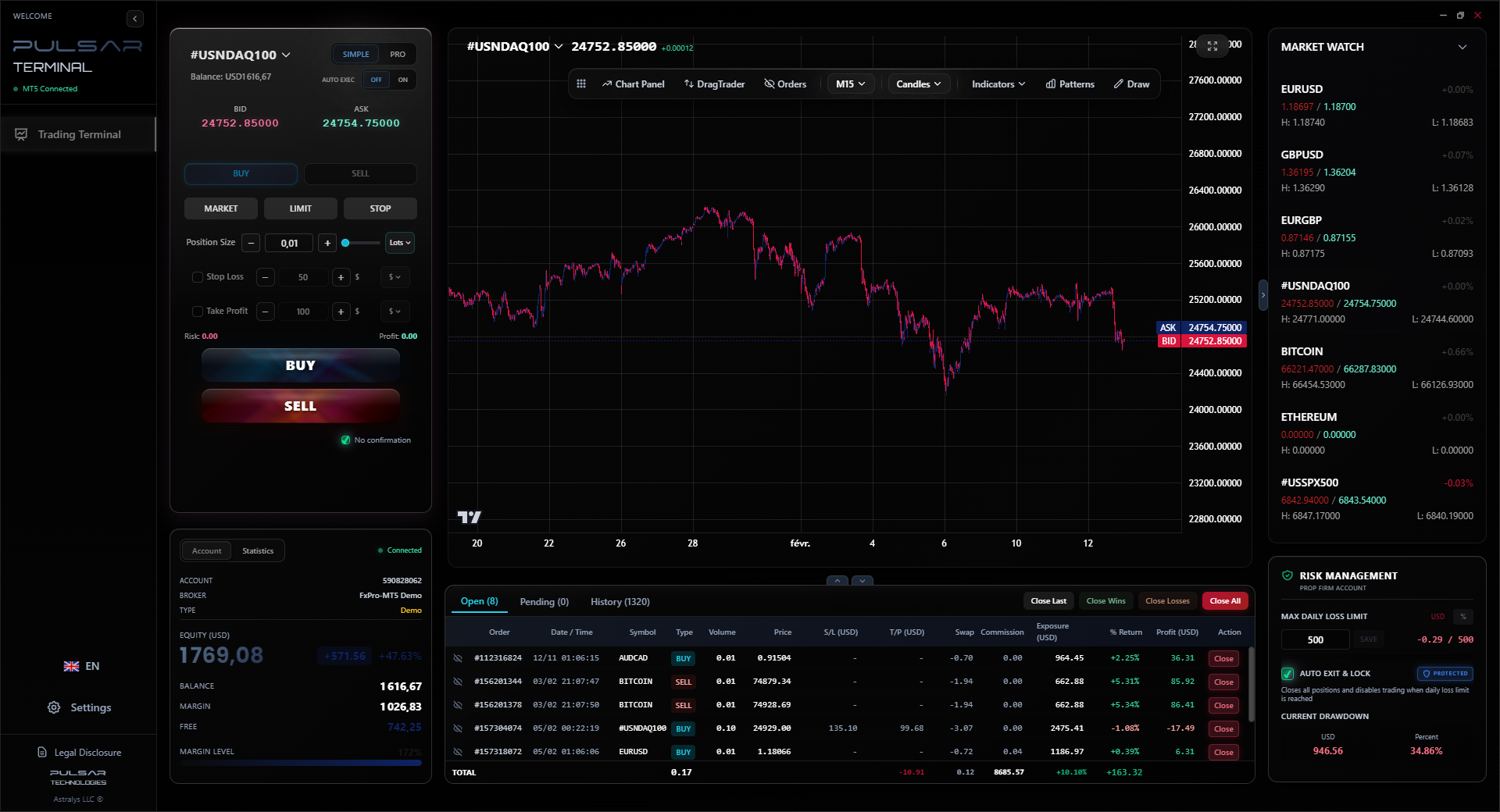
Managing multiple profit targets and moving stops to breakeven on a volatile double top trade is stressful, but tools like Pulsar Terminal automate this directly on your MT5 chart.
Pulsar Terminal
Lo strumento MT5 tutto-in-uno: ordini drag-and-drop, multi-TP/SL, trailing stop, grid trading, Volume Profile e protezione prop firm. Usato da oltre 1.000 trader ogni giorno.
“Trading a double top on USD/ZAR without adjusting for volatility is like driving a F1 car with bicycle brakes.”
Trading this pattern on EUR/USD is one thing. Trading it on USD/ZAR or GBP/ZAR is a whole different ball game. Our market has unique quirks you must respect.
Higher Volatility & Wider Spreads: ZAR pairs are emerging market currencies. They move faster and have wider spreads. A 10-pip spread on EUR/USD might be 50 pips or more on USD/ZAR. This means your profit target needs to be much further away to be meaningful after costs. It also affects your stop placement - you need to give the trade more room to breathe, which means trading smaller position sizes.
Impact of Local Data and SARB: The South African Reserve Bank's interest rate decisions, inflation data (CPI), and political news can cause massive, sudden moves that obliterate technical patterns. A perfect double top on USD/ZAR can be invalidated in minutes by a surprise SARB hike. Always check the economic calendar. If major ZAR news is due, it's often better to wait and see.
Liquidity Times: The ZAR market is most liquid during South African and European trading hours (7 AM - 5 PM SAST). Trying to trade a double top breakout on USD/ZAR at 2 AM SAST is risky, as thin liquidity can lead to exaggerated, false breaks.
I primarily use brokers with deep liquidity on ZAR pairs and FSCA regulation, like IC Markets or Pepperstone. Their raw spreads help manage the inherent cost of trading these pairs. A reliable broker is your first line of defense against slippage on these volatile breaks.
💡 Consiglio di Winston
Your first profit target is a gift. Take it. Move your stop to breakeven and let a runner go. Greed turns winners into break-evens.
“Your stop loss goes above the second peak. If price goes there, the market is laughing at your pattern. Listen to it.”
Let me save you some money and frustration by sharing where I've messed up.
1. Trading the Pattern in Isolation: A double top in the middle of a ranging market is useless. The pattern only has high-probability meaning when it forms after a clear, prior uptrend. I once lost R2,500 trying to short a "double top" on EUR/ZAR that was actually just the upper boundary of a massive range. The trend is your friend. Don't fight it.
2. Ignoring the Higher Time Frame: You see a beautiful double top forming on the 15-minute chart. But what does the daily chart show? If the daily trend is still powerfully bullish, that little 15-minute pattern is likely to get steamrolled. Always do a top-down analysis. A double top on the 4-hour or daily chart carries far more weight. This is a cornerstone of swing trading success.
3. Poor Risk Management: This is the killer. You get excited, you size up your trade, and then a small move against you triggers a margin call or a devastating loss. With the wider stops needed on ZAR pairs, your position size must be smaller. If your usual lot size on EUR/USD would risk 1% of your account, cut it by at least half for USD/ZAR to account for the increased volatility. Your survival depends on this.
“Your stop loss goes above the second peak. If price goes there, the market is laughing at your pattern. Listen to it.”
Once you've mastered the basics, you can increase your edge by layering other forms of analysis.
With Support & Resistance: The most powerful double tops form at a key, obvious resistance level on the higher time frame. Maybe it's a previous all-time high, a major psychological number (like R19.00 for USD/ZAR), or a long-term Fibonacci retracement level (like the 78.6%). When the pattern forms right at these confluent zones, the probability of a reversal skyrockets.
With the MACD: Use the MACD indicator for additional confirmation. Look for the MACD line to cross below its signal line after the second peak forms, ideally as price breaks the neckline. Also, watch for the MACD histogram to show weakening upward momentum (lower peaks) between the two price peaks.
As Part of a Larger Structure: Sometimes a double top is just the right shoulder of a larger head and shoulders pattern. Or, it can be the first leg down in a new downtrend. Zoom out. Understanding the broader context turns you from a pattern-spotter into a market reader.

Example: In Q3 2023, Gold (XAU/USD) formed a double top right at the $1980 resistance level, which was also the 61.8% Fib retracement of a prior major drop. The neckline break, confirmed by a bearish MACD crossover, led to a 5% drop. For more on trading gold, see our XAU/USD guide.
💡 Consiglio di Winston
If you're constantly getting stopped out just above your second peak, your time frame is too noisy. Move up to a chart where the market's breathing is slower.
“Backtesting turns theory into your own personal trading data. Theory is cheap. Data is priceless.”
You wouldn't perform heart surgery after just reading a book. Don't trade real money on double tops until you've practiced.
1. Use a Demo Account: Every reputable FSCA broker offers a demo account with virtual money. Open one. I still use demos to test new tweaks to my strategy. Go back in time on the chart (use the bar replay feature in MT4/MT5) and practice identifying the patterns, drawing the necklines, and planning the trades.
2. Backtest Religiously: Pick a single pair, like EUR/USD or USD/ZAR. Go back over the last 2-3 years of price action on the daily chart. Mark every clear double top pattern you see. Note:
- Did it break the neckline?
- What was the result after the break?
- Where would your stop and target have been?
- What was the average risk-reward?
This data is gold. It will give you concrete, historical win rates and expectations, not just theory. You'll start to see which variations of the pattern work best.
3. Journal Your Trades: When you switch to a live account, start small. Journal every double top trade you take. Include a screenshot, your reasoning, your emotional state, and the outcome. Review this journal weekly. This is how you learn from both wins and losses and build your own profitable system. The goal isn't to be right every time; it's to have a positive expectancy over dozens of trades.
FAQ
Q1Is the double top pattern reliable in forex?
It can be, but not by itself. Its reliability increases massively when it forms after a clear uptrend, at a major resistance level, and is confirmed by a strong volume spike on the neckline break. On its own, it's just a shape. With confluence from other factors, it becomes a high-probability setup.
Q2What's the difference between a double top and a triple top?
A triple top is just a double top with one more failed attempt to break higher. It shows even stronger resistance at that price level and can lead to a more powerful reversal. The trading rules are the same: wait for the break below the support level (neckline) that connects the swing lows between the peaks.
Q3Can I use double tops for scalping?
You can, but it's tricky. On very short time frames like the 1-minute or 5-minute chart, false patterns and market noise are rampant. If you want to try it, you need ultra-tight execution and a broker with razor-thin spreads. Generally, double tops work better for higher-timeframe scalping strategy (like the 15-min chart) or swing trading.
Q4How do I draw the neckline correctly?
Connect the lowest low point between the two peaks. If there are two similar lows, connect them. The line can be horizontal or slightly sloped. The key is to be consistent. The neckline is the level that, when broken, confirms the pattern and triggers the trade idea.
Q5What is a good risk-reward ratio for a double top trade?
I aim for a minimum of 1:1.5, but 1:2 or better is ideal. Because your stop loss is placed above the second peak (which can be far away), the pattern often provides a large enough measured move target to achieve this. Always calculate your position size calculator based on the stop distance to ensure you're not over-risking.
Q6Do double tops work on cryptocurrency?
Yes, the same principles of market psychology apply. However, crypto markets are even more volatile than forex. Expect more false breaks and whipsaws. Use wider stops, smaller position sizes, and place even more emphasis on waiting for a confirmed candle close below the neckline.
Q7What's the most important rule for trading double tops?
Patience. Wait for the close below the neckline. Don't anticipate. I've blown more trades by jumping in early than by missing the entry altogether. Let the market confirm the pattern before you commit your capital.
Lezione del Prof. Winston
Punti chiave:
- ✓Wait for the close below the neckline. No exceptions.
- ✓Place your stop loss above the second peak's high.
- ✓Target a minimum 1:1.5 risk-reward ratio.
- ✓Use lower volume on the second peak as key confirmation.
- ✓Adjust position size for ZAR pair volatility (cut it by 50%).
Quanto è stato utile questo articolo?
Clicca su una stella
Analisi Trading Settimanali
Analisi e strategie settimanali gratuite. Nessuno spam.
Sull'autore
David van der Merwe
Trader dei Mercati Emergenti
Trader con base a Johannesburg con 11 anni di esperienza nelle valute dei mercati emergenti. Specializzato in coppie ZAR, trading regolamentato dalla FSCA e analisi del mercato sudafricano.
Commenti
Avviso di rischio
Il trading di strumenti finanziari comporta rischi significativi e potrebbe non essere adatto a tutti gli investitori. Le performance passate non garantiscono risultati futuri. Questo contenuto è fornito solo a scopo educativo e non deve essere considerato un consiglio di investimento. Conduci sempre le tue ricerche prima di fare trading.
Potrebbe interessarti anche

Cara Trading Forex Sukses: 7 Prinsip dari Trader Profesional
Cara trading forex sukses dengan 7 prinsip trader pro: manajemen modal, disiplin, journal trading, backtest. Data nyata, bukan janji profit palsu.
Jam Trading Forex Terbaik untuk Trader Indonesia: Panduan Lengkap dengan Tabel Waktu
Panduan jam trading forex untuk trader Indonesia. Tabel 4 sesi dunia, jam emas 20:00-00:00, sesi mana yang harus dihindari. Data akurat + tips dari trader berpengalaman.
Top 5 Sàn Forex Uy Tín Nhất 2026: Review Jujur dari Trader Indonesia
Top 5 sàn forex uy tín 2026 untuk trader Indonesia. Review jujur: spread, deposit, withdraw, dukungan lokal. Exness, XM, IC Markets & lebih.
Scarica Pulsar Terminal
Tutti questi calcolatori sono integrati in Pulsar Terminal con dati in tempo reale dal tuo conto MT5.
Scarica Pulsar Terminal