


Let me be straight with you: most of what you read online about fair value gaps is pure nonsense.

David van der Merwe
Trader dei Mercati Emergenti ·  South Africa
☕ 10 min di lettura
Cosa imparerai:
- 1What Exactly Is a Fair Value Gap? Cutting Through the Hype
- 2Spotting FVGs in the South African Market: It's Different Here
- 3A Simple, Actionable FVG Trading Strategy (That Works)
- 4The 3 Biggest Mistakes South African Traders Make with FVGs
- 5Brokers & Platforms: Finding FVGs with a South African Account
- 6How to Fit FVGs Into Your Overall Trading Plan
Let me be straight with you: most of what you read online about fair value gaps is pure nonsense. It's presented as a magic bullet, a secret key to the market's inner workings. It's not. I spent months chasing 'imbalances' and 'inefficiencies' like a dog chasing its tail, blowing up a small account in the process. But here's the twist: when I stripped away the guru-speak and started treating FVGs for what they actually are - simple visual markers of momentum - they became one of the most reliable tools in my kit for trading the volatile ZAR. This isn't about 'smart money' secrets. This is a practical, no-BS guide from a trader in Johannesburg on how to actually use fair value gap forex strategies without losing your shirt.
Forget the complex definitions. A fair value gap (FVG) is just a blank space on your chart where price jumped from point A to point C without trading at point B. It's a visual footprint of a strong, impulsive move. You see it as a gap between the wicks of three candles.
Here’s how you spot it: look for a big candle (the driving candle) followed by a candle that doesn't retrace much. The FVG is the space between the high of the first candle's wick and the low of the third candle's wick in an uptrend (or vice versa for a downtrend). The market literally skipped those prices.
The theory, popularized by the ICT (Inner Circle Trader) community, is that this gap represents an 'unfair' price. The market, in its quest for balance, will eventually return to trade in that zone, 'filling the gap.' This is where new traders, myself included, get sucked in. We see the gap and think, 'Aha! The market MUST come back here for a retest.'
Spoiler: it doesn't always. Treating every FVG as a guaranteed return ticket is a fast track to a margin call. The real value isn't in the gap itself, but in what it tells you about market momentum and where institutional orders might have been clustered.

Warning: An FVG is not a trade signal. It's a context tool. I learned this the hard way by placing limit orders in every FVG I saw on USD/ZAR, only to watch price blow straight past them during a major dollar rally. I was 'filling gaps' all the way to a 15% drawdown.
Trading FVGs on EUR/USD is one thing. Trading them on USD/ZAR or EUR/ZAR is a whole different ball game. Our market has a personality - it's thinner, more volatile, and reacts sharply to local data and commodity flows.
The ZAR Volatility Factor
Because the Rand can move 100-200 pips in a blink during local session overlaps (8am-5pm SAST), FVGs form more frequently and are often wider. A 15-pip gap on EUR/USD might be notable; on USD/ZAR, a 50-pip gap is common during news. This means you need to be more selective. Don't mark up every little gap. Focus on the ones that form on higher timeframes (like the 1-hour or 4-hour chart) or at clear technical levels like previous daily highs/lows.
Watch the Spread
This is critical. With some brokers, the spread on USD/ZAR can be 5 pips or more. If you're trying to trade a retest of a 10-pip FVG, the spread alone can eat half your potential profit. You must factor this into your position size and profit target. I only trade FVG setups on ZAR pairs with brokers known for decent pricing, like IC Markets or Pepperstone, where I've seen USD/ZAR spreads around 5 pips on their raw accounts.
A Real Trade Example
On March 15th, 2024, USD/ZAR had a massive bullish move following stronger-than-expected US CPI data. On the 1-hour chart, a clear FVG formed between 18.8520 and 18.8720. A few sessions later, price dipped back into that zone. Instead of blindly buying, I waited for a bullish rejection candle (a pin bar) to form inside the FVG. That was my signal. Entry: 18.8605. Stop loss: just below the FVG at 18.8480. Take profit: at the next resistance. That trade netted a clean 1:2.5 risk/reward. The key? The FVG gave me the zone. Price action gave me the trigger.

💡 Consiglio di Winston
An FVG is like a footprint in the sand. It tells you a big move happened here, but it doesn't tell you if the tide is coming back in. Always check the direction of the tide (the trend) first.
“Trading every FVG you see is like trying to drink from a firehose. You'll get knocked over.”
Here's the exact 3-step process I use now. It's boring, but it's kept me profitable.
Step 1: Identify the FVG in Context. Don't just find a gap. Ask: Where did it form?
- At a Key Level? (e.g., a previous swing high, a daily open). This is high-probability.
- In the Middle of Nowhere? On a clean chart with no other structure nearby. This is low-probability. Ignore it. I only trade FVGs that align with the higher timeframe trend. In an uptrend, I look for bullish FVGs to buy into on a retest. In a downtrend, I look for bearish FVGs to sell into.
Step 2: Wait for the Retest and a Confirmation Signal. This is the step most people skip, and it's why they lose. You do NOT enter as soon as price touches the FVG. You wait.
- Price Action Signal: Look for a bullish or bearish rejection candle (pin bar, engulfing candle) forming within the FVG zone.
- Indicator Confluence: I often use a simple RSI indicator reading oversold (near 30) when price enters a bullish FVG in an uptrend, or overbought (near 70) for a bearish FVG in a downtrend.
Step 3: Execute with Tight Risk Management.
- Entry: On the close of the confirmation candle.
- Stop Loss: Place it just outside the opposite side of the FVG. The logic is simple: if price fills the entire gap and keeps going, the imbalance is gone, and your thesis is wrong.
- Take Profit: I use a minimum 1:2 risk-to-reward. My first target is often the recent swing high/low that created the FVG in the first place.

Pro Tip: FVGs work brilliantly for swing trading setups on the 4H and daily charts. The retests are slower, more deliberate, and give you plenty of time to assess. Trying to use them for scalping on the 1-minute chart with ZAR pairs is a recipe for stress and losses.
I've made all of these. Learn from my losses.
1. Trading Every Single Gap. Early on, my charts looked like a connect-the-dots puzzle with FVGs marked everywhere. I was trading noise. The market creates dozens of minor inefficiencies that it never intends to revisit. Filter for significance: higher timeframes, high volume nodes, and alignment with trend.
2. Placing Limit Orders in the Gap. This feels smart - 'I'll get the best price!' But it's dangerous. You're assuming price will react at the edge of the FVG. Often, it overshoots, takes out your limit order, reverses, and runs without you. Or worse, it slices through the gap, hits your limit order, and then continues down to your stop loss. Wait for the confirmation candle. Patience pays.
3. Ignoring Fundamental Context. This is huge for ZAR pairs. You see a perfect bearish FVG on USD/ZAR forming, but the South African budget speech is in 2 hours. Trading that is gambling, not analysis. The fundamental catalyst can completely override any technical imbalance. Always check the economic calendar. If there's major SA or US data due, step away and let the volatility settle first.
💡 Consiglio di Winston
If you're trading a retest, your stop loss should be placed where the FVG's story ends. If price closes beyond the far side of the gap, the narrative has changed. Get out.
“Wait for the confirmation candle. Your patience is the most important indicator on your chart.”
You need a platform that lets you draw cleanly and a broker that won't kill you on ZAR pair costs.
Platform Choice:
- TradingView: My top recommendation. Its drawing tools are excellent, and you can easily mark FVGs with the rectangle tool. The community scripts also have FVG auto-draw indicators (use them with caution).
- MetaTrader 4/5: Still the king for execution. You can manually draw FVGs. For a much better experience, consider tools like Pulsar Terminal that integrate with MT5, offering advanced drawing and order management that makes managing these zone-based trades smoother.
- cTrader: Clean and precise, great for manual drawing. Offered by brokers like Pepperstone.
Broker Considerations for FVG Trading: You need tight spreads on majors for analysis and fair pricing on ZAR pairs for execution. Here’s a quick comparison relevant to us:
| Broker | FSCA Regulated? | Key Feature for FVG Trading | ZAR Pair Spread (USD/ZAR approx.) |
|---|---|---|---|
| Khwezi Trade | Yes (Proudly SA) | ZAR-denominated accounts, low min deposit (R500) | Can be competitive, check their ZAR One account |
| IC Markets | Yes | Raw spreads, great execution speed | ~5 pips (Raw account) |
| Pepperstone | Yes | cTrader & MT5, excellent pricing | ~5 pips (Razor account) |
| XM | Yes | Low minimum deposit ($5), good for practice | Can be wider on exotics |
Local Payment is a Game-Changer: Using a broker like Khwezi Trade or Exness (which offers local ZAR deposits) saves you a fortune in bank conversion fees. Depositing and withdrawing in Rands directly is a huge practical advantage we have.

Example: If you deposit $500 with an international broker, your bank might charge a 2.5% conversion fee + a fixed cost. That's R250+ gone before you even place a trade. Local ZAR deposits often have zero fees.
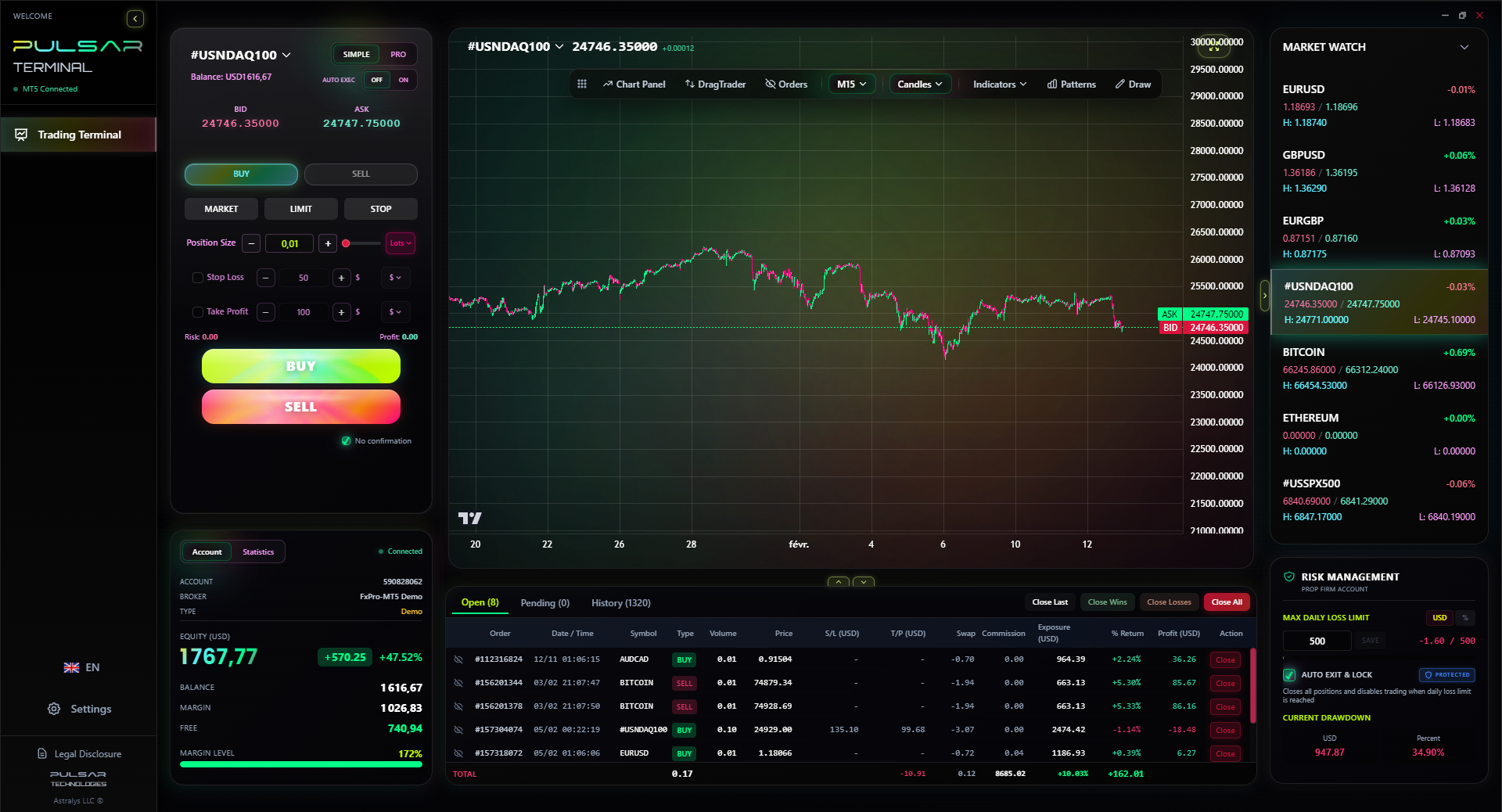
Manually drawing FVGs and setting orders at their edges is tedious; Pulsar Terminal's advanced drawing tools and drag-and-drop order management on MT5 make marking these zones and planning your trades far more efficient.
Pulsar Terminal
Lo strumento MT5 tutto-in-uno: ordini drag-and-drop, multi-TP/SL, trailing stop, grid trading, Volume Profile e protezione prop firm. Usato da oltre 1.000 trader ogni giorno.
An FVG strategy isn't a standalone system. It's a specialized tool. Here’s how I've integrated it.
As a Confluence Filter: This is its best use. My primary system might be based on moving average crossovers or MACD indicator divergence. Before I take a signal, I check: is there a supporting FVG in the area? If yes, it increases my conviction and might allow me to size up slightly (using my position size calculator, of course). If no, I might pass or take a smaller position.
For Trade Management: FVGs are fantastic for managing open trades. Let's say I'm long on EUR/USD from a trendline bounce. As price moves up and leaves a bullish FVG below, I now have a logical area to move my stop loss to breakeven. If price retraces to fill that FVG, I'm out at breakeven, not a loss. If it doesn't, my runner continues.
Setting Realistic Expectations: Don't expect a 90% win rate. A well-executed FVG strategy, combined with other factors, might give you a 55-65% win rate. The edge comes from the favorable risk/reward setups it helps you identify. Your job is to manage risk so you can stay in the game for those winning trades.
Finally, backtest. Don't take my word for it. Go on TradingView, replay the past year of USD/ZAR, and manually mark the major FVGs. See how often price retested them. See what happened at those retests. Your own data will teach you more than any article ever could. Start with the XAU/USD guide and EUR/USD guide to practice on more liquid pairs first, then apply the lessons to the ZAR.
FAQ
Q1Is fair value gap trading legal in South Africa?
Yes, absolutely. Fair value gap trading is just a method of technical analysis. There's no law against how you read a chart. What matters is that you trade through a broker that is licensed by the Financial Sector Conduct Authority (FSCA) to ensure your funds are protected under South African law.
Q2What's the best timeframe to use for FVG trading on USD/ZAR?
I've found the 1-hour and 4-hour charts to be the sweet spot. They're slow enough to filter out market noise and identify significant gaps, but fast enough to provide several opportunities a week. Avoid the lower timeframes (like 1-min or 5-min) as the spreads will destroy your edge on ZAR pairs.
Q3Do FVGs work on gold (XAU/USD) as well as forex?
They work exceptionally well on gold, often even better than on forex pairs. Gold moves in sharp, impulsive waves that leave clear FVGs, and it tends to retest these zones with high reliability. It's a great market to practice the concept.
Q4How do I know if an FVG is 'strong' or valid?
Look for three things: 1) Size: A larger gap (in pips) suggests stronger momentum. 2) Context: A gap that forms by breaking a key support/resistance level is stronger than one in a range. 3) Volume: If your platform shows volume, a gap formed on high volume is more significant.
Q5Can I use an indicator to automatically plot FVGs?
Yes, there are many custom indicators for TradingView and MT4/5 that auto-draw FVGs. I used them when I started, but I've gone back to drawing them manually. Auto-indicators often plot too many, including insignificant ones, which creates clutter and confusion. Manual drawing forces you to be selective and truly understand the price action that created the gap.
Q6What's the biggest risk with FVG trading?
Complacency. The biggest risk is assuming the market must return to fill the gap. It doesn't. Price can trend indefinitely, leaving a trail of unfilled FVGs behind it. Always use a stop loss, and never risk more than 1-2% of your capital on any single FVG trade idea.
Lezione del Prof. Winston
Punti chiave:
- ✓FVGs are context tools, not entry signals.
- ✓Always wait for price action confirmation inside the gap.
- ✓Filter for FVGs on the 1H/4H charts in line with the trend.
- ✓Never trade a FVG ahead of major SA or US economic data.
Quanto è stato utile questo articolo?
Clicca su una stella
Analisi Trading Settimanali
Analisi e strategie settimanali gratuite. Nessuno spam.
Sull'autore
David van der Merwe
Trader dei Mercati Emergenti
Trader con base a Johannesburg con 11 anni di esperienza nelle valute dei mercati emergenti. Specializzato in coppie ZAR, trading regolamentato dalla FSCA e analisi del mercato sudafricano.
Commenti
Avviso di rischio
Il trading di strumenti finanziari comporta rischi significativi e potrebbe non essere adatto a tutti gli investitori. Le performance passate non garantiscono risultati futuri. Questo contenuto è fornito solo a scopo educativo e non deve essere considerato un consiglio di investimento. Conduci sempre le tue ricerche prima di fare trading.
Potrebbe interessarti anche

Cara Trading Forex Sukses: 7 Prinsip dari Trader Profesional
Cara trading forex sukses dengan 7 prinsip trader pro: manajemen modal, disiplin, journal trading, backtest. Data nyata, bukan janji profit palsu.
Jam Trading Forex Terbaik untuk Trader Indonesia: Panduan Lengkap dengan Tabel Waktu
Panduan jam trading forex untuk trader Indonesia. Tabel 4 sesi dunia, jam emas 20:00-00:00, sesi mana yang harus dihindari. Data akurat + tips dari trader berpengalaman.
Top 5 Sàn Forex Uy Tín Nhất 2026: Review Jujur dari Trader Indonesia
Top 5 sàn forex uy tín 2026 untuk trader Indonesia. Review jujur: spread, deposit, withdraw, dukungan lokal. Exness, XM, IC Markets & lebih.
Scarica Pulsar Terminal
Tutti questi calcolatori sono integrati in Pulsar Terminal con dati in tempo reale dal tuo conto MT5.
Scarica Pulsar Terminal