


Everyone's searching for the 'forex best pairs,' but most advice is generic garbage written for Americans or Europeans.

David van der Merwe
Trader dei Mercati Emergenti ·  South Africa
☕ 13 min di lettura
Cosa imparerai:
- 1Why the 'Majors' Aren't Always Your Best Bet
- 2ZAR Pairs: Your Home-Ground Advantage
- 3The Real Cost of Trading: A South African Breakdown
- 4How to Pick *Your* Best Pair (A Practical Guide)
- 5Brokers & Platforms: The Local Context
- 6Adapting Your Strategy for Volatile Pairs
- 7Mistakes I Made (So You Don't Have To)
Everyone's searching for the 'forex best pairs,' but most advice is generic garbage written for Americans or Europeans. The truth? Your best pair depends entirely on where you trade from, your account size, and your tolerance for volatility. I've traded from Johannesburg for over a decade, and I'll tell you straight: for a South African, the 'best' pair is often the one everyone else calls 'too dangerous.' I'm going to prove why, break down the real costs with our local brokers, and show you exactly how I trade our unique market conditions.
When you start out, every guide tells you to stick with EUR/USD, GBP/USD, USD/JPY. They're liquid, they have tight spreads, and the charts are clean. That's all true. For a beginner with a small account, they're a sensible training ground. I made my first consistent profits on EUR/USD, learning to read order flow without getting obliterated by wild swings.
But here's the uncomfortable truth I learned the hard way: trading majors from South Africa puts you at a permanent information disadvantage. You're reacting to European and US economic data hours after the professionals in those time zones have already positioned themselves. Your 0.1 pip spread advantage means nothing if you're always a step behind.
I remember a specific trade in 2021. The US NFP data came out strong. EUR/USD tanked 50 pips instantly. My broker's feed lagged by a fraction of a second - just enough for my limit order to get filled at the absolute worst price. I lost R800 on a trade that, on a chart replay, looked like a sure thing. That's when I realized I needed an edge, not just a cheap spread. Sometimes, the real opportunity is in the pairs others ignore.

Warning: Don't confuse low spread with low risk. A 0.0 pip spread on EUR/USD during the London open can vanish in a flash crash, leaving you with a massive loss before you can blink. Always use a stop loss, no matter how 'safe' the pair feels.
That said, for pure technical practice and building foundational skills, you can't beat the majors. My advice? Use a demo account or very small live capital on a platform like XM or Exness to get a feel for them. But don't expect them to be your golden ticket. Your real edge as a South African trader lies elsewhere.
This is where we get to the heart of the matter. For a South African trader, pairs like USD/ZAR, EUR/ZAR, and GBP/ZAR aren't just 'exotics' - they're your home turf. This is our massive, often overlooked advantage.
Think about it. You wake up and hear on 702 that load-shedding is worsening, or you see a headline about a platinum strike in Rustenburg. You immediately have a gut sense of what that means for the rand. A trader in London or New York has to research it; you live it. That's an informational edge you can't buy.
Trading USD/ZAR: The Realities
USD/ZAR is the main event. It's volatile, it can gap on weekends, and the spreads are wider - often 40-80 pips compared to less than 1 pip on EUR/USD. That scares people off. But volatility is just another word for opportunity if you manage it right.
My most profitable year came from focusing almost exclusively on USD/ZAR. I stopped trying to scalp it like a major pair and started treating it like a swing trading instrument. The trends are powerful and can last for months. In early 2022, I caught a long swing from around R14.80 to R16.20. I didn't catch the top or bottom, but holding through the noise with a wide stop netted over R25,000 on a R50,000 account. The key? Understanding what moves it.
What Moves the Rand?
The rand is a commodity currency. Forget fancy economic models for a second. Watch these three things:
- Gold Price (XAU/USD): A strong positive correlation. Gold up? Rand often strengthens. I always have the XAU/USD guide chart open next to USD/ZAR.
- SA Political & Economic News: Corruption headlines, Eskom crises, budget speeches. The market hates uncertainty.
- Global Risk Sentiment: When global markets panic (like during the 2024-2025 period), money flees emerging markets like South Africa. USD/ZAR spikes.

Pro Tip: Don't just look at the USD/ZAR price. Watch the spread. During local market hours (8am-5pm SAST), spreads on ZAR pairs are tightest. If you trade at 2am SAST, you're paying a much wider spread for the privilege. Trade when your local brokers and banks are active.
Yes, the spreads are higher. But your potential profit per pip is also much larger because the pair moves in hundreds of pips, not tens. You just need to adjust your position size calculator settings accordingly. A 50-pip stop on USD/ZAR is normal; on EUR/USD, it's a massive move.

💡 Consiglio di Winston
Your first R10,000 in profits should be re-invested in education and better tools, not a new car. The market will always take back money gained from luck.
“For a South African trader, pairs like USD/ZAR aren't just 'exotics' - they're your home turf.”
Let's talk numbers. What does it actually cost to trade these 'forex best pairs' from here? It's more than just the spread. I've had accounts with half a dozen local and international brokers. Here's the real breakdown.
Spreads & Commissions:
| Pair | Typical Spread (SA Broker) | Typical Spread (Int'l Broker) | Key Consideration |
|---|---|---|---|
| EUR/USD | 0.7 - 1.2 pips | 0.0 - 0.3 pips (+$5 commission) | Local brokers often have wider fixed spreads. International brokers like IC Markets offer raw spreads but charge commission. Do the math on your trade volume. |
| USD/ZAR | 40 - 80 pips | 50 - 120 pips | Crucially, local brokers often have MUCH tighter spreads on ZAR pairs. This is a huge advantage. I've seen 40 pips on Khwezi Trade vs 90 pips on an EU-regulated platform. |
| GBP/JPY | 1.8 - 3.0 pips | 1.0 - 1.5 pips | A volatile cross. Spreads matter more here due to the pair's wild intraday moves. |
The Hidden Killers:
- Swap Fees (Overnight Financing): This is where ZAR pairs can eat you alive. If you're long USD/ZAR (betting the rand weakens), you're typically paying a daily swap fee because South African interest rates are higher. In 2023, holding that position over a weekend could cost you hundreds of rands per lot. You must factor this into any swing trade. A trade that looks good on charts can be a loser due to swap.
- Currency Conversion: If your trading account is in USD but you fund it in ZAR, your broker converts it. They don't use the interbank rate. They add a 1-2% fee. That's R100-R200 gone on a R10,000 deposit before you place a single trade. Always check if a broker offers a ZAR-denominated account.
- Withdrawal Fees: Some international brokers charge $25+ for a bank transfer back to South Africa. Local FSCA-regulated brokers usually have free or cheap EFTs.
A painful lesson: In 2020, I had a beautiful short EUR/ZAR trade that was 300 pips in profit. I decided to hold it for another week for a political event. The swap fees over those 7 days eroded nearly 30% of my paper profits. I learned to always check the swap rate in my platform's order window before hitting 'buy' or 'sell.'
So, with all this info, how do you choose? Don't just pick a pair because some website ranked it #1. Match the pair to your trader profile.
The New Trader (Account < R10,000): Start with a major pair, but for the right reasons. Pick EUR/USD. Your goal isn't to get rich. Your goal is to learn price action without getting your head ripped off by volatility. Use a micro lot (0.01). Focus on surviving for 100 trades. The tight spreads mean your mistakes are cheaper. A platform like XM with its $5 minimum is perfect for this phase. Avoid ZAR pairs completely at this stage. The emotional rollercoaster will break you.
The Developing Trader (Account R10,000 - R50,000): This is where you experiment. Allocate 80% of your capital to your 'core' pair - maybe a major you understand well. Use the other 20% to learn one ZAR pair. I suggest USD/ZAR. Don't trade it live yet. Paper trade it for a month. Track how it reacts to local news, gold prices, and the US dollar index. Feel the volatility. Once you're comfortable, risk no more than 0.5% of your account on a single USD/ZAR trade. The wider stop losses mean your position size must be smaller.
The Committed Trader (Account R50,000+): Now you can specialize. You have the capital to absorb the wider stops of ZAR pairs. Your 'best pair' might become USD/ZAR or EUR/ZAR. You can also effectively trade cross pairs like GBP/JPY or AUD/NZD that require more margin. This is where tools beyond basic MT4/MT5 become valuable. You need strong analysis to justify the larger absolute risk.

Example: Let's say you have R100,000 and want to trade USD/ZAR. A sensible risk is 1% per trade = R1,000. If your stop loss is 500 pips (common), each pip is worth R2. Therefore, your position size should be 0.02 lots (where 1 pip ≈ R100). This keeps your risk controlled despite the pair's wild nature.
No matter your level, your first filter should always be liquidity. Is there a clear bid/ask? Is the spread stable? If not, walk away. The second filter is your own understanding. Can you explain, in one sentence, the main fundamental driver of that pair right now? If not, you're gambling.
💡 Consiglio di Winston
If you can't explain your trade's thesis in one simple sentence before you enter, you don't have a thesis. You have a hope.
“Volatility is just another word for opportunity if you manage it right.”
Your choice of broker fundamentally changes which pairs are 'best' for you. This is the most practical part of the decision.
The FSCA-Regulated Local Broker (e.g., Khwezi Trade, IG South Africa): Pros for ZAR Pairs: Tighter spreads on USD/ZAR. ZAR-denominated accounts (no conversion fees). Local customer support that understands your issues. Fast EFT deposits/withdrawals in rands. Cons: Often wider spreads on major pairs. Sometimes fewer platform options or advanced tools.
The International Tier-1 Broker (e.g., IC Markets, Pepperstone): Pros for Majors/Crosses: Razor-thin spreads on EUR/USD, GBP/JPY, etc. Access to cTrader or advanced MT5 plugins. Often lower commissions. Cons for ZAR Pairs: Wider spreads on USD/ZAR. You'll pay currency conversion on deposits/withdrawals. Withdrawal fees and slower processing.
My Hybrid Approach: I run two accounts. One with a local FSCA broker for my ZAR pair trades. Another with an international broker like IC Markets for when I want to trade majors or exotic crosses with the tightest possible raw spreads. It's a bit more admin, but it optimizes costs for each type of trade.
Platforms Matter: MT4 and MT5 are king here. But it's what you add to them that counts. When trading volatile pairs, managing your trade is critical. Setting multiple take-profit levels or moving your stop to breakeven quickly can be the difference between a winner and a loser. Doing that manually on a fast-moving USD/ZAR chart is stressful and error-prone.
You can't trade USD/ZAR the same way you trade EUR/USD. The strategies that work on one will fail spectacularly on the other. Here’s how I had to adapt.
From Scalping to Swing Trading: I used to be a scalping strategy addict on EUR/USD, grabbing 5-10 pips here and there. Tried that on USD/ZAR in 2019. The 40-pip spread meant I needed a 50-pip move just to break even. The noise swallowed me whole. I blew R15,000 in two weeks. My mistake was forcing a low-timeframe strategy onto a high-volatility instrument.
I switched to daily and 4-hour charts for ZAR pairs. I look for key support/resistance levels, major trendlines, and fundamental catalysts (like a SARB interest rate decision). My profit targets are 300-800 pips away. My stop losses are 200-500 pips wide. It requires immense patience, but the risk-to-reward ratios (often 2:1 or 3:1) justify the wide stops.
Indicator Adjustments: The standard RSI indicator settings (14 period) are useless on a volatile pair. It will be stuck at 'overbought' or 'oversold' for weeks during a strong trend. I use a longer-period RSI (21 or 28) to smooth out the noise. Similarly, the MACD indicator is better for confirming trend direction on higher timeframes rather than for precise entries.
The News Trap: With ZAR pairs, local news is a trap for the unprepared. The price often moves in anticipation of the news. By the time the headline hits your screen, the move is halfway done. If you trade the news, you're late. I got caught buying USD/ZAR on a 'bad' inflation print once, only to watch it plummet. The market had priced it in days before. Now, I either position myself days ahead based on expectation, or I wait for the post-news volatility to settle before entering.
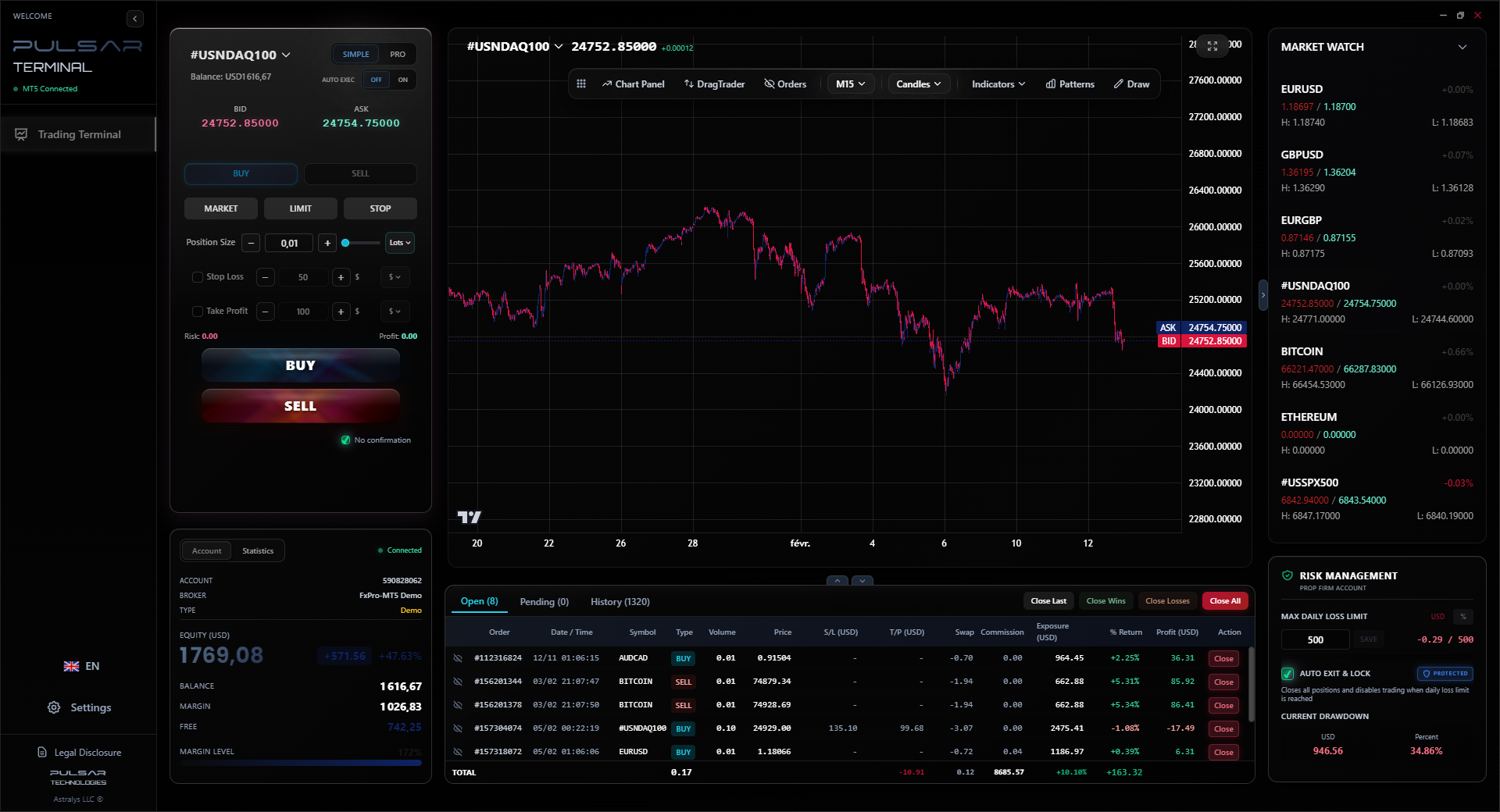
Managing wide stops and multiple take-profit levels on volatile pairs like USD/ZAR is stressful, which is why a tool like Pulsar Terminal that automates these adjustments directly on your MT5 chart is a game-saver.
Pulsar Terminal
Lo strumento MT5 tutto-in-uno: ordini drag-and-drop, multi-TP/SL, trailing stop, grid trading, Volume Profile e protezione prop firm. Usato da oltre 1.000 trader ogni giorno.
“Your best pair is the one where you have a repeatable, logical edge - not the one that's most exciting.”
Let's get brutally honest. The path to finding your best pair is paved with losses. Here are my most expensive lessons.
1. Chosing a Pair Based on Past Performance: In 2023, GBP/JPY was on a tear. I saw friends making money. I jumped in without understanding the carry trade dynamics. I got in late, the trend reversed, and I rode it all the way down, stubbornly holding because 'it was a best pair.' Loss: R12,000. A pair is only 'best' when you understand its current drivers.
2. Ignoring Swap on Long-Term Holds: As mentioned earlier, I held a EUR/ZAR short for weeks. The swap fee was -R45 per lot per day. On 2 lots, that's -R630 a week. It turned a winning trade into a breakeven mess. Always, always calculate the cost of holding.
3. Using the Same Lot Size for Everything: This is the fastest way to a margin call. After a good run on EUR/USD with 1-lot trades, I opened a 1-lot trade on USD/ZAR. The 500-pip move against me nearly wiped out my account. The value per pip was astronomically higher. I didn't use my position size calculator. A 0.1-lot trade would have given me the same risk exposure. Never trade by lot size. Always trade by risk percentage.
4. Trading Exotics for the 'Action': There's a boredom that sets in with majors. I started dabbling in pairs like USD/TRY or USD/MXN for the crazy moves. It was exciting. It was also completely random for me. I had no edge, no understanding of Turkish politics or Mexican oil. I was just gambling. I lost R8,000 in 'tuition fees' learning that excitement is the enemy of profitable trading.
The core lesson? Your best pair is the one where you have a repeatable, logical edge - not the one that's most exciting or currently trending on social media. It's the pair whose movements you can analyze calmly, whose risks you can calculate precisely, and whose quiet hours you don't feel compelled to watch.
💡 Consiglio di Winston
The most important chart you'll ever study is your own trading journal. Patterns in your losses are more valuable than patterns on a price chart.
FAQ
Q1What is the single best forex pair for a beginner in South Africa?
For a complete beginner, it's EUR/USD, but not for the reason you think. It's the best because its tight spreads make your mistakes cheaper, and the abundance of learning material available is based on it. Use it on a demo or micro account purely to learn order execution, basic chart patterns, and emotional control. Don't expect to get rich from it initially.
Q2Is USD/ZAR too volatile for a new trader?
Yes, absolutely. The wide spreads (40-80 pips) mean you start every trade significantly in the red. The volatility can trigger stop losses easily, and the emotional swings are intense. New traders should paper trade USD/ZAR for at least 3-6 months to understand its rhythm before risking real money.
Q3Should I use a South African broker or an international one?
It depends on your focus. If you plan to primarily trade ZAR pairs (USD/ZAR, EUR/ZAR), a local FSCA-regulated broker like Khwezi Trade often offers tighter spreads and easier ZAR banking. If you want to trade global majors and crosses with the lowest possible raw spreads, an international broker like IC Markets or Pepperstone is better. Many serious traders use both.
Q4Why are swap fees so important for South African traders?
Because of our relatively high interest rates. If you're buying a currency with a lower interest rate against the ZAR (like going long USD/ZAR), you pay the interest differential daily. This can silently erode profits on swing trades. You must check the swap rate (also called overnight financing) for your specific pair and broker before holding a position for more than a day.
Q5What time of day is best to trade forex in South Africa?
For ZAR pairs, the best liquidity and tightest spreads are during South African business hours (8am-5pm SAST). For major pairs like EUR/USD, the best overlap is during the London session (10am-1pm SAST) when both European and some US markets are active. Avoid trading major pairs exclusively during late SAST nights (US afternoon), as liquidity drops and spreads can widen.
Q6How much money do I need to start trading forex in South Africa?
You can technically start with as little as $5 (R90) with some brokers like XM. However, practically, I recommend a minimum of R5,000-R10,000. This allows you to trade micro lots (0.01) with proper risk management. With less than R5,000, a single losing trade on almost any pair can be a devastating percentage loss, making it nearly impossible to recover psychologically or financially.
Q7Can I make a living trading forex in South Africa?
A very small percentage of traders do. It requires significant capital (I'd argue at least R250,000+ to generate meaningful income), years of disciplined practice, and treating it like a business, not a hobby. Most successful 'full-time' traders I know have other income streams (like teaching or managing funds) and do not rely solely on their own trading P&L to pay bills, especially in the early years.
Lezione del Prof. Winston
Punti chiave:
- ✓Trade ZAR pairs during SA hours for 40-pip spreads, not 120.
- ✓A 500-pip stop on USD/ZAR requires a 90% smaller position size than EUR/USD.
- ✓Swap fees can erase 30% of a swing trade's profit. Always calculate.
- ✓Your informational edge on local news is worthless if you trade emotionally.
Quanto è stato utile questo articolo?
Clicca su una stella
Analisi Trading Settimanali
Analisi e strategie settimanali gratuite. Nessuno spam.
Sull'autore
David van der Merwe
Trader dei Mercati Emergenti
Trader con base a Johannesburg con 11 anni di esperienza nelle valute dei mercati emergenti. Specializzato in coppie ZAR, trading regolamentato dalla FSCA e analisi del mercato sudafricano.
Commenti
Avviso di rischio
Il trading di strumenti finanziari comporta rischi significativi e potrebbe non essere adatto a tutti gli investitori. Le performance passate non garantiscono risultati futuri. Questo contenuto è fornito solo a scopo educativo e non deve essere considerato un consiglio di investimento. Conduci sempre le tue ricerche prima di fare trading.
Potrebbe interessarti anche

Cara Trading Forex Sukses: 7 Prinsip dari Trader Profesional
Cara trading forex sukses dengan 7 prinsip trader pro: manajemen modal, disiplin, journal trading, backtest. Data nyata, bukan janji profit palsu.
Jam Trading Forex Terbaik untuk Trader Indonesia: Panduan Lengkap dengan Tabel Waktu
Panduan jam trading forex untuk trader Indonesia. Tabel 4 sesi dunia, jam emas 20:00-00:00, sesi mana yang harus dihindari. Data akurat + tips dari trader berpengalaman.
Top 5 Sàn Forex Uy Tín Nhất 2026: Review Jujur dari Trader Indonesia
Top 5 sàn forex uy tín 2026 untuk trader Indonesia. Review jujur: spread, deposit, withdraw, dukungan lokal. Exness, XM, IC Markets & lebih.
Scarica Pulsar Terminal
Tutti questi calcolatori sono integrati in Pulsar Terminal con dati in tempo reale dal tuo conto MT5.
Scarica Pulsar Terminal