


I once lost R4,200 in about 90 seconds trying to be clever with a Malaysian broker.

David van der Merwe
Trader dei Mercati Emergenti ·  South Africa
☕ 12 min di lettura
Cosa imparerai:
- 1The Malaysian Broker Trap (And Why You Should Avoid It)
- 2FSCA Regulation: Your Only Real Safety Net
- 3The Actual Best Brokers for South African Traders (2026)
- 4The Real Cost of Trading in South Africa (It's Not Just the Spread)
- 5Getting Money In & Out: EFT, Cards, and the New SARB Rules
- 6Trading Platforms & Tools: MT5 Isn't Enough Anymore
- 7Taxes & SARS: Don't Bury Your Head in the Sand
- 8Your Step-by-Step Broker Setup Checklist
I once lost R4,200 in about 90 seconds trying to be clever with a Malaysian broker. It was 2021, and I was chasing higher use on USD/MYR. The platform froze during a news event, my stop-loss didn't trigger, and the 'support' line just played hold music. That's when I learned the hard truth: your broker's location isn't a feature, it's a liability if it's not aligned with your own regulatory safety net. For us in South Africa, that means the FSCA. This guide will show you why chasing a 'forex broker Malaysia' setup is usually a mistake, and how to pick a broker that won't leave you hanging when things go wrong.
Let's clear this up straight away. When South Africans search for 'forex broker Malaysia,' they're usually after one of three things: higher use, exotic Asian pairs, or lower costs. I get the appeal. But here's the blunt reality: you're solving the wrong problem.
Malaysian brokers are regulated by the Securities Commission Malaysia (SCM) or the Labuan FSA. Their rules are designed to protect Malaysian citizens. If you, a South African resident, have a dispute with them, your recourse is limited. The FSCA can't help you. You'd be dealing with a foreign financial ombudsman, if one exists at all. I learned this after my R4,200 vanish act. The complaint process was a maze of forms and time zones, and it went nowhere.
Also,, the use cap for retail traders in South Africa is 30:1, set by the FSCA. Any broker offering you more than that from a non-FSCA license is operating in a grey area for you specifically. It might seem like an advantage until you get a margin call you didn't see coming because you were over-leveraged.

Warning: Trading with an offshore broker that isn't FSCA-regulated means you're on your own if they decide to freeze withdrawals, manipulate spreads, or simply disappear. Your funds are not protected under South African law.
The real question isn't 'which Malaysian broker is best?' It's 'which globally respected broker is properly licensed to serve me here?' Luckily, many of the big international names you'd find in Asia also hold FSCA licenses. That's your golden ticket.

💡 Consiglio di Winston
A broker is a utility, not a strategy. If you're thinking about your broker more than your charts, you've chosen wrong.
The Financial Sector Conduct Authority (FSCA) isn't just a logo on a website. It's the difference between having a referee on the field and playing in an alleyway. Every broker mentioned in this guide as a primary option holds an FSCA license. Here's what that actually gives you:
Client Money Protection: This is the big one. FSCA-licensed brokers must keep your trading funds in segregated accounts at top-tier banks. This means if the broker goes bankrupt (it happens), your money isn't part of their assets to be claimed by creditors. It's supposed to be returned to you.
use Limits: The 30:1 cap for retail clients might feel restrictive, but it's there to stop you from blowing up your account in two trades. For major pairs, it's plenty. If you truly need more, you can apply for professional status, but you'll need to pass strict tests proving your experience and portfolio size.
Dispute Resolution: If you have a legitimate grievance you can't solve with the broker, you can escalate it to the FSCA. They have an enforcement division. This use alone makes brokers behave better.
Transparency: They have to undergo annual audits and adhere to strict financial reporting. You can look up their FSP number on the FSCA's website to verify their status.
I once had a spread spike inexplicably on a GBP/USD trade with an FSCA broker. A support ticket and a reference to their duty of fair pricing under FSCA rules got the trade reviewed and adjusted in my favour within 48 hours. Try that with an unregulated entity.
The Professional Client Loophole (And Its Cost)
Some brokers with offshore entities might suggest you sign up as a 'professional' with their global brand to access 500:1 use. Understand this: you are voluntarily giving up all the retail client protections. No segregated funds, no use cap, no access to the official dispute resolution. It's a terrible trade-off for most people.
“The 30:1 use cap isn't there to limit your profits; it's there to guarantee you'll live to trade another day.”
Forget geography. Focus on regulation, costs, and local service. These brokers have a strong presence here and are FSCA-licensed. I've traded with all of them over the years.
| Broker | FSCA License # | Best For | Min. Deposit (ZAR approx) | Key Thing to Know |
|---|---|---|---|---|
| Exness | FSP 510244 | Ultra-low spreads, fast execution | ~R180 ($10) | Raw spreads often at 0.0 pips, but you pay a commission. Their local support is surprisingly good. |
| XM | FSP 49146 | Beginners, flexible accounts | ~R90 ($5) | Huge range of account types. Their standard account has no commission, spreads from 0.6 pips. |
| IC Markets | FSP 48278 | Serious scalpers & ECN purists | ~R3,600 ($200) | Consistently top-tier raw spreads & execution speed. The $200 min filters out dabblers. |
| Pepperstone | FSP 49434 | All-rounders & algo traders | ~R1,800 ($100) | Excellent Razor account, great cTrader integration. Very reliable. |
| AvaTrade | FSP 45984 | Fixed spreads & peace of mind | ~R1,800 ($100) | You want a spread that doesn't move? They offer that. Good for longer-term swing trading. |
My personal workhorse is a combination. I use IC Markets for my main ECN scalping on EUR/USD because their fills are impeccable. But I keep an XM account for trying out weird ideas with tiny risk, thanks to their R90 minimum.

Pro Tip: Don't just look at the 'from' spread. Check the average spread on the pairs you actually trade, at the times you trade. A broker might advertise 0.0 but have huge slippage during London open. Use their demo accounts relentlessly.
You see '0.0 pips!' and think it's free. It's not. Let's break down where your money really goes, using a standard 1 lot (100,000 units) trade on EUR/USD as an example.
1. The Spread: This is the difference between the buy and sell price. On a raw ECN account like IC Markets' or Exness's, this can genuinely be 0.0-0.1 pips during good liquidity.
2. The Commission: This is how they make money on raw accounts. Typically $3.50 per lot, per side. So, to open and close a 1-lot trade, you pay $7.00 (about R126).
3. The Swap/Rollover Fee: Holding a position overnight? You pay or receive interest. For a long EUR/USD position, you might pay about -$4.00 per lot per night. This kills long-term carry trades if you're not careful.
4. The Funding Cost: This is the silent killer. Depositing in ZAR? The broker converts it to USD at their marked-up rate, often 1-2% worse than the interbank rate. Withdrawing? Same thing in reverse.
5. The Inactivity Fee: Some brokers charge you if you don't trade for 3-6 months. Usually $5-$15 a month.

Example: You deposit R10,000. The broker's USD/ZAR rate is 18.50 vs. the real rate of 18.20. You've instantly lost about R165 to the spread. You make a 1-lot EUR/USD trade, pay $7 commission, and make 10 pips profit ($100). Your net is $93 (R1,674). Not bad, but that initial funding hit is a hidden entry fee.
The cheapest overall path is often: use a broker with ZAR accounts to avoid conversion, and use a Wise borderless account to fund in USD if you can. And always, always use a position size calculator so you know your exact risk in Rands before you click buy.
💡 Consiglio di Winston
The first R10,000 you make trading is the broker's money. The second R10,000 is your bank's money (in fees). The third R10,000 is finally yours. Plan accordingly.
“All net profits from forex trading are taxable income in South Africa, regardless of where your broker is based.”
This is where local brokers shine. The big change in 2026 is the SARB increasing the Single Discretionary Allowance (SDA) from R1 million to R2 million per year. This is huge. It means you can send up to R2 million abroad for investment (like funding a broker) without needing a Tax Compliance Status PIN from SARS for that specific transfer.
Best Payment Methods:
- Local EFT/Bank Transfer: If your broker offers a ZAR trading account (many do), this is king. It's fast, cheap (often free), and stays in Rands until you trade. No hidden forex fees.
- Credit/Debit Card (Visa/Mastercard): Instant, but your bank will add a 2-3% forex fee. The new limit is R100,000 per transaction, up from R50,000.
- Wise (Formerly TransferWise): For funding USD accounts, this is the smartest tool. You send ZAR from your bank to Wise's local South African bank account, they convert it at a near-perfect rate, and send USD to your broker. Fees are transparent and low.
What to Avoid:
- Cryptocurrency deposits unless you're sure the broker accepts them and you understand the tax implications. The FSCA now regulates crypto assets, but it's still messy.
- Direct international SWIFT transfers from your bank for small amounts. The fees are brutal (R200+).
Withdrawal is usually the reverse. ZAR account? EFT back to your SA bank account in 1-2 days. USD account? You can withdraw via Wise or back to your card. Always withdraw to the same method you deposited from to avoid anti-money laundering flags.
MetaTrader 5 is the standard here, and for good reason. It's stable, has heaps of indicators, and supports automated trading. But if you're just using vanilla MT5, you're working with one hand tied behind your back.
You need tools that manage risk and save time. This is where companion apps come in. Let's say you're in a prop firm challenge with a strict daily loss limit. Manually tracking that is a nightmare. Or you want to set a trailing stop that moves automatically, or take partial profits at multiple levels without babysitting the chart.
That's the kind of functionality a good terminal adds. It sits on top of MT5 and lets you drag and drop orders, set multi-level take-profits, and automate complex exit strategies. For a scalping strategy, being able to set a breakeven stop with one click the moment you're 5 pips in profit is a game-saver. For swing trading, having a trailing stop that follows the trend lets you sleep at night.
The key is finding tools that integrate directly with your broker's MT5 server, so everything happens in real-time. Drawing tools, volume profile, pattern recognition - these aren't just bells and whistles. They're the difference between reacting and having a plan execute flawlessly.
I used to manually move my stop-loss to breakeven. I'd get distracted, forget, and then watch a winning trade turn into a loser. Automating that single task probably saved me R20,000 in stupid losses last year.
💡 Consiglio di Winston
Your trading platform should feel like a surgeon's scalpel, not a butter knife. If basic tasks are clumsy, you're at a disadvantage before the market even opens.
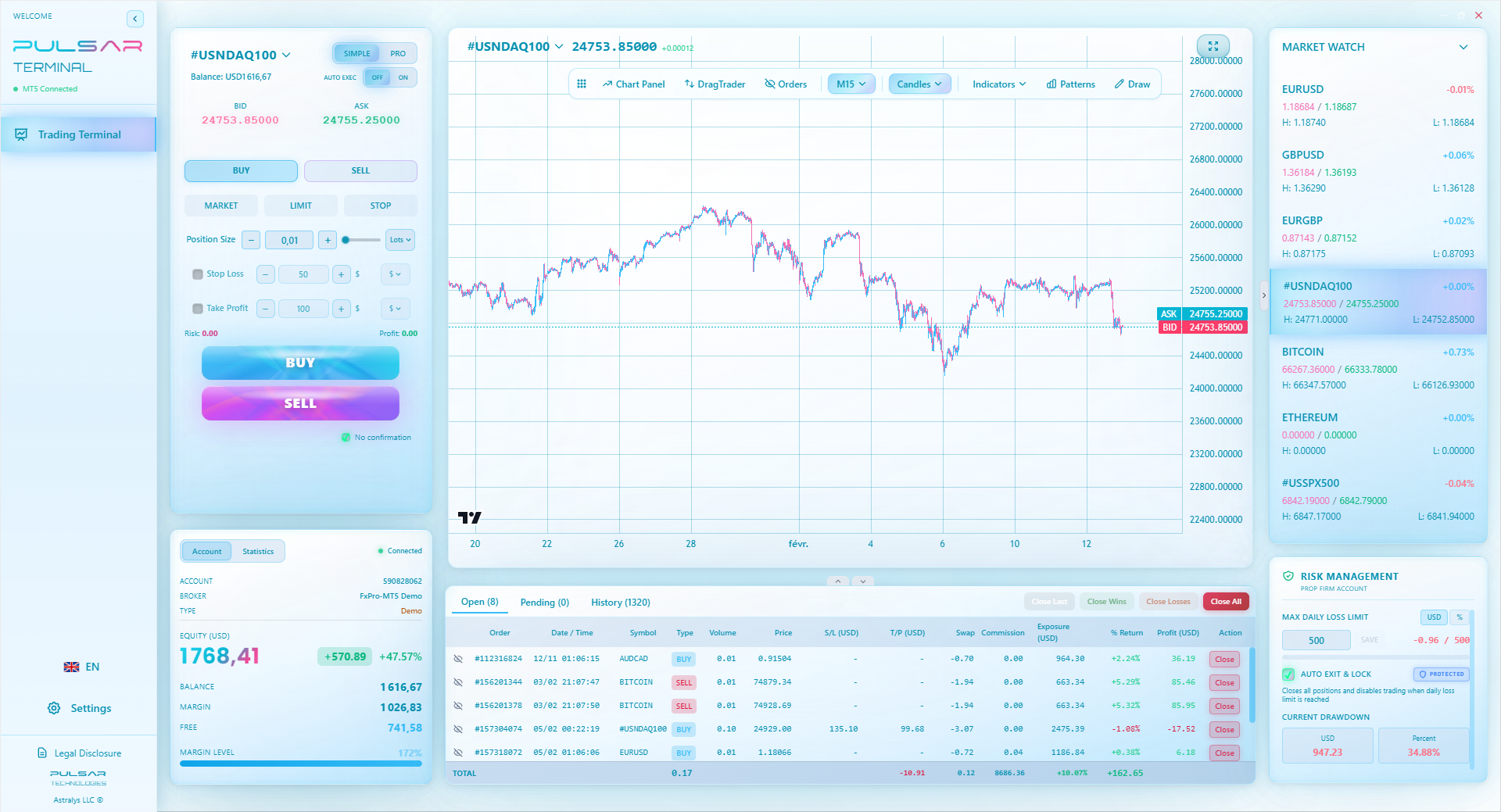
Managing complex exit strategies and daily loss limits manually on MT5 is error-prone; a tool like Pulsar Terminal automates this directly on your broker's server.
Pulsar Terminal
Lo strumento MT5 tutto-in-uno: ordini drag-and-drop, multi-TP/SL, trailing stop, grid trading, Volume Profile e protezione prop firm. Usato da oltre 1.000 trader ogni giorno.
“The cheapest broker isn't the one with the lowest spread; it's the one that doesn't cost you money when you need to withdraw.”
Here's the rule, straight from a tax consultant I paid too much money to after ignoring this: All net profits from forex trading are taxable income in South Africa, regardless of where your broker is based.
If you make R50,000 net profit trading USD/JPY with an FSCA broker, or a Malaysian broker, or a broker on the moon, you owe SARS income tax on that R50,000. It's not capital gains. It's income.
The good news? You can deduct legitimate expenses. This includes:
- Data fees for trading
- Subscriptions to trading journals, news services, or analysis tools (like a terminal app)
- Portion of your home office expenses (if you trade professionally)
- Education costs (courses, books)
- Broker commissions and fees
Keep a Trading Journal: This is non-negotiable. Use a spreadsheet or software. Every trade: date, instrument, entry/exit, profit/loss in ZAR. At the end of the tax year (end of February), you tally it up. Your net profit (total wins minus total losses minus expenses) goes on your tax return.
SARS is getting smarter about tracking offshore income. The Common Reporting Standard (CRS) means many foreign brokers automatically share account info with SARS. Getting caught hiding trading income leads to back taxes, penalties, and interest. It's not worth the stress. Just declare it.
- Choose a Regulated Broker: Pick one from the list in Section 3. Go to the FSCA website (fsb.co.za) and verify their FSP number.
- Open a Demo Account First: Test everything. Execution speed, platform stability, spreads during your trading hours. Trade it like it's real money for at least two weeks.
- Decide on Account Currency: If you plan to start small and trade mostly ZAR pairs, a ZAR account is simpler. If you're going serious with majors and gold (XAU/USD), consider a USD account funded via Wise.
- Submit Your KYC: Have your SA ID and a recent proof of residence (utility bill, bank statement) ready. This is mandatory for FSCA brokers.
- Make Your First Deposit: Use the cheapest method. For ZAR accounts, that's EFT. Start with the minimum or an amount you can afford to lose completely. This is tuition money, not rent money.
- Install Your Tools: Download MT5 from your broker's website (not a generic one). Then, set up any additional tools or terminals you've chosen.
- Trade Small & Journal: Start with micro lots (0.01). Your goal for the first 100 trades isn't profit. It's to test your strategy, your emotions, and the broker's execution. Log every single trade.
- Withdraw Early: Once you're in profit, make a small withdrawal. This tests the withdrawal process and proves to yourself the money is real. There's no better feeling than that first profit hitting your bank account.
Stick to this, and you'll avoid 90% of the nightmares that beginner traders face. You'll have a regulated partner, a clear cost structure, and a path to actually keeping what you make.
FAQ
Q1Can I legally use a forex broker in Malaysia as a South African?
Technically, yes, there's no law stopping you from opening an account. But practically, it's a terrible idea. You forfeit all protections from the FSCA, have limited dispute resolution, and complicate your tax situation. The minor benefits (like potentially higher use) are not worth the massive risk to your capital.
Q2What is the best FSCA-regulated broker for beginners?
XM is hard to beat for absolute beginners. The $5 (R90) minimum deposit means you can start with almost no risk, their platform is straightforward, and they offer good educational material. Once you're consistent and trading larger sizes, you'll likely graduate to a raw spread broker like IC Markets or Pepperstone for lower overall costs.
Q3How do I avoid high currency conversion fees?
Use a broker that offers ZAR-denominated trading accounts and fund it via local EFT. Your money stays in Rands until the moment of trade. If you must fund a USD account, use Wise (TransferWise) to convert your ZAR to USD at a mid-market rate before sending it to the broker. Never let your bank or the broker do the conversion for you.
Q4What's the deal with the new R2 million SARB allowance?
As of March 2026, the Single Discretionary Allowance (SDA) increased from R1m to R2m per calendar year. This means you can send up to R2 million abroad for any legal purpose (including funding a forex broker) without needing a Tax Compliance Status PIN from SARS. It simplifies moving larger amounts for serious traders.
Q5Do I pay tax on losses?
No, you only pay tax on your net profit (total profits minus total losses minus allowable expenses). If you have a net loss for the tax year, you don't pay income tax on your trading. That loss can sometimes be carried forward to offset future profits, but the rules are specific - consult a tax professional.
Q6Is MetaTrader 4 or 5 better for South African brokers?
MT5 is now the standard and is better in almost every way. It has more timeframes, more pending order types, a built-in economic calendar, and better back-testing. Most new brokers only offer MT5. Some older brokers still offer MT4, but you should be learning on MT5 for future-proofing.
Q7Can I get more than 30:1 use in South Africa?
As a retail client, no. The FSCA cap is 30:1 for major forex pairs. You can apply for 'professional client' status with a broker, but you must meet strict criteria (large portfolio size, significant trading experience, etc.). Most traders who think they need 500:1 use are simply under-capitalized and taking on suicidal risk.
Lezione del Prof. Winston
Punti chiave:
- ✓FSCA regulation is non-negotiable for fund safety.
- ✓The real cost includes spreads, commissions, and hidden forex fees.
- ✓Use ZAR accounts or Wise to slash conversion costs.
- ✓Always log trades for SARS - net profit is taxable income.
- ✓Test withdrawals early to confirm the broker is legitimate.
Quanto è stato utile questo articolo?
Clicca su una stella
Analisi Trading Settimanali
Analisi e strategie settimanali gratuite. Nessuno spam.
Sull'autore
David van der Merwe
Trader dei Mercati Emergenti
Trader con base a Johannesburg con 11 anni di esperienza nelle valute dei mercati emergenti. Specializzato in coppie ZAR, trading regolamentato dalla FSCA e analisi del mercato sudafricano.
Commenti
Avviso di rischio
Il trading di strumenti finanziari comporta rischi significativi e potrebbe non essere adatto a tutti gli investitori. Le performance passate non garantiscono risultati futuri. Questo contenuto è fornito solo a scopo educativo e non deve essere considerato un consiglio di investimento. Conduci sempre le tue ricerche prima di fare trading.
Potrebbe interessarti anche

Cara Trading Forex Sukses: 7 Prinsip dari Trader Profesional
Cara trading forex sukses dengan 7 prinsip trader pro: manajemen modal, disiplin, journal trading, backtest. Data nyata, bukan janji profit palsu.
Jam Trading Forex Terbaik untuk Trader Indonesia: Panduan Lengkap dengan Tabel Waktu
Panduan jam trading forex untuk trader Indonesia. Tabel 4 sesi dunia, jam emas 20:00-00:00, sesi mana yang harus dihindari. Data akurat + tips dari trader berpengalaman.
Top 5 Sàn Forex Uy Tín Nhất 2026: Review Jujur dari Trader Indonesia
Top 5 sàn forex uy tín 2026 untuk trader Indonesia. Review jujur: spread, deposit, withdraw, dukungan lokal. Exness, XM, IC Markets & lebih.
Scarica Pulsar Terminal
Tutti questi calcolatori sono integrati in Pulsar Terminal con dati in tempo reale dal tuo conto MT5.
Scarica Pulsar Terminal