


I remember my first big loss on the ZAR/JPY pair back in 2015.

David van der Merwe
Trader dei Mercati Emergenti ·  South Africa
☕ 11 min di lettura
Cosa imparerai:
I remember my first big loss on the ZAR/JPY pair back in 2015. I was using an offshore broker that promised the world - 1:1000 use, tiny spreads. What they didn't mention clearly was the insane overnight swap fee. I held a position for three days, made a small profit on the price move, but ended up paying over R800 in financing costs. The profit was R650. I actually lost money on a winning trade. That's when I learned that a forex brokers list in South Africa isn't just about who's cheapest; it's about who plays by our rules and doesn't hide the real costs. Let's get you set up properly.
Look, I get the temptation. You see ads for brokers offering 1:2000 use when our local regulator, the Financial Sector Conduct Authority (FSCA), caps it at 1:30 for retail clients. The siren song of bigger positions is strong. But here's the cold, hard truth I learned the expensive way: that FSCA logo is your first and most important line of defense.
Since 2021, the FSCA has enforced stricter rules to protect people like you and me. The 1:30 use limit might feel restrictive, but it's there to stop you from blowing up your account in two bad trades. Brokers operating here must segregate client funds. That means your money is held in a separate bank account, not mixed with the company's operational cash. If the broker goes under (it happens), your capital isn't automatically part of their bankruptcy estate.
They also need professional indemnity insurance of at least R5 million. It's not perfect, but it's a safety net. The key thing is accountability. If an FSCA-regulated broker messes you around with withdrawals or shady price feeds, you have a local authority to complain to. Try getting help from a regulator in the Marshall Islands.

Warning: Some international brokers on global lists are FSCA-regulated, but they might sign you up under their offshore entity by default to offer higher use. Always check which legal entity you're actually opening an account with. If it's not the FSCA-regulated one, you're not protected by South African rules.
Forget the flashy car giveaways. When I'm sizing up a broker, I have a simple checklist. These are the things that affect your P&L every single day.
Account Currency and Costs
Can you deposit and hold funds in ZAR? This is huge. If you fund a USD account with your rand, every deposit and withdrawal has a bank conversion fee, usually 2-3%. On a R10,000 deposit, that's R200-R300 gone before you even place a trade. A ZAR-denominated account eliminates that. Also, check the spread on USD/ZAR if you ever need to convert profits. Some brokers have a massive markup there.
The Real Cost of Trading: Spreads + Commissions
You'll see two main account types: standard (with wider spreads, no commission) and raw/pro ( tight spreads + a commission per lot). You need to do the math. Let's say Broker A has a 1.2 pip spread on EUR/USD with no commission. Broker B has a 0.2 pip spread but charges $7 per round-turn lot ($3.50 per side).

Example: If you trade 1 standard lot (100,000 units), a pip is $10.
- Broker A cost: 1.2 pips = $12
- Broker B cost: 0.2 pips ($2) + $7 commission = $9 Broker B is cheaper, but only if you're trading full or mini lots. For a micro lot (0.01), the commission might make it more expensive. Know your typical trade size. Use a position size calculator to work this out precisely.
Platform and Tools
Most offer MetaTrader 4 or 5. It's the industry standard for a reason. But check if they allow third-party tools or plugins. As your skills grow, you might want advanced charting or trade management tools that MT5 doesn't have natively. Also, test their mobile app. Is it reliable? Can you manage trades easily? I've been caught out by a glitchy app before, it's not fun.
Deposit and Withdrawal Reality
How do you get your money in and out? EFT, credit card, PayPal, or cryptocurrency? What are the fees? How long does it take? A good South African broker should process EFT withdrawals back to your local bank account within 24-48 hours. If they quote 5-7 business days, be suspicious. I once waited 10 days for a withdrawal from an offshore broker; never again.

💡 Consiglio di Winston
A broker is a utility, not a strategy. Spend 95% of your time learning price action and risk management, 5% worrying about who executes it.
“Just because you can open an account with R150 doesn't mean you should.”
Here’s my take on some of the big names you’ll see. This isn't just copied from their websites; it's based on my experience and that of traders I know.
| Broker (FSCA #) | My Take & Best For | Min. Deposit (ZAR) | Key Thing to Know |
|---|---|---|---|
| IG Markets | The institutional giant. | ~R5,000+ | Superb research and platform. Spreads are okay, not the tightest. You're paying for the brand and stability. Good for swing trading where execution speed isn't as critical. |
| Tickmill (49464) | The cost-effective scalper. | ~R1,800 ($100) | Their Raw account is legit. I've seen the EUR/USD spread at 0.1 pips. You pay a commission, but overall cost is low. Excellent for a scalping strategy. Their customer service is surprisingly good. |
| AvaTrade (45984) | The beginner-friendly option. | R1,500 | Fixed spreads. Great if you hate variable costs. Offers a lot of platforms, including their own AvaTradeGo. Good educational content. use is strictly at the FSCA 1:30 limit here. |
| Khwezi Trade | The local champion. | R500 | A proudly South African broker. ZAR accounts, local support, spreads from 0.4 pips. They understand the local market nuances. A solid, trustworthy choice if you want to keep everything in-house. |
| Exness (51024) | The high-use option. | R182 ($10) | Here's the nuance: Exness is FSCA regulated, but they often onboard SA clients under their global entity to offer use up to 1:2000. You must choose to be under the FSCA entity for 1:30 use and its protections. Read our full Exness review for details. |
| IC Markets | The raw spreads favorite. | ~R1,800 ($100) | Not always on every SA list, but they accept SA clients and are a monster in the ECN space. Consistently some of the tightest spreads and fastest execution I've seen. Our IC Markets review breaks down why pros love them. |
A quick story: I ran a 3-month test on EUR/USD between Tickmill and a standard account broker. Trading 1 lot per day, the commission-based model on Tickmill saved me about $450 in spread costs over that period. That's real money.
Let's talk brass tacks. Your profitability comes down to managing these three things.
use: The Double-Edged Sword The FSCA's 1:30 limit is your friend. Let me illustrate. On a R10,000 account at 1:30, your buying power is R300,000. For a standard EUR/USD lot ($100,000), that's about $5,500 margin required (depending on the pair). You could still open a decent position, but one bad move won't instantly vaporize your account. At 1:500, that same R10,000 controls R5 million. A 2% move against you wipes you out. I've seen it happen. Use use to control sensible position sizes, not to pretend you're a whale.
The Hidden Fee: Overnight Financing (Swap) This caught me early on. If you hold a position past the daily rollover time (usually 10pm SAST), you pay or receive a swap fee. It can be positive or negative. For ZAR pairs, these fees can be especially high due to our interest rate. Always check the swap rates on your broker's platform before holding a trade for multiple days. A swing trading idea can become a loss if the negative swap eats your potential profit.
Tax: Don't Get a Surprise from SARS This isn't financial advice, but you need to know the basics. In South Africa, profits from trading are generally considered capital gains. You get an annual exclusion (around R40,000). Above that, your net gain is included in your taxable income and taxed at your effective rate (max 18.6% for individuals). Keep a detailed log of all your trades. SARS may want to see it. The biggest mistake is not setting aside a portion of your profits. If you make R50,000 in a year, assume at least R2,000-R5,000 might be owed. Put it in a separate savings account.

Pro Tip: The most common cause of a margin call isn't just a bad trade. It's not accounting for the spread cost on entry and exit. If your stop-loss is 10 pips away, but the spread is 2 pips, the price only needs to move 8 pips against you to hit your stop. Always calculate risk based on the exit price, not the entry.
💡 Consiglio di Winston
The spread is the first loss on every trade. If your strategy can't overcome the average spread cost, it's not a strategy, it's a donation.
“The spread is the first loss on every trade.”
We all start somewhere, and somewhere is usually making dumb errors. Here are the big ones.
Chasing the Lowest Minimum Deposit Just because you can open an account with R150 doesn't mean you should. With that amount, even at 1:30 use, your position sizes will be microscopic. The transaction costs (spreads) will eat a huge percentage of any gain. It's a surefire way to get frustrated. Save up a realistic starter bankroll. I'd say R5,000 is a serious minimum. It lets you breathe, make small mistakes, and learn without the pressure of every pip being life or death.
Ignoring the Demo Account You wouldn't buy a car without a test drive. Don't fund a live account without spending at least 2-4 weeks on the broker's demo. Test everything: order execution speed during news events, how the platform behaves when you're in a trade, the withdrawal process simulation. I demo trade every new strategy for a month before risking real capital.
Overcomplicating Your Strategy You've found a broker, now you're going to load up your charts with 15 indicators, right? Wrong. When I started, I had the MACD indicator, RSI, Bollinger Bands, and Stochastic all on one chart. It was a mess of conflicting signals. Pick one or two tools, like the RSI indicator for momentum and a moving average for trend, and learn them inside out. A clean chart leads to clearer decisions.
Not Having a Written Plan Where will you enter? Where is your stop-loss? Where will you take profit? What's your risk per trade (I recommend never more than 1-2% of your account)? Write it down before you click 'buy' or 'sell'. Emotion will try to change the plan mid-trade. Don't let it.
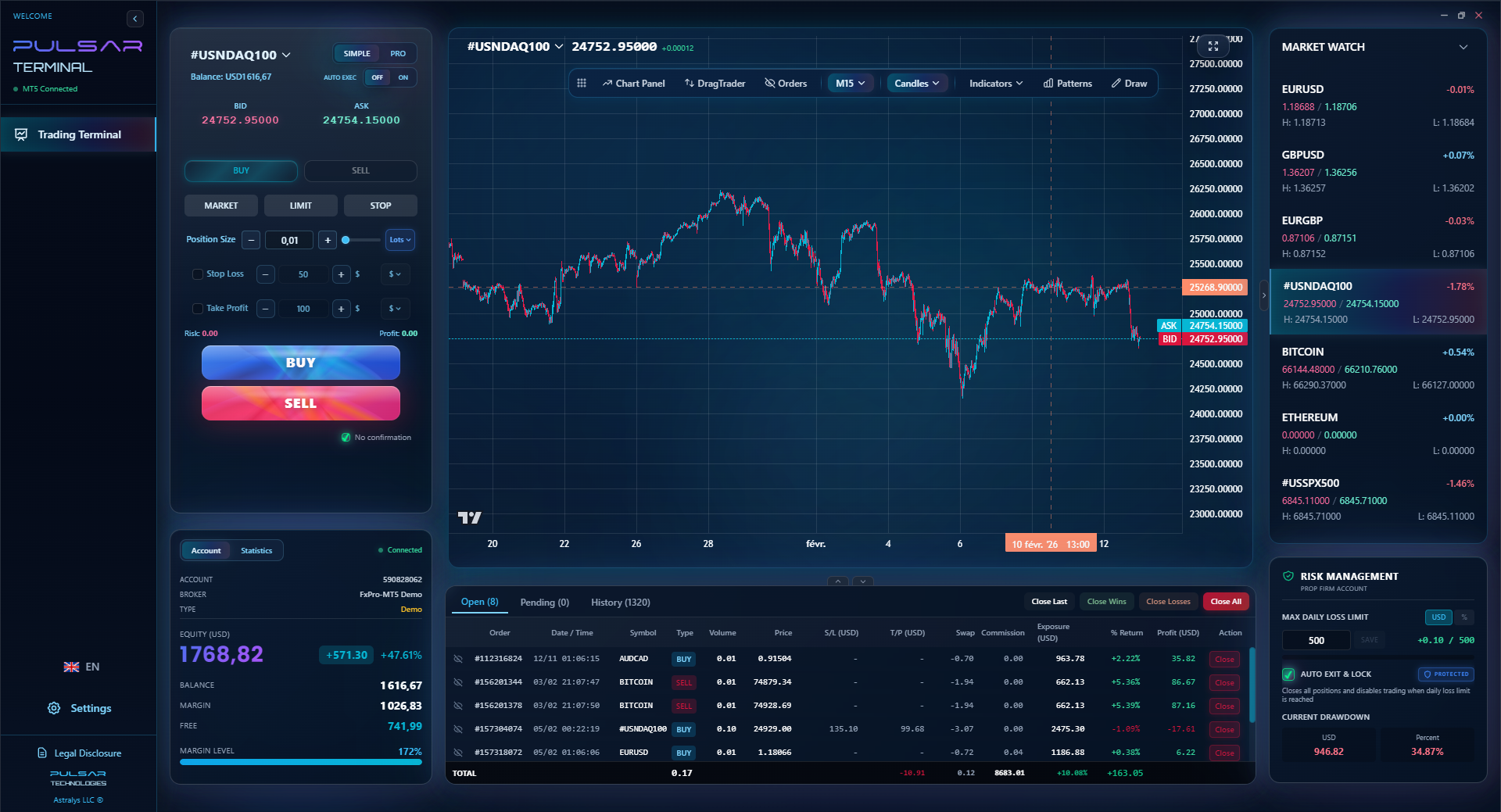
Sticking to a written trading plan is the hardest part, which is why tools like Pulsar Terminal automate your risk rules and trade management directly on MT5.
Pulsar Terminal
Lo strumento MT5 tutto-in-uno: ordini drag-and-drop, multi-TP/SL, trailing stop, grid trading, Volume Profile e protezione prop firm. Usato da oltre 1.000 trader ogni giorno.
- Regulation First: Shortlist only brokers with a verifiable FSCA license number. Check it on the FSCA's website.
- Open a Demo: Pick your top 2 brokers. Open demo accounts with both. Trade the same ideas on both for two weeks. Compare the feel, the spreads at different times, the platform stability.
- Choose Your Account Type: Based on your intended trade size and style, decide between a standard or commission-based raw spread account. Do the math.
- Start Small for Real: Fund your chosen account with a small, sensible amount (e.g., R5,000). Use the FSCA's 1:30 use limit as a guide, but consider starting with even less, like 1:10, while you learn.
- Define Your Risk: Set a hard rule. Mine is: "No single trade risks more than 1.5% of my current account balance." Use a calculator to determine your lot size every time.
- Keep a Journal: Record every trade. Entry, exit, reason, profit/loss, and most importantly, how you felt. Review it weekly. This is how you improve.
- Withdraw Early: Once you've grown your account by 20-30%, withdraw your initial investment. Trade with the house's money. It changes your psychology completely.
The South African forex scene is vibrant and growing, with over 200,000 of us in the game. By choosing the right partner from a credible forex brokers list in South Africa, you're not just picking a platform, you're choosing a foundation. A good foundation lets you build. A shaky one guarantees a collapse. Now go test some demos.
FAQ
Q1Is forex trading legal and safe in South Africa?
Yes, it's completely legal. Its safety depends almost entirely on your broker's regulation. Trading with an FSCA-licensed broker is safe because they must follow strict rules like segregating your funds and having insurance. Trading with an unregulated offshore broker is significantly riskier.
Q2What is the best forex broker for beginners in South Africa?
For a true beginner, I'd point to AvaTrade or Khwezi Trade. AvaTrade offers fixed spreads (so costs are predictable) and great educational materials. Khwezi Trade provides excellent local support and ZAR accounts, making everything simpler. Both are fully FSCA-regulated, so you're protected as you learn.
Q3Can I use international brokers like Pepperstone or XM in South Africa?
You can, and many do. Brokers like Pepperstone and XM accept South African clients. However, you'll typically be onboarded under their global (e.g., Australian or Cypriot) regulation, not the FSCA. This means you might get higher use (like 1:500) but forfeit the specific protections of South African law. Always check which entity you're signing up with.
Q4How much money do I need to start forex trading in South Africa?
Technically, some brokers let you start with R150. Practically, I strongly advise a minimum of R5,000. This allows for proper position sizing, absorbs the inevitable learning-curve losses, and means trading costs (spreads) won't consume a huge part of your potential profits. It's about giving yourself a fighting chance.
Q5What is the FSCA use limit, and can I get around it?
The FSCA retail use limit is 1:30 for major forex pairs. Some brokers with both FSCA and offshore licenses may give you the option to open an account under their global entity to access higher use (like 1:500 or more). Be aware that if you choose this, you are voluntarily opting out of the FSCA's client protection rules. It's a trade-off.
Q6Do I pay tax on my forex trading profits in South Africa?
Yes. Profits are generally treated as capital gains for tax purposes. You have an annual exclusion (around R40,000). Any net gain above that is included in your taxable income. It's crucial to keep detailed, accurate records of all your trades for your tax return. Consult a tax professional for advice specific to your situation.
Lezione del Prof. Winston
Punti chiave:
- ✓FSCA regulation is non-negotiable for capital protection.
- ✓A ZAR account saves you ~3% on every deposit/withdrawal.
- ✓Realistic starting capital is R5,000, not R150.
- ✓At 1:30 use, a 3.4% move against you triggers a margin call.
Quanto è stato utile questo articolo?
Clicca su una stella
Analisi Trading Settimanali
Analisi e strategie settimanali gratuite. Nessuno spam.
Sull'autore
David van der Merwe
Trader dei Mercati Emergenti
Trader con base a Johannesburg con 11 anni di esperienza nelle valute dei mercati emergenti. Specializzato in coppie ZAR, trading regolamentato dalla FSCA e analisi del mercato sudafricano.
Commenti
Avviso di rischio
Il trading di strumenti finanziari comporta rischi significativi e potrebbe non essere adatto a tutti gli investitori. Le performance passate non garantiscono risultati futuri. Questo contenuto è fornito solo a scopo educativo e non deve essere considerato un consiglio di investimento. Conduci sempre le tue ricerche prima di fare trading.
Potrebbe interessarti anche

Cara Trading Forex Sukses: 7 Prinsip dari Trader Profesional
Cara trading forex sukses dengan 7 prinsip trader pro: manajemen modal, disiplin, journal trading, backtest. Data nyata, bukan janji profit palsu.
Jam Trading Forex Terbaik untuk Trader Indonesia: Panduan Lengkap dengan Tabel Waktu
Panduan jam trading forex untuk trader Indonesia. Tabel 4 sesi dunia, jam emas 20:00-00:00, sesi mana yang harus dihindari. Data akurat + tips dari trader berpengalaman.
Top 5 Sàn Forex Uy Tín Nhất 2026: Review Jujur dari Trader Indonesia
Top 5 sàn forex uy tín 2026 untuk trader Indonesia. Review jujur: spread, deposit, withdraw, dukungan lokal. Exness, XM, IC Markets & lebih.
Scarica Pulsar Terminal
Tutti questi calcolatori sono integrati in Pulsar Terminal con dati in tempo reale dal tuo conto MT5.
Scarica Pulsar Terminal