


I remember staring at my screen on November 3rd, 2023.

Olumide Adeyemi
Pioniere del Trading in Africa Occidentale ·  Nigeria
☕ 11 min di lettura
Cosa imparerai:
- 1What Exactly Is the Forex Factory Calendar?
- 2Setting Up Your Calendar for Nigerian Trading
- 3How to Read the Forecast vs. Actual Numbers
- 4My Trading Strategies Around High-Impact News
- 5The Nigerian Context: Volatility and Funding
- 6Common Mistakes I See (And Made Myself)
- 7How I Integrate the Calendar with Technical Analysis

I remember staring at my screen on November 3rd, 2023. The USD/NGN was at 1,680, and the U.S. Non-Farm Payrolls report was about to drop. My heart was pounding. I had a small long position on EUR/USD, but I hadn't checked the Forex Factory calendar today. The number came in way above forecast. The chart spiked down 40 pips in seconds, hitting my stop-loss and wiping out two days of careful gains. That loss, about $120, taught me a brutal lesson: trading without the calendar is like driving in Lagos with your eyes closed. You might get lucky, but you're asking for trouble. Now, checking that red, yellow, and orange grid is the first thing I do every single morning, before I even look at a chart.
Forget fancy jargon. The Forex Factory calendar is simply a website that lists all the scheduled economic announcements that can move currency prices. Think of it as the market's shared diary. Central banks, governments, and research firms announce data like inflation rates, employment numbers, and interest rate decisions at specific times. This calendar tells you what's coming, when, and most importantly, how much the market cares about it.
The magic is in the color coding. You'll see three main colors:
- Red (High Impact): Market movers. These are the big ones like U.S. Non-Farm Payrolls, CPI inflation, or Central Bank rate decisions. Prices can jump 50-100 pips or more in minutes. You need a plan for these.
- Orange (Medium Impact): Can cause decent volatility, usually 20-40 pips. Things like retail sales or manufacturing data fall here.
- Yellow (Low Impact): Minor announcements that might cause a small blip but rarely change the overall trend.
For us trading from Nigeria, this tool is non-negotiable. Our own market hours (GMT+1) mean that major European and U.S. news hits during our active trading day. A high-impact event at 2:30 PM GMT is 3:30 PM Nigerian time. If you're not aware, you can get caught in a liquidity squeeze or a massive spread widening, especially on pairs involving the Naira.

Warning: Never, ever have an open trade during a high-impact red news event unless you are a seasoned news trader with a specific strategy. The spreads can widen so much your stop-loss gets executed at a terrible price. I learned this the hard way trading GBP/USD during a BoE announcement.
The calendar also shows the previous value, the forecast (what economists expect), and the actual result once it's released. The difference between the actual and the forecast is what fuels the market's immediate reaction.

💡 Consiglio di Winston
Professor Winston always said, 'The market's greatest moves are born from the gap between expectation and reality.' Your job isn't to predict the news, but to measure that gap and react to it.
The default view on Forex Factory is in GMT. The first thing you must do is change this. Click the little clock icon at the top and set it to your local time (Abuja/Lagos, GMT+1). This simple step prevents costly timing mistakes. You don't want to be an hour late because you forgot about the time difference.
Filtering is Your Best Friend
You can't possibly track every event for every country. You'll go mad. I filter my view to show only High and Medium impact events for the currencies I trade. For most Nigerian traders, that means:
- USD (United States): The dollar is the world's reserve currency. Its data moves everything. Always watch for U.S. news.
- EUR (Eurozone): Major pairs like EUR/USD are hugely popular here. ECB announcements and German data are key.
- GBP (United Kingdom): Another major currency with liquid pairs.
- CAD, AUD, NZD, JPY, CHF: If you trade these, add their filters.
I make a point of also checking for any Nigerian data, like GDP or inflation, though its direct impact on major forex pairs is usually low. However, it can affect the parallel market rate for USD/NGN, which influences your deposit and withdrawal psychology.

Pro Tip: Use the 'Calendar View' tab to see the whole week ahead. I do this every Sunday night. I mark the high-impact events in my trading journal. Knowing that the U.S. CPI is on Wednesday lets me adjust my entire week's strategy - maybe I avoid scalping that morning and focus on swing trading setups instead.
“Trading without the calendar is like driving in Lagos with your eyes closed.”
This is where the real skill comes in. It's not just about whether the news is 'good' or 'bad.' It's about whether it's better or worse than expected.
Let's use a real example from my journal. On January 12th, 2024, the U.S. Core CPI (Consumer Price Index) data was due.
- Previous: 4.0%
- Forecast: 3.8%
- Actual: 3.9%
At first glance, inflation came down (3.9% is lower than 4.0%). Good news, right? But the market had expected 3.8%. The actual was higher than forecast. This was a 'hawkish' surprise, meaning the Fed might keep rates higher for longer. The immediate reaction? The U.S. Dollar spiked higher. EUR/USD dropped about 25 pips in the first minute.
I had been leaning long on EUR/USD based on the daily chart. Seeing the actual number beat the forecast, I didn't wait. I closed my pending buy order and stayed flat. Saved myself a loss.
Another critical column is the revised figure. Sometimes, the previous month's number is adjusted. If the actual beats the forecast and the previous month is revised higher, that's a double-whammy of strength for that currency.

Example: Let's say UK Retail Sales come out. Forecast is 0.3%, Actual is 0.5%. That's a beat. GBP/USD should rally. But if the Previous month was revised down from 0.2% to -0.1%, the overall picture is muddied. The initial pop might be sold into. You need to look at the whole picture.
I've tried every approach over the years. Here’s what actually works for me, trading from Lagos with brokers like IC Markets and Exness.
1. The Avoidance Strategy (My Go-To Now): This is the safest. I simply do not trade 15 minutes before and 15-30 minutes after a high-impact red news event. I close all pending orders and tighten stops on any open swing trades. The volatility is insane, and spreads can blow out. My broker's servers are under load. It's not a fair fight. I use this time to analyze the aftermath.
2. The Breakout / Fade Strategy: After the initial 5-10 minute spike, the market often settles into a new range or retraces. I wait for that initial volatility to subside. I then look for a breakout of the first 15-minute high/low after the news, or a fade (trade against) the initial move if it looks exhausted. This requires patience and a clear head.
3. The Straddle / Pending Order Strategy (Advanced): This involves placing both a buy-stop and a sell-stop order just outside the pre-news range. Whichever way the market breaks, it triggers an order. The key is to set a tight profit target (10-15 pips) and get out quickly, because the reversal can be vicious. You also need a broker with fast execution and no requotes. I've had mixed results with this; sometimes you get a beautiful spike, other times you get whipsawed and hit both stops. Always use a position size calculator for this, as the risk is defined but real.
A Personal Mistake: I once tried to 'guess' the direction of the ECB press conference based on headlines. I went long on EUR/USD just as Christine Lagarde started speaking. The pair jumped 15 pips, then reversed and dropped 60. I was so married to my idea I didn't cut the loss. That one trade erased a week's profits. News trading requires absolute discipline and the willingness to be wrong instantly.
💡 Consiglio di Winston
If you wouldn't cross the Third Mainland Bridge during peak chaos, don't trade during a red news event. Wait for the traffic to clear, then proceed with caution.
“News dictates short-term volatility, but technicals define the playing field.”
Trading the calendar from Nigeria adds unique layers. First, our internet isn't always stable. A drop in connection during a news event is a disaster. I now use a mobile data backup whenever a major red event is due.
Second, funding. The CBN prohibits using official FX windows to fund trading accounts. We rely on parallel market rates or broker-specific payment channels. When there's major global USD volatility, the local USD/NGN parallel rate often moves with it. A strong dollar globally can mean even higher rates for buying dollars to deposit. Checking the Forex Factory calendar today helps me plan my deposits. If I see a volatile USD week ahead, I might deposit a bit earlier to avoid a worse rate.
Third, tax. Remember, profits are subject to a 10% Capital Gains Tax. When you're calculating the risk/reward of a news trade, factor that in. A 20-pip win isn't 20 pips after costs and tax.
Broker choice is critical. You need one with a proven track record of stable platforms during news. I've found IC Markets and Pepperstone to be reliable, with tight spreads even around news. Their servers can handle the load. Always check a broker's news trading policy - some widen spreads dramatically, which can trigger your stop-loss prematurely.
Finally, the psychological toll. Seeing a trade go against you 50 pips in a blink is stressful. It can ruin your trading mindset for the rest of the day. I have a rule: if I take a news-related loss, I close the platform and walk away. No revenge trading.
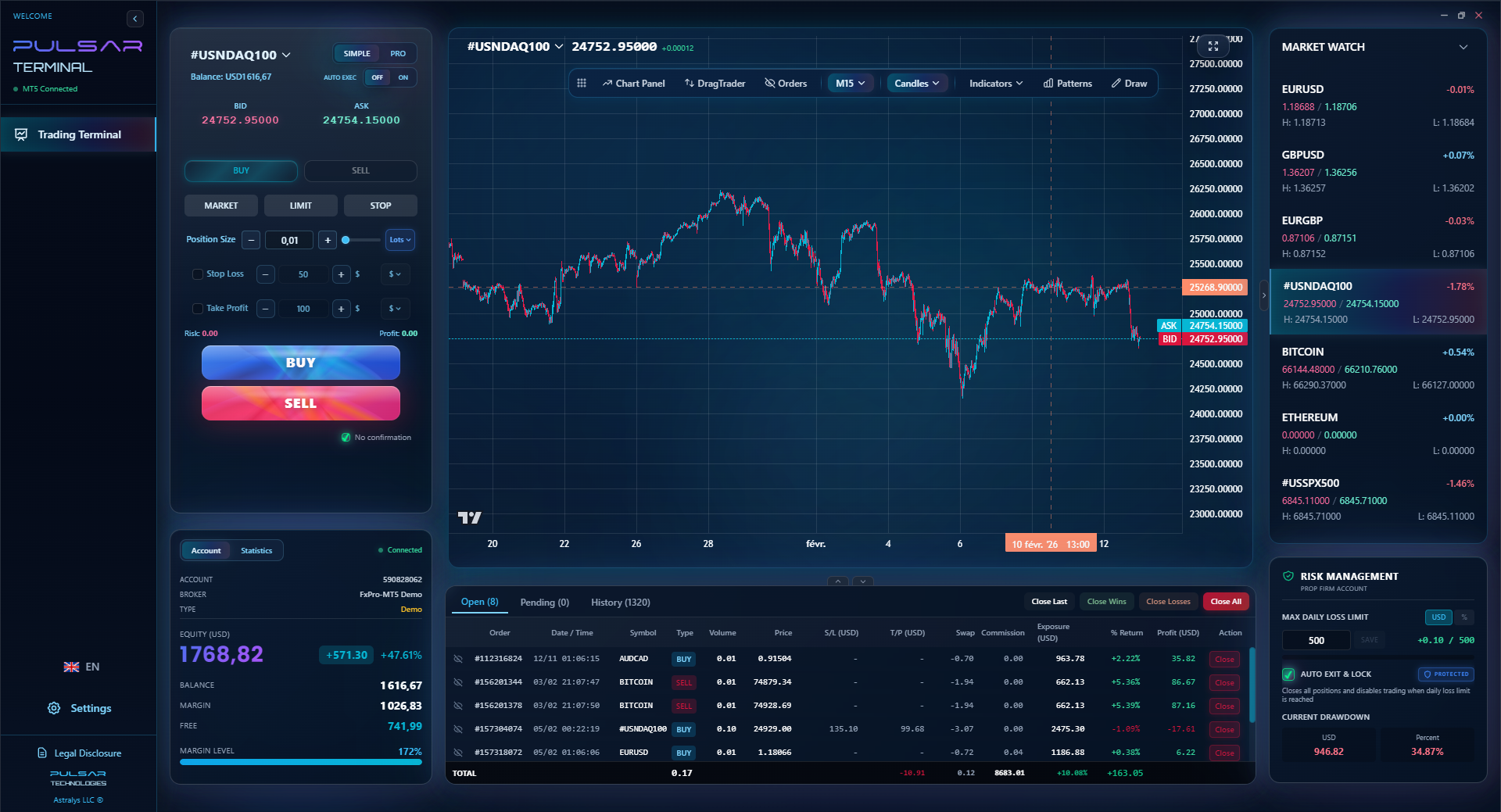
Managing risk during volatile news events is critical, and Pulsar Terminal's automated stop-loss and breakeven features help protect your capital instantly on MT5, so you can focus on the news, not your mouse.
Pulsar Terminal
Lo strumento MT5 tutto-in-uno: ordini drag-and-drop, multi-TP/SL, trailing stop, grid trading, Volume Profile e protezione prop firm. Usato da oltre 1.000 trader ogni giorno.
Let me save you some money and stress.
Mistake 1: Trading the Rumor, Ignoring the Fact. The market often 'prices in' the forecast before the news. I once bought GBP on rumors of a hawkish BoE. The actual decision was hawkish, but it was exactly as expected. The price sold off in a classic 'buy the rumor, sell the news' move. I was left holding the bag.
Mistake 2: Not Accounting for Revisions. As mentioned, a revised previous number can change everything. I got caught once on a Canadian jobs report that beat forecasts, but the previous month was revised down significantly. The initial CAD strength lasted all of 90 seconds before it collapsed.
Mistake 3: Misjudging the 'Actual' Color. Sometimes, a high-impact event's actual number is so close to forecast it's effectively a non-event. The calendar might still show it in red, but the market doesn't move. Don't force a trade just because the box is red.
Mistake 4: Forgetting About Consecutive Events. Sometimes two high-impact events are back-to-back. A U.S. CPI at 1:30 PM GMT and a Fed Chair speech at 3:00 PM GMT. The volatility can be compounded. You need to be aware of the whole landscape, not just the next item.
Mistake 5: No Post-News Plan. You survive the initial spike. Now what? Have a plan for the next hour. Is the trend established? Is there a retracement to enter? Don't just sit there stunned.
💡 Consiglio di Winston
A calendar is a map of potential storms. A good captain doesn't sail into the storm; he uses the map to navigate around it, or to use its wind from a safe distance.
“That loss taught me a brutal lesson: the Forex Factory calendar today is non-negotiable.”
The calendar doesn't exist in a vacuum. It interacts with the charts. My rule: News dictates short-term volatility, but technicals define the playing field.
Here's my process:
- Identify the Technical Context: Before the news, I look at the chart. Is price at a key support or resistance level? Is it trending strongly, or is it in a tight range? Is the RSI indicator overbought or oversold?
- Overlay the News Event: If a high-impact news is due at a major technical level (e.g., U.S. NFP when EUR/USD is sitting on a strong support trendline), that's a potential powder keg. The news will decide if the level holds or breaks.
- Post-News Analysis: After the volatility settles, I look for a new technical signal. Did the news cause a clean breakout with a close outside the range? That's a new trend candidate. Did it spike and then reject back into the range? That's a false breakout, and I might fade it.
A concrete example: Last month, Gold (XAU/USD) was consolidating in a triangle. The U.S. PCE data (high impact) was due. I drew the triangle boundaries. The news caused a sharp break above the triangle. I didn't chase it. I waited for the first pullback to the former resistance line (now support) and entered long there. That pullback was my high-probability, post-news technical entry. The news provided the energy, the technicals provided the precise entry.
Indicators like the MACD indicator can help confirm the momentum direction after the news dust settles. But never rely on a lagging indicator during the news release itself.
FAQ
Q1What time should I check the Forex Factory calendar in Nigeria?
Check it first thing in the morning (Abuja/Lagos time, GMT+1). Set the calendar to your local time in the settings. Also, check it the night before to plan for the next day's major events, especially if they occur during Asian/London session overlap which is early morning for us.
Q2Is it illegal to use Forex Factory for trading in Nigeria?
No, it's not illegal. Forex Factory is a free, publicly available information website. Using it to inform your legal forex trading decisions is perfectly fine. The legality concerns in Nigeria revolve around funding sources (not using official CBN windows) and broker registration, not the tools you use for analysis.
Q3What's the single most important news event for a beginner to watch?
The U.S. Non-Farm Payrolls (NFP), released usually on the first Friday of the month at 2:30 PM GMT (3:30 PM Nigerian time). It's the biggest regular market mover. As a beginner, just observe it. Close your trades beforehand and watch how the market reacts. It's the best free lesson in news volatility.
Q4Can economic news from Nigeria affect forex pairs like EUR/USD?
Directly, almost never. Nigerian data like GDP or inflation has a very minor global impact. However, it can affect the parallel market USD/NGN rate, which impacts your personal funding costs and psychology. Indirectly, major oil price news (as Nigeria is an oil exporter) can affect commodity currencies like CAD, which can then influence broader market sentiment.
Q5Why did the price move opposite to what the news suggested?
This happens often. It's usually because: 1) The market had already 'priced in' the news (buy the rumor, sell the fact). 2) The focus was on a different sub-component of the report (e.g., wage growth within jobs data). 3) A simultaneous event from another country overshadowed it. 4) The initial knee-jerk reaction was reversed by algorithmic trading. This is why trading the initial spike is so risky.
Q6Do I need to pay attention to low-impact (yellow) news?
Generally, no, you can ignore them for direct trading purposes. However, sometimes a series of yellow events from one country, all pointing in the same direction, can build a narrative that affects the currency over days. For day-to-day trading, focus your mental energy on the red and orange events.
Q7How do I manage risk during a high-impact news event?
The best risk management is to not be in the market. Close positions or use very wide stop-losses (50+ pips) if you must hold through it, understanding the spread may widen massively. If you are trading the news, define your risk upfront (e.g., 1% of account) and use a stop-loss. Be prepared for slippage, where your order is filled at a worse price than you set.
Lezione del Prof. Winston
Punti chiave:
- ✓Always filter the calendar to your traded currencies (USD, EUR, GBP).
- ✓The market reacts to the gap between Forecast and Actual, not good/bad.
- ✓Avoid trading 15 mins before and after high-impact red events.
- ✓Integrate news levels with key chart support/resistance.
- ✓Plan your Nigerian deposits around volatile USD news weeks.
Quanto è stato utile questo articolo?
Clicca su una stella
Analisi Trading Settimanali
Analisi e strategie settimanali gratuite. Nessuno spam.
Sull'autore
Olumide Adeyemi
Pioniere del Trading in Africa Occidentale
Uno degli educatori di trading forex più attivi in Nigeria. 8 anni di esperienza di trading da Lagos. Specializzato in strategie a basso capitale e sfide prop firm per trader africani.
Commenti
Avviso di rischio
Il trading di strumenti finanziari comporta rischi significativi e potrebbe non essere adatto a tutti gli investitori. Le performance passate non garantiscono risultati futuri. Questo contenuto è fornito solo a scopo educativo e non deve essere considerato un consiglio di investimento. Conduci sempre le tue ricerche prima di fare trading.
Potrebbe interessarti anche

Cara Trading Forex Sukses: 7 Prinsip dari Trader Profesional
Cara trading forex sukses dengan 7 prinsip trader pro: manajemen modal, disiplin, journal trading, backtest. Data nyata, bukan janji profit palsu.
Jam Trading Forex Terbaik untuk Trader Indonesia: Panduan Lengkap dengan Tabel Waktu
Panduan jam trading forex untuk trader Indonesia. Tabel 4 sesi dunia, jam emas 20:00-00:00, sesi mana yang harus dihindari. Data akurat + tips dari trader berpengalaman.
Top 5 Sàn Forex Uy Tín Nhất 2026: Review Jujur dari Trader Indonesia
Top 5 sàn forex uy tín 2026 untuk trader Indonesia. Review jujur: spread, deposit, withdraw, dukungan lokal. Exness, XM, IC Markets & lebih.
Scarica Pulsar Terminal
Tutti questi calcolatori sono integrati in Pulsar Terminal con dati in tempo reale dal tuo conto MT5.
Scarica Pulsar Terminal