


It was October 2024, and the GBP/NGN pair was in freefall.

Olumide Adeyemi
Pioniere del Trading in Africa Occidentale ·  Nigeria
☕ 10 min di lettura
Cosa imparerai:
- 1What You're Actually Trading (It's Not Just Currency)
- 2The Nigerian Trader's Setup: Brokers, Fees, and Power
- 3Finding a Strategy That Works When Lights Go Out
- 4Risk Management: This Is How You Survive
- 5The Psychology: Your Mind is Your Worst Enemy
- 6Tools and Platforms: Working Smarter, Not Harder
- 7Your First 100 Days: A Realistic Action Plan

It was October 2024, and the GBP/NGN pair was in freefall. I had a sell order open, watching the profits stack up as the Central Bank of Nigeria made another announcement. My phone was buzzing with messages from a guy in my trading group who was on the wrong side of the move, begging for advice as his margin call got closer. That moment, the sheer velocity of gain and loss, is the forex market trading reality. It's not a side hustle, it's a high-stakes arena where sentiment shifts faster than you can refresh your chart. This guide is for the Nigerian trader who's tired of the 'get rich quick' YouTube hype and wants the unvarnished truth about how this market actually works.
Let's clear this up first. When you're forex market trading, you're not buying Nigerian Naira because you believe in the economy. You're speculating on the relative value of one currency against another, and that value is a cocktail of interest rates, political stability, inflation, and pure, unadulterated sentiment. The most important pair for any Nigerian trader to understand is the USD/NGN. It's not just a chart, it's a real-time report card on dollar liquidity, CBN policy, and import demand. I made a classic mistake early on: I traded it like any other pair, ignoring the local context. A 50-pip move on EUR/USD is noise. A 50-pip move on USD/NGN can mean the cost of your next generator fuel shipment just changed. The 'market' is the collective mood of every bank, corporation, and speculator with skin in the game. Your job is to find a sliver of an edge before the mood changes.
The Major Pairs vs. Your Reality
While everyone talks about EUR/USD and GBP/USD (and you should learn them, our EUR/USD guide is a good start), your local broker's spreads on USD/NGN are where they often make their real money. It's less liquid internationally, so the bid-ask spread is wider. You might see a 2-pip spread on EUR/USD but a 15-pip spread on USD/NGN. That means the price has to move 15 pips in your favor just for you to break even. That changes everything about your strategy.

Warning: Trading exotic pairs like USD/NGN or GBP/NGN through an international broker? The spreads can be astronomical, sometimes 50 pips or more. Always check the live spread before you click buy or sell.

💡 Consiglio di Winston
If your trade idea requires a complex paragraph to justify, it's probably wrong. The best setups are obvious in hindsight.
Your first battle is getting a reliable setup. This isn't Europe or the US. You're dealing with power outages, internet fluctuations, and a regulatory environment that's, let's say, dynamic. Your choice of broker isn't just about use, it's about deposit and withdrawal methods that actually work here. I've had profits stuck in a broker for weeks because they only offered bank transfers to countries we have limited correspondence with.
You need a broker with local payment options. Some international brokers now offer deposits via local debit cards or even direct bank transfers in Naira. This is non-negotiable. Check reviews from other Nigerian traders on sites like ours, but look for specifics about withdrawal times and customer service response to local issues.
Here’s a brutal truth about costs most gurus won't tell you:
| Cost Type | What It Is | Typical Impact on a $1,000 Account |
|---|---|---|
| Spread | Difference between buy/sell price. Your instant loss. | 2-3 pips on majors = $2-$3 per standard lot trade. On exotics, can be $15+. |
| Commission | Broker fee per trade. Not all charge it. | $3-$7 per standard lot round turn (open & close). |
| Swap/Rollover | Interest for holding overnight. Can be positive or negative. | Can be $5+ per lot per night. Crucial for swing trading. |
| Payment Fees | Depositing/withdrawing in Naira. | 1-3% of the transaction amount. Adds up fast. |
I used Exness for a while because their local deposit process was seamless. But I moved a portion of my capital to IC Markets for their raw spreads on major pairs when I focused on a scalping strategy. There's no one perfect broker. You often need two: one for local access, one for optimal trading conditions. And always, always use a position size calculator before every trade. Your internet might go down, and you don't want a poorly sized trade blowing up your account while you're looking for fuel for your inverter.

“The 'market' is the collective mood of every bank, corporation, and speculator with skin in the game.”
All the fancy indicators in the world mean nothing during a 'NEPA take light' moment. Your strategy must be strong and simple enough that you can manage risk even with intermittent connectivity. I learned this the hard way in 2023. I was in a complex gold trade using multiple time frame analysis on XAU/USD (here's our XAU/USD guide for reference). The power went out, my mobile data was sluggish, and by the time I got back online, a news event had triggered a stop hunt that wiped out my profit for the month. My strategy was too dependent on me being glued to the screen.
You need rules so clear you could explain them to your cousin in one sentence. For example: 'I only buy GBP/USD when the price is above the 200-day moving average on the 4-hour chart and the RSI indicator has bounced from oversold.' Then you set your stop loss and take profit orders immediately. If the power goes out, the trade manages itself.

Pro Tip: Build a 'disconnection protocol.' Use pending orders with stop losses attached. Assume you will lose connectivity at the worst possible time. Your trade plan should execute without you.
Also, be wary of strategies built for stable, liquid markets. A breakout strategy that works beautifully on EUR/USD might fail miserably on USD/NGN because the liquidity just isn't there to follow through. Price will spike, hit your entry, then reverse instantly because one large bank order filled. I've been 'whipsawed' more times than I can count. Test any strategy in a demo account on the specific pair you want to trade, during both London and late New York sessions (when liquidity for exotics can dry up).
This is the only section that matters. You can be wrong about the market 60% of the time and still be profitable. I am living proof. But you must have iron-clad risk management. Here’s my non-negotiable rule, born from a $2,000 mistake: Never risk more than 1% of your account balance on a single trade. For a $1,000 account, that's $10. Not $50, not $100. Ten dollars.
How does that look in practice? Let's say you're trading USD/NGN. You identify a key support level at 1450.00. You decide if it breaks to 1445.00, you're wrong. That's a 500-pip stop loss (remember, pips on USD/NGN are different). To risk only $10 with a 500-pip stop, you can only trade a position size of 0.02 micro lots. That's tiny. But that's the reality. The volatility demands smaller positions. If you want to trade bigger, you need a tighter stop loss, which means you need to be more precise with your entry. This is where most Nigerian traders blow up. They see the volatility, dream of huge profits, and put on a position so large that a normal 100-pip move against them triggers a margin call.

Example:
- Account Balance: ₦500,000
- 1% Risk: ₦5,000
- Trade: Sell USD/NGN at 1480.00
- Stop Loss: 1490.00 (100 pip risk)
- Pip Value for 1 Standard Lot: ~₦1,000
- To risk ₦5,000 on a 100-pip stop: ₦5,000 / 100 pips = ₦50 per pip.
- Therefore, your position size should be 0.05 lots.
Automate this. Use a calculator for every single trade. Your emotional brain will try to override this when you're 'sure' about a trade. Don't let it.
💡 Consiglio di Winston
Your first loss is often your cheapest loss. Holding a losing trade hoping for a CBN intervention is a strategy for beggars, not traders.

“You can be wrong about the market 60% of the time and still be profitable. I am living proof.”
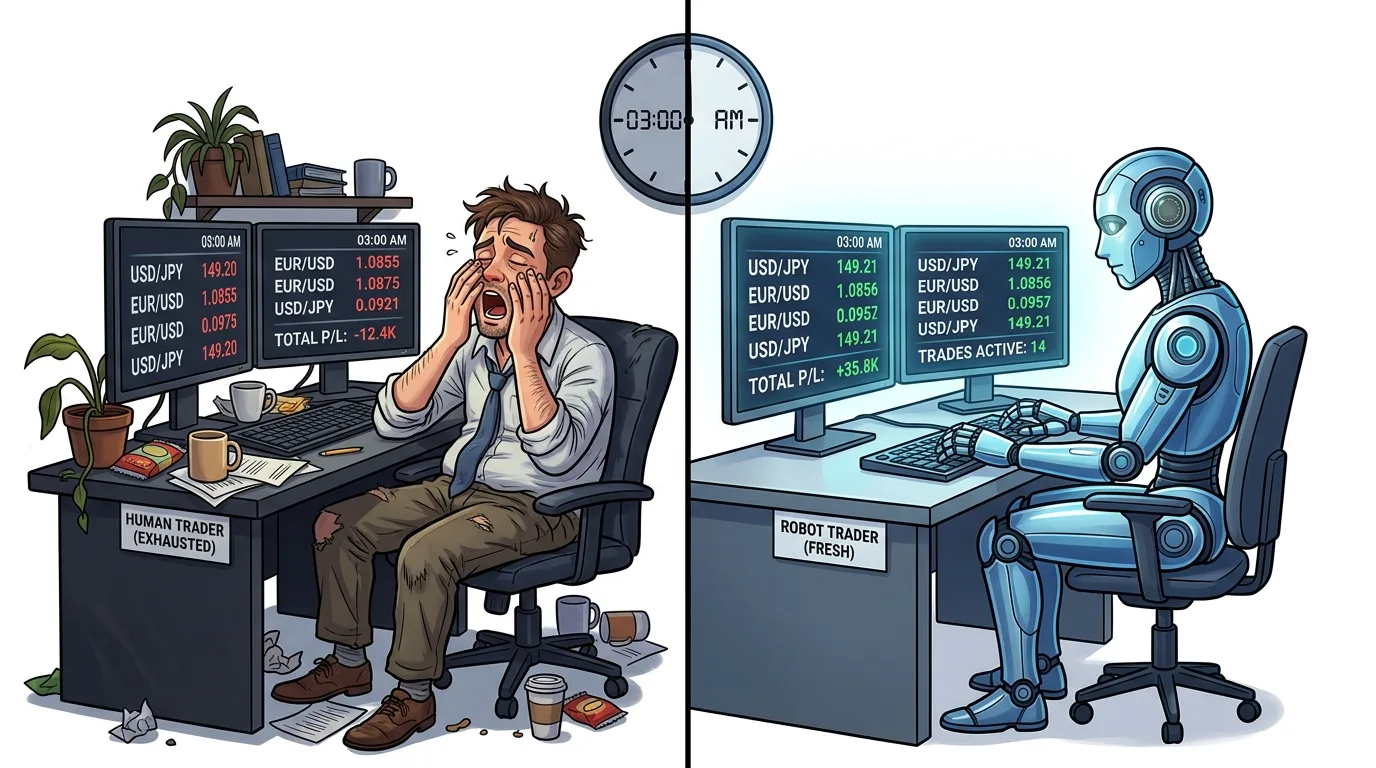
Forex market trading in Nigeria comes with unique psychological pressures. You're not just trading against the market, you're trading against the pressure to provide, to 'make it' in a tough economy. This leads to revenge trading after a loss. It leads to holding losers too long because 'the government will intervene.' I've sat on a losing USD/NGN short for days, convinced the CBN had to step in, only to watch my account bleed out. The market doesn't care about your convictions or your bills.
The second big trap is 'proof trading' – taking trades just to show your friends on WhatsApp that you're in the market, even if your system didn't give a signal. It's ego. I've done it. You feel like a prophet when it works, but it erodes your discipline. Real trading is boring. It's waiting. It's passing on 10 potential trades to take the one that fits your plan perfectly.
You need a trading journal. Not a fancy one. A Google Sheet where you record: the date, pair, reason for entry (e.g., '4hr MACD indicator crossover, support bounce'), entry price, stop loss, take profit, position size, and most importantly, your emotional state ('Felt impatient after missing last move'). Review it weekly. You'll see your own stupid patterns emerge, and you can start to fix them.

MT4/MT5 is the standard here for a reason. It's relatively lightweight and stable. But the default platforms are clunky. Setting a trailing stop or managing multiple take-profit levels on MT5 is a multi-click nightmare. When you're in a fast-moving market on USD/NGN, those seconds matter.
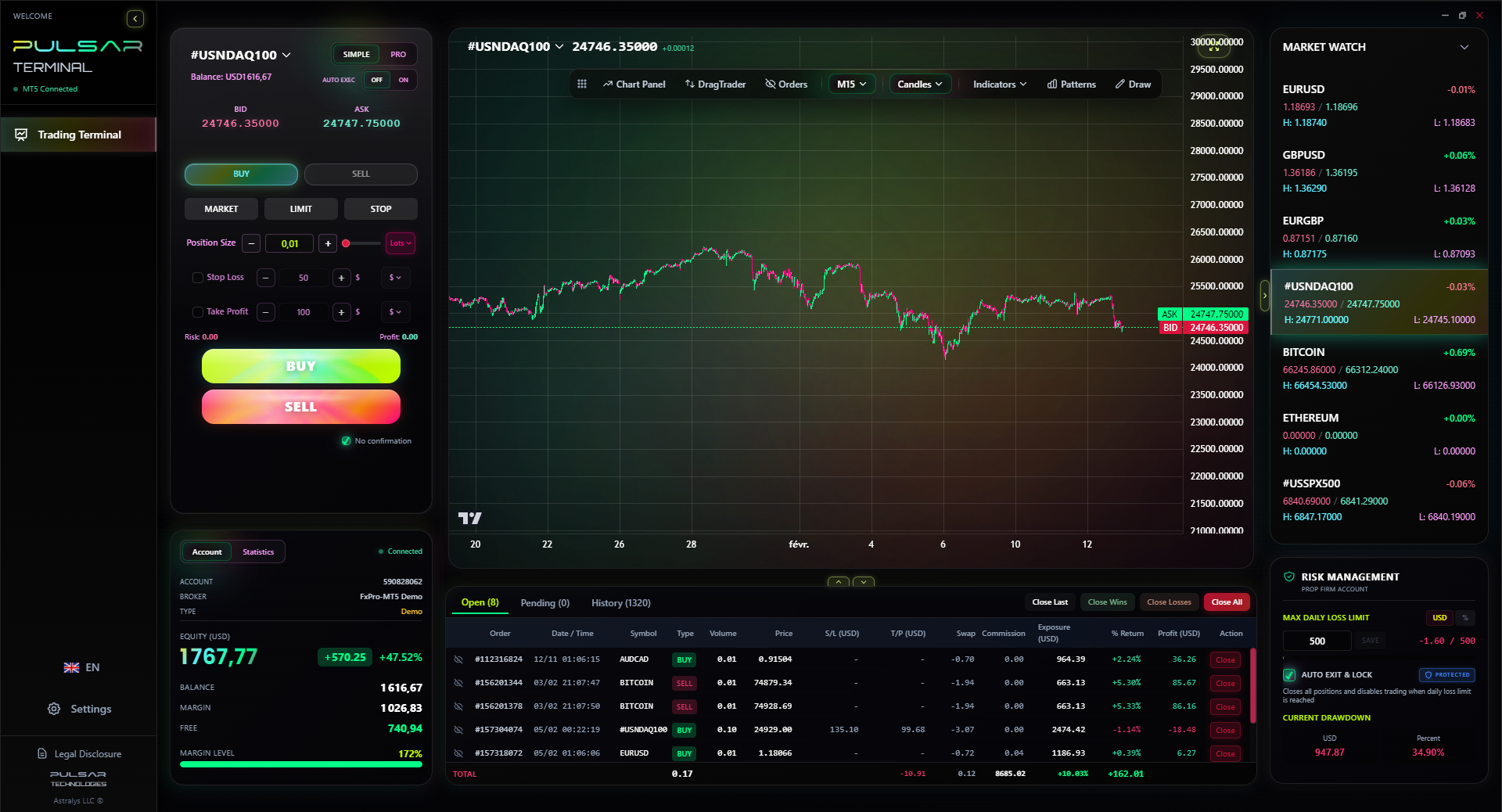
This is where companion tools become force multipliers. You need tools that let you execute your plan faster and more precisely. Think about a tool that lets you drag and drop an order with your stop loss and three take-profit levels already pre-set. Or one that can automatically move your stop loss to breakeven once a certain profit level is hit, protecting you from those vicious reversals. For prop firm traders, a tool that automatically enforces your daily loss limit is a lifesaver, preventing one bad day from failing your entire challenge.
These aren't luxuries for the Nigerian trader dealing with intermittent power and data. They are essentials that reduce screen time, eliminate manual error, and enforce the discipline you struggle to maintain emotionally. The less you have to fiddle with your platform during a trade, the better. Your focus should be on analysis and decision-making, not on clicking through menus.
💡 Consiglio di Winston
The market doesn't know you exist. Your rent, your dreams, your ego - it cares for none of it. Trade the price, not your life.
Manually managing complex orders on MT5 during a power fluctuation is a recipe for disaster, which is why tools like Pulsar Terminal that allow drag-and-drop order placement and automated trade management are essential for the Nigerian trader.
Pulsar Terminal
Lo strumento MT5 tutto-in-uno: ordini drag-and-drop, multi-TP/SL, trailing stop, grid trading, Volume Profile e protezione prop firm. Usato da oltre 1.000 trader ogni giorno.
“Real trading is boring. It's waiting. It's passing on 10 potential trades to take the one that fits your plan perfectly.”
Forget about making money. Your goal for the first three months is to not lose your seed capital while learning. Here's the step-by-step:
- Education with a Focus on Risk: Spend two weeks only learning about pips, lots, use, and risk management. Understand what a spread is and how it kills scalpers. Read our glossary on pips and margin.
- Open a Demo Account: Do it with a broker you're seriously considering, like XM or Pepperstone, so the conditions are realistic. Don't play. Treat it like real money from day one.
- Choose ONE Pair: Start with EUR/USD. It's the most liquid, has the tightest spreads, and moves predictably. Master one market before adding noise.
- Test ONE Strategy: Pick a simple strategy based on support/resistance or one indicator. Trade it on the demo for at least 50 trades. Record every outcome in your journal.
- Analyze Your Demo Trades: Are you consistently profitable? Is your win rate above 40%? Is your average winner bigger than your average loser? If not, go back to step 4. Do not deposit real money.
- Go Live (Tiny): If your demo stats are solid, fund a live account with the minimum amount you can. For you, that might be ₦50,000. Your goal is to make 20 consecutive trades following your plan, risking 0.5% per trade. If you can do that, you've passed the first real test.
I deposited $500 when I started. I blew it up in 6 weeks because I skipped the demo phase. I thought I was special. I wasn't. Don't be me.

FAQ
Q1Is forex trading legal in Nigeria?
Yes, forex trading is legal for individuals in Nigeria. However, the regulatory environment is evolving. The SEC Nigeria has shown increasing interest in overseeing forex brokers and investment platforms. You are responsible for ensuring your broker is reputable and that you understand the tax implications of your profits.
Q2What is the minimum amount I need to start forex trading in Nigeria?
Technically, you can start with as little as $10 (about ₦15,000) with some brokers offering micro accounts. But realistically, with proper risk management (risking 1% per trade), that's not enough to withstand normal market movements. A more practical starting amount that allows for meaningful learning is between ₦100,000 and ₦250,000. Remember, the minimum deposit is not your trading capital; you should never deposit money you cannot afford to lose entirely.
Q3Which currency pairs should a Nigerian beginner trade?
Start with major pairs like EUR/USD or GBP/USD. They have high liquidity, low spreads, and abundant analysis available. Avoid USD/NGN or other exotic pairs as a beginner. The wide spreads and lower liquidity make them much harder to trade profitably and will distort your understanding of standard strategy execution.
Q4How do I handle withdrawals and taxes on forex profits in Nigeria?
Withdrawals depend on your broker. Choose one with reliable local bank transfer or card withdrawal options. Test the withdrawal process with a small amount first. Regarding taxes, the situation is complex. Profits from trading may be considered taxable income. It is crucial to keep detailed records of all your trades, deposits, and withdrawals. Consult with a Nigerian tax professional for the most current advice, as this is not legal tax guidance.
Q5Why do most Nigerian forex traders fail?
They fail for the same reasons traders everywhere fail, amplified by local pressures: poor risk management (overtrading, too much use), lack of a tested strategy, emotional trading driven by the need for quick money, and using unreliable brokers or infrastructure. Many also jump straight into complex pairs like USD/NGN without mastering the basics on more stable majors.
Q6Can I use my phone for forex trading in Nigeria?
Yes, and you probably will have to sometimes due to power issues. MT4/MT5 have good mobile apps. However, phone trading is for monitoring and managing existing trades, not for deep analysis or entering complex strategies. Your primary analysis should be done on a computer when you have stable power and internet. Never place a trade on mobile data during a volatile news event if your signal is weak.
Lezione del Prof. Winston
Punti chiave:
- ✓Risk a maximum of 1% of your account per trade. No exceptions.
- ✓Master EUR/USD on demo before touching USD/NGN.
- ✓Wide spreads on exotic pairs require entirely different math.
- ✓Your trading plan must survive a power outage.
- ✓A trading journal is your most important tool.
Quanto è stato utile questo articolo?
Clicca su una stella
Analisi Trading Settimanali
Analisi e strategie settimanali gratuite. Nessuno spam.
Sull'autore
Olumide Adeyemi
Pioniere del Trading in Africa Occidentale
Uno degli educatori di trading forex più attivi in Nigeria. 8 anni di esperienza di trading da Lagos. Specializzato in strategie a basso capitale e sfide prop firm per trader africani.
Commenti
Avviso di rischio
Il trading di strumenti finanziari comporta rischi significativi e potrebbe non essere adatto a tutti gli investitori. Le performance passate non garantiscono risultati futuri. Questo contenuto è fornito solo a scopo educativo e non deve essere considerato un consiglio di investimento. Conduci sempre le tue ricerche prima di fare trading.
Potrebbe interessarti anche

Cara Trading Forex Sukses: 7 Prinsip dari Trader Profesional
Cara trading forex sukses dengan 7 prinsip trader pro: manajemen modal, disiplin, journal trading, backtest. Data nyata, bukan janji profit palsu.
Jam Trading Forex Terbaik untuk Trader Indonesia: Panduan Lengkap dengan Tabel Waktu
Panduan jam trading forex untuk trader Indonesia. Tabel 4 sesi dunia, jam emas 20:00-00:00, sesi mana yang harus dihindari. Data akurat + tips dari trader berpengalaman.
Top 5 Sàn Forex Uy Tín Nhất 2026: Review Jujur dari Trader Indonesia
Top 5 sàn forex uy tín 2026 untuk trader Indonesia. Review jujur: spread, deposit, withdraw, dukungan lokal. Exness, XM, IC Markets & lebih.
Scarica Pulsar Terminal
Tutti questi calcolatori sono integrati in Pulsar Terminal con dati in tempo reale dal tuo conto MT5.
Scarica Pulsar Terminal