


I lost R4,200 in about 15 minutes back in 2019.

David van der Merwe
Trader dei Mercati Emergenti ·  South Africa
☕ 11 min di lettura
Cosa imparerai:
I lost R4,200 in about 15 minutes back in 2019. I was short on USD/ZAR, convinced the rand would strengthen after a decent GDP print. What I missed was a simultaneous announcement from Moody's about a potential credit rating review. The forex movement was brutal and immediate - the pair spiked 180 pips against me before I could even process what happened. That trade taught me a hard lesson: in South Africa, you're not just trading charts, you're trading a story. A story about politics, commodities, and global risk sentiment, all wrapped up in our volatile rand.
If you think forex movement is just about support and resistance lines, you're going to have a bad time. Especially here. Price is the final score, but the game is played with fundamentals. For us trading the ZAR, there are three heavyweight champions in the ring.
The Big Three: Commodities, Politics, and The Dollar
First, commodities. We're a resource economy. When the prices of platinum, gold, or iron ore go up, it generally brings dollars into the country. That demand for rand can strengthen it. I keep a live chart of gold (XAU/USD) next to my USD/ZAR chart. In early 2023, when gold broke above $1,950, I went long on USD/ZAR expecting the typical inverse relationship. It worked, but it was slow. The real move came later when copper and palladium also rallied. That combined commodity strength pushed USD/ZAR from around R18.20 down to R17.80 over two weeks.
Second, local politics and policy. This is our unique headache. Budget speeches, SONA, municipal election results, and especially Eskom's latest status report - they all cause immediate forex movement. The market hates uncertainty. I got caught short on EUR/ZAR during a period of cabinet reshuffle rumors in 2021. The spread on my broker Exness review widened massively for a few minutes, and by the time my order filled, I was already 50 pips in the hole on a trade that should have been a winner.
Third, and this is the big one: the US Dollar and global risk sentiment. The ZAR is a classic 'risk-on, risk-off' currency. When global investors are feeling brave, they put money into emerging markets like ours for the higher yield. That's 'risk-on' and the rand often strengthens. When they get scared - by a US inflation scare, a war, or a banking crisis - they pull money out and run to the safety of the US Dollar. That's 'risk-off' and the rand gets hammered. You can't understand USD/ZAR movement without watching the DXY (US Dollar Index) and the VIX (the 'fear index').

Warning: Trading around major SA political events is like playing with fire. The spreads widen, liquidity dries up, and the price can gap right through your stop loss. I treat the 24 hours before a major speech or rating announcement as a no-trade zone for ZAR pairs.

💡 Consiglio di Winston
The market's job is to prove you wrong. Your job is to have a plan for when it does. A stop loss isn't admitting defeat; it's paying a small insurance premium to stay in the game.
Trading the rand gives you a local knowledge edge, but you've got to know which pairs to watch and how they behave. Let's break down the main players.
The king is USD/ZAR. It's the most liquid, has the tightest spreads (often 40-80 pips on a standard account, but as low as 0.4 pips with a broker like Khwezi Trade), and reacts to everything. A move of 100 pips (1 cent) in a day is normal. 300+ pip days happen during major events. Remember, in USD/ZAR, if the number goes UP, the rand is WEAKENING. If it goes DOWN, the rand is STRENGTHENING. This trips up so many new traders.
EUR/ZAR and GBP/ZAR are your secondary pairs. They're great for when you have a strong view on Europe or the UK relative to SA. For example, if you think the UK economy is struggling more than ours, you might short GBP/ZAR. The spreads are wider, often 80-150 pips, so they're less ideal for a scalping strategy. They also tend to follow USD/ZAR's overall direction, but with their own twists.
Cross pairs without the USD, like EUR/GBP or AUD/CAD, are where many SA traders go to get away from rand volatility. The spreads are much tighter (often 1-3 pips on majors), and the forex movement is more technical and driven by the respective economies. It's a different game - slower, more predictable, but without that home-ground feel. I often switch to these when local news is too chaotic to read.

Pro Tip: Don't just look at the price of USD/ZAR. Look at the rate of change. A slow, grinding move from R18.00 to R18.50 over a month is very different from a rocket from R18.00 to R18.50 in two days. The first might be a fundamental trend; the second is panic, and panic reverses fast.
“Trading the rand because you're patriotic, or selling it because you're angry at load-shedding, is not a strategy. The market doesn't care about your feelings.”
You can't trade the ZAR like you'd trade the Swiss Franc. Its wild swings demand specific tactics. Here’s what I’ve found works over 12 years of getting whipped around.
Swing Trading is Your Best Friend. Trying to scalp USD/ZAR for 20-pip profits is a recipe for stress and spread costs. The noise will eat you alive. Instead, aim for the bigger swings. I look for 200-500 pip moves over several days or weeks. My tool of choice here is the daily chart. I use the MACD indicator on the daily to gauge momentum and the 50 and 200-period moving averages to identify the trend. A classic setup is waiting for a pullback to the 50-period EMA in a strong trend, then entering with a stop loss below the recent swing low. This requires patience, but it aligns with how the ZAR actually moves.
Position Sizing is Non-Negotiable. This is the most important point in this guide. With the ZAR's volatility, a standard 1% risk per trade can still lead to a scary ride. Because each pip definition in USD/ZAR is worth so much more in rand terms (roughly R10 per pip on a standard lot with the pair at R18.50), your position can balloon in value fast. I use a position size calculator for every single trade. If my stop is 250 pips away, I size down so that 250 pips equals my maximum risk (usually 0.5-1% of my account). I learned this after a 250-pip stop loss hit on a too-large position and wiped out a week's profits.
News Trading: The High-Risk, High-Reward Game. Trading SARB interest rate announcements or US Non-Farm Payrolls can be profitable, but it's advanced. You don't trade the news itself; you trade the market's reaction to the news versus its expectation. The key is to wait for the initial spike and volatility to settle - often 2 to 5 minutes after the release - and then trade the breakout from the initial range. This requires a broker with fast execution and a stable platform. I've had good experiences with IC Markets review for this. Never, ever have an open position right as the news hits unless you're intentionally gambling.

Example: Let's say your account is R20,000 and you're willing to risk 1% (R200). You want to buy USD/ZAR at R18.40, with a stop loss at R18.15 - a 250-pip risk. Pip value ≈ R10. So, R200 risk / (250 pips * R10/pip) = 0.08 lots. That's your max position size. Sizing correctly lets you sleep at night.
💡 Consiglio di Winston
Volatility is not risk. Risk is how much of your capital you expose to that volatility. A 500-pip move means nothing if your position is sized correctly.
Managing multiple take-profit levels and a trailing stop on a volatile pair like USD/ZAR is stressful to do manually, which is why a tool like Pulsar Terminal that automates it directly on MT5 is a game-saver.
Pulsar Terminal
Lo strumento MT5 tutto-in-uno: ordini drag-and-drop, multi-TP/SL, trailing stop, grid trading, Volume Profile e protezione prop firm. Usato da oltre 1.000 trader ogni giorno.
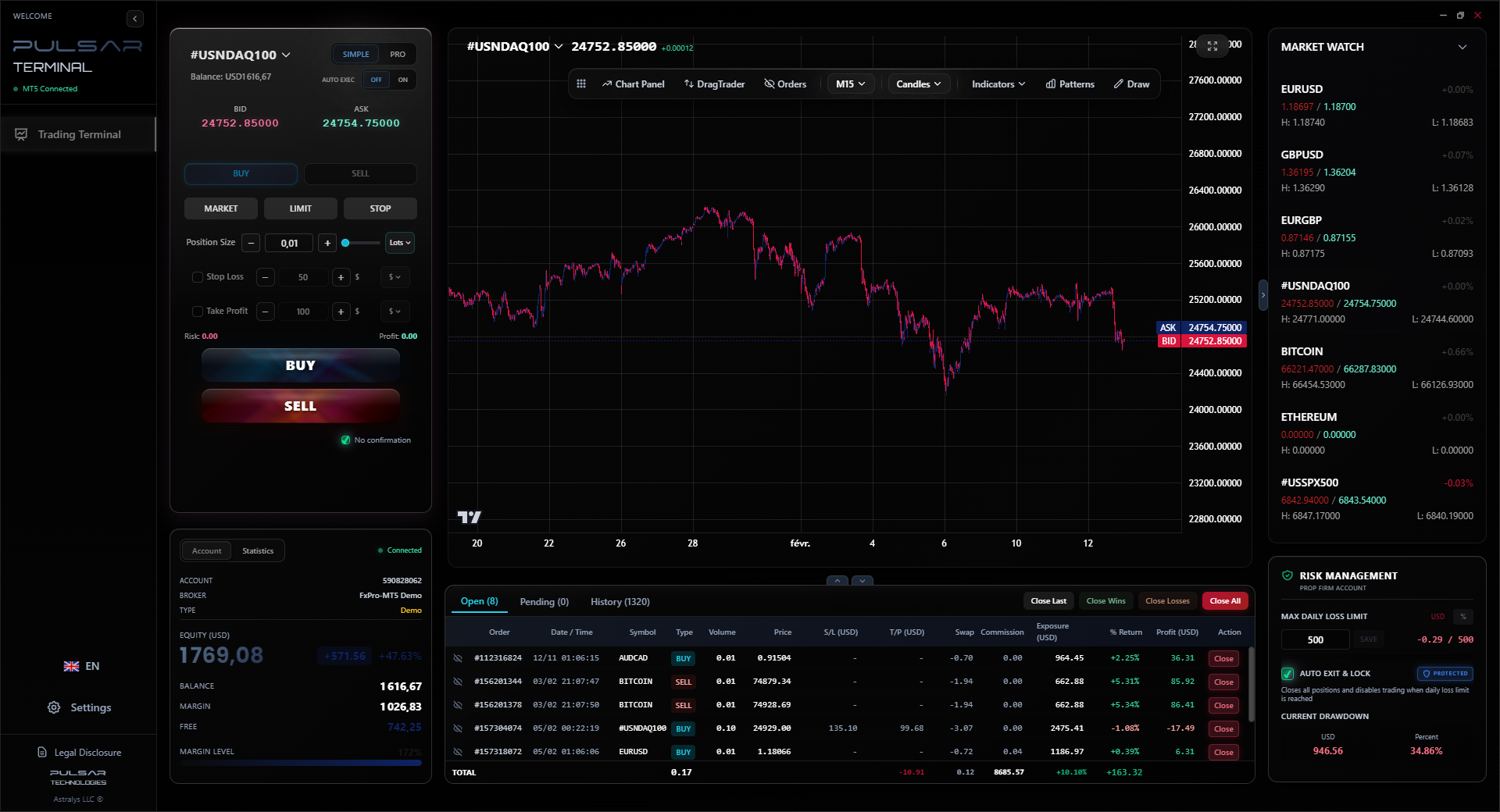
You need the right gear. Here’s my everyday toolkit for decoding forex movement in SA.
Economic Calendars: This is your pre-trade checklist. I use Investing.com's calendar, filtered for 'High Impact' events for South Africa, the US, and the EU. I mark every SARB meeting, SA inflation print, US Fed meeting, and US jobs report. If a high-impact event is within 6 hours, I'm either out of the market or I've widened my stops significantly.
Charting Platforms: MetaTrader 5 is the industry standard here for a reason. Most local and international brokers offer it. The built-in indicators are solid. For more advanced analysis, I connect MT5 to TradingView for their superior drawing tools and community ideas. Some brokers, like FP Markets, also offer cTrader, which is fantastic for pure price action trading.
Key Indicators I Actually Use:
- Moving Averages (50 & 200 period): For trend direction on the daily chart.
- Relative Strength Index (RSI): I use it to spot potential reversals when USD/ZAR gets overbought above 70 or oversold below 30. But in a strong trend, it can stay overbought/oversold for ages, so it's a warning sign, not a signal.
- Support & Resistance: Hand-drawn lines are more valuable than any indicator. I mark the major weekly highs and lows. The market has a long memory for these levels.
Sentiment Gauges: The SA Currency Volatility Index (SAVI) is a niche but useful tool. Also, just reading the business section of Moneyweb or Business Day can give you a feel for local investor sentiment that charts won't show.
“Your goal for the first 100 trades isn't to get rich. It's to survive.”
Let's get real. We all mess up. Here are the classic errors that burn South African traders, complete with my personal receipts.
1. Over-leveraging. The FSCA capped use at 30:1 for local brokers for a reason. Yet, I see guys signing up with offshore brokers offering 500:1 or even 1000:1 to trade USD/ZAR. This is suicide. At 500:1, a 20-pip move against you can wipe out your entire margin. I used 100:1 early on. A 150-pip whipsaw on some UK news triggered a margin call and closed my trade for a loss, only for the price to immediately reverse and hit my original profit target. The trade was right, the use was stupid.
2. Trading Without a Stop Loss. "It'll come back, the rand always comes back." Famous last words. In 2020, USD/ZAR ran from R16.50 to R19.35 in the pandemic panic. If you were short without a stop, you were destroyed. A stop loss isn't a suggestion; it's your lifeline. Place it at a level that, if hit, proves your trade idea wrong.
3. Ignoring the Total Cost. It's not just the spread. Think about the overnight financing charges (swap rates). Holding a short USD/ZAR position (where you're long rand) often pays you a small positive swap. Holding a long USD/ZAR position (short rand) usually costs you money daily. For a swing trading hold of a week or more, these costs add up. Factor them into your profit target.
4. Letting Emotions Drive During News. Buying the rand because you're patriotic, or selling it because you're angry at load-shedding, is not a strategy. The market doesn't care about your feelings. I once averaged down on a losing EUR/ZAR trade because I 'believed in SA's resilience.' I turned a R1,500 loss into a R5,000 loss. Trade the price, not your pride.
💡 Consiglio di Winston
Your trading edge isn't a secret indicator. It's your discipline, your journal, and your ability to follow your own rules when your last three trades have lost money.
Okay, you're fired up. Let's talk about the practical first steps to take without blowing up your account.
1. Choose the Right Broker. Regulation is key. Stick with FSCA-regulated brokers like Khwezi Trade, AvaTrade, or FxPro for safety of funds. Compare their spreads on USD/ZAR (this is a major cost), their minimum deposit (R500-R2000 is common), and their platform. Most offer MT4/5. Start with a demo account and trade it like real money for at least a month.
2. Start Small, Think Big. When you go live, deposit an amount you can afford to lose completely - your 'tuition fee.' Use micro or cent accounts if available. Your goal for the first 100 trades isn't to get rich. It's to survive, to learn how the price moves, and to practice your discipline. Aim for 1:2 or 1:3 risk-to-reward ratios. Risk R100 to make R200 or R300.
3. Keep a Trading Journal. This is the single best thing I ever did. For every trade, note: the pair, entry/exit price, stop loss, take profit, the reason for the trade (e.g., 'bounce off daily support'), and your emotional state. Review it weekly. You'll quickly see your own patterns - maybe you always cut winners too early, or you ignore your stop loss rules on Fridays.
4. Understand the Tax Implications. SARS sees forex trading profits as income. You need to declare your net profit (profits minus losses, minus trading expenses) in your annual tax return. Keep careful records of all your statements. It's a hassle, but it's part of the game here.
The forex movement in South Africa offers incredible opportunity because of its volatility. But that same volatility will punish the unprepared, the emotional, and the reckless. Respect the market, manage your risk obsessively, and never stop learning. The rand has a personality - learn to read its moods, and you can learn to profit from them.
FAQ
Q1Is forex trading legal in South Africa?
Yes, it's completely legal. The key is to use a broker that is properly licensed by the Financial Sector Conduct Authority (FSCA). This ensures they follow local rules, like segregating your client funds from their own company money.
Q2What's a good starting amount for a South African trader?
You can start very small. Some brokers allow deposits as low as $1 (about R18) or R500. However, I'd recommend starting with at least R2,000-R5,000 in a demo account to practice properly, then funding a live account with an amount you're prepared to lose - think of it as your market education fee. Never trade with money you need for rent or bills.
Q3Why is the USD/ZAR pair so volatile?
The rand is considered an emerging market currency, which makes it sensitive to global investor sentiment. When the world is feeling risky, money flows into SA for higher returns. When panic hits, that money flees to safe havens like the US Dollar. This, combined with our local political and economic news (like Eskom or budget speeches), creates a perfect storm for big swings.
Q4What's the difference between a pip and a cent in USD/ZAR?
This confuses everyone. In most pairs, a pip is the 4th decimal place (0.0001). In USD/ZAR, a pip is typically the 3rd decimal place (0.001), because the pair is quoted as, say, R18.5000. So, a move from R18.5000 to R18.6000 is 100 pips, or 10 cents. A 1-cent move is equal to 10 pips. Always check your broker's quote to be sure.
Q5Can I use high use from an international broker?
Technically, yes. Many offshore brokers offer use of 500:1 or more to South African clients. But just because you can, doesn't mean you should. The FSCA's 30:1 cap for local brokers exists to protect retail traders. High use massively amplifies both profits and losses. It's the fastest way to turn a small account into zero.
Q6Do I pay tax on my forex trading profits?
Yes. The South African Revenue Service (SARS) views consistent forex trading profits as income from a business or as capital gains. You are required to declare your net profit (total profits minus total losses and allowable expenses) in your annual tax return. Keep detailed records of all your trades and statements.
Q7What's the best time of day to trade the ZAR?
The most active and liquid times are during the overlap of the European and South African sessions (10:00 SAST - 16:00 SAST) and when the US market opens (15:30 SAST). This is when you'll see the most decisive forex movement and the tightest spreads. Trading in the middle of the night (SA time) is usually slower and riskier due to lower liquidity.
Lezione del Prof. Winston
Punti chiave:
- ✓Size your position for the ZAR's 200+ pip daily swings.
- ✓A 30:1 use cap exists to protect you, not limit you.
- ✓Always know where your stop loss is before you enter.
- ✓Trade the price on your screen, not the hope in your heart.
Quanto è stato utile questo articolo?
Clicca su una stella
Analisi Trading Settimanali
Analisi e strategie settimanali gratuite. Nessuno spam.
Sull'autore
David van der Merwe
Trader dei Mercati Emergenti
Trader con base a Johannesburg con 11 anni di esperienza nelle valute dei mercati emergenti. Specializzato in coppie ZAR, trading regolamentato dalla FSCA e analisi del mercato sudafricano.
Commenti
Avviso di rischio
Il trading di strumenti finanziari comporta rischi significativi e potrebbe non essere adatto a tutti gli investitori. Le performance passate non garantiscono risultati futuri. Questo contenuto è fornito solo a scopo educativo e non deve essere considerato un consiglio di investimento. Conduci sempre le tue ricerche prima di fare trading.
Potrebbe interessarti anche

Cara Trading Forex Sukses: 7 Prinsip dari Trader Profesional
Cara trading forex sukses dengan 7 prinsip trader pro: manajemen modal, disiplin, journal trading, backtest. Data nyata, bukan janji profit palsu.
Jam Trading Forex Terbaik untuk Trader Indonesia: Panduan Lengkap dengan Tabel Waktu
Panduan jam trading forex untuk trader Indonesia. Tabel 4 sesi dunia, jam emas 20:00-00:00, sesi mana yang harus dihindari. Data akurat + tips dari trader berpengalaman.
Top 5 Sàn Forex Uy Tín Nhất 2026: Review Jujur dari Trader Indonesia
Top 5 sàn forex uy tín 2026 untuk trader Indonesia. Review jujur: spread, deposit, withdraw, dukungan lokal. Exness, XM, IC Markets & lebih.
Scarica Pulsar Terminal
Tutti questi calcolatori sono integrati in Pulsar Terminal con dati in tempo reale dal tuo conto MT5.
Scarica Pulsar Terminal