


You've probably downloaded a dozen 'forex patterns PDF' files promising the secret to consistent profits.

David van der Merwe
Trader dei Mercati Emergenti ·  South Africa
☕ 13 min di lettura
Cosa imparerai:
- 1Why Most Forex Patterns PDFs Set You Up to Fail
- 2The 3 Patterns That Actually Work in South Africa
- 3Trading Patterns on ZAR Pairs: What's Different
- 4Patterns Are Useless Without This Context
- 5South African Risk Management: Non-Negotiables
- 6Building Your Own Pattern Trading System
- 7Better Than Any PDF: Tools That Actually Help
- 8Your 30-Day Action Plan (Forget the PDFs)
You've probably downloaded a dozen 'forex patterns PDF' files promising the secret to consistent profits. I know I did when I started. The question isn't whether patterns work - they do - but which ones are worth your time in the South African market, and which are just setting you up for another blown account. Let me save you the R500 million that South Africans lost to forex scams last year by showing you what actually works.
Here's the hard truth I learned after burning through R15,000 in my first six months: most forex patterns PDFs are generic garbage. They're usually recycled content from 2005, written by someone who's never traded the ZAR pairs you're actually watching.
These PDFs show perfect textbook examples - clean head and shoulders patterns on weekly EUR/USD charts from 2017. Real trading, especially with our market's volatility, looks nothing like that. The rand can move 200 pips in an hour during budget speeches or load-shedding announcements. A PDF showing perfect patterns on stable majors won't prepare you for that.

Warning: I've seen PDFs sold for R2,000+ on South African Facebook groups that were literally copied from free websites. The FSCA issued over 150 warnings against unlicensed operators last year, and many sell these 'educational' PDFs as a front for signal scams.
The biggest problem? These PDFs never teach you about position sizing for our use environment. With some brokers still offering 1:500 (though that's changing to 1:200 soon), a small pattern failure can wipe you out. They don't mention that our spreads on ZAR pairs like USD/ZAR can be 50-80 pips during volatile periods, which changes your entire risk calculation.
My first major loss came from exactly this. I saw a perfect double top pattern on a GBP/USD PDF, entered without checking the economic calendar, and got wrecked by a surprise Fed announcement. The pattern was technically correct - the market just didn't care about it that day. That's what PDFs don't tell you: patterns need context.

💡 Consiglio di Winston
A pattern is just a story the market might tell. Always ask: 'Who's listening?' If volume is low (like during SA public holidays), the story won't matter.
After 12 years and countless trades, I've found only three patterns consistently work across timeframes. Forget the 20-pattern PDFs - master these.
The Flag Pattern (The Workhorse)
This is my bread and butter for ZAR pairs. When USD/ZAR makes a strong move (like the 150-pip rally we saw last month), it often consolidates in a tight flag before continuing. The key is volume - you need to see decreasing volume during the consolidation, then a spike on the breakout.
I took a trade on USD/ZAR at 18.45 last November after a flag formed on the 4-hour chart. The initial move was 300 pips up, the flag consolidated between 18.40-18.50 for two days, and I entered on the break above 18.52. Exited at 18.85 for 330 pips profit. The pattern gave me a clear stop loss at 18.38 (below the flag).
The Double Bottom/Top (For Reversals)
These work well around key psychological levels for the rand. When USD/ZAR approaches 19.00 or drops toward 18.00, watch for double formations. The second bottom must not break the first by more than 10-15 pips, and you need confirmation with a close above the middle peak.

Example: USD/ZAR hits 18.95, pulls back to 18.70, rallies to 18.90, then drops again to 18.93 (second bottom). That's your setup. Entry on break above 18.90, stop below 18.93. Target is the pattern height added to breakout: (18.95-18.70=0.25) + 18.90 = 19.15 target.
The Wedge (For Breakouts)
Rising or falling wedges on EUR/ZAR or GBP/ZAR often precede big moves. The trick is patience - wait for the price to break the trendline with conviction. I use the RSI indicator here to check for divergence as the wedge forms.
What makes these patterns work in our market? They're simple enough to identify during fast moves, and they provide clear risk levels. With our average daily trading volume hitting $21.39 billion recently, these patterns get respect from institutional players too.
“Trading USD/ZAR isn't like trading EUR/USD. If you treat them the same, you'll lose money.”
Trading USD/ZAR isn't like trading EUR/USD. If you treat them the same, you'll lose money. Here's what those generic forex patterns PDFs never mention about our local pairs.
First, the spreads. On a calm day, USD/ZAR might have a 15-pip spread with a broker like Khwezi Trade (who offers from 0.4 pips with zero commission). During SARB announcements or load-shedding news? That can jump to 80 pips instantly. Your pattern's profit target might be 100 pips away - if 80 of those are spread, you're already fighting an uphill battle.
Second, liquidity. EUR/USD trades 24/5 with deep liquidity. USD/ZAR is most active during Johannesburg and London overlap (9 AM to 4 PM SAST). Try trading a pattern at 2 AM, and you'll get whipsawed by thin markets. I learned this the hard way trying to scalp USD/ZAR during Asian session - the spread ate my profits every time.
Third, correlation with commodities. The rand moves with gold and platinum prices. If you see a beautiful pattern on USD/ZAR but XAU/USD (gold) is breaking down, your pattern will likely fail. Always check the XAU/USD guide for context when trading ZAR pairs.
Here's a real example from last month: I identified a head and shoulders pattern forming on EUR/ZAR on the daily chart. Everything looked perfect - but I noticed platinum prices (which heavily influence ZAR) were showing unusual strength. Instead of taking the short signal, I waited. The pattern failed, and EUR/ZAR rallied 400 pips. The commodity correlation saved me from a bad trade.

Pro Tip: Always check the USD/ZAR and EUR/ZAR correlation before trading EUR/USD patterns from those PDFs. They often move together during risk-on/off periods, which can confirm or contradict your setup.
This is where I see most new traders fail. They see a pattern, they trade it, and they wonder why it fails 60% of the time. Patterns aren't crystal balls - they're probability tools that need context to work.
Economic Calendar Alignment
Never trade a pattern against scheduled news. If you see a beautiful flag forming on USD/ZAR, but SARB is announcing rates tomorrow, wait. The pattern might be valid technically, but fundamentals will override it. I use a simple rule: no pattern trades within 2 hours of major SA news (CPI, rates, budget) or US news (NFP, Fed).
Timeframe Confluence
A pattern on the 1-hour chart means nothing if the daily chart shows the opposite trend. I look for patterns that align across at least two timeframes. If I see a double bottom on the 4-hour USD/ZAR chart, I check that the daily isn't in a strong downtrend that could overwhelm it.
Volume and Volatility
Our market has unique volatility patterns. December is typically quiet as traders go on holiday. January through March sees increased activity with budget season. A pattern that works in November might fail in December due to low participation. Check average true range (ATR) to see if current volatility supports your profit targets.
Here's a personal mistake: I once took a textbook ascending triangle pattern on GBP/ZAR. The pattern was perfect on the charts, but I didn't check that it formed during the Christmas holiday period. Volume was 40% below average. The breakout failed miserably, and I lost 2% of my account. The pattern was right - the market context was wrong.
This is why those forex patterns PDFs fail traders. They show the pattern in isolation, like a pretty picture in a museum. Real trading happens in the messy, context-filled real world. Tools like Pulsar Terminal's Volume Profile can help you see where real buying and selling is happening within your pattern, not just where lines on a chart suggest it should.
💡 Consiglio di Winston
The most profitable pattern I've seen in 30 years? Patience. Waiting for the right setup beats forcing ten mediocre ones.
“Successful trading isn't about finding a magical pattern in a PDF. It's about developing a strong process.”
You can have the best pattern recognition in the world, but without proper risk management for our market, you'll join the 90% who fail. Here's what works with South African conditions.
First, position sizing. With use potentially at 1:500 (though moving to 1:200), a 20-pip move against you can be catastrophic if you're over-leveraged. I never risk more than 1% per trade, and I use a position size calculator religiously. For USD/ZAR, remember that each pip is worth about R5.40 per standard lot at current rates - not the $10 you see in those USD-based PDFs.
Second, account for spreads. If your pattern profit target is 50 pips away, but the spread is 30 pips, you need 80 pips of movement just to break even. Either widen your target or wait for better liquidity periods.
Third, have a margin call plan. Our market can gap significantly over weekends due to global events. If you're holding USD/ZAR over a weekend when something breaks internationally, you could open Monday with a 500-pip gap against you. I never hold more than 25% of my account in open positions over weekends.
Here's my actual risk setup for pattern trades:
- Stop loss: Always below/above the pattern structure (not arbitrary)
- Take profit: 1.5x to 2x my risk (pattern height helps determine this)
- Maximum daily loss: 3% of account (I stop trading if hit)
- Maximum weekly loss: 7% of account (take a break if hit)
Warning: Many 'prop firm challenges' sold in South Africa require unrealistic profit targets with tight drawdown limits. If you're using patterns to pass these, tools that automate daily loss protection (like some MT5 companions offer) can save you from accidental rule violations during volatile ZAR movements.
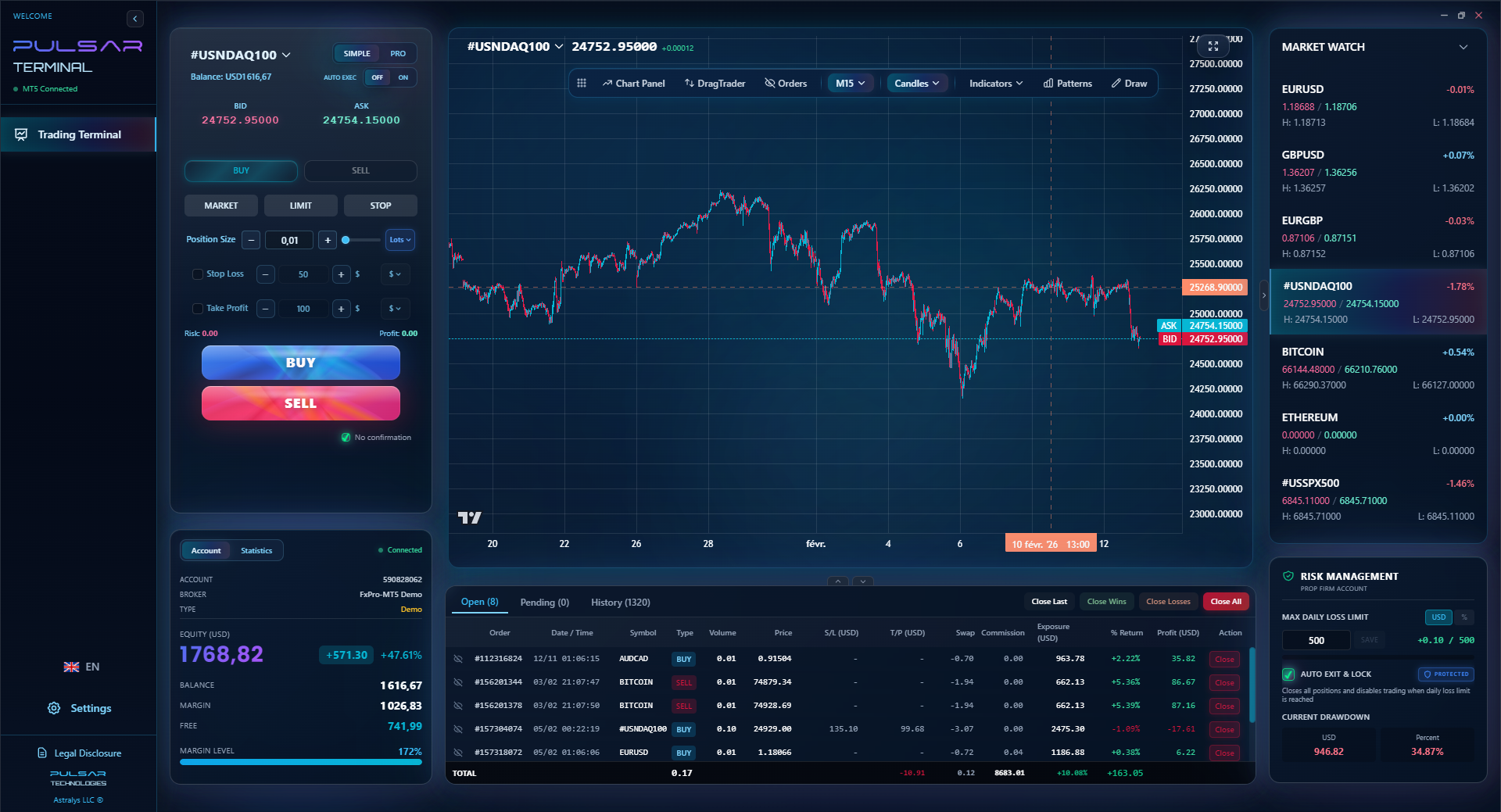
Managing multiple pattern trades with different profit targets is complex, but tools like Pulsar Terminal let you set multi-TP/SL with partial closures directly on MT5, automating what most PDFs never teach.
Pulsar Terminal
Lo strumento MT5 tutto-in-uno: ordini drag-and-drop, multi-TP/SL, trailing stop, grid trading, Volume Profile e protezione prop firm. Usato da oltre 1.000 trader ogni giorno.
Instead of relying on someone else's forex patterns PDF, build your own reference guide based on what works for you. Here's how I did it.
Start with a trading journal. Every time you trade a pattern, screenshot it, note the conditions (time, news, volume), and record the outcome. After 100 trades, you'll see which patterns work best for your personality and schedule.
I found I'm better with longer-term patterns (daily charts) than quick scalping setups. My journal showed my win rate was 45% on 15-minute patterns but 62% on 4-hour patterns. That's valuable personal data no PDF can give you.
Create your own 'cheat sheet' with these elements:
- Your 2-3 best patterns (mine: flag, double bottom, wedge)
- Required confluence (e.g., 'Daily trend must align')
- Invalidating conditions (e.g., 'No trade if within 2 hours of SARB')
- Position size formula (I use: Account risk / (stop loss in pips * pip value))
- Entry/exit rules (e.g., 'Enter on close above pattern, not intra-break')
Test everything. When I started, I backtested the double bottom pattern on USD/ZAR over 5 years of data. The win rate was 58% with a 1.8:1 reward-to-risk ratio - good enough to be profitable with proper risk management.
Update your system quarterly. Markets change. The patterns that worked in 2020 might need adjustment in 2026 with new regulations and use caps. I review my journal every three months and adjust my rules if I see performance drifting.
This personalized approach beats any generic forex patterns PDF because it's tailored to you, your broker's conditions (like XM's spreads or IC Markets' execution), and the South African market's unique rhythms.
“The rand can move 200 pips in an hour during budget speeches. No generic PDF prepares you for that.”
Let's be honest - a static PDF can't help you in real-time trading. These tools will serve you better than any downloaded document.
First, a proper trading platform with pattern recognition. Many brokers like Exness and Pepperstone offer MT4/MT5 where you can add pattern indicators. But the built-in ones are basic. I prefer tools that let me draw and test patterns manually - it trains your eye better than auto-detection.
Second, economic calendar integrated with your charts. You need to see news events directly on your timeframe. I've missed crucial SARB announcements because I was focused on a pattern and didn't check the calendar. Now I use tools that overlay news directly on my charts.
Third, backtesting software. Instead of trusting a PDF's claimed 80% win rate, test patterns yourself on historical ZAR pair data. You'll quickly see what actually worked during different market conditions (load-shedding periods, political events, commodity cycles).
Fourth, trade management tools. This is where most PDFs fall completely short. They show you entry patterns but never discuss how to manage the trade. Where do you move your stop? When do you take partial profits? Tools that allow multi-TP/SL with partial closures let you lock in profits while letting winners run - crucial for pattern trades where the initial target is often just the pattern minimum.
Here's what I use daily:
- MT5 with custom pattern templates I've saved
- Volume indicator to confirm breakouts
- Economic calendar overlay
- A trade manager that lets me set breakeven stops automatically after a certain profit
The last one saved me thousands. I used to watch patterns hit my first target, reverse, and turn winners into losers. Now I move to breakeven automatically at 1x risk, guaranteeing at worst a scratch trade. No PDF taught me that - experience did.
💡 Consiglio di Winston
South African traders: Your edge isn't in finding exotic patterns. It's in understanding ZAR's relationship with gold and platinum better than overseas traders do.
Ready to move beyond forex patterns PDFs? Here's exactly what to do next.
Week 1: Clean Slate Delete those downloaded PDFs (or archive them for reference). Open a demo account with a South African-regulated broker like Khwezi Trade or an FSCA-regulated international broker. Practice identifying just the three patterns I mentioned - flag, double bottom/top, wedge - on USD/ZAR and EUR/ZAR. Don't trade yet, just identify.
Week 2: Context Practice Now add context. When you see a pattern, check:
- Economic calendar for next 24 hours
- Daily trend direction
- Commodity correlations (gold for ZAR)
- Current spread vs average Practice this for 20 patterns without trading.
Week 3: Demo Trading Trade 20 pattern setups on demo with strict risk management. Use 1% risk per trade, proper stop losses, and your position size calculator. Journal every trade - what worked, what didn't, why.
Week 4: Review and Refine Analyze your journal. Which patterns had the best win rate? During which sessions? What context factors helped most? Create your personal one-page trading plan based on your results.
Ongoing: Continuous Improvement Each month, review your last 50 trades. Is your pattern system still working? Adjust as needed. Markets evolve, and so should your approach.
Remember, successful trading isn't about finding a magical pattern in a PDF. It's about developing a strong process that works consistently in the South African market's unique conditions. The patterns are just one piece of that puzzle - context, risk management, and discipline complete the picture.
Pro Tip: Start with just one ZAR pair. Master USD/ZAR patterns before adding EUR/ZAR or GBP/ZAR. Each has its own personality, and trying to learn them all at once will overwhelm you. I traded only USD/ZAR for my first year, and that focus made all the difference.
FAQ
Q1Are free forex patterns PDFs from the internet reliable for South African traders?
Most aren't. They're usually generic content not tailored to ZAR pairs' unique spreads, volatility, or economic drivers. While the basic patterns might be correct, they lack crucial South African context about liquidity times, correlation with commodities, and proper position sizing for our use environment. Use them as a starting point only, not a complete system.
Q2What's the biggest mistake South Africans make when using pattern trading PDFs?
Applying USD-based examples directly to ZAR pairs without adjusting for spreads. USD/ZAR spreads can be 5-10 times wider than EUR/USD spreads shown in most PDFs. If a PDF shows a 50-pip profit target on a pattern, but you're trading USD/ZAR with a 30-pip spread, you need 80 pips of movement just to break even - a completely different trade.
Q3How much should I pay for a good forex patterns guide in South Africa?
Nothing initially. There's enough free quality information to start. If you eventually pay for education, verify the provider is FSCA-authorized if they're offering advice. Many scams sell overpriced PDFs as 'education' fronts. Better to invest in proper trading tools or save the money for your trading capital. I've seen South Africans pay R5,000 for PDFs worth maybe R500.
Q4Can I use the same patterns for crypto trading as forex?
The patterns themselves (flags, triangles, etc.) appear across all markets, but execution differs dramatically. Crypto trades 24/7 with even higher volatility than ZAR pairs, and lacks the economic calendar context crucial for forex patterns. Also, many crypto 'brokers' in South Africa aren't properly regulated - the FSCA only started licensing crypto providers in 2024.
Q5What timeframes work best for pattern trading South African pairs?
4-hour and daily charts work best for most retail traders. They filter out market noise while capturing meaningful ZAR movements. Avoid 1-minute or 5-minute patterns unless you're an experienced scalping trader with a broker offering tight spreads - our market's wider spreads eat into short-term profits. The sweet spot is patterns that develop over 1-3 days.
Q6How do I know if a pattern is valid or just random price movement?
Three checks: 1) Does it have clear, distinct touches of support/resistance lines? (At least two for each side) 2) Is there volume confirmation on the breakout? (Increasing volume validates the move) 3) Does it align with higher timeframe trend? If all three are yes, it's likely valid. Most random movements fail one of these checks.
Q7Should I use automated pattern recognition software?
Not as a beginner. Manual identification trains your eye and judgment. After 6-12 months, you might use auto-detection as a secondary check, but never as your primary signal. The software often identifies 'patterns' in random noise, especially in volatile ZAR pairs. I use it only to scan multiple pairs quickly, then manually verify any alerts.
Lezione del Prof. Winston
Punti chiave:
- ✓Master 3 patterns maximum - flag, double bottom, wedge
- ✓Always adjust for ZAR pair spreads (30-80 pips common)
- ✓Check commodity correlations before trading any ZAR pattern
- ✓Never trade patterns against scheduled SARB announcements
- ✓Use 4-hour charts minimum for reliable SA patterns
Quanto è stato utile questo articolo?
Clicca su una stella
Analisi Trading Settimanali
Analisi e strategie settimanali gratuite. Nessuno spam.
Sull'autore
David van der Merwe
Trader dei Mercati Emergenti
Trader con base a Johannesburg con 11 anni di esperienza nelle valute dei mercati emergenti. Specializzato in coppie ZAR, trading regolamentato dalla FSCA e analisi del mercato sudafricano.
Commenti
Avviso di rischio
Il trading di strumenti finanziari comporta rischi significativi e potrebbe non essere adatto a tutti gli investitori. Le performance passate non garantiscono risultati futuri. Questo contenuto è fornito solo a scopo educativo e non deve essere considerato un consiglio di investimento. Conduci sempre le tue ricerche prima di fare trading.
Potrebbe interessarti anche

Cara Trading Forex Sukses: 7 Prinsip dari Trader Profesional
Cara trading forex sukses dengan 7 prinsip trader pro: manajemen modal, disiplin, journal trading, backtest. Data nyata, bukan janji profit palsu.
Jam Trading Forex Terbaik untuk Trader Indonesia: Panduan Lengkap dengan Tabel Waktu
Panduan jam trading forex untuk trader Indonesia. Tabel 4 sesi dunia, jam emas 20:00-00:00, sesi mana yang harus dihindari. Data akurat + tips dari trader berpengalaman.
Top 5 Sàn Forex Uy Tín Nhất 2026: Review Jujur dari Trader Indonesia
Top 5 sàn forex uy tín 2026 untuk trader Indonesia. Review jujur: spread, deposit, withdraw, dukungan lokal. Exness, XM, IC Markets & lebih.
Scarica Pulsar Terminal
Tutti questi calcolatori sono integrati in Pulsar Terminal con dati in tempo reale dal tuo conto MT5.
Scarica Pulsar Terminal