


If you're searching for 'forex pavilion' in South Africa, you're probably picturing the Travelex kiosk at The Pavilion Mall.

David van der Merwe
Trader dei Mercati Emergenti ·  South Africa
☕ 10 min di lettura
Cosa imparerai:
If you're searching for 'forex pavilion' in South Africa, you're probably picturing the Travelex kiosk at The Pavilion Mall. That's for swapping holiday cash. The real 'pavilion' we're talking about is the entire arena of online retail forex trading. It's where dreams of financial freedom go to die for 90% of participants. I've seen it happen for over a decade. The problem isn't a lack of information; it's a surplus of bad advice and a fundamental misunderstanding of risk. This guide will cut through the noise. We'll look at the real regulations, the actual costs, and the brutal math that separates the 10% from the 90%.
Let's clear this up first. The term 'forex pavilion' in a local context usually means a physical bureau de change, like those in shopping malls. They offer terrible rates for travel money. That's not our world.
The online forex trading 'pavilion' is a global, 24-hour market. For South Africans, it's a legitimate, regulated way to speculate on currency movements. But here's the critical distinction most miss: trading is not investing. It's a performance sport with a high casualty rate. The FSCA allows it, brokers help it, but your psychology and risk management determine if you survive it.
I made this mistake early on. I treated my first R5,000 account like a lottery ticket, chasing the 'big win' on USD/ZAR. I was wiped out in three trades. The reality is that this market doesn't care about your need for income. It's a probabilistic game where the house (in the form of spreads, commissions, and your own emotions) has a built-in edge. Your job is to build a bigger edge.

Warning: Don't confuse the accessibility of trading apps with the difficulty of being profitable. Downloading an app and placing a trade takes seconds. Consistently making money over 100+ trades takes years of disciplined practice.
“Trading is a performance sport with a high casualty rate.”
The Financial Sector Conduct Authority (FSCA) is your first line of defense. They capped retail use at 30:1 for a reason: to stop you from blowing up your account in five minutes. This is a good thing. Yet, I still see brokers advertising 'unlimited use' to South African clients through offshore entities. This is a trap.
Why the 30:1 Cap is Your Friend
At 30:1, a 3.33% move against you wipes out your margin. That sounds like a lot, but in volatile pairs like USD/ZAR, it can happen in a bad hour. Before the cap, I used 100:1. I turned R2,000 into R8,000 on a single GBP/USD trade and felt like a genius. The very next week, I lost R9,000 on a single USD/ZAR trade that gapped on local liquidity news. The high use amplified my gains, but it vaporized my capital even faster.
The Tax Man Cometh (SARS)
This is non-negotiable. All net profits from trading are taxable income in the eyes of SARS. It doesn't matter if your broker is in Cyprus or the Seychelles. You must declare it. I keep a simple spreadsheet: date, instrument, P&L, and a running total. Your broker's statement is your proof. If you're trading actively, expect to pay your marginal income tax rate on your profits. Factor this into your profit targets. A 10% return isn't 10% after tax.

Example: You make R50,000 profit in a tax year. If your marginal tax rate is 36%, you owe SARS R18,000. Your net profit is R32,000. If you didn't account for this, your risk calculations are fundamentally flawed.
Sticking with FSCA-regulated brokers like those reviewed on our site, such as IG or AvaTrade, ensures local recourse for disputes. But remember, regulation protects you from broker fraud, not from your own bad trades.

💡 Consiglio di Winston
The market's primary function is to transfer capital from the impatient to the patient. Your edge is time, not timing.
“Your edge isn't a secret indicator. It's a repeatable process that manages risk first.”
Brokers love to advertise 'Trade with just $5!' It's marketing. Technically true, practically useless. Let's break down the real economics of a South African trading account.
The True Cost of a Trade:
| Cost Type | Typical Range | What It Means For You |
|---|---|---|
| Spread (Major Pairs) | 0.0 - 1.5 pips | Your trade starts in a hole. At 1 pip on EUR/USD, a R10,000 trade costs you R10 before it moves. |
| Commission (ECN Accounts) | $3 - $7 per lot | Often paired with 0.0 pip spreads. Adds up fast for scalping. |
| Swap/Overnight Fee | Variable | Can be a cost or a small credit. Holding USD/ZAR long can have a heavy negative swap. |
| Bank Charges | R250 - R500 | For international deposits/withdrawals. Use local ZAR transfers to FSCA brokers where possible. |
The Minimum Deposit Reality: Depositing R150 ($8) is a waste of time. You can't practice proper risk management. If you risk just 1% of that (R1.50), your stop-loss is so tight any market noise will hit it. You'll learn nothing except that trading is frustrating.
My advice? Start with a minimum of R5,000 in a demo account. Treat it like real money. Once you can grow it consistently over three months, then fund a live account with R5,000 - R10,000. This is enough to use a sensible position size calculator and feel the psychological pressure without risking life-altering money.
Brokers like IC Markets and Pepperstone offer tight spreads, but your success depends on your system, not saving 0.2 pips.
“Your edge isn't a secret indicator. It's a repeatable process that manages risk first.”
This is the heart of the issue. The local pair, USD/ZAR, is a siren song for South African traders. You follow the news, you understand the politics, it feels familiar. It's also a professional-grade pair that will eat retail traders alive.
Why USD/ZAR is Dangerous:
- Low Liquidity (Relatively): Compared to EUR/USD, it has thinner markets. This means wider spreads (often 50-100 pips during off-hours) and sharper, unpredictable moves.
- Political & Commodity Volatility: The Rand reacts violently to local politics, credit rating announcements, and global commodity prices (gold, platinum). These events cause gaps. Your stop-loss won't protect you.
- Emotional Attachment: You have a view on SA's economy. Trading becomes an argument with the market, not a reaction to price action.
I learned this the hard way in 2018. I was short USD/ZAR at R13.80, convinced the Rand would strengthen. Local news was positive. The pair drifted to R13.70. Then, a surprise cabinet reshuffle hit the wires. Within 90 minutes, it was at R14.20. My stop at R14.00 was skipped over in the gap. I lost 4% of my account on one trade because I traded my opinion, not the chart.
Beginners should stick to major pairs like EUR/USD for their predictability and tight spreads. They are brutally efficient, which forces you to learn proper technique. Save USD/ZAR for when you have years of experience and a system built for volatility. Even then, size your positions smaller. A tool like Pulsar Terminal's advanced order management can help manage the wild swings of such pairs by automating partial closures and moving stops to breakeven faster than you can react emotionally.
💡 Consiglio di Winston
If you can't articulate your edge in one sentence, you don't have one. 'Making money' is not an edge; it's a hope.
“The 30:1 use cap isn't a restriction; it's a life raft the FSCA threw you.”
Your edge isn't a secret indicator. It's a repeatable process that manages risk first and seeks opportunity second.
Start with a Simple, Tested Strategy
Pick one approach and master it. Are you a swing trader holding for days, or a scalper in and out in minutes? Don't mix them. I use a simple price action model on the 4-hour chart, combined with the RSI indicator for confluence. I might take only 2-3 trades a week. Boring? Yes. Profitable? Consistently.
Risk Management is Non-Negotiable
This is your only control.
- Risk per Trade: Never, ever risk more than 1% of your account capital on a single trade. Use a calculator. On a R10,000 account, that's R100. If your stop-loss is 50 pips away, your position size must be small enough that a 50-pip loss equals R100.
- Stop-Loss Placement: Place your stop based on market structure (a recent swing high/low), not the amount you're willing to lose. If the math doesn't work, the trade is invalid. Walk away.
The Psychology of Loss
You will have losing streaks. Six, seven losses in a row. If you're risking 1%, a 7-loss streak is a 7% drawdown. It's uncomfortable but survivable. If you were risking 5%, that same streak is a 35% drawdown. You're now in panic mode, likely to revenge trade and blow up. The math dictates survival.

Pro Tip: Keep a trading journal. For every trade, note the setup, your emotional state, and the outcome. After 100 trades, you'll see your real patterns. You'll find you lose more on Tuesday afternoons, or when you trade before a major news event. This data is more valuable than any indicator.
“The 30:1 use cap isn't a restriction; it's a life raft the FSCA threw you.”
Your broker is your gateway, and your platform is your cockpit. Choose wisely.
Broker Checklist for South Africans:
- FSCA Regulation: Primary or secondary license is a must.
- ZAR Account & Local Deposits: Saves on brutal bank forex fees.
- Reasonable Costs: Look at the all-in cost (spread + commission) on the pairs you'll actually trade.
- Platform Choice: MT4/MT5 are industry standards for a reason. They're stable and support automated trading.
The Platform Decision: MetaTrader 5 (MT5) is the logical choice now. It has more timeframes, a better economic calendar, and allows hedging. While MT4 is legendary, development is focused on MT5. All serious brokers, like XM or Exness, offer it.
However, the native MT5 platform has limitations for advanced order management. This is where companion tools become force multipliers. Imagine you're in a good USD/JPY trade and want to take partial profit at one level, move your stop to breakeven, and trail the rest. Doing this manually on a fast-moving chart is stressful and error-prone.
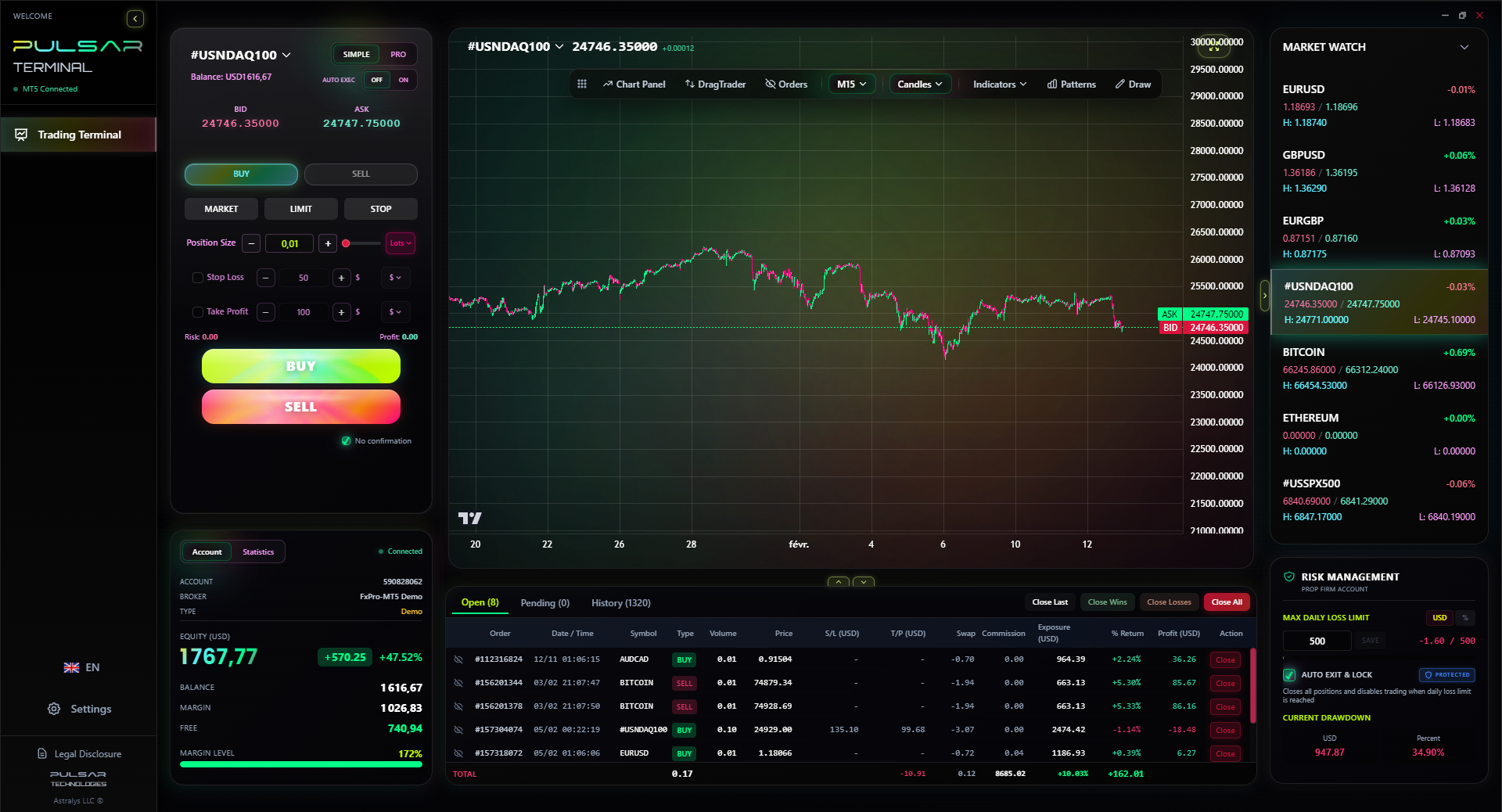
Software that integrates directly with MT5 to automate these processes - dragging a multi-TP/SL bracket onto the chart, setting a trailing stop, or managing a grid of orders - removes emotion and executes your plan with precision. It turns your trading plan into a set of automated rules. In a market where milliseconds and discipline count, this isn't a luxury; it's a critical component of a professional setup for those moving beyond the basics.
💡 Consiglio di Winston
The most important price on your chart is not where you enter, but where you decide you were wrong. Define that before you click buy or sell.
Managing complex trades on volatile pairs requires tools that automate your plan, turning emotional decisions into systematic rules executed directly on your MT5 charts.
Pulsar Terminal
Lo strumento MT5 tutto-in-uno: ordini drag-and-drop, multi-TP/SL, trailing stop, grid trading, Volume Profile e protezione prop firm. Usato da oltre 1.000 trader ogni giorno.
“Beginners should stick to major pairs for their predictability and tight spreads. They are brutally efficient, which forces you to learn proper technique.”
Here's your action plan, stripped of hype:
- Education, Not Deposit: Spend a month learning. Understand what a pip is, what spread means, and what a margin call feels like (in demo).
- Open a Demo Account: Use a broker you're considering. Fund it with R50,000 virtual money. Your goal is not to double it. Your goal is to not lose more than 2% in any week for eight consecutive weeks.
- Develop One Strategy: Test it on the demo. I suggest starting with a trend-following method on the daily chart of EUR/USD, using something like the MACD indicator for confirmation. Take every signal for 20 trades. Record the results.
- Live Funding: If and only if your demo results are break-even or better, fund a live account with money you can afford to lose completely. Start with R5,000-R10,000.
- Trade Small, Learn Big: With your live account, cut your position size in half from what you used in demo. The psychological weight is real. Your goal for the first six months is to preserve capital, not to get rich.
The forex pavilion isn't a get-rich-quick scheme. It's a skill-building marathon. The market will be here tomorrow. Your job is to make sure your account is, too.
FAQ
Q1Is forex trading legal in South Africa?
Yes, it's completely legal and regulated by the Financial Sector Conduct Authority (FSCA). You must trade with an authorized financial services provider, and all profits are subject to normal income tax by SARS.
Q2What is the best forex broker for South Africans?
There's no single 'best' broker. You need one that is FSCA-regulated, offers ZAR accounts for cheaper deposits/withdrawals, and has competitive costs on the instruments you trade. Compare reviews of major brokers like IG, AvaTrade, and IC Markets to find one that fits your style.
Q3How much money do I need to start forex trading in South Africa?
While some brokers allow deposits as low as R70, that's pointless for learning real risk management. A realistic minimum to start practicing properly in a live environment is between R5,000 and R10,000. Never start with money you can't afford to lose entirely.
Q4Why is USD/ZAR so dangerous for new traders?
USD/ZAR has wider spreads, lower liquidity, and is prone to sudden gaps due to local political and economic news. This makes stop-losses less reliable and losses can escalate quickly. Beginners should practice on major pairs like EUR/USD first.
Q5How are my forex trading profits taxed?
SARS views net profits from trading as ordinary income. You must declare it on your annual tax return, and it will be taxed at your marginal income tax rate. You cannot claim losses against your salary income, but you can carry trading losses forward to offset future trading profits.
Q6What's the difference between a forex bureau and a forex broker?
A forex bureau (like Travelex at a mall's 'forex pavilion') is for exchanging physical currency for travel, usually at poor rates. A forex broker provides an online platform for speculating on the price movements of currency pairs using leveraged derivatives like CFDs.
Q7Can I use international brokers like Exness or XM as a South African?
Yes, many South Africans do. However, if that broker also has an FSCA license, it's preferable as it gives you local legal recourse. Always check the specific regulatory entity that will be holding your funds.
Lezione del Prof. Winston
Punti chiave:
- ✓Risk a maximum of 1% of capital per trade.
- ✓Demo trade until you are consistently boring.
- ✓Avoid USD/ZAR until you have 3+ years experience.
- ✓Taxation is 100% certain; factor it in from trade one.
Quanto è stato utile questo articolo?
Clicca su una stella
Analisi Trading Settimanali
Analisi e strategie settimanali gratuite. Nessuno spam.
Sull'autore
David van der Merwe
Trader dei Mercati Emergenti
Trader con base a Johannesburg con 11 anni di esperienza nelle valute dei mercati emergenti. Specializzato in coppie ZAR, trading regolamentato dalla FSCA e analisi del mercato sudafricano.
Commenti
Avviso di rischio
Il trading di strumenti finanziari comporta rischi significativi e potrebbe non essere adatto a tutti gli investitori. Le performance passate non garantiscono risultati futuri. Questo contenuto è fornito solo a scopo educativo e non deve essere considerato un consiglio di investimento. Conduci sempre le tue ricerche prima di fare trading.
Potrebbe interessarti anche

Cara Trading Forex Sukses: 7 Prinsip dari Trader Profesional
Cara trading forex sukses dengan 7 prinsip trader pro: manajemen modal, disiplin, journal trading, backtest. Data nyata, bukan janji profit palsu.
Jam Trading Forex Terbaik untuk Trader Indonesia: Panduan Lengkap dengan Tabel Waktu
Panduan jam trading forex untuk trader Indonesia. Tabel 4 sesi dunia, jam emas 20:00-00:00, sesi mana yang harus dihindari. Data akurat + tips dari trader berpengalaman.
Top 5 Sàn Forex Uy Tín Nhất 2026: Review Jujur dari Trader Indonesia
Top 5 sàn forex uy tín 2026 untuk trader Indonesia. Review jujur: spread, deposit, withdraw, dukungan lokal. Exness, XM, IC Markets & lebih.
Scarica Pulsar Terminal
Tutti questi calcolatori sono integrati in Pulsar Terminal con dati in tempo reale dal tuo conto MT5.
Scarica Pulsar Terminal