


You've probably seen the ads.

David van der Merwe
Trader dei Mercati Emergenti ·  South Africa
☕ 11 min di lettura
Cosa imparerai:
You've probably seen the ads. 'Download my FREE Forex PDF and discover the secret to consistent profits!' It's a fantasy sold to thousands of South Africans every month. I'm here to tell you why that search for the perfect 'forex pdf download' is the first sign you're about to lose money. The real edge isn't in a document, it's in understanding the brutal, regulated reality of trading in South Africa. Let's set the record straight with cold, hard numbers from the local market.
Here's the uncomfortable truth I learned the hard way: no PDF ever written will make you a profitable trader. Not one. The entire 'forex pdf download' industry is built on a fundamental misunderstanding of what trading actually is. It's not an academic subject you can master by reading. It's a probabilistic game of risk management, played against your own psychology, with real money on the line.
I remember downloading a 50-page 'Sniper Entry System' PDF back in 2014. It had beautiful charts, complex indicators layered on top of each other, and promised 90% accuracy. I followed it religiously for two months. Result? A 23% drawdown on my account. The problem wasn't the PDF's logic on paper; it was my inability to handle the 10% of trades that went violently against me. The PDF didn't mention position sizing for those moments, or the emotional toll of three losing trades in a row. It just showed the pretty winning examples.

Warning: Any resource that promises a 'secret' or 'guaranteed' system is selling you a dream, not a strategy. The FSCA regularly warns against such marketing. Profitable trading is boring, disciplined, and mostly about not losing big.
South Africa has between 190,000 and 200,000 active traders. Global studies on CFD trading (which includes forex) consistently show that 50% to 89% of retail clients lose money. The common thread among the losers isn't a lack of information - it's poor execution of the basics. They chase the next 'forex pdf download' hoping for a magic bullet, instead of grinding through the unsexy work of building a swing trading journal, mastering a position size calculator, and learning to accept small losses.
Forget the generic PDFs. A real plan is specific to you, your capital, and the South African regulatory environment. It's a living document you update after every major loss or win. Here's what matters, with local context.
Your Legal Framework is Your First Rule
Your plan must start with the law. The FSCA's 30:1 use cap for retail traders isn't a suggestion, it's a hard stop. A proper plan defines your personal use, which should be far lower. If you're trading a R20,000 account, using even 10:1 use on a single trade is a recipe for a margin call. My rule? Never exceed 5:1 net use across all open positions.
The Numbers That Actually Matter
Your plan needs concrete numbers, not vague ideas.
- Maximum Daily Loss: This is your circuit breaker. Mine is 2% of my account balance. If I hit it, I shut down the platform for 24 hours. No excuses.
- Maximum Risk Per Trade: This is non-negotiable. I risk 0.5% to 1% of my account on any single idea. On a R15,000 account, that's R75 to R150. It feels tiny, but it keeps you in the game.
- Profit-Taking & Stop-Loss Logic: Define exactly how you'll set these before you enter. Is it based on support/resistance? A multiple of your risk (e.g., a 2:1 reward-to-risk ratio)? Write it down.

Example: You have a R25,000 account. Your risk per trade is 1% (R250). You want to buy USD/ZAR, with a stop loss 50 pips away. Your position size must be calculated so that a 50-pip loss equals R250. This math is more important than any indicator.
A real plan also accounts for South African costs. That 0.9 pip spread on EUR/USD with your broker? It's a tax on every trade. If your average profit target is only 10 pips, that spread eats nearly 10% of your potential gain. This is why many successful local traders focus on higher-timeframe swing trading or instruments with cleaner execution.

💡 Consiglio di Winston
The most valuable PDF on your computer is your trading journal. A strategy is just a hypothesis until it's tested and recorded in the wild.
“The entire 'forex pdf download' industry is built on a fundamental misunderstanding of what trading actually is.”
Choosing a broker based on who has the flashiest free 'forex pdf download' is a classic rookie error. Your broker is your lifeline. You need to vet them with the diligence you'd use to choose a surgeon.
The FSCA license is your baseline protection. It means client funds should be segregated, and the broker meets minimum capital requirements. But not all FSCA brokers are equal. You need to dig into their execution model.
Are they a true ECN/STP broker passing your orders to the market, or are they a market maker taking the other side of your trade? There's a place for both, but you should know which one you're dealing with. I made my worst trading mistake ever with a slick, unregulated offshore broker promising tight spreads. When I tried to withdraw R40,000 in profits, the platform 'glitched,' my trades were voided, and the support line went dead. That R40,000 lesson taught me to only use reputable, regulated entities.
Look at the real data from our market:
| Broker | FSCA Regulated | Min. Deposit | Avg. EUR/USD Spread | Key Consideration for ZAR Traders |
|---|---|---|---|---|
| IG | Yes | £250 | ~0.98 pips | Strong educational hub (IG Academy), but higher minimums. |
| XM | Yes | $5 | ~0.8 pips | Very low barrier to entry, good for testing small. |
| IC Markets | Yes | $200 | 0.0 pips + commission | True raw spreads, excellent for scalping strategy. |
| AvaTrade | Yes (FSP 45984) | $100 | ~0.9 pips | User-friendly platforms, good for beginners. |
Your choice should hinge on your strategy. A scalper needs the tightest spreads (like IC Markets). A beginner might value educational tools and stability. Always check the specific ZAR pair spreads (like USD/ZAR, EUR/ZAR), as they can be much wider than majors.
This is where 95% of traders fail. You can have the world's best plan, but if your execution is emotional, you're finished. The gap between knowing what to do and actually doing it under pressure is a canyon.
Let me give you a personal example. My plan once said: 'On a strong daily trend, look for a pullback to the 50-period EMA on the 4-hour chart and enter with the trend.' Sounds simple, right? In practice, I'd see the pullback, but fear would creep in. 'What if the trend is over?' I'd hesitate, miss the entry, then FOMO in as price raced away, entering at a terrible price. My plan's clean 20-pip risk would become a 40-pip risk because I entered late. I was right on the market direction, but wrong on the trade, and I lost money.
Execution is about creating rules so rigid that emotion is removed. This is where technology beats willpower every time.

Pro Tip: Use pending orders. If your analysis says 'buy at 18.9500 with a stop at 18.9300,' place a buy limit order at 18.9500 with the attached stop loss. Then walk away. This stops you from chickening out or chasing the market.
Tools that automate parts of your risk management are force multipliers. Being able to set a trailing stop that automatically locks in profits, or a breakeven stop that removes risk after a move in your favor, takes the emotion out of the most critical moments. It turns you from a reactive gambler into a proactive manager. This discipline is the single biggest difference between the 80% who lose and the 20% who don't.
💡 Consiglio di Winston
If you can't explain your edge in one simple sentence, you don't have one. 'A good PDF told me to' is not an edge.
“Your edge is the unique intersection of your skills, your environment, and your discipline.”
Okay, so you should avoid the 'get rich quick' PDFs. What should you be reading and using? Focus on primary sources and tools that build skill, not just hope.
First, download the FSCA's FAIS Act General Code of Conduct and the FSCA's list of authorised financial services providers. Knowing your rights and how to verify a broker is your first line of defense. This is the most important 'forex pdf download' you'll ever get.
Second, study market structure, not indicator patterns. Learn about auction market theory, volume profiles, and how support and resistance are formed by collective market action. Understanding why price is at a certain level is more valuable than knowing an RSI indicator is at 70.
Third, get familiar with a trading journal template. Your journal shouldn't just record 'Bought EUR/USD, won 50 bucks.' It must log:
- The chart setup (with a screenshot)
- The emotional state you were in
- The exact risk (% and Rands)
- The outcome
- What you learned
I review my journal every Sunday. It's cringe-worthy to read my entries from 2015, but it shows the evolution. I can see the exact month I stopped overtrading and started respecting my daily loss limit.
Finally, practice with a demo account, but not in the way you think. Don't just trade randomly. Use it to test one specific aspect of your plan for a month. For example, 'This month, I will only take trades that offer a minimum 2:1 reward-to-risk ratio.' Record the results. This turns demo trading from a game into a laboratory.
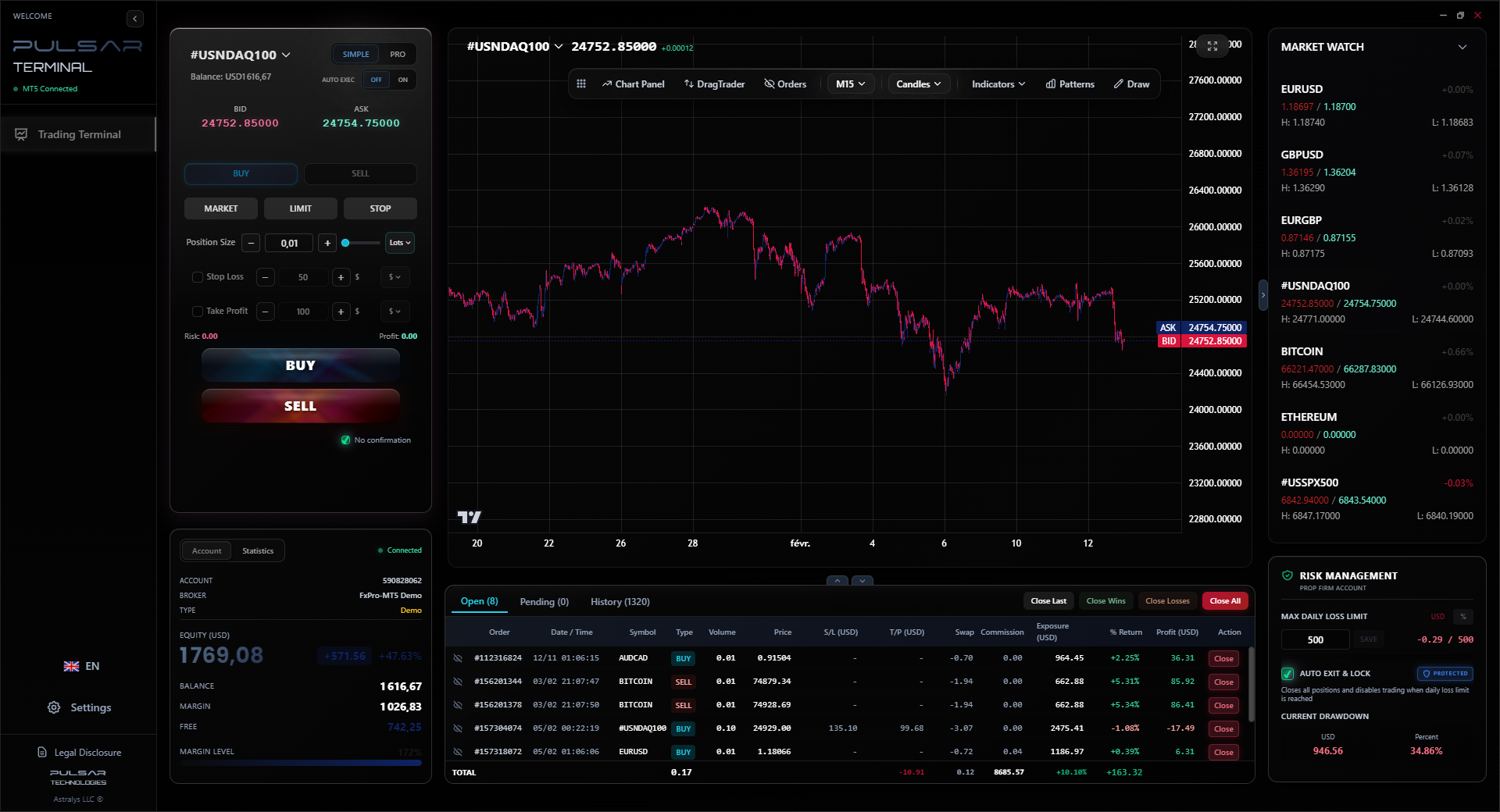
Manually moving stops to breakeven and managing multiple trades is where plans fall apart; Pulsar Terminal automates these critical risk rules directly on your MT5 charts.
Pulsar Terminal
Lo strumento MT5 tutto-in-uno: ordini drag-and-drop, multi-TP/SL, trailing stop, grid trading, Volume Profile e protezione prop firm. Usato da oltre 1.000 trader ogni giorno.
Your edge won't come from a secret indicator. It comes from exploiting a small, consistent advantage that the majority overlooks. In South Africa, several contextual edges exist.
The ZAR Knowledge Edge: You live the macro story. You feel the load-shedding, you follow the local political news, you understand the dynamics of mining exports. This intrinsic understanding of Rand volatility is an edge over a trader in London looking at USD/ZAR as just another exotic pair. Pair this fundamental sense with technical timing on the charts.
The Regulatory Safety Edge: Trading with an FSCA-regulated broker like Pepperstone or Exness (where applicable) is an edge in itself. Your funds are safer. You have a formal recourse path. This peace of mind allows you to focus on trading, not on whether your broker will disappear with your money.
The Cost Efficiency Edge: South Africans can trade global markets with relatively low capital. But you must be hyper-aware of costs. Choosing a broker with tight spreads on your preferred pairs, understanding swap rates if you hold positions overnight, and minimizing unnecessary trades all contribute to a cost edge that compounds over time.
The Time Zone Edge: Our time zone (SAST) overlaps with both the London session late morning and the US session opening in the afternoon. This gives you a window into the two most volatile trading sessions without having to wake up at 3 AM.
Build your strategy around these concrete, local advantages. Maybe you become a specialist in USD/ZAR during London liquidity hours. Perhaps you use your local knowledge to take longer-term fundamental views on the Rand, using smaller position sizes and wider stops. Your edge is the unique intersection of your skills, your environment, and your discipline.
💡 Consiglio di Winston
Your first R10,000 in the market is tuition, not investment. Expect to pay it. The goal is to learn as much as possible before it's gone.
“The search for the perfect 'forex pdf download' is a form of procrastination. It feels like progress, but it's just delaying the real work.”
The search for the perfect 'forex pdf download' is a form of procrastination. It feels like progress, but it's just delaying the real work. The path to becoming a trader who survives in South Africa's market is painfully straightforward, and very few have the patience for it.
Here is your actual to-do list:
- Regulate Yourself: Choose one reputable, FSCA-regulated broker. Open a demo and a live account with a small, risk-capital deposit you can afford to lose entirely.
- Define Your Risk: Use a position size calculator to determine your lot size for every single trade. Never wing it.
- Journal Relentlessly: Every trade. Every emotion. Every mistake. Review it weekly.
- Specialise: Pick one or two currency pairs. USD/ZAR and EUR/USD are great starts. Learn their personality, their average daily range, their spread behavior.
- Embrace Losses: A good trade is one with good risk management, not necessarily a winning one. If you followed your plan and got stopped out, that's a successful trade. Celebrate it.
I've been where you are. I downloaded gigabytes of PDFs, indicators, and expert advisors. I blew up my first two accounts searching for the secret. The third account survived, and eventually grew, when I finally accepted that the secret was there was no secret. Just the boring, repetitive, disciplined application of risk management.
The South African market is waiting. It doesn't care about your dreams or the PDFs on your hard drive. It only responds to disciplined action. Start with your first proper trade today - small, defined, and journaled. That's the only download that matters.
FAQ
Q1Is it legal to download and use free forex trading PDFs in South Africa?
Yes, it's perfectly legal to download educational material. The critical issue is the content. Be extremely wary of any PDF that promises guaranteed profits, secret systems, or encourages you to trade with unregulated brokers. The FSCA does not endorse any specific trading methods, so treat all such materials as opinion, not regulated financial advice.
Q2What should I look for in a forex broker as a South African, beyond an FSCA license?
Look for: 1) Tight, consistent spreads on the pairs you trade (especially ZAR pairs), 2) Reliable deposit/withdrawal methods in Rands (like Ozow, Instant EFT), 3) Low or transparent fees on currency conversion, 4) A platform (like MT4/MT5) you're comfortable with, and 5) Responsive local customer support. Always test with a small deposit first.
Q3Why is the 30:1 use limit from the FSCA actually a good thing for new traders?
It forces you to use less use, which directly limits your potential losses. Before the cap, brokers offered 500:1 or even 1000:1, allowing traders to wipe out an account with a tiny market move. The 30:1 cap is a protective barrier that encourages more sensible position sizing. Successful traders often use far less - 5:1 or 10:1 - to survive volatility.
Q4How much money do I realistically need to start forex trading in South Africa?
You can technically start with as little as $5 (roughly R90) with some brokers like XM. However, realistically, starting with such a small amount teaches bad habits. A more practical start is R2,000 - R5,000 of true risk capital. This allows you to trade micro lots, practice proper risk management (e.g., risking R50-R100 per trade), and experience real P&L emotions without catastrophic loss.
Q5What's the biggest mistake South African traders make when starting out?
Two linked mistakes: 1) Trading ZAR pairs with too large a size because they 'understand' them, ignoring their wider spreads and volatility, and 2) Not accounting for the total cost of trading. They see a potential 50-pip profit but forget the 10-pip spread and commission, which turns a 20% potential gain into a 16% gain before the market even moves.
Q6Can I pass a prop firm challenge using strategies from a free PDF guide?
Highly unlikely. Prop firm challenges (like FTMO, The5%ers) have strict drawdown and profit targets that require iron-clad discipline and advanced risk management. A generic PDF won't address the specific tactics needed for the challenge's time limit and rules. Passing requires a strong, personal system and often tools to automate loss protection, which is a feature of advanced trading software.
Lezione del Prof. Winston
Punti chiave:
- ✓No PDF replaces a FSCA broker check.
- ✓Risk 1% per trade, max 2% daily loss.
- ✓Your journal is your best teacher.
- ✓30:1 use is a limit, not a target.
- ✓Specialize in 1-2 pairs you understand.
Quanto è stato utile questo articolo?
Clicca su una stella
Analisi Trading Settimanali
Analisi e strategie settimanali gratuite. Nessuno spam.
Sull'autore
David van der Merwe
Trader dei Mercati Emergenti
Trader con base a Johannesburg con 11 anni di esperienza nelle valute dei mercati emergenti. Specializzato in coppie ZAR, trading regolamentato dalla FSCA e analisi del mercato sudafricano.
Commenti
Avviso di rischio
Il trading di strumenti finanziari comporta rischi significativi e potrebbe non essere adatto a tutti gli investitori. Le performance passate non garantiscono risultati futuri. Questo contenuto è fornito solo a scopo educativo e non deve essere considerato un consiglio di investimento. Conduci sempre le tue ricerche prima di fare trading.
Potrebbe interessarti anche

Cara Trading Forex Sukses: 7 Prinsip dari Trader Profesional
Cara trading forex sukses dengan 7 prinsip trader pro: manajemen modal, disiplin, journal trading, backtest. Data nyata, bukan janji profit palsu.
Jam Trading Forex Terbaik untuk Trader Indonesia: Panduan Lengkap dengan Tabel Waktu
Panduan jam trading forex untuk trader Indonesia. Tabel 4 sesi dunia, jam emas 20:00-00:00, sesi mana yang harus dihindari. Data akurat + tips dari trader berpengalaman.
Top 5 Sàn Forex Uy Tín Nhất 2026: Review Jujur dari Trader Indonesia
Top 5 sàn forex uy tín 2026 untuk trader Indonesia. Review jujur: spread, deposit, withdraw, dukungan lokal. Exness, XM, IC Markets & lebih.
Scarica Pulsar Terminal
Tutti questi calcolatori sono integrati in Pulsar Terminal con dati in tempo reale dal tuo conto MT5.
Scarica Pulsar Terminal