


You're staring at your MT4 chart, the Naira pairs are moving, and you're trying to guess where the market might turn.

Olumide Adeyemi
Pioniere del Trading in Africa Occidentale ·  Nigeria
☕ 10 min di lettura
Cosa imparerai:
- 1What Exactly Is a Pivot Point Calculator? (It's Not Magic)
- 2Calculating Your Own Levels: A Naira Example
- 3The Mistakes I Made (So You Don't Have To)
- 4Practical Trading Strategies for Nigerian Traders
- 5Brokers, Platforms, and the Nigerian Reality
- 6Advanced Tips: Finding Confluence for Higher Probability Trades
- 7Your Action Plan: Putting It All Together
You're staring at your MT4 chart, the Naira pairs are moving, and you're trying to guess where the market might turn. Sound familiar? I spent years doing that, losing money on false breakouts and getting stopped out just before a reversal. Then I started using a forex pivot point calculator properly. It didn't magically make me rich, but it gave my trading a structure I desperately needed. This is my honest journal of how I use it, the mistakes I made, and how you can apply it to the unique Nigerian trading scene.
Let's cut through the jargon. A forex pivot point calculator is just a formula. It takes the high, low, and closing price from the previous trading day (or week, or month) and spits out a series of potential support and resistance levels for the current session.
The core idea is simple: yesterday's battle between buyers and sellers gives us clues about where today's fight might happen. The main level it calculates is the Pivot Point (PP) itself. Above and below that, it gives you Resistance (R1, R2, R3) and Support (S1, S2, S3) levels.
When I first heard about it, I thought it was some secret code. It's not. It's a structured way to stop guessing and start observing where price actually reacts. The biggest lesson? These levels don't predict the future. They highlight areas where price is more likely to pause, reverse, or accelerate. Treating them as guaranteed bounce zones was my first, and most expensive, mistake.

Warning: A pivot point calculator gives you a map, not a destination. Price can and will blow straight through these levels. They are areas of interest, not orders from the market gods.

💡 Consiglio di Winston
A pivot level is a zone, not a line. Give your trade room to breathe by placing your entry order a few pips away from the exact level.
“A forex pivot point calculator gives you a map, not a destination.”
You don't always need a fancy tool. Knowing the math puts you in control, especially when trading during volatile Naira sessions. Here's the standard formula, and I'll use a real example from a USD/NGN trade I took.
Let's say yesterday's price action on USD/NGN (using a CFD broker like Exness or XM) was:
- High (H): ₦1,450.00
- Low (L): ₦1,420.00
- Close (C): ₦1,438.00
The Calculations:
- Pivot Point (PP) = (H + L + C) / 3 = (1450 + 1420 + 1438) / 3 = ₦1,436.00
- First Resistance (R1) = (2 * PP) - L = (2 * 1436) - 1420 = ₦1,452.00
- First Support (S1) = (2 * PP) - H = (2 * 1436) - 1450 = ₦1,422.00
- Second Resistance (R2) = PP + (H - L) = 1436 + (1450 - 1420) = ₦1,466.00
- Second Support (S2) = PP - (H - L) = 1436 - (1450 - 1420) = ₦1,406.00
Why Bother with the Math?
Doing this manually once a week burned these levels into my brain. When price approached ₦1,422 the next day, I didn't just see a random number. I saw S1. I was prepared. I watched for a bullish rejection candle, got in long, and placed my stop-loss just below S2 at ₦1,405. That trade netted me a 1.5% gain on my account. Small, but structured. The position size calculator was my next stop to figure out exactly how many units to buy.
Most platforms have these built-in, but calculating them yourself removes the mystery. It turns a black-box indicator into a logical reference point.
“Doing the math manually once a week burned these levels into my brain. I was prepared.”
I wish someone had slapped me with these lessons earlier. Pivot points are simple, which makes it easy to use them stupidly.
Mistake 1: Trading Every Touch. I used to place a market order every time price hit R1 or S1. Result? I got chopped up in ranging markets. Now, I only look for trades at these levels if there's confluence. That means the pivot level aligns with something else: a previous daily high/low, a 50% or 61.8% Fibonacci retracement, or the edge of a Volume Profile node. One level by itself is weak. Two or more together are strong.
Mistake 2: Ignoring the Central Bank of Nigeria (CBN). This one hurt. I had a beautiful short setup at a pivot resistance on USD/NGN. The level held, price started dropping... then the CBN made an unexpected announcement about forex liquidity. Price spiked 2% straight through my stop-loss and R2 like they weren't even there. Pivot points are technical tools. Fundamental news from the CBN or SEC will vaporize them. Always know the economic calendar.
Mistake 3: Using the Wrong Session Close. This is critical for Nigerians trading global pairs like EUR/USD. Which closing price do you use? The 5pm EST New York close is the standard for most calculators. If you're using a platform that defaults to a different time zone, your levels will be off. I lost money on a EUR/USD scalping trade because my MT4 was set to WAT and I used the wrong high and low. Double-check your data source.

Pro Tip: Don't use pivot points in isolation on Naira pairs during major CBN news windows (like MPC meetings). The algos and banks will run straight through every technical level on the chart.
“Doing the math manually once a week burned these levels into my brain. I was prepared.”
How do you actually use these levels to place trades? Here are two frameworks I've settled on after years of trial and error.
Strategy 1: The Bounce (For Ranging Markets) This works well when USD/NGN is consolidating, often after a big move. The idea is to buy near support (S1, S2) and sell near resistance (R1, R2).
- Entry: Wait for price to reach a pivot level (e.g., S1). Don't just enter. Look for a price action signal - a bullish engulfing candle, a pin bar, or a divergence on the RSI indicator.
- Stop-Loss: Place your stop just below the next support level (e.g., below S2). This gives the trade room to breathe.
- Take-Profit: Your first target is the PP. Your second target is the next resistance (R1). I often use a trailing stop once price breaks past the PP to lock in profits.
Strategy 2: The Breakout (For Trending Markets) When there's strong momentum (like a sustained CBN-driven trend), you can use pivots to trade breakouts.
- Entry: If price is bullish and breaks decisively above R1, wait for a small pullback to retest R1 (which now acts as support). Enter on the retest.
- Stop-Loss: Place your stop below the breakout level (R1) or below the PP.
- Take-Profit: Look for a move towards R2. This is a momentum play, so it requires faster decision-making and is better suited for experienced traders.
My Hybrid Approach for Swing Trading: I use Weekly Pivot Points for my directional bias. If price is above the Weekly PP, I only look for long setups on the Daily chart, preferably near Daily Support levels. This filters out a lot of noise and keeps me on the right side of the higher-time-frame trend. It's saved me from countless revenge trades.
💡 Consiglio di Winston
The most important pivot is the Weekly Pivot Point. It often acts as a major trend filter. Price above it suggests bullish bias; below it, bearish.
“A lone pivot level is a suggestion. A pivot level with confluence is a strong recommendation.”
Here's the raw truth about trading with pivots in Nigeria. The broker you choose directly impacts the accuracy of your levels and the outcome of your trades.
The Spread Problem: You calculate S1 at ₦1,422.00. Your broker's sell price hits ₦1,422.05, but their buy price (where you enter) is ₦1,422.25 due to the spread. You're already 0.25 Naira in the hole before the trade starts. With pivots often targeting small moves, a wide spread can kill your edge. This is why I moved to raw spread accounts from brokers like IC Markets or Pepperstone. The commission is worth it for the precision.
Platform Comparison:
| Platform | Pivot Point Feature | Good For Nigerian Traders Because... |
|---|---|---|
| MT4/MT5 | Built-in indicator, customizable. | Universal, reliable data. You can manually input your calculated levels as horizontal lines. |
| TradingView | Excellent visual tools, multiple pivot types. | Great for analysis and sharing ideas. The free version has a delay, unsuitable for execution. |
| Broker Web Platform | Varies wildly in quality. | Convenient, but often has limited drawing tools. I never rely solely on these for critical level analysis. |
Tax Reminder: That profitable bounce trade at S1? Remember, Nigeria's 10% Capital Gains Tax applies to your gross profit. A ₦100,000 profit means ₦10,000 for the taxman. Factor this into your net profitability. A forex pivot point calculator helps you find edges, but taxes and costs erode them. Always trade with your net profit in mind.
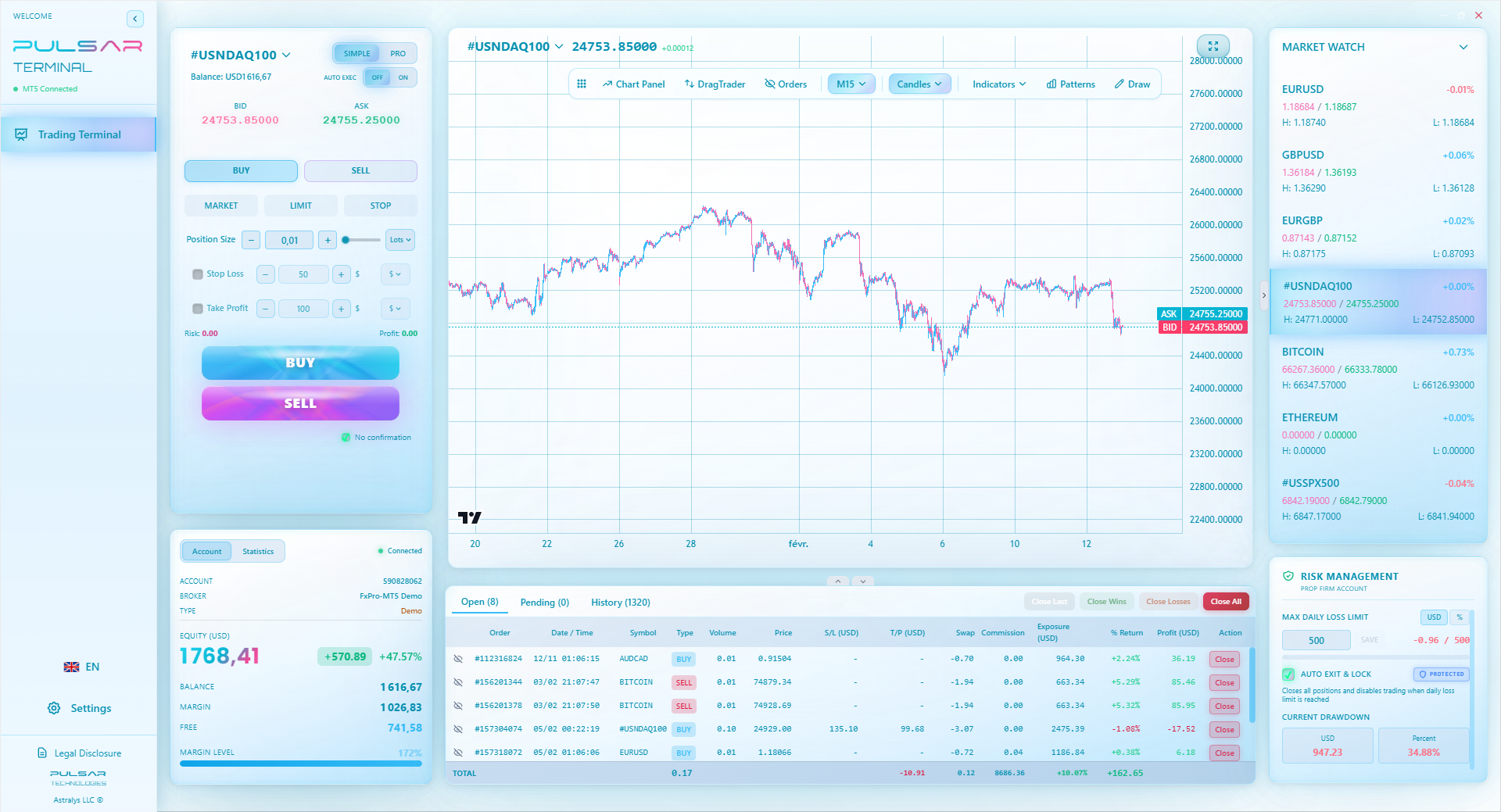
Manually drawing pivot levels every day is a chore; Pulsar Terminal's advanced drawing tools let you plot and save your custom levels directly on MT5 in seconds.
Pulsar Terminal
Lo strumento MT5 tutto-in-uno: ordini drag-and-drop, multi-TP/SL, trailing stop, grid trading, Volume Profile e protezione prop firm. Usato da oltre 1.000 trader ogni giorno.
“A lone pivot level is a suggestion. A pivot level with confluence is a strong recommendation.”
This is where the magic happens. A lone pivot level is a suggestion. A pivot level with confluence is a strong recommendation. Here’s how I stack the odds.
1. Confluence with Moving Averages: The 50-day and 200-day Exponential Moving Averages (EMAs) are watched by everyone. If the Daily Pivot Point (PP) sits right on the 50 EMA, that level becomes a magnet for price action. I’ve seen price respect that combined zone when it would have ignored either one alone.
2. Confluence with Previous Price Action: Look at the chart. Was yesterday’s high also a major high from last week? If that level is near today’s R1, you have a double reason for sellers to step in. I mark previous weekly highs/lows on my chart in a different color. When they line up with a pivot, I pay extra attention.
3. Confluence with Momentum Indicators: I use the MACD indicator histogram. If price is approaching R1 and the MACD histogram is showing weakening bullish momentum (making lower highs while price makes a higher high), that’s a potential reversal signal at a key level. It’s not a sure thing, but it tells a story of exhaustion.
A Real Trade Example (GBP/NGN): In Q1 2024, GBP/NGN was in a downtrend. Price rallied and hit the Daily R1 level. At that exact same level was:
- The 38.2% Fibonacci retracement of the prior down move.
- A previous swing low from two weeks prior (now acting as resistance).
- The MACD line was crossing down towards the signal line. That was a triple confluence. I took the short. Stop above R2, target at S1. It worked perfectly. The pivot point told me where, the confluence told me why a reversal was likely there.
💡 Consiglio di Winston
If price is consolidating tightly around the Daily Pivot Point (PP), it often indicates equilibrium. Wait for a breakout above R1 or below S1 before committing to a direction.
“Your goal isn't profit this week. Your goal is to execute the plan correctly 5 times.”
So, where do you start tomorrow morning? Don't try to do everything at once. You'll get overwhelmed.
Week 1: Observation. Don't trade. Just plot the daily pivot points on your chart for the major pairs you follow (USD/NGN, EUR/NGN, maybe GBP/USD). Watch how price behaves around the PP, R1, and S1. Note if it respects them or slices through. Use a demo account if you must place trades. This builds pattern recognition without risk.
Week 2: Simple Execution. Pick one instrument. Maybe USD/NGN. Look for one setup: a bounce at S1 or R1 with a clear pin bar or engulfing candle. Use a strict position size calculator. Your goal isn't profit this week. Your goal is to execute the plan correctly 5 times. Track every trade in a journal. Why did it work? Why did it fail?
Week 3 & Beyond: Add Confluence. Now, start filtering. Only take that bounce trade if the pivot level aligns with a previous daily high/low, or if the RSI indicator is showing oversold/overbought conditions. You'll take fewer trades, but their quality should improve.
Finally, remember this: A forex pivot point calculator is a foundational tool. It's not a standalone system. It's the skeleton. Your job is to add the muscles of price action, the nerves of risk management, and the brain of fundamental awareness (especially of CBN news). Build that complete trader, and the pivots will serve you well for years.
FAQ
Q1Is forex trading with pivot points legal in Nigeria?
Yes, forex trading is legal in Nigeria. However, the online retail market is largely unregulated locally. Nigerian traders typically use international brokers regulated by bodies like the FCA or CySEC. Using a pivot point calculator is just an analytical technique and is perfectly legal. Always ensure your broker is reputable.
Q2What time should I use to calculate daily pivots for EUR/USD as a Nigerian trader?
Use the New York session close at 5:00 PM EST (which is 10:00 PM or 11:00 PM Nigerian Time, depending on daylight savings). This is the standard for most institutional calculations. Using the wrong session close (like the Lagos close) will give you incorrect levels that the broader market isn't watching.
Q3Can I use pivot points for scalping Naira pairs?
You can, but be very careful. Naira pairs can have wider spreads and less liquidity than majors like EUR/USD. The 5-minute or 15-minute charts can be noisy. I've found pivots more reliable for higher time frame scalping (like the 1-hour chart) on these pairs, where the pivot zones are wider and give you more room to manage the trade.
Q4Do I have to pay tax on profits from pivot point trading?
Yes. Nigerian residents are subject to a 10% Capital Gains Tax on gross trading profits, regardless of the broker's location. Profitable trading with a pivot point strategy doesn't exempt you. Keep detailed records of all trades for tax purposes.
Q5Which free forex pivot point calculator is best for Nigerians?
Many are online, but I recommend learning the formula and plotting the lines manually on your MT4/MT5 chart. This ensures you're using the correct high, low, and close data from your broker's feed. If you must use an online tool, choose one that lets you manually input prices and clearly states it uses the 5 PM EST close.
Q6Why do my pivot points sometimes seem completely ignored by the market?
This usually happens during high-impact news events (like CBN announcements or US Non-Farm Payrolls). Pivot points are technical levels, and fundamentals trump technicals. If there's major news, the market's focus shifts and liquidity pours in, blowing through technical levels. Always check the economic calendar.
Q7Should I use Classic, Fibonacci, or Camarilla pivots?
Start with Classic. It's the most widely watched and forms the basis for the others. Once you're comfortable, experiment with Fibonacci pivots, which place the support/resistance levels closer to the pivot point. I found Camarilla too cluttered for my taste. 95% of my trading is done using Classic pivots.
Lezione del Prof. Winston
Punti chiave:
- ✓Pivot Points are areas of interest, not guaranteed reversal points.
- ✓Always use the 5 PM EST New York close for daily calculations.
- ✓Confluence with another indicator or level doubles your edge.
- ✓Factor in the spread and 10% Capital Gains Tax on all profits.
Quanto è stato utile questo articolo?
Clicca su una stella
Analisi Trading Settimanali
Analisi e strategie settimanali gratuite. Nessuno spam.
Sull'autore
Olumide Adeyemi
Pioniere del Trading in Africa Occidentale
Uno degli educatori di trading forex più attivi in Nigeria. 8 anni di esperienza di trading da Lagos. Specializzato in strategie a basso capitale e sfide prop firm per trader africani.
Commenti
Avviso di rischio
Il trading di strumenti finanziari comporta rischi significativi e potrebbe non essere adatto a tutti gli investitori. Le performance passate non garantiscono risultati futuri. Questo contenuto è fornito solo a scopo educativo e non deve essere considerato un consiglio di investimento. Conduci sempre le tue ricerche prima di fare trading.
Potrebbe interessarti anche

Cara Trading Forex Sukses: 7 Prinsip dari Trader Profesional
Cara trading forex sukses dengan 7 prinsip trader pro: manajemen modal, disiplin, journal trading, backtest. Data nyata, bukan janji profit palsu.
Jam Trading Forex Terbaik untuk Trader Indonesia: Panduan Lengkap dengan Tabel Waktu
Panduan jam trading forex untuk trader Indonesia. Tabel 4 sesi dunia, jam emas 20:00-00:00, sesi mana yang harus dihindari. Data akurat + tips dari trader berpengalaman.
Top 5 Sàn Forex Uy Tín Nhất 2026: Review Jujur dari Trader Indonesia
Top 5 sàn forex uy tín 2026 untuk trader Indonesia. Review jujur: spread, deposit, withdraw, dukungan lokal. Exness, XM, IC Markets & lebih.
Scarica Pulsar Terminal
Tutti questi calcolatori sono integrati in Pulsar Terminal con dati in tempo reale dal tuo conto MT5.
Scarica Pulsar Terminal