


Most Nigerian traders think a forex portfolio is just a collection of random currency pairs.

Olumide Adeyemi
Pioniere del Trading in Africa Occidentale ·  Nigeria
☕ 10 min di lettura
Cosa imparerai:
- 1What Actually Is a Forex Portfolio? (It's Not What You Think)
- 2Core Principles: Diversification & Correlation
- 3position-sizing-risk-management
- 4Broker Selection & The Nigerian Reality
- 5Strategic Allocation: Three Portfolio Models
- 6The Naira Bottom Line: Taxes & Record Keeping
- 7Mistakes That Wreck Nigerian Forex Portfolios
- 8Evolving Your Portfolio as You Grow
Most Nigerian traders think a forex portfolio is just a collection of random currency pairs. They chase the 'hot pair' of the week, pile into one trade, and wonder why their account gets wiped out when sentiment shifts. That's not a portfolio, it's a gamble. A real forex portfolio is a strategic, diversified engine designed to survive market chaos and grow your capital consistently. Let's cut through the noise and build one that actually works for you.
Forget the fancy finance terms. Your forex portfolio is simply your total trading capital, strategically allocated across different trades and currency pairs. The goal isn't to hit a home run on one trade. It's to ensure that no single loss can cripple you, and that different market conditions work in your favor at different times.
Think of it like a football team. You wouldn't field 11 strikers. You need defenders (low-risk, stable pairs), midfielders (moderate risk, good momentum), and a couple of strikers (higher-risk, high-reward opportunities). A portfolio balances these roles.
A common mistake I see in Nigeria is over-concentration in USD/NGN or other pairs tied to the Naira's volatility. While trading what you know is good, putting all your eggs in one highly volatile basket is a recipe for a margin call. True diversification means spreading risk across different currencies, timeframes, and even trading strategies like swing trading and scalping.
This is the heart of portfolio management. If you buy EUR/USD, GBP/USD, and AUD/USD, you're not diversified. You're just betting on the US dollar weakening three times. When the dollar rallies, all three trades will likely lose. You've multiplied your risk, not spread it.
Understanding Currency Correlation
Correlation measures how pairs move in relation to each other. A correlation of +1.0 means they move in lockstep. -1.0 means they move perfectly opposite. You want a mix. For instance, EUR/USD and USD/CHF often have a strong negative correlation. When one goes up, the other tends to go down. Holding both can hedge some directional risk.
Building a Simple Starter Portfolio
A basic, well-diversified portfolio for a Nigerian trader might look like this:
| Pair | Role | Typical Correlation to Others |
|---|---|---|
| EUR/USD | Core "Major" - High liquidity, lower spreads | Benchmark pair |
| GBP/JPY | "Carry" or Volatility Pair - For momentum | Low/negative corr. to EUR/USD |
| AUD/CAD | Commodity Bloc Pair - Tied to resource prices | Different drivers than EUR or GBP |
| XAU/USD (Gold) | Safe-Haven Asset - Performs in risk-off markets | Often moves inverse to USD pairs |
This gives you exposure to different economic blocs (Europe, UK, Asia-Pacific, Commodities) and different market drivers. I learned this the hard way in 2015. I was long USD/JPY and USD/CAD, thinking I was smart. When the Fed delayed rate hikes, both got hammered. I lost 22% of my account in a week. That single event taught me more about correlation than any book.

Warning: Don't just copy this table. Your portfolio should reflect your strategy. A scalper needs highly liquid pairs with tight spreads, while a swing trader can handle more exotic pairs. Check out our guide on scalping strategy for the former approach.

💡 Consiglio di Winston
Your portfolio's worst enemy is correlation disguised as diversification. If all your pairs are moving together, you're just making one big, risky bet.
“If you're risking more than 2% per trade, you're not building a portfolio, you're conducting an experiment on how fast you can lose money.”
This is where most portfolios fail. You can have the perfect mix of pairs, but if your position sizing is reckless, you're finished. The golden rule: Never risk more than 1-2% of your total portfolio capital on any single trade.
Let's say you have a 500,000 NGN account (roughly $330). Risking 1% means your maximum loss per trade is 5,000 NGN. You use this number to determine your position size based on your stop-loss distance.
Here's a real example from my trading:
- Account Balance: $10,000
- Risk per Trade: 1% = $100
- Trade Idea: Buy EUR/USD at 1.0850, Stop Loss at 1.0820 (30 pips risk)
- Pip Value Needed: $100 risk / 30 pips = $3.33 per pip
- On a standard lot (where 1 pip = $10), that's 0.33 lots.
I'd enter a 0.33 lot position. If I'm stopped out, I lose exactly $100, protecting 99% of my portfolio. Use a position size calculator religiously. It removes emotion.

Example: If your 500,000 NGN account risks 2% (10,000 NGN) on a USD/JPY trade with a 50-pip stop, your max position size is calculated as: (10,000 NGN) / (50 pips * pip value in NGN). This math is non-negotiable.
Your portfolio's survival depends on this discipline. It lets you take 10 losing trades in a row and still have 80%+ of your capital to fight another day. I've been there. It's not fun, but it's survivable.
Your portfolio lives and dies by your broker's integrity and conditions. In Nigeria, the landscape is tricky. The CBN's focus isn't squarely on retail forex, so many traders use internationally regulated brokers. This is generally the safer path.
You need to check three things: regulation, costs, and Naira practicality.
1. Regulation & Safety: Prioritize brokers with top-tier licenses (UK FCA, Australian ASIC, Cyprus CySEC). Your funds are safer. Brokers like Pepperstone (ASIC) and IC Markets (ASIC, CySEC) are solid choices.
2. Costs That Eat Your Portfolio: Look at spreads and commissions. For your core pairs (like EUR/USD), a spread of 0.6-1.0 pips is decent. For a commission-based account, $3-$7 per round lot is competitive. These costs directly impact your portfolio's compounding ability. A broker with a 3-pip spread on EUR/USD is stealing from your future profits.
3. Naira Accounts & Transfers: This is huge. Funding in USD with your Naira card often incurs terrible bank exchange rates and fees. Brokers like Exness offer NGN accounts. You fund in Naira, trade USD-based pairs, and withdraw in Naira. It simplifies everything. Check our Exness review for specifics on their local offering.
Minimum deposits are low now. You can start a portfolio with $10-$100 at many brokers. Don't be fooled. Starting small is smart, but remember, proper position sizing with a $100 account is extremely challenging. You're often forced to risk too much per trade just to make the math work.
“In Nigeria, your portfolio's real success is measured by what you keep after costs, losses, and taxes.”
Your portfolio structure should match your personality and time commitment. Here are three models I've used or seen work.
1. The Core-Satellite Model (My Favorite)
- Core (70% of risk capital): Steady, lower-frequency trades on major pairs like EUR/USD or GBP/USD. Use higher timeframes (4H/Daily). This is your portfolio's anchor.
- Satellite (30% of risk capital): Higher-conviction, higher-risk opportunities. This could be a XAU/USD breakout play or a short on an exotic pair. These are your potential profit boosters.
2. The Timeframe Diversification Model Allocate trades across different charts:
- Swing Trades (Daily Chart): 1-2 positions, wider stops, aiming for 150+ pips.
- Intraday Trades (1H/4H Chart): 2-3 positions, moderate stops.
- Scalp Trades (1M/5M Chart): Small, quick positions for active days. This keeps you engaged across market phases. Learn more about the swing trading mindset for the longer-term part.
3. The Strategy-Specific Model You might run a trend-following system on EUR/USD using the MACD indicator, and a mean-reversion system on USD/CHF using the RSI indicator. The key is the systems must be non-correlated. Their combined equity curve should be smoother than either one alone.

Pro Tip: Keep a trading journal. Note not just wins/losses, but which part of your portfolio is working. If your 'satellite' trades are losing 80% of the time, maybe you're not good at that style. Cut it and focus on your core strength.
💡 Consiglio di Winston
A journal entry that says 'got greedy' is useless. One that says 'risked 2.5% instead of 1% on GBP/USD because of yesterday's loss' is a roadmap to fixing your fatal flaw.
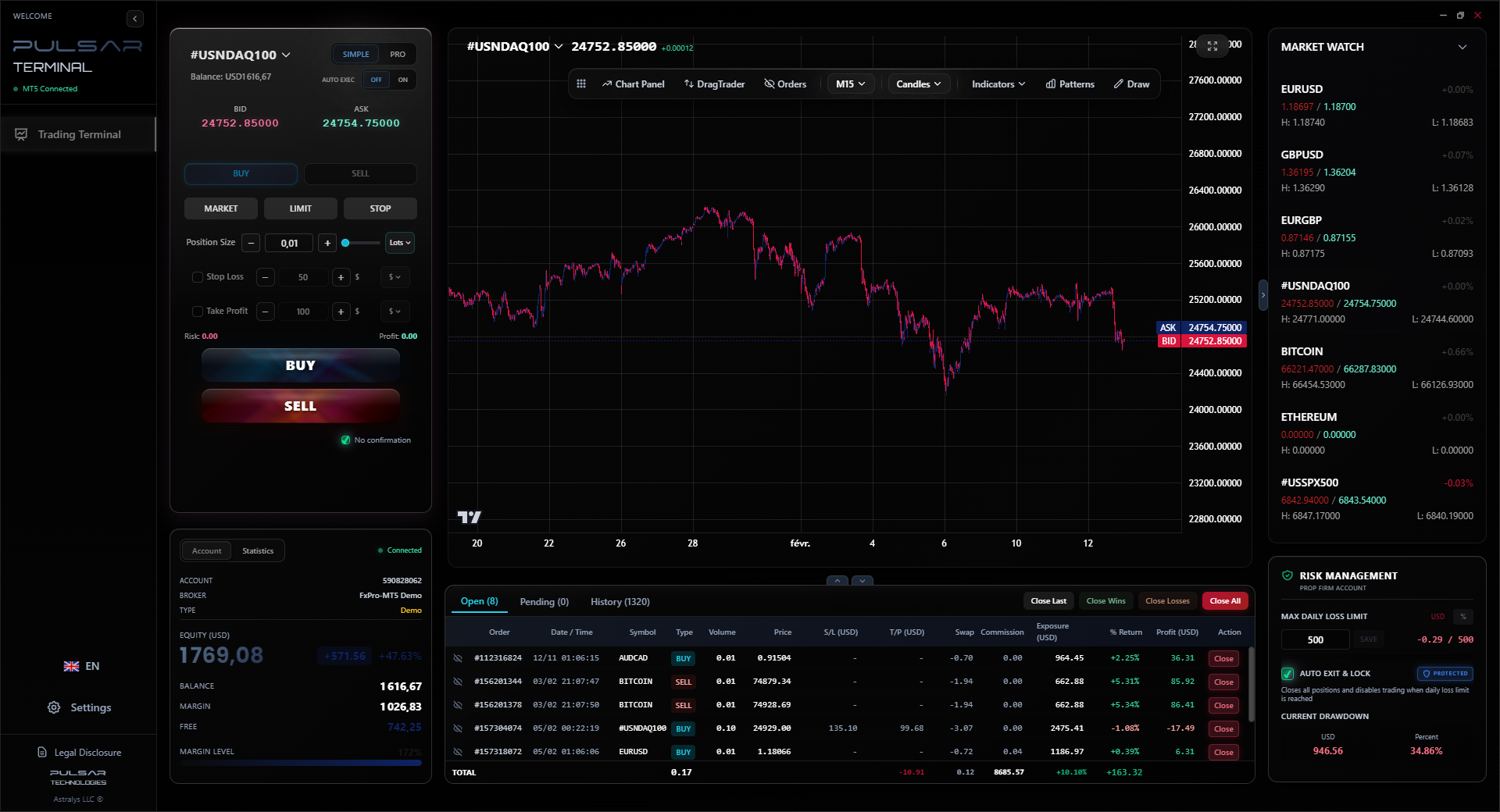
Managing a multi-pair portfolio with precise stop-losses and take-profits across different trades is complex, but tools like Pulsar Terminal automate this directly on your MT5 platform.
Pulsar Terminal
Lo strumento MT5 tutto-in-uno: ordini drag-and-drop, multi-TP/SL, trailing stop, grid trading, Volume Profile e protezione prop firm. Usato da oltre 1.000 trader ogni giorno.
Let's talk about the government's cut. In Nigeria, profits from forex trading are subject to Capital Gains Tax (CGT) at 10%. If you're trading full-time, it could be considered business income. I'm not a tax advisor, but I can tell you what's prudent.
Keep Impeccable Records. For every single trade:
- Entry/Exit price and date
- Profit/Loss in your account currency (and Naira equivalent)
- Screenshot of the trade closing
- Records of all deposits and withdrawals
Why? First, for your own portfolio analysis. Second, when you withdraw profits to your Nigerian bank account, that's a taxable event. The FIRS may not be knocking down doors for retail traders yet, but being able to calculate your liability is just smart business.
Calculate your net profit annually (Total Withdrawals - Total Deposits). 10% of that is your potential CGT liability. Set it aside. Seriously. Opening a separate savings account and moving 10% of every profitable withdrawal there is a discipline that will save you a massive headache later.
Your portfolio's real success is measured by what you keep after costs, losses, and taxes. A trader who makes 50% but can't account for it and gets a huge tax bill later didn't really make 50%.
“use doesn't amplify your genius; it amplifies your mistakes, and you will make mistakes.”
I've made most of these. Learn from my losses.
1. Over-Leveraging the Portfolio: Just because your broker offers 1:500 use doesn't mean you use it. use amplifies losses faster than gains. Using high use across multiple positions is a guaranteed blow-up. I once used 1:100 on three correlated pairs during a news event. A 50-pip move against me wiped out 60% of my account. It was a stupid, expensive lesson.
2. Chasing Losses with Bigger Bets: You lose on EUR/USD. Instead of sticking to your 1% risk, you throw 5% at GBP/USD to 'make it back fast.' This is emotional trading, not portfolio management. It's the fastest path to zero.
3. Ignoring Portfolio Review: You don't 'set and forget' a portfolio. Every month, review it. Are some pairs consistently losing? Is your risk per trade still at 1% of your current balance? (If your account shrinks, your position size must shrink too). Rebalance.
4. Neglecting the Spread: Trading exotic pairs with 20-pip spreads means the price has to move 20 pips just for you to break even. That's a huge hurdle. Stick to majors and minors for your core holdings where the spread is tight.
💡 Consiglio di Winston
The 10% you set aside for taxes isn't lost money. It's the cost of running a legitimate, sustainable business. Treat it that way.
Your first portfolio with a $100 account will look different from a $10,000 portfolio. As your capital grows, your opportunities expand.
Starting Out (< $1,000): Focus on 2-3 major pairs max. Master them. Your goal is consistency and learning, not getting rich. Use micro lots to practice proper position sizing.
Intermediate ($1,000 - $10,000): This is where you can implement a true Core-Satellite model. You have enough capital to diversify meaningfully without being killed by percentage-based fees. You can start adding instruments like gold (XAU/USD) for diversification.
Advanced ($10,000+): Here, you can think about more sophisticated strategies. Maybe you allocate a small portion to a fully automated system, or use options for hedging. The key is that each new element serves a specific risk-management or diversification purpose. It's not about being fancy; it's about being strong.
Throughout all stages, the constants are your risk-per-trade rule, your journal, and your continuous review. A forex portfolio isn't a static thing. It's a living system that you manage. Treat it with the seriousness of a business, because that's exactly what it is.
FAQ
Q1Is forex trading legal in Nigeria, and can I build a portfolio legally?
Yes, forex trading is legal for individuals in Nigeria. You are participating in the global market. While local retail forex oversight is nuanced, building a portfolio by trading with reputable, internationally regulated brokers is a standard and accepted practice. The key is to use licensed brokers and be aware of your tax obligations.
Q2What is the minimum amount I need to start a forex portfolio in Nigeria?
Technically, you can start with as little as $1 with some brokers like Exness. However, practically speaking, with a very small account, proper portfolio diversification and risk management (like the 1% rule) become almost impossible. I'd suggest a minimum of $100 (about 150,000 NGN) to start applying basic portfolio principles without being overly constrained by lot size limits.
Q3How do I fund my forex trading account with Naira?
Many international brokers catering to Nigeria offer NGN-denominated accounts (e.g., Exness, FXTM). You can fund these directly via bank transfer or card in Naira. If your broker only offers USD accounts, you can still fund with your Naira card, but your bank will convert it at their rate, often with added fees. The NGN account route is usually cheaper and simpler.
Q4Do I pay tax on my forex trading profits in Nigeria?
Yes. According to Nigerian law, profits from forex trading are subject to Capital Gains Tax (CGT) at a rate of 10% on gross profits. It is your responsibility to keep accurate records of your trading activity, calculate your profit (withdrawals minus deposits), and declare it. Consult a local tax professional for definitive advice.
Q5How many currency pairs should be in my portfolio?
Quality over quantity. A beginner should master 1-2. An intermediate trader can effectively manage 3-5 correlated pairs (like EUR/USD, GBP/JPY, and XAU/USD). Having 10+ pairs usually means you're not analyzing any of them properly. It's better to have deep knowledge of a few instruments than shallow knowledge of many.
Q6What's the biggest risk to my forex portfolio?
Without a doubt, it's you. Emotional decisions - over-leveraging, revenge trading, abandoning your risk rules - cause more blow-ups than any market crash. The second biggest risk is using an unregulated or shady broker. Stick to your plan and stick to reputable brokers like those we review (e.g., XM, IC Markets).
Q7Can I trade forex part-time and still manage a good portfolio?
Absolutely. In fact, part-time traders often avoid the overtrading trap. Focus on higher timeframes (4-hour or daily charts) for your swing trades. Set your orders, place your stop-loss and take-profit, and walk away. Review in the evening. This is a perfect fit for the Core-Satellite model, where your 'core' trades are longer-term.
Lezione del Prof. Winston
Punti chiave:
- ✓Never risk more than 1-2% of your total capital on a single trade.
- ✓Diversify across non-correlated pairs and timeframes.
- ✓Choose brokers with top-tier regulation and NGN accounts.
- ✓Set aside 10% of profits for Capital Gains Tax from day one.
- ✓A trading journal is your most important analytical tool.
Quanto è stato utile questo articolo?
Clicca su una stella
Analisi Trading Settimanali
Analisi e strategie settimanali gratuite. Nessuno spam.
Sull'autore
Olumide Adeyemi
Pioniere del Trading in Africa Occidentale
Uno degli educatori di trading forex più attivi in Nigeria. 8 anni di esperienza di trading da Lagos. Specializzato in strategie a basso capitale e sfide prop firm per trader africani.
Commenti
Avviso di rischio
Il trading di strumenti finanziari comporta rischi significativi e potrebbe non essere adatto a tutti gli investitori. Le performance passate non garantiscono risultati futuri. Questo contenuto è fornito solo a scopo educativo e non deve essere considerato un consiglio di investimento. Conduci sempre le tue ricerche prima di fare trading.
Potrebbe interessarti anche

Cara Trading Forex Sukses: 7 Prinsip dari Trader Profesional
Cara trading forex sukses dengan 7 prinsip trader pro: manajemen modal, disiplin, journal trading, backtest. Data nyata, bukan janji profit palsu.
Jam Trading Forex Terbaik untuk Trader Indonesia: Panduan Lengkap dengan Tabel Waktu
Panduan jam trading forex untuk trader Indonesia. Tabel 4 sesi dunia, jam emas 20:00-00:00, sesi mana yang harus dihindari. Data akurat + tips dari trader berpengalaman.
Top 5 Sàn Forex Uy Tín Nhất 2026: Review Jujur dari Trader Indonesia
Top 5 sàn forex uy tín 2026 untuk trader Indonesia. Review jujur: spread, deposit, withdraw, dukungan lokal. Exness, XM, IC Markets & lebih.
Scarica Pulsar Terminal
Tutti questi calcolatori sono integrati in Pulsar Terminal con dati in tempo reale dal tuo conto MT5.
Scarica Pulsar Terminal