


I was staring at my screen in late 2024, watching a $150,000 funded account evaporate not from a bad trade, but from an email.

James Mitchell
Analista Trading Senior
☕ 12 min di lettura
Cosa imparerai:
I was staring at my screen in late 2024, watching a $150,000 funded account evaporate not from a bad trade, but from an email. MetaQuotes had just pulled the plug on the prop firm's MT5 license. Overnight, the account was frozen, the challenge void. That moment, watching six months of work disappear into regulatory ether, taught me more about this game than any winning streak. The landscape for forex prop firms for US traders isn't just changing, it's undergoing a seismic shift. If you're thinking about using a prop firm's capital, you need to understand the new rules of survival.
Let's cut through the noise. Most prop firms aren't regulated as brokers. They've cleverly positioned themselves as 'educational evaluators' or 'talent scouts' trading their own money. This keeps them outside the direct reach of the SEC and CFTC, for now. But that 'for now' is doing a lot of heavy lifting.
The CFTC is sniffing around, hard. Their main question: if a firm charges you a fee, gives you rules, and takes a cut of your profits, aren't they acting as a Commodity Trading Advisor (CTA)? If that label sticks, the whole model changes. We're talking mandatory registration, audited financials, and segregated client funds. Some firms are already getting ahead of this. The smart ones are implementing bank-level KYC checks not because they want to, but because their payment processors are forcing them to.
Here's the kicker for US traders: the regulatory pressure is creating a two-tier system. On one side, you have firms partnering with regulated entities (like a futures commission merchant) to offer a quasi-legal path back into the US market. On the other, you have firms that just quietly stop accepting US clients. I've seen traders wake up to find their favorite firm's website now says 'Not available in your region.' It's a gut punch.

Warning: Don't assume a firm is 'safe' because it's big or popular. Some of the largest closures (MyForexFunds, TrueForex Funds) happened overnight. Your challenge fee is often just that - a fee for a service. It's rarely treated as client money sitting in a protected account until you pass. That's changing, but slowly.

💡 Consiglio di Winston
A prop firm's rules aren't guidelines, they are the law of that land. Your strategy must be built within those walls, not in spite of them.
“The landscape for forex prop firms for US traders isn't just changing, it's undergoing a seismic shift.”
Everyone sees the ads: 'Pass our challenge, get $100,000, keep 80% of profits!' It sounds like a golden ticket. The reality is a numbers game designed for the house. Let's talk real stats, the ones the firms don't put in their marketing.
Industry-wide data shows only 5% to 10% of traders pass the evaluation. Let that sink in. A 90%+ failure rate. Even bleaker? Only about 7% of everyone who attempts a challenge ever sees a single payout. Most traders I've met, myself included in the early days, burn through four figures in challenge fees before they even get a funded account. I personally blew through $1,200 on various 'Phase 1' attempts before I finally got my risk management tight enough to pass.
Breaking Down the Fees
You're not 'depositing' you're buying a test. Fees range from a 'too-good-to-be-true' $39 to a more standard $100-$500. The cheaper the fee, the tighter the rules usually are (think tiny 5% max drawdown). Instant funding accounts, where you skip the eval, can cost $1,000 or more. That's a serious bet on yourself.
The profit split is usually the honest part. 80/90 in your favor is standard. Some firms offer scaling plans to get you to 100%. But remember, you only split realized profits. Most firms have a 'first payout threshold' you must hit before you can withdraw anything. That's your first real milestone.
The Hidden Cost: Your Psychology
The biggest cost isn't the fee. It's the psychological toll of trading with artificial constraints. A 5% max drawdown on a $100k account means you can only lose $5,000. That's just 50 pips on a standard lot. It forces ultra-conservative trading that can be hard to unlearn. I once missed a 120-pip move on EUR/USD because I was so terrified of my daily loss limit I used a position size calculator to trade a laughably small 0.05 lots. Made $60, left $1,200 on the table. The rules protect the firm's capital, but they can strangle your opportunity.

Example: You buy a $299 challenge for a $100k account. You have a 10% max drawdown ($10,000) and a 5% daily loss limit ($5,000). You trade 1 standard lot on EUR/USD. Each pip is worth $10. Your daily safety net is just 500 pips. A bad news spike can wipe that out in minutes. This is why strict scalping strategy is so common in prop challenges.
“Only about 7% of everyone who attempts a challenge ever sees a single payout.”
With firms shutting down left and right, due diligence is your most important trade. Here’s my checklist, forged from painful experience.
1. Platform & Infrastructure: The MetaQuotes crackdown of 2024 was a massacre. If a firm is 100% reliant on MT4/MT5, they're one license review away from disaster. Look for firms that have diversified to cTrader, DXtrade, or TradeLocker. It shows they've invested in stability. I now only consider firms that offer at least one non-MetaQuotes platform.
2. Payout Proof & History: Don't just look at the firm's testimonials. Go to independent forums, YouTube, and Twitter. Search for '[Firm Name] payout proof' and '[Firm Name] withdrawal problem'. Look for consistency over time. A firm that's been paying weekly for two years is a better bet than a new firm with flashy ads.
3. Regulatory Posture: Are they pretending regulation doesn't exist, or are they addressing it? Look for phrases like 'partnered with a regulated entity', 'segregated trader profits', or 'CFTC-compliant evaluation'. For US traders, a firm offering futures trading through a registered FCM (Futures Commission Merchant) is currently the most strong legal structure. Check out our Pepperstone review to see how a fully regulated broker operates, for comparison.
4. Rule Clarity & Realism: Avoid firms with 'hidden' rules or insanely tight limits. The rules should be crystal clear on their website: drawdown type (trailing vs. static), news trading policies, overnight/weekend holding rules. If you have to dig through a Discord channel to understand the max lot size, walk away.
5. Payment Methods & Speed: Can you get paid via crypto or wire? How fast? Firms like FundedNext promoting 24-hour payouts are setting a new standard. If a firm says 'payouts processed in 14 business days,' that's a red flag in 2026.
Here’s a quick comparison of key traits to look for:
| Trait | Green Flag | Red Flag |
|---|---|---|
| Platforms | MT5 + cTrader or DXtrade | MT4 only |
| Payout Speed | Weekly, 24-48 hour guarantee | 'By the 15th of the following month' |
| Rule Clarity | All rules on main website, clear FAQ | Rules scattered, reliant on support |
| US Access | Explicitly states service for US, details structure | 'Contact support to see if you qualify' |
| Drawdown | Static Max Drawdown (e.g., 10%) | Trailing Drawdown from starting balance |
“Only about 7% of everyone who attempts a challenge ever sees a single payout.”
Passing a prop challenge is a different sport from trading your own account. The goal isn't maximum return, it's consistent, rule-compliant survival. Here’s what works when someone else is holding the stop-loss.
Scalping for Consistency: This is the king of prop challenges. Small gains, high frequency, minimal exposure. You're aiming to chip away at the profit target while staying miles away from the daily loss limit. The key is a razor-sharp edge with a high win rate, even if the risk/reward is 1:1. You can't afford drawdowns. I passed my first real challenge using a simple RSI indicator divergence scalping set-up on the 5-minute chart, never holding a trade for more than 15 minutes.
Swing Trading (The Careful Way): It's possible, but riskier. You must use wider stops relative to your account size, which means trading much smaller positions. This is where a position size calculator is non-negotiable. If your swing trading setup needs a 50-pip stop, on a $100k account with a 5% ($5,000) daily limit, you can only risk 100 pips per day. That means your position on that trade can only be 2 mini lots (0.2 standard). It's a patience game.
The Tools That Matter: Forget fancy indicators. The most important tools are:
- A Trade Journal: To track your proximity to daily/maximum drawdown in real dollars, not just pips.
- A Hard Daily Loss Cutoff: The moment you hit 50% of your daily loss limit, you stop trading for the day. No exceptions.
- Automated Rule Protection: This is crucial. Manually watching a trailing drawdown is a nightmare. Using a platform tool that can automatically close positions or prevent new ones when you near a limit saves your sanity and your account.

Pro Tip: Your first goal in a challenge is not to hit the profit target. Your first goal is to survive for 2 weeks without touching the daily loss limit. This builds the discipline you need. Trade tiny, laughably small sizes just to get used to the platform and the pressure. The money comes later.
💡 Consiglio di Winston
The real test begins *after* you get funded. That's when most fail. Trade the first month like you're still in the challenge.
“Passing a prop challenge is a different sport from trading your own account. The goal is consistent, rule-compliant survival.”
You passed. Congrats. You now have a $100,000 funded account. This is where most traders blow it, again.
The psychology shifts dangerously. 'It's not my money' leads to either reckless over-trading or paralyzing fear. You have to mentally treat it as your own capital from day one. The firm's first payout threshold is your new challenge target. Don't even think about the $100k number. Think about making the first $5,000.
Scaling Plans: Many firms offer to increase your capital if you perform well (e.g., grow account by 10%, get a 25% capital boost). This is a fantastic feature, but it's another rule set. Often, the scaling phase has its own, sometimes stricter, drawdown rules. Read the fine print.
The real trap is consistency. Firms are looking for steady, manageable growth, not a hero trade. A 30% gain in a month might actually flag you as a risk, not a star. Aim for 3-5% monthly growth consistently, and you'll likely scale faster than the guy who bagged 20% in a week then gave 15% back.
Withdrawal discipline is key. Actually request payouts, on schedule. It proves the firm's liquidity and builds your own financial runway. I set a calendar reminder for every other Friday to request a payout, no matter how small. It turns the abstract 'funded account' into real cashflow, which is the whole point.
Remember, the funded account is a privilege, not a right. One breach of the often-complex rules (like holding news, over-leveraging, or using a forbidden EA) can terminate it instantly. The rules don't get easier after you pass; you just have more room to breathe.
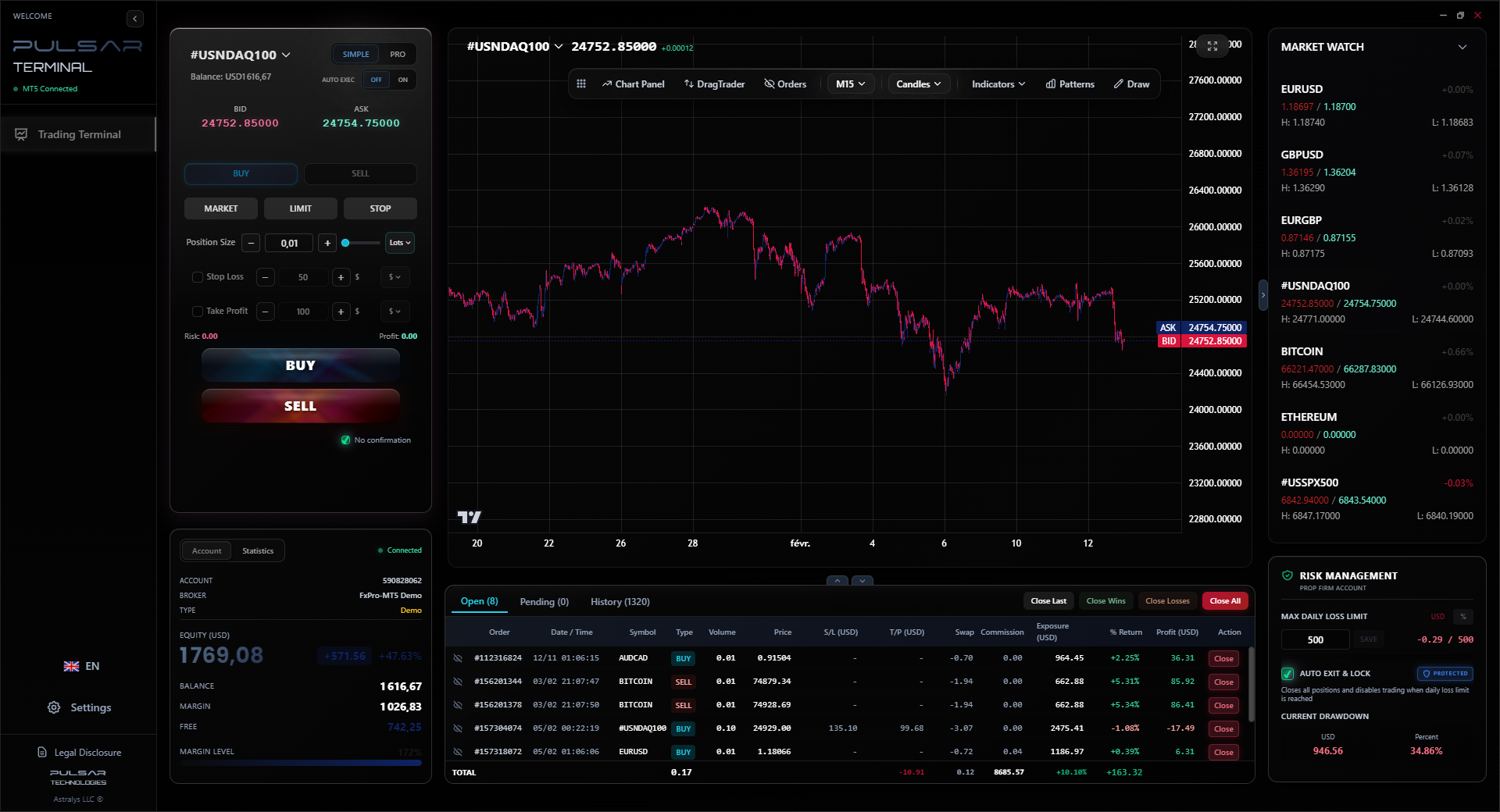
Managing a prop firm's complex daily loss and trailing drawdown rules manually is a recipe for disaster; Pulsar Terminal automates this protection directly on your MT5 chart, so you can focus on trading.
Pulsar Terminal
Lo strumento MT5 tutto-in-uno: ordini drag-and-drop, multi-TP/SL, trailing stop, grid trading, Volume Profile e protezione prop firm. Usato da oltre 1.000 trader ogni giorno.
“Passing a prop challenge is a different sport from trading your own account. The goal is consistent, rule-compliant survival.”
Where is this all heading? The wild west days are over. Here’s my read for 2026 and beyond.
Increased Formalization: The CFTC will likely succeed in classifying many futures-focused prop firms as CTAs. This means mandatory registration, disclosures, and audits. This is good for serious traders. It will weed out the shady operators and protect trader profits. Your challenge fee might even be held in escrow.
The Great Migration to Futures: There's a clear trend of traders moving from forex CFDs to regulated futures (traded on the CME). The rules are clearer, the counterparty is the exchange, and the regulatory framework is solid. Prop firms facilitating this through registered FCMs will dominate the US landscape. If you're not familiar with futures, it's time to learn.
Lower use, Tighter Rules: Regulators hate retail use. Expect maximum use on forex to keep dropping, perhaps standardizing at 30:1 or even lower for prop accounts. Rules around news trading and EAs will become stricter and more uniformly enforced.
Consolidation: The hundreds of pop-up prop firms will continue to vanish or get acquired. We'll be left with a dozen or so major players with strong legal structures, multiple platforms, and a track record of payouts. Choosing a firm will be less about who has the shiniest website and more about who has the strongest compliance department.
For the US trader, this means more security but less flexibility. The dream of easy, unregulated use is fading. What's replacing it is a more professional, if more constrained, pathway to trading larger capital. Your edge will need to be sharper than ever, because the firms themselves are being forced to raise their game.
“The wild west days are over. Your edge will need to be sharper than ever.”
So, you've read this and still want in. Here's your action plan.
- Paper Trade the Rules First: Pick a firm you're interested in. Take their exact rules - daily loss limit, max drawdown, profit target, minimum trading days - and apply them to a demo account for one full month. Use a position size calculator religiously. Can you survive? Can you hit the target without breaking the rules? This is the cheapest education you'll get.
- Start Small: Your first challenge should be your smallest. Use a $100-$200 fee on a $25k or $50k account. The pressure is lower, and the loss is survivable. It's a paid learning experience. Don't go for the $500, $200k account right out the gate. I didn't follow this advice, and it cost me.
- Master One Instrument: Don't jump between 28 forex pairs and gold. Become a specialist in one, maybe two. Understand its average daily range, its typical spread on your prop firm's platform (check our XAU/USD guide for an example of deep instrument analysis). Depth beats breadth in a challenge.
- Have Your Own Broker Account: Never let the prop firm be your only connection to the markets. Maintain a small, real personal account with a regulated broker like IC Markets or similar. It keeps your skills sharp on a platform you fully control, and it's a reality check on spreads and execution.
- Define Your Exit: Before you pay the fee, know your exit. Will you attempt the challenge twice? Three times? What's the total dollar amount you're willing to invest in this 'education'? Write it down. Stick to it. This prevents the sunk-cost fallacy from bleeding you dry.
The truth about forex prop firms for US traders is this: they are a fantastic capital-access tool for a tiny minority of disciplined, rule-based traders. For everyone else, they are an expensive lesson. Your job is to do the work to find out which one you are, before you risk a single dollar.
💡 Consiglio di Winston
If you can't consistently make money with a $5,000 personal account, you won't magically succeed with a prop firm's $100,000. Master your craft first.
FAQ
Q1Are forex prop firms legal in the United States?
It's a gray area, not black and white. Most firms aren't registered as brokers or advisors. They operate as educational evaluation services. However, regulators like the CFTC are scrutinizing this model, especially for futures trading. Their legality is stable for now but subject to change. Always choose a firm that's transparent about its compliance structure.
Q2What is the best prop firm for a beginner in the US?
There's no single 'best,' but for a beginner, look for a firm with: 1) Clear, static (not trailing) drawdown rules, 2) A low-cost evaluation option (under $200), 3) A platform you're familiar with, and 4) Extensive educational resources on their rules. Starting small is key. Don't go for the largest account size immediately.
Q3How often do prop firms actually pay out?
Reputable firms pay out on time, every time. The problem isn't the payout mechanics of good firms; it's getting to the point of being eligible. Industry data suggests only about 7% of traders who attempt challenges ever receive a payout. The barrier is passing the evaluation and then consistently trading profitably within the rules on a funded account.
Q4Can I use Expert Advisors (EAs) or trade during news with a prop firm?
You must check each firm's rules carefully. Most firms have strict rules against fully automated EAs, though some allow assistive tools. News trading is often restricted - you may be prohibited from opening trades 5-15 minutes before major economic releases. Violating these rules is the fastest way to get an account terminated, even if you're profitable.
Q5What happens if the prop firm shuts down while I have a funded account?
This is the biggest risk. If the firm goes bankrupt or is shut down by regulators, you are likely an unsecured creditor. Any profits you've earned but not yet withdrawn could be lost. This is why due diligence on the firm's financial stability and history is more important than any specific rule or payout split.
Q6Is the 'challenge fee' refundable if I pass?
Almost never. The fee is considered payment for the evaluation service. Some firms may offer a refund or fee waiver as part of a promotion, but standard practice is that the fee is gone once paid. A few progressive firms are starting to treat fees as 'trader capital' held in trust, but this is not yet the norm.
Q7Should I focus on forex or futures with a US prop firm?
In 2026, futures present a clearer regulatory path. Forex prop firms exist in a grayer area. If you're equally interested in both, leaning towards a firm that offers futures trading through a registered FCM (Futures Commission Merchant) might offer more long-term stability for a US-based trader.
Lezione del Prof. Winston
Punti chiave:
- ✓Treat challenge fees as tuition, not an investment.
- ✓Master position sizing before you touch a live challenge.
- ✓Prioritize firms with non-MT4/5 platforms for stability.
- ✓Your daily loss limit is your most important number.
Quanto è stato utile questo articolo?
Clicca su una stella
Analisi Trading Settimanali
Analisi e strategie settimanali gratuite. Nessuno spam.
Sull'autore
James Mitchell
Analista Trading Senior
Con base a New York e oltre 9 anni di esperienza nel trading. Si occupa delle principali coppie USD, sfide delle prop firm e del contesto normativo statunitense.
Commenti
Avviso di rischio
Il trading di strumenti finanziari comporta rischi significativi e potrebbe non essere adatto a tutti gli investitori. Le performance passate non garantiscono risultati futuri. Questo contenuto è fornito solo a scopo educativo e non deve essere considerato un consiglio di investimento. Conduci sempre le tue ricerche prima di fare trading.
Potrebbe interessarti anche

Cara Trading Forex Sukses: 7 Prinsip dari Trader Profesional
Cara trading forex sukses dengan 7 prinsip trader pro: manajemen modal, disiplin, journal trading, backtest. Data nyata, bukan janji profit palsu.
Jam Trading Forex Terbaik untuk Trader Indonesia: Panduan Lengkap dengan Tabel Waktu
Panduan jam trading forex untuk trader Indonesia. Tabel 4 sesi dunia, jam emas 20:00-00:00, sesi mana yang harus dihindari. Data akurat + tips dari trader berpengalaman.
Top 5 Sàn Forex Uy Tín Nhất 2026: Review Jujur dari Trader Indonesia
Top 5 sàn forex uy tín 2026 untuk trader Indonesia. Review jujur: spread, deposit, withdraw, dukungan lokal. Exness, XM, IC Markets & lebih.
Scarica Pulsar Terminal
Tutti questi calcolatori sono integrati in Pulsar Terminal con dati in tempo reale dal tuo conto MT5.
Scarica Pulsar Terminal