


I remember staring at my screen in late 2023, watching USD/NGN blow straight through my mental stop-loss.

Olumide Adeyemi
Pioniere del Trading in Africa Occidentale ·  Nigeria
☕ 9 min di lettura
Cosa imparerai:
- 1Why Risk Management is Non-Negotiable Here
- 2The Cornerstone: Position Sizing You Can Actually Use
- 3Stop-Losses & Taking Profit: Setting Your Guardrails
- 4Handling Naira Volatility & Weekend Gaps
- 5The Psychology & The Daily Routine
- 6Tools That Actually Help (Beyond the Basics)
- 7Putting It All Together: Your Survival Plan

I remember staring at my screen in late 2023, watching USD/NGN blow straight through my mental stop-loss. I was short from 980, convinced the CBN would defend the level. It didn't. The pair ripped to 1,050 in what felt like minutes, and I watched a 7% account drawdown happen live. That wasn't market analysis failure. That was a complete, avoidable breakdown in my forex risk management. In Nigeria, where volatility is a constant companion and regulations shift, protecting your capital isn't just a strategy. It's the only thing that keeps you in the game long enough to win.
Trading in Nigeria adds layers of complexity you won't read about in generic guides. It's not just about the charts. The Naira's volatility can turn a sensible trade into a disaster overnight due to factors completely outside your technical analysis. I learned this the hard way not with a forex pair, but with a broker. Early on, I funded an account with an international firm that later had serious withdrawal issues for Nigerian clients. My risk management plan never accounted for 'broker risk'. I got my money out, but it took months. That's a type of drawdown no indicator can predict.
Then there's the tax man. That 10% capital gains tax on profits isn't a suggestion. If you're not factoring that into your profit targets and overall risk-reward math, you're kidding yourself. You need to make enough to cover taxes, bank charges, and still have a gain that justifies the risk. A 1:1 risk-reward ratio? Forget it here. After costs, you're basically breaking even.

Warning: Many international brokers popular with Nigerians operate in a regulatory grey area regarding the CBN's licensing rules. Your first risk management step is broker due diligence. Check our deep dives on regulated platforms like Exness review or IC Markets review to understand their local operation status.
The Local Mindset Trap
There's a common mindset I see: 'I'll just risk more to make back my losses quickly.' It's fueled by the pressure of our economic environment. This is the fastest path to a margin call. Real forex risk management is boring. It's systematic. It's about surviving the NGN's bad days so you're still capitalised for its good days.

💡 Consiglio di Winston
A Naira saved from a bad trade is better than a Naira earned from a lucky one. Focus on the quality of your risk, not the size of your potential reward.
“In Nigeria, protecting your capital isn't just a strategy. It's the only thing that keeps you in the game long enough to win.”
This is where most Nigerians fail. We see a 'sure' opportunity and bet the farm. My rule now is simple, and I've broken it to my detriment more than once: Never risk more than 1% of your trading capital on a single trade. For a $1,000 account (roughly ₦1.5 million at the time of writing), that's $10 or ₦15,000.
Let's make it practical with a Naira-based example. Say your account is ₦500,000. Your 1% risk is ₦5,000. You're looking to buy GBP/NGN, which is at ₦1,800. Your analysis says if it drops to ₦1,785, you're wrong. That's a 15 Naira stop-loss.
How many units can you trade? The formula is: Risk Amount / Stop-Loss in Naira = Units. ₦5,000 / 15 = 333.33 units.
So, you can buy about 333 units of GBP/NGN. If you get stopped out, you lose your planned ₦5,000. Not your rent money.

Example: I once broke this rule on a USD/NGN scalping strategy. Account: ₦750,000. Risked 3% (₦22,500) on a 'can't lose' trade. A surprise CBN announcement hit, and I lost ₦26,700 in 90 seconds. It took me three weeks of disciplined 1% trades just to climb back. The lesson was more valuable than the money.
I don't do this math manually anymore. I use a position size calculator every single time, no exceptions. It removes emotion. Your position size isn't about how much you want to make. It's strictly about how much you can afford to lose.

“Your position size isn't about how much you want to make. It's strictly about how much you can afford to lose.”
If you don't set a stop-loss, the market will set it for you. And it will be brutal. A stop-loss isn't a sign of weakness; it's a pre-defined cost for being wrong. I place mine at a level where my trade thesis is invalidated, not at a random round number.
For instance, trading EUR/USD, I don't just slap a stop 20 pips away. If my entry is based on a bounce off a key support level shown by the MACD indicator, my stop goes just below that support. The market needs room to breathe, but not enough room to cripple me.
Taking profit is the other half. The greediest thing you can do is watch a 5% gain turn into a 2% loss. I use a tiered approach. I'll close half my position at a 1:1 risk-reward ratio (so if I risk ₦5,000, I take ₦5,000 off the table). Then, I move my stop-loss on the remaining half to breakeven. Now, the trade is risk-free. I can let the rest run toward a second target.

Pro Tip: For volatile pairs like GBP/NGN or XAU/USD (Gold), use wider stops. A too-tight stop will get hunted and taken out by normal noise. If the required stop is too wide for your 1% risk, the answer is to trade smaller, or not trade at all. Don't squeeze the stop.
“Your position size isn't about how much you want to make. It's strictly about how much you can afford to lose.”
Sunday night opens are a special kind of terror for currency traders here. While you're at church or with family, the global market is moving, and the Naira can gap significantly against the dollar or pound. I've logged in to see USD/NGN 30 Naira away from my Friday close. That can wipe out an account.
My solution is twofold. First, I avoid holding Naira-based pairs over the weekend unless my position is already in significant profit with a breakeven stop. Second, for major pairs like EUR/USD, I reduce my position size on Friday if I'm holding over. A 1% risk becomes a 0.5% risk to account for potential gap risk.
Volatility isn't always your enemy, though. It's why we can make money. The key is to adjust your strategy to it. In high-volatility periods (like during CBN policy announcements), I switch from swing trading to shorter timeframes or just stay out. Chasing a market moving 500 pips a day is a good way to get run over.
Remember the BDC rules? That $150,000 weekly cap and 24-hour utilization rule for BDCs creates sharp, predictable flows. News-driven volatility is a risk you can manage by simply not being in the market during major news releases.
💡 Consiglio di Winston
Your first profit target should always be to get your original risk capital off the table. A risk-free trade is a peaceful trade.
“Two consecutive losses, and I'm done for the day. This single rule has saved me more money than any indicator.”
Your biggest risk is between your ears. After a loss, the urge to 'revenge trade' is overwhelming. I've done it. I lost ₦8,000 on a bad EUR/USD trade, then immediately jumped into a gold trade with double my normal size to make it back. I lost another ₦12,000. That one hurt.
Now, my rule is: Two consecutive losses, and I'm done for the day. I close the platform. I go for a walk. The market will be there tomorrow. This single rule has saved me more money than any indicator.
My daily risk routine looks like this:
- Check News: Any CBN or SEC announcements? Any major global data due?
- Review Trades: Any open positions? Are my stops and targets still valid?
- Calculate Size: Before any new trade, I run the numbers through my calculator.
- Journal: I record every trade. Entry, exit, reason, emotional state. This is how I learned my revenge-trading pattern.
This boring routine is my armor. It makes risk management automatic, not an afterthought.
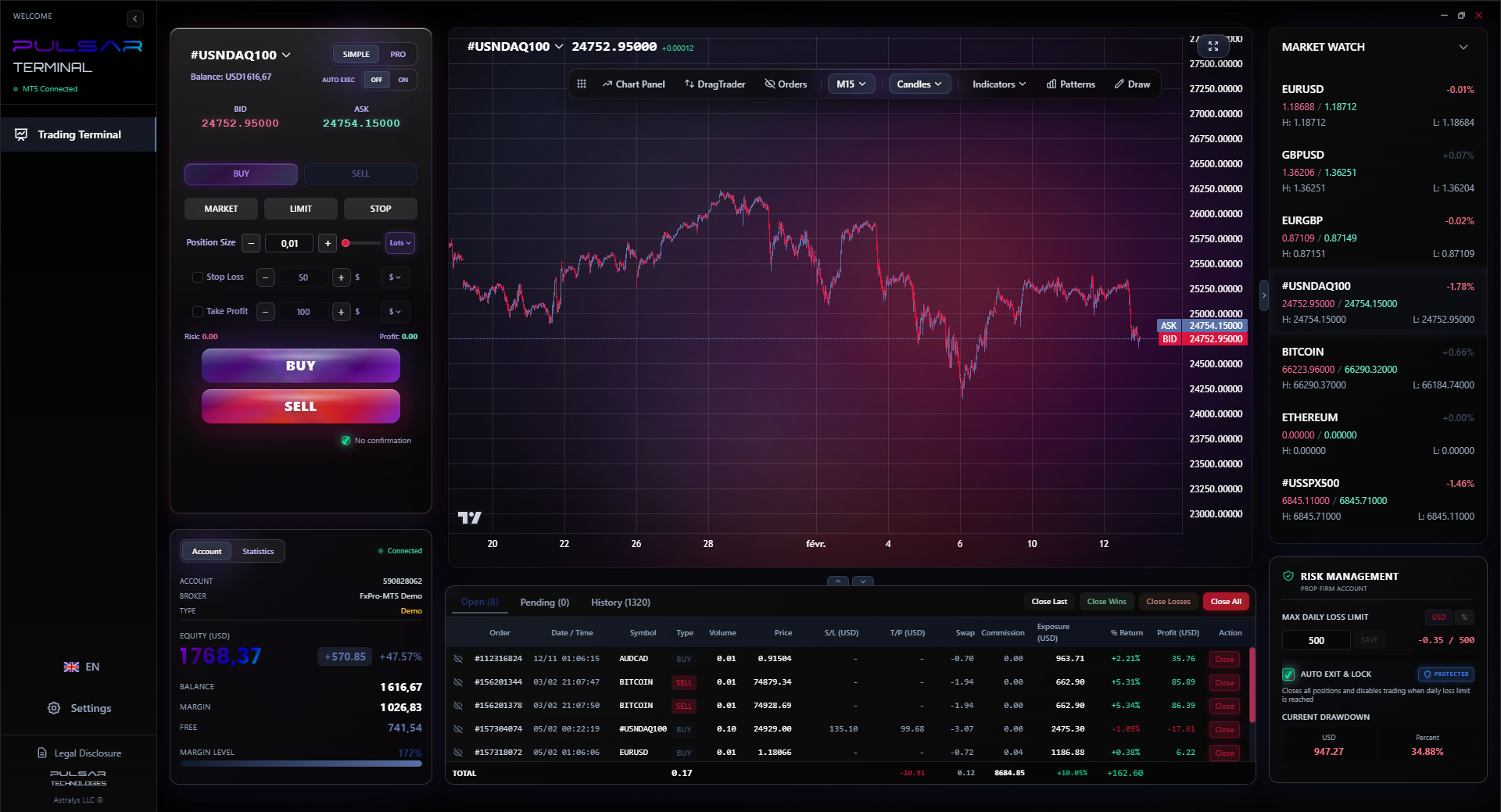
When your risk plan relies on precise stop-losses, take-profit levels, and trailing stops, a tool like Pulsar Terminal lets you set and manage all those rules directly on your MT5 charts without the emotional hassle.
Pulsar Terminal
Lo strumento MT5 tutto-in-uno: ordini drag-and-drop, multi-TP/SL, trailing stop, grid trading, Volume Profile e protezione prop firm. Usato da oltre 1.000 trader ogni giorno.
“Two consecutive losses, and I'm done for the day. This single rule has saved me more money than any indicator.”
Once you've mastered the 1% rule and stop-losses, you can look at tools that refine your edge. A trailing stop is a beautiful thing. It locks in profits as a trade moves in your favor. On a long GBP/NGN trade that ran from ₦1,800 to ₦1,850, a 50 Naira trailing stop would have captured most of that move instead of me exiting too early at ₦1,830.
Another concept is correlation. If you're long USD/NGN, you're short the Naira. Be careful about also being long other dollar pairs (like USD/CAD) at the same time. You're doubling your exposure to one currency move. A single US dollar crash could hit all your trades.
Finally, understand the spread. Nigerian traders often use brokers with variable spreads. That 3-pip spread on EUR/USD can widen to 15 pips during news. If your profit target is only 10 pips away, you start the trade at a 15-pip deficit. That's not a trade, it's a donation. I stick to brokers known for stable spreads, like those reviewed in our Pepperstone review.
These tools aren't magic. They're force multipliers for a solid, disciplined foundation. Don't use a trailing stop to manage a poorly conceived trade. Garbage in, garbage out.
💡 Consiglio di Winston
If you can't write down your exact entry, stop, target, and position size before clicking 'buy', you have no trade. You have a gamble.

“Do this consistently, and you're not just a trader. You're a business owner. Your most important job is capital preservation.”
Here’s what real-world forex risk management looks like for a Nigerian trader on a Monday morning.
Your Account: ₦1,000,000. Your Max Risk per Trade: 1% = ₦10,000.
The Setup: You see a potential bounce on EUR/NGN at ₦1,620 support, confirmed by the RSI indicator showing oversold conditions. Resistance is at ₦1,650.
The Plan:
- Entry: Buy at ₦1,622.
- Stop-Loss: ₦1,615 (where the support breaks). That's a 7 Naira risk per unit.
- Position Size: ₦10,000 / 7 = ~1,428 units. You buy 1,400 units to be safe.
- Take Profit 1: ₦1,635 (13 Naira gain). Close 700 units here. Profit = 700 * 13 = ₦9,100.
- Action: Move stop-loss on remaining 700 units to breakeven (₦1,622).
- Take Profit 2: Let the remaining 700 units run to ₦1,650 resistance.
Worst-case scenario: You lose ₦9,800 (1,400 units * 7 Naira loss). That's 0.98% of your account. You live to trade another day. Best-case scenario: You bank ₦9,100 + (700 * 28) = ₦9,100 + ₦19,600 = ₦28,700.
That's the game. Not hunting for 100% returns, but executing a plan where the downside is controlled and the upside is open. Do this consistently, manage your psychology, and account for Nigerian realities, and you're not just a trader. You're a business owner. And your most important job is capital preservation.
FAQ
Q1Is 1% risk per trade really enough to make money in Nigeria?
It's not about getting rich quick. It's about not going broke. A 1% risk means you can survive 20 consecutive losses before blowing your account. That gives you time to learn and refine your strategy. Consistency with 1% risks, using good risk-reward ratios (like 1:2 or 1:3), compounds surprisingly fast. Trying to make a fortune in one trade is how most people fail.
Q2How do I factor in the 10% capital gains tax into my risk management?
You bake it into your profit targets. If your trading system aims for a 5% return per month, you know 0.5% of that will go to tax. More importantly, it makes low risk-reward trades pointless. If you risk ₦10,000 to make ₦10,000 (1:1), your net gain after tax is ₦9,000. You're almost risking 1 to make 0.9. Aim for trades where the potential reward is at least 1.5 to 2 times the risk to make the tax hit meaningful.
Q3What's the biggest risk management mistake you see Nigerian traders make?
Using use like it's free money. A broker offers 1:500 use, so they trade a full ₦500,000 position with a ₦100,000 account. A tiny 2% move against them wipes out 10% of their capital. use amplifies gains AND losses. My advice? Start with use no higher than 1:10 until your strategy is proven. use is a tool, not a strategy.
Q4How should I manage trades during CBN announcement periods?
The safest move is to not be in the market at all. Close existing positions or use very wide stops if you must hold. The volatility can trigger your stop-loss instantly, only for the price to reverse and hit your target. If you want to trade the news, have a specific, practiced strategy for it with tiny position sizes. Don't wing it.
Q5Can good risk management protect me from broker issues?
It can limit the damage. This is called 'counterparty risk'. Never keep all your capital with one broker. Split it between two reputable, well-regulated firms. Also, never risk more than you can afford to lose entirely. If a broker has issues, your risk-managed account size means the loss, while painful, isn't catastrophic.
Q6My emotions make me move my stop-loss. How do I stop?
You're not alone. I did this for years. The solution is mechanical: set your stop-loss and take-profit orders the moment you enter the trade. Then, walk away. Don't watch it tick by tick. Use a platform that allows you to set these orders easily. Turning your plan into an automated instruction removes the emotional interference in the heat of the moment.
Lezione del Prof. Winston
Punti chiave:
- ✓Never risk more than 1% of your capital on a single trade.
- ✓Always set a stop-loss where your trade thesis is broken.
- ✓Factor the 10% capital gains tax into all profit targets.
- ✓Avoid holding volatile Naira pairs over the weekend.
- ✓Two losing trades in a day means stop trading immediately.
Quanto è stato utile questo articolo?
Clicca su una stella
Analisi Trading Settimanali
Analisi e strategie settimanali gratuite. Nessuno spam.
Sull'autore
Olumide Adeyemi
Pioniere del Trading in Africa Occidentale
Uno degli educatori di trading forex più attivi in Nigeria. 8 anni di esperienza di trading da Lagos. Specializzato in strategie a basso capitale e sfide prop firm per trader africani.
Commenti
Avviso di rischio
Il trading di strumenti finanziari comporta rischi significativi e potrebbe non essere adatto a tutti gli investitori. Le performance passate non garantiscono risultati futuri. Questo contenuto è fornito solo a scopo educativo e non deve essere considerato un consiglio di investimento. Conduci sempre le tue ricerche prima di fare trading.
Potrebbe interessarti anche

Cara Trading Forex Sukses: 7 Prinsip dari Trader Profesional
Cara trading forex sukses dengan 7 prinsip trader pro: manajemen modal, disiplin, journal trading, backtest. Data nyata, bukan janji profit palsu.
Jam Trading Forex Terbaik untuk Trader Indonesia: Panduan Lengkap dengan Tabel Waktu
Panduan jam trading forex untuk trader Indonesia. Tabel 4 sesi dunia, jam emas 20:00-00:00, sesi mana yang harus dihindari. Data akurat + tips dari trader berpengalaman.
Top 5 Sàn Forex Uy Tín Nhất 2026: Review Jujur dari Trader Indonesia
Top 5 sàn forex uy tín 2026 untuk trader Indonesia. Review jujur: spread, deposit, withdraw, dukungan lokal. Exness, XM, IC Markets & lebih.
Scarica Pulsar Terminal
Tutti questi calcolatori sono integrati in Pulsar Terminal con dati in tempo reale dal tuo conto MT5.
Scarica Pulsar Terminal