


I was staring at my screen on March 20th, 2024, watching the USD/NGN chart.

Olumide Adeyemi
Pioniere del Trading in Africa Occidentale ·  Nigeria
☕ 12 min di lettura
Cosa imparerai:
- 1What Are Forex Trade Pictures? (It's Not Just Candlesticks)
- 2Reading Charts in the Nigerian Context: Naira Volatility & You
- 3The 3 Most Common Picture Mistakes That Wipe Out Accounts
- 4Building Your Own Trade Picture: A 5-Step Checklist
- 5Tools & Platforms: Seeing the Picture Clearly in Nigeria
- 6The Final Picture: Taxes and Record Keeping in Nigeria
- 7Putting It All Together: From Picture to Profit
I was staring at my screen on March 20th, 2024, watching the USD/NGN chart. The naira had just plunged another 5% in a week, and my phone was buzzing with messages from other traders screaming about a 'sure thing' short. The chart, the ultimate forex trade picture, told a different story. It showed exhaustion, a massive volume spike, and a bullish divergence on the RSI that everyone was ignoring in their panic. I went long against the crowd. That single trade, based on reading the picture correctly, netted me over ₦450,000 in two days. Most of my friends who followed the hype lost their shirts. This is the power and the peril of forex trade pictures in Nigeria.
When Nigerian traders say 'forex trade pictures,' they're talking about the whole story a chart tells. It's not just a bunch of green and red candles. It's the combination of price action, volume, key indicator readings, and market structure all in one frame. Think of it like a snapshot of a battlefield. You can see who's winning (buyers or sellers), where the key fights are happening (support/resistance), and whether the troops are getting tired (momentum divergence).
Most new traders here just look for pretty patterns like triangles or flags. That's like judging a football match by the color of the kits. The real forex trade picture includes context. What's the economic calendar saying? Is the CBN about to make an announcement? What's the spread on your broker like right now? I've seen perfect head-and-shoulders patterns fail because they formed during low liquidity on a Nigerian public holiday. The picture was incomplete.

Warning: A chart pattern without volume confirmation is just a drawing. In Nigeria's volatile market, low volume can make any pattern a trap.
Your job is to be a detective, not an artist. You're piecing together clues from the price chart, maybe an oscillator like the RSI indicator, and overall market sentiment. A true trade picture gives you a hypothesis, not a guarantee. It says, 'Based on all this visual evidence, here's what is most likely to happen next.' Getting this right separates the guys trading from their phones in Lagos traffic from the professionals managing real capital.

💡 Consiglio di Winston
A chart is a Rorschach test. Greedy traders see buy signals everywhere. Fearful traders see sell signals. Your first job is to clean your lens before you look.
“A chart pattern without volume confirmation is just a drawing.”
Trading EUR/USD from London is one thing. Trading it from Port Harcourt while the naira is swinging 10% in a quarter is another ball game entirely. Our local context changes how we interpret forex trade pictures.
The Liquidity Crunch
Major news about Nigeria's foreign reserves or CBN policy hits when Europe is asleep. This means the initial reaction on charts can be wild and exaggerated because the big banks aren't there to provide liquidity. You might see a huge spike on the USD/NGN pair (or even on majors if the news is big enough) that gets completely retraced a few hours later. That spike isn't always a breakout; sometimes it's just a panic attack. I learned this the hard way in 2025, shorting GBP/NGN on a spike, only to watch it run another 300 pips against me before reversing. I lost ₦120,000 on a trade the chart picture told me was right, but my timing was destroyed by local illiquidity.
Sentiment is a Local Indicator
In Nigeria, trader sentiment can be a leading indicator itself. When everyone on WhatsApp and Twitter is screaming 'BUY DOLLAR!', it's often a fantastic forex trade picture for a contrarian move. The market loves to punish the overcrowded trade. During the peak naira fear in late 2024, the MACD indicator on the USD/NGN weekly chart was showing a clear bearish divergence while sentiment was peak bullish. That was the trade picture that saved me.

Pro Tip: Overlay a simple 20-period moving average on your chart. In our volatile market, price tends to mean-revert to it violently. A touch of that MA, combined with a key support level, often paints a high-probability trade picture.
Remember, your broker's spread is part of the picture too. If you're looking at a potential 50-pip scalping strategy but the spread on Exness or IC Markets is 3 pips wide, that's a 6% haircut on your profit before you even start. That chart setup isn't as pretty as you think.
“Your stop loss goes just beyond the level that, if hit, proves your entire trade picture wrong.”
After coaching hundreds of Nigerian traders, I see the same three errors in reading forex trade pictures. They're account killers.
-
Chasing the Ghost: You see a massive, beautiful trend on the gold (XAU/USD) daily chart. You jump in, only for it to reverse immediately. Why? You entered on the fourth consecutive bullish candle without any pullback. The picture showed strength, but you missed the sub-picture: exhaustion. Strong trends need to breathe. Entering after a 3-5 candle move with no retracement is buying at the point of maximum pain. The smart money is already taking profit.
-
Ignoring the Timeframe Hierarchy: This is the biggest one. You see a buy signal on the 15-minute chart and go all in. Meanwhile, the 4-hour chart is smack in the middle of a heavy resistance zone, and the daily trend is bearish. You're trying to paddle a canoe upstream during a waterfall. Always start your analysis from the higher timeframe. A good trade picture aligns across at least two timeframes. If the daily says up and the 4-hour says up, then a buy signal on the 1-hour is a picture worth trading.
-
Plotting Lines in a Vacuum: You draw a perfect trendline connecting three swing lows. Price approaches it for a fourth touch, and you buy. It slices straight through. You didn't check if that trendline coincided with a previous resistance level, a round number (like 1.1000 on EUR/USD), or a key Fibonacci level. Single-technique analysis is fragile. A strong trade picture uses confluence – multiple, unrelated techniques pointing to the same zone.
I blew my first funded account (a $5,000 challenge) because of mistake #2. I was scalping the 5-minute chart perfectly, up $800. Then I took a 'swing trade' based on the same 5-minute picture, ignoring the daily downtrend. One trade wiped out all my profits and hit the daily loss limit. Game over. The picture was clear, but I was looking at the wrong frame.
“Your stop loss goes just beyond the level that, if hit, proves your entire trade picture wrong.”
Stop looking at charts and start building forensic evidence. Here's my non-negotiable checklist before any trade. It turns vague hope into a structured forex trade picture.
Step 1: The Big Picture (Daily Chart) What's the overall trend? Not your opinion, but what is the price actually doing? Are we making higher highs and higher lows (uptrend)? Mark the last major support and resistance zones. This step tells you if you should be primarily looking for buys or sells. No swing trading against the daily trend.
Step 2: The Zone (4-Hour / 1-Hour Chart) Zoom in. Where is price right now relative to the daily structure? Is it approaching a key daily level? Identify your potential entry zone. This isn't a single price, it's an area. For example, 'between $2345 and $2350 on gold, where the 50-period EMA meets the previous week's high.'
Step 3: The Trigger (15-Min / 5-Min Chart) This is your entry signal within the zone. It could be a candlestick pattern (pin bar, engulfing), a break of a minor trendline, or an indicator crossover. The trigger must happen IN your zone. If it happens elsewhere, the picture is invalid. Walk away.
Step 4: The Safety Net (Stop Loss) Your stop loss isn't a guess. It goes just beyond the level that, if hit, proves your entire trade picture wrong. If you're buying at support, your stop goes below the recent swing low. Period. Use a position size calculator to ensure this stop distance doesn't risk more than 1-2% of your account. This is how you avoid a margin call.
Step 5: The Exit Plan (Take Profit) Before you click buy, know where you're selling. Do you take profit at the next resistance? Do you scale out? Your profit target should be based on a logical level from Step 1 or Step 2. A good rule of thumb: aim for a risk-to-reward ratio of at least 1:1.5. If your stop is 20 pips away, your first profit target should be 30 pips away.

Example: Let's say your account is ₦500,000. You won't risk more than 2% (₦10,000) on a trade. Your trade picture on USD/NGN suggests a stop loss 50 pips away. If each pip is worth ₦100, a 50-pip loss would be ₦5,000. That's within your risk. So your position size is correct. If the pip value was ₦500, that same stop would cost ₦25,000 – you'd need a smaller position.
This checklist forces discipline. It filters out 95% of the 'maybe' trades and leaves you with the high-probability pictures.
💡 Consiglio di Winston
The most important line on your chart isn't a trendline. It's the horizontal line marking your stop loss. Everything else is just decoration until that line is decided.
“You pay 10% tax on your gross profits in Nigeria. That changes every calculation.”
You can't paint a masterpiece with a broken brush. Your trading platform and tools are your brush and canvas. For Nigerian traders, this comes with specific challenges and solutions.
The Platform Choice: MetaTrader 4 and 5 are the global standards for a reason. They're stable, have thousands of indicators, and are supported by almost every international broker like XM or Pepperstone. The mobile app is crucial for us – you need to check charts when the power is out or you're stuck in traffic. But the default MT4/5 charting is basic. This is where advanced tools come in.
Advanced Charting Tools: This is where 'forex trade pictures' get serious. You need to see more than just candles.
- Volume Profile: Shows where most trading activity happened at specific price levels. It reveals the true fair value price, which is gold in our volatile market.
- Market Profile: Similar, but organizes data by time. It helps you understand market structure in a way simple support/resistance can't.
- Auto-Pattern Recognition: Good tools can automatically spot triangles, head-and-shoulders, and channels. This saves hours and removes emotional bias from your drawing.
Order Management: This is the hidden part of the picture. A good setup means nothing if your order execution is sloppy. You need to be able to set multiple take-profit levels, move stops to breakeven automatically, and trail stops to lock in profits. Manually doing this on a phone while your signal flickers is a recipe for disaster.
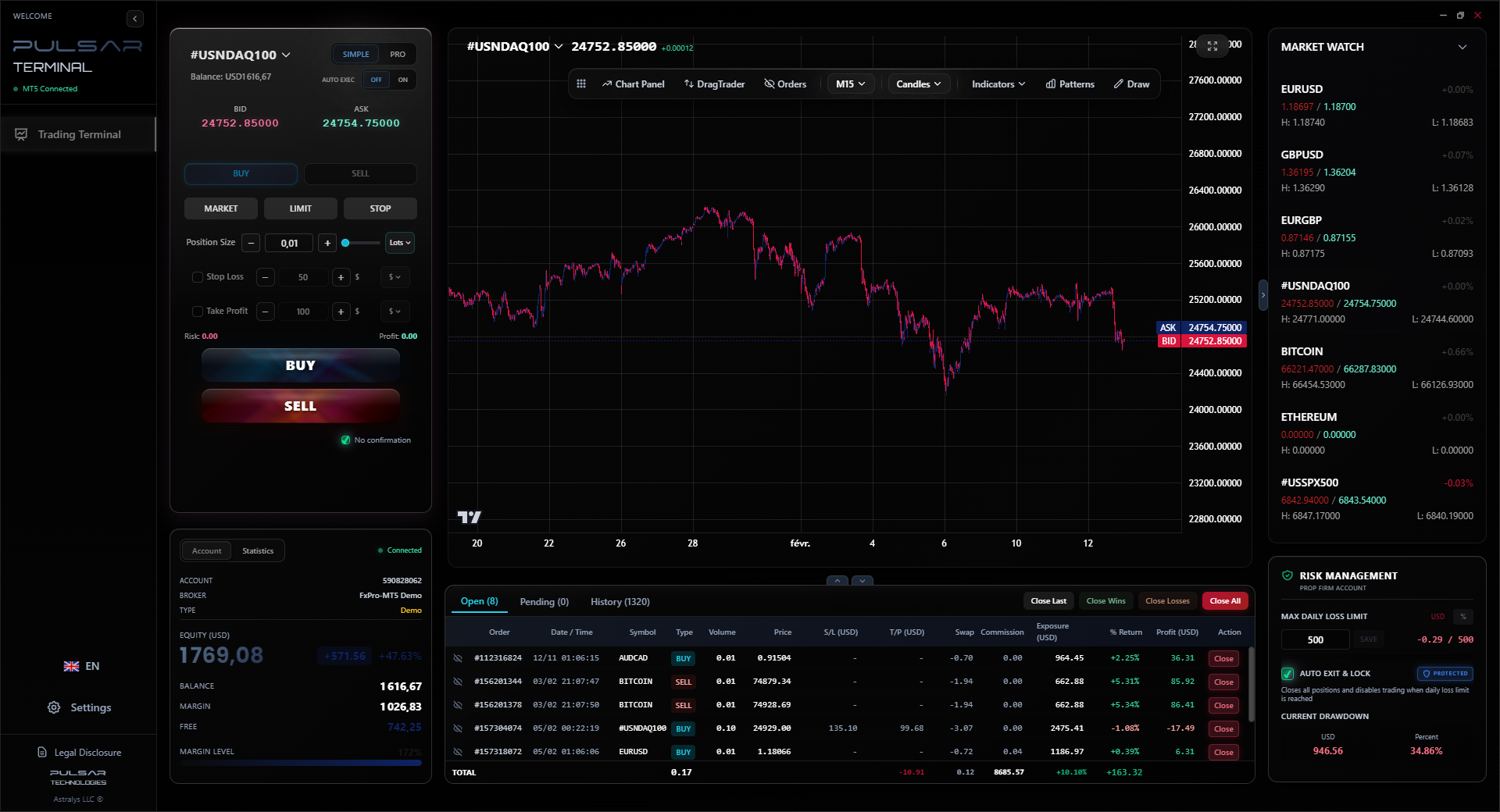
The right tools bundle all this – advanced charting, pattern recognition, and precise order management – into one clean interface that works on top of your MT5. They turn a confusing screen of lines into a clear, actionable forex trade picture.
Building a clear trade picture requires more than MT5's basic tools; Pulsar Terminal adds the Volume Profile, pattern recognition, and one-click order management you need to see the full story.
Pulsar Terminal
Lo strumento MT5 tutto-in-uno: ordini drag-and-drop, multi-TP/SL, trailing stop, grid trading, Volume Profile e protezione prop firm. Usato da oltre 1.000 trader ogni giorno.
“You pay 10% tax on your gross profits in Nigeria. That changes every calculation.”
Here's a forex trade picture nobody likes to look at: the tax man. In Nigeria, it's simple but brutal. You owe a 10% Capital Gains Tax on your gross profits. Not net. Gross.
Let's break that down with real numbers, because most traders get this wrong. Say in 2026, you make 100 trades.
- Total Winning Trades: ₦2,000,000 profit
- Total Losing Trades: ₦800,000 loss
- Net Profit: ₦1,200,000
You don't pay tax on the ₦1.2 million. You pay 10% on the ₦2,000,000. That's ₦200,000 in tax. Your actual take-home is now ₦1,200,000 - ₦200,000 = ₦1,000,000. Your effective tax rate on your net profit is nearly 17%.
This changes your entire risk calculus. That 'small' scalping strategy that generates 100 tiny wins and 80 tiny losses? The taxman feasts on it. You need a strategy with a higher win rate or larger risk-to-reward to offset this drag.
Warning: The FIRS can and does track transactions. Using a local broker or withdrawing profits to your Nigerian bank account creates a clear audit trail. Assume they will see it.
Your Trading Journal is Non-Negotiable This is your most important forex trade picture – the picture of you as a trader. Every single trade must be logged:
- Entry/Exit Price and Date
- Screenshot of the chart (your trade picture at the time)
- Reason for entry (e.g., 'Daily support + bullish engulfing on H1')
- Reason for exit
- Profit/Loss in Naira
- Broker statement confirmation
This journal isn't for bragging. It's for forensic analysis. Why did you miss that stop? Why did you exit early? Over time, you'll see the real patterns in your behavior. This is how you stop being a gambler reacting to charts and start being a trader reading pictures.
💡 Consiglio di Winston
In Nigeria, the 'smart money' often uses retail panic as fuel. When your trader WhatsApp group is unanimous, take the other side of the trade and thank them for their sacrifice.
“The picture guides your opportunity, but your risk management ensures you survive.”
So, you've got a clean chart from a good broker like Exness, you've done your multi-timeframe analysis, found a zone with confluence, and your risk is set at 1%. You have the perfect forex trade picture. Now what?
You execute. And then you do the hardest thing in trading: you leave it alone.
Your job after placing the trade is not to stare at the pips flicker. Your job is to manage the trade according to the plan you built from your picture. If you said you'd move to breakeven at +30 pips, you do it. If you said you'd take half off at the first resistance, you do it. The picture told a story of what should happen. Your job is to follow the script, not rewrite it mid-scene because you got greedy or scared.
Most Nigerian traders fail right here. They see a 10-pip profit and snatch it, afraid it'll disappear. Or they see a 20-pip loss and double down, turning a small loss into a margin call. They abandon the picture because of emotion.
The final truth about forex trade pictures is this: they are a probability tool, not a crystal ball. Even the most beautiful setup fails sometimes. That's why your position size calculator and stop loss are more important than your entry. The picture guides your opportunity, but your risk management ensures you survive to see the next one. In a market where the Naira can move 10% in a quarter, survival isn't a strategy, it's the only goal. Master the pictures, but worship your risk rules. That's how you build something that lasts.
FAQ
Q1Is forex trading legal in Nigeria, and how are profits taxed?
Yes, forex trading is legal for individuals in Nigeria. However, the key financial obligation is a 10% Capital Gains Tax on your GROSS trading profits, not your net profit. This means if you have ₦2 million in winning trades and ₦500,000 in losses, you pay tax on ₦2 million, not the ₦1.5 million net. Proper record-keeping is essential.
Q2What's the biggest mistake Nigerian traders make when looking at charts?
The most common and costly mistake is ignoring the higher timeframe trend. They'll see a buy signal on a 15-minute chart and jump in, while the daily chart is in a strong downtrend. This is like trying to swim against a tidal wave. Always start your analysis from the daily chart down to align your trades with the major market flow.
Q3How much money do I need to start seeing realistic 'trade pictures'?
While some brokers allow deposits as low as $5, you can't properly test strategies or manage risk with that. To realistically practice reading forex trade pictures and managing position size, start with at least $50-$100 (₦70,000 - ₦140,000 approx). This allows you to trade micro lots and experience real spreads and slippage without risking a life-changing amount.
Q4Why do my chart patterns often fail in the Nigerian market?
Patterns often fail due to low liquidity during off-peak hours (when major global markets are closed) and extreme volatility around local news (CBN announcements, inflation data). A pattern without confirming volume or one that forms against the overarching trend is likely to fail. Also, wide spreads from some brokers can turn a theoretically good setup into an unprofitable one.
Q5What tools do I need to improve my chart analysis?
Beyond basic candlestick charts, you need volume analysis tools (like Volume Profile) to see where real trading activity is, reliable pattern recognition software, and precise order management tools for setting multiple take-profits and trailing stops. These help you build a more complete and actionable trade picture than MT4/5 offers by default.
Q6How do I handle the extreme volatility of the Naira in my analysis?
First, acknowledge it and respect it. Use wider stop losses on Naira pairs to avoid being stopped out by normal noise. Focus more on market structure (key support/resistance) and less on short-term indicator signals. Also, consider trading during overlapping London/New York sessions for better liquidity, which can smooth out some of the wildest swings.
Q7Can I rely on trading signals from groups instead of reading charts myself?
Absolutely not. This is a fast track to losing money. By the time a signal reaches a group, the move is often over. You have no understanding of the risk or the 'picture' behind the trade. You're blindly following someone else's stop loss and target with no exit plan. Learning to read charts yourself is the only sustainable path.
Lezione del Prof. Winston
Punti chiave:
- ✓Always analyze from Daily chart down
- ✓Risk maximum 2% per trade
- ✓10% tax is on GROSS profits
- ✓Confluence beats a single indicator
Quanto è stato utile questo articolo?
Clicca su una stella
Analisi Trading Settimanali
Analisi e strategie settimanali gratuite. Nessuno spam.
Sull'autore
Olumide Adeyemi
Pioniere del Trading in Africa Occidentale
Uno degli educatori di trading forex più attivi in Nigeria. 8 anni di esperienza di trading da Lagos. Specializzato in strategie a basso capitale e sfide prop firm per trader africani.
Commenti
Avviso di rischio
Il trading di strumenti finanziari comporta rischi significativi e potrebbe non essere adatto a tutti gli investitori. Le performance passate non garantiscono risultati futuri. Questo contenuto è fornito solo a scopo educativo e non deve essere considerato un consiglio di investimento. Conduci sempre le tue ricerche prima di fare trading.
Potrebbe interessarti anche

Cara Trading Forex Sukses: 7 Prinsip dari Trader Profesional
Cara trading forex sukses dengan 7 prinsip trader pro: manajemen modal, disiplin, journal trading, backtest. Data nyata, bukan janji profit palsu.
Jam Trading Forex Terbaik untuk Trader Indonesia: Panduan Lengkap dengan Tabel Waktu
Panduan jam trading forex untuk trader Indonesia. Tabel 4 sesi dunia, jam emas 20:00-00:00, sesi mana yang harus dihindari. Data akurat + tips dari trader berpengalaman.
Top 5 Sàn Forex Uy Tín Nhất 2026: Review Jujur dari Trader Indonesia
Top 5 sàn forex uy tín 2026 untuk trader Indonesia. Review jujur: spread, deposit, withdraw, dukungan lokal. Exness, XM, IC Markets & lebih.
Scarica Pulsar Terminal
Tutti questi calcolatori sono integrati in Pulsar Terminal con dati in tempo reale dal tuo conto MT5.
Scarica Pulsar Terminal