


Let's be brutally honest: most people in South Africa who 'trade forex' are just playing a very expensive video game.

David van der Merwe
Trader dei Mercati Emergenti ·  South Africa
☕ 8 min di lettura
Cosa imparerai:

Let's be brutally honest: most people in South Africa who 'trade forex' are just playing a very expensive video game. They're chasing adrenaline, not alpha. They treat their trading platform like a slot machine, hoping for that one big win to solve everything. I did it too, back in the day. I'm here to tell you that if you want to make real money, you have to quit the game. This isn't about fun; it's about building a cold, calculated, and consistently profitable business. I'll show you how the game is rigged against you, and more importantly, how you can rig it in your favour.
Brokers and social media gurus have perfected the art of turning trading into entertainment. It's all flashing lights, instant execution, and the promise of life-changing money from your couch. The psychological hooks are identical to gambling: variable rewards (you never know which trade will win), the 'near-miss' effect (stopped out by 1 pip), and the illusion of control (thinking your fancy indicator gives you an edge).
In South Africa, with our high unemployment and economic pressure, this fantasy is especially potent. The dream of replacing a salary with a few clicks is incredibly seductive. I fell for it. I remember blowing my first R5,000 account in two days because I was 'in the zone,' trading USD/ZAR like it was a rugby match. I wasn't analyzing; I was reacting. That's not trading. That's playing a game where the house - the broker via the spread - always wins in the long run.
The platform design encourages this. One-click trading, loud order execution sounds, profit/loss figures that update in real-time with bright green and red colours. It's designed to keep you engaged and emotionally invested. Your job is to recognise this theatre for what it is and change the entire production.
“Most people in South Africa who 'trade forex' are just playing a very expensive video game.”
Forget the fantasy. Let's talk about the real Rands and cents. This isn't just about your deposit.
The Obvious Costs
Your broker isn't a charity. They make money from spreads, commissions, and sometimes overnight financing (swap rates). On the USD/ZAR pair, a spread of 80-120 pips is common with standard accounts. That means the price has to move 80 pips just for you to break even on a round-turn trade. Use a position size calculator to see the brutal maths: on a R10,000 account with a 2% risk, a 100-pip stop-loss means you can only trade 0.02 lots. Your potential profit on a 200-pip win? Maybe R400 before costs. Hardly a Lamborghini.
The Hidden Tax: Currency Conversion
This one kills more South African traders than they realise. Your account is in USD, but your bank account is in ZAR. When you deposit, you lose on the bank's awful exchange rate and fees. When you withdraw profits, you lose again. I've seen traders make a 10% return in USD, only to see it become 7% after conversion and fees hit their FNB or Standard Bank account. It's a silent leak in your profit bucket.

Warning: Trading international pairs like EUR/USD with a ZAR-based income is a double currency bet. You're betting on the forex pair AND the USD/ZAR rate. If the Rand strengthens when you withdraw, your profits shrink.

💡 Consiglio di Winston
Your first R10,000 in the market is tuition, not capital. Expect to lose it while learning. If that thought terrifies you, you're not ready.
“Your most important tool is price action. Your second is your trading journal.”
This is the single most important shift. You are not a player. You are the CEO, risk manager, and analyst of a one-person financial firm.
Your New Daily Routine:
- Market Analysis (Before 9 AM SAST): Review what happened in the Asian and late US sessions. Look at the economic calendar. No charts yet. Just facts.
- Planning: Based on your swing trading or scalping strategy, define your key levels for the day. Where is support/resistance? Where will you look for entries? WRITE THIS DOWN.
- Execution: Place your orders with stops and limits. Then, walk away. Do not sit and watch the screen. You've done your job. Let the market do its job.
- Review (After 5 PM SAST): Journal every trade. Why did you take it? Did it follow your plan? What was the outcome? Not P&L, but process.
I forced myself to do this for a month. The first week was agony - I felt like I was missing out. But my results improved because I was no longer making impulsive, game-like decisions. My biggest win that month came from a gold (XAU/USD) trade I planned the night before, entered at $1812.50, and didn't look at again until my take-profit at $1835.00 hit while I was having lunch.
“Your most important tool is price action. Your second is your trading journal.”
Indicators are not cheat codes. Most are lagging, and using too many creates paralysis. I used to have a chart with 12 different indicators - it looked like a spaceship dashboard and was just as useful.
Stick to the classics and understand what they actually tell you:
- Moving Averages: Trend direction and dynamic support/resistance. Nothing more.
- RSI Indicator: Measures momentum and potential overbought/oversold conditions in a ranging market. It's useless in a strong trend.
- MACD Indicator: Trend momentum and potential crossovers. Good for confirmation, not prediction.
Your most important tool is price action. Learn to read candlestick patterns and market structure (higher highs, lower lows). Support and resistance levels are more valuable than any oscillator. Draw them on your chart and respect them. The second most important tool is your trading journal - a simple spreadsheet is fine. Track your trades, your emotional state, and your adherence to your plan. This is your business ledger.
💡 Consiglio di Winston
The most profitable trade you'll ever make is walking away from the screen after placing your orders. Screen-watching is the enemy of discipline.

“I triggered my own margin call. That was the day I stopped being a gamer.”
You need a broker that facilitates your business, not one that encourages gaming. Regulation is non-negotiable. The FSCA (Financial Sector Conduct Authority) is our local regulator, but many international brokers also serve SA clients under other reputable jurisdictions (ASIC, CySEC, FCA).
What to look for (and avoid):
| Feature | What Gamers Want | What Traders Need |
|---|---|---|
| Account Types | "Cent" accounts, Bonuses | Raw spread/ECN accounts, No bonus nonsense |
| Platform | Fancy one-click gadgets | Reliable execution, low latency |
| Marketing | "Get rich quick", Lambos | Transparent pricing, educational resources |
I've used many. The ones that suited a serious approach were brokers like Pepperstone and IC Markets for their Razor/RAW spreads. For beginners, XM offers a decent balance with good education. Be wary of local bucket shops promising the moon - if their office looks flashier than a Sandton casino, their priorities are wrong.

Pro Tip: Always test a broker with a small deposit first. Check their slippage during news events (like SARB interest rate announcements) and their withdrawal process. A smooth, fast withdrawal is the hallmark of a legitimate operation.
“I triggered my own margin call. That was the day I stopped being a gamer.”
Analysis gives you an edge. Risk management keeps you in the game. This is where 90% of 'gamers' fail spectacularly.
The Non-Negotiable Rules:
- Never risk more than 1-2% of your capital on a single trade. On a R20,000 account, that's R200-R400 max risk. This means your stop-loss distance and position size are calculated together. Use a calculator.
- Use a stop-loss on EVERY trade. No exceptions. Not a mental stop. A physical order in the market. This is your fire escape.
- Have a profit target (take-profit) before you enter. Know your reward-to-risk ratio. Aim for at least 1:1.5. If your stop is 50 pips away, your target should be 75 pips away.
I learned this the hard way. In 2016, I had a great run on EUR/GBP. Got greedy. Put on a huge position without a stop, convinced I was right. A surprise Brexit headline vaporised 40% of my account in minutes. I triggered my own margin call. That was the day I stopped being a gamer. The loss wasn't the worst part; the complete loss of control was.
💡 Consiglio di Winston
If you can't explain your trade setup in one simple sentence (e.g., 'buying pullback to weekly support after hawkish SARB speech'), it's too complicated and likely to fail.
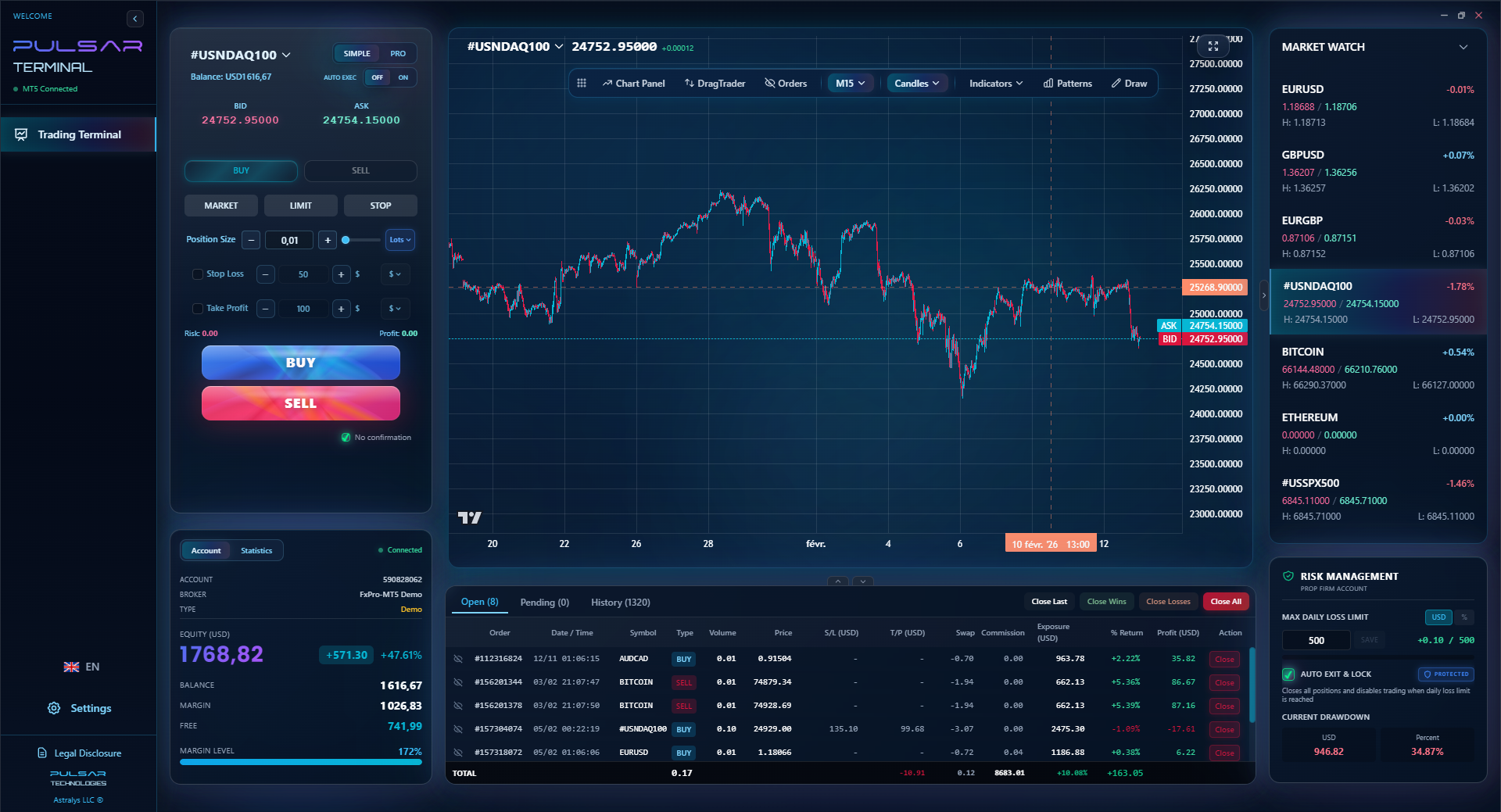
Sticking to strict risk rules like a 2% stop-loss is manual and emotional; Pulsar Terminal automates this by letting you set and forget your risk parameters directly on your MT5 charts.
Pulsar Terminal
Lo strumento MT5 tutto-in-uno: ordini drag-and-drop, multi-TP/SL, trailing stop, grid trading, Volume Profile e protezione prop firm. Usato da oltre 1.000 trader ogni giorno.
“An edge is a slight, statistical advantage over many trades. It's not a secret signal.”
An edge is a slight, statistical advantage over many trades. It's not a secret signal. It's a repeatable process.
A simple, boring edge for South Africans: Focus on the USD/ZAR and EUR/ZAR. You live here. You understand the local news, political tension, and load-shedding's impact better than any hedge fund in London. Combine this fundamental sense with a simple technical edge.
Example Process:
- SARB is hawkish, hinting at rate hikes. Rand is strengthening fundamentally.
- Technically, USD/ZAR is testing a major weekly support level that has held three times before.
- Wait for a clear price action rejection candle (like a bullish engulfing) at that support.
- Enter long with a stop below the weekly low, targeting the previous swing high.
- Your edge? You combined a fundamental bias (SARB) with a proven technical reaction at a key level. You're not predicting; you're reacting to a higher-probability setup.
Backtest this. Journal it. See if over 20 trades, you are profitable. That's how you find an edge. Not by buying a "100% win rate system" from a guy on Instagram.

FAQ
Q1Is forex trading legal in South Africa?
Yes, absolutely. It's regulated by the Financial Sector Conduct Authority (FSCA). However, you must use a broker that is authorised to offer services to South African residents, either through a local FSCA license or a recognised foreign one. Trading with an unregulated offshore broker is legal but offers you zero protection.
Q2How much money do I need to start forex trading in South Africa?
Technically, you can start with a few hundred Rands on a micro or cent account. Practically, if you want to treat it seriously and survive the learning curve, I'd say no less than R10,000. This allows for proper position sizing and emotional breathing room. Starting with R500 is a surefire way to blow up and learn nothing.
Q3What is the best time to trade forex in South Africa?
The most liquid overlaps are 10:00 AM - 12:00 PM SAST (when London opens) and 4:00 PM - 6:00 PM SAST (when London and New York overlap). This is when spreads are tightest and moves can be strongest. Trading the USD/ZAR is naturally most active during the Johannesburg business day.
Q4Do I pay tax on forex trading profits in South Africa?
Yes. The South African Revenue Service (SARS) views trading profits as income if you're seen as a frequent trader (running a business). It's subject to your marginal income tax rate. If you trade infrequently, it might be considered capital gains. Keep careful records and consult a tax professional. Ignoring this is asking for trouble.
Q5Can I pass a prop firm challenge from South Africa?
Yes, many international prop firms accept South African traders. The key is their strict risk rules. You need iron-clad discipline, far beyond what a 'gamer' has. The daily loss limits force you to use tight stops and perfect risk management from day one.
Q6Why do 90% of forex traders in South Africa fail?
They treat it as a game or a get-rich-quick scheme. They don't have a business plan, they ignore risk management, they chase losses, and they let emotions drive decisions. They're playing, not working. The market ruthlessly exploits this lack of discipline.
Lezione del Prof. Winston
Punti chiave:
- ✓Risk a maximum of 2% per trade. No exceptions.
- ✓USD/ZAR spreads of 80+ pips demand larger moves to profit.
- ✓Currency conversion fees can slash 30% off your real returns.
- ✓A simple 1:1.5 reward-to-risk ratio builds profits over time.
- ✓Your first R10k is tuition. Plan to learn, not to earn.
Quanto è stato utile questo articolo?
Clicca su una stella
Analisi Trading Settimanali
Analisi e strategie settimanali gratuite. Nessuno spam.
Sull'autore
David van der Merwe
Trader dei Mercati Emergenti
Trader con base a Johannesburg con 11 anni di esperienza nelle valute dei mercati emergenti. Specializzato in coppie ZAR, trading regolamentato dalla FSCA e analisi del mercato sudafricano.
Commenti
Avviso di rischio
Il trading di strumenti finanziari comporta rischi significativi e potrebbe non essere adatto a tutti gli investitori. Le performance passate non garantiscono risultati futuri. Questo contenuto è fornito solo a scopo educativo e non deve essere considerato un consiglio di investimento. Conduci sempre le tue ricerche prima di fare trading.
Potrebbe interessarti anche

Cara Trading Forex Sukses: 7 Prinsip dari Trader Profesional
Cara trading forex sukses dengan 7 prinsip trader pro: manajemen modal, disiplin, journal trading, backtest. Data nyata, bukan janji profit palsu.
Jam Trading Forex Terbaik untuk Trader Indonesia: Panduan Lengkap dengan Tabel Waktu
Panduan jam trading forex untuk trader Indonesia. Tabel 4 sesi dunia, jam emas 20:00-00:00, sesi mana yang harus dihindari. Data akurat + tips dari trader berpengalaman.
Top 5 Sàn Forex Uy Tín Nhất 2026: Review Jujur dari Trader Indonesia
Top 5 sàn forex uy tín 2026 untuk trader Indonesia. Review jujur: spread, deposit, withdraw, dukungan lokal. Exness, XM, IC Markets & lebih.
Scarica Pulsar Terminal
Tutti questi calcolatori sono integrati in Pulsar Terminal con dati in tempo reale dal tuo conto MT5.
Scarica Pulsar Terminal