


I was short EUR/USD at 1.0950 when the Swiss National Bank dropped its bombshell in January 2015.

Olumide Adeyemi
Pioniere del Trading in Africa Occidentale ·  Nigeria
☕ 12 min di lettura
Cosa imparerai:
- 1The Nigerian Reality Check: It's Legal, But It's Messy
- 2Picking Your Global Broker: Regulation Trumps Everything
- 3Costs: The Real Numbers That Eat Your Profits
- 4Trading the Global Session: Lagos Time vs. World Time
- 5Strategy Adaptation: What Actually Works From Here
- 6Risk Management: The Non-Negotiable Pillar
- 7The Future and Your Edge
I was short EUR/USD at 1.0950 when the Swiss National Bank dropped its bombshell in January 2015. The pair spiked 400 pips in minutes. My stop-loss got hit, my margin call alarm screamed, and I lost 3% of my account before I could blink. That's your first lesson in forex trading global: the world doesn't care about your analysis. Events in Zurich, Tokyo, or London will rip through your screen in Lagos. Trading from Nigeria means you're playing in the biggest, most chaotic casino on earth, with rules written by everyone but you. Let's talk about how to survive it.
First things first: yes, you can trade forex from Nigeria. No, the government isn't about to kick your door down. But let's be clear about what 'legal' actually means here. It means you're on your own.
The Central Bank of Nigeria (CBN) and the Securities and Exchange Commission (SEC) are the main players. The CBN's job is to protect the Naira, not your trading account. Their 2025 Foreign Exchange Code? That's for the big banks and authorized dealers in the wholesale market. You, the retail trader, are operating in what local authorities have politely called a 'poorly regulated' space. That's a fancy way of saying it's the wild west.
Here's the practical headache: funding your account. The CBN blocks you from using the official FX window (the cheaper rate) for trading. Your Nigerian debit card? Many banks have suspended international transactions for this exact purpose. You'll likely be funding your broker via crypto or a payment processor, which adds another layer of cost and complexity.

Warning: That 'poorly regulated' label is a double-edged sword. It allows international brokers to offer Nigerians crazy use (I've seen 1:2000). It also means scam platforms flourish. If a 'broker' promises guaranteed returns or is based in some island you've never heard of, run.
The market is exploding, though. Turnover hit $8.6 billion in 2025. There are an estimated 300,000 of us retail traders, and get this, 93.7% are between 18 and 35. We're a young, hungry market. But growth doesn't equal safety. Your first job is navigating this local chaos before you even think about the EUR/USD guide.

💡 Consiglio di Winston
Your first profit target should always be to preserve your capital. Making money comes second.
Forget fancy platforms and bonus offers. The single most important line on a broker's website is their regulatory license number. This is non-negotiable.
The Regulatory Hierarchy
You want a broker regulated by a top-tier authority. Why? Because when things go wrong (and they do), you want someone with power to complain to. Here’s the pecking order:
- UK (FCA), EU (CySEC), Australia (ASIC): The gold standard. Strong client money protection rules. use is capped lower (1:30 for major pairs), which is actually a good thing. It stops you from blowing up your account in one trade.
- South Africa (FSCA), Mauritius (FSC): Solid middle-ground. Often better use options while maintaining a decent regulatory framework.
- Offshore (SVG, Vanuatu, Cayman Islands): The wild west. High use, low barriers. This is where many 'bucket shops' operate. Tread very carefully.
Most Nigerians use international brokers because the local, CBN-authorized options are limited. I've had accounts with several over the years.
My Experience: I started with an offshore broker offering 1:500 use. I turned $1,000 into $5,000 in two months scalping gold. I felt like a genius. Then, on a major news day, my platform 'froze' during a volatile spike. By the time it came back, my position was liquidated. I couldn't prove it was a deliberate 'requote' or slippage, and with their offshore regulator, I had zero recourse. I lost the entire $5,000. That lesson cost me five grand.
Now, I only use brokers with FCA or ASIC regulation, even with the lower use. Brokers like IC Markets (ASIC) and Pepperstone (FCA/ASIC) are popular here for a reason. They're reliable. Exness is also widely used, but pay close attention to which entity of theirs you're signing up with (their Cypriot vs. Seychelles entity, for example).

Pro Tip: When you visit a broker's site, it will often auto-direct you to their 'global' or offshore entity. You may need to manually find and select their UK or Australian site to open an account under that stricter regulation. It's worth the extra clicks.
“Trading from Nigeria means you're playing in the biggest, most chaotic casino on earth, with rules written by everyone but you.”
Let's talk money. Not the money you make, the money you lose before you even start. The spread isn't just a number; it's a tax on every single trade you take.
In Nigeria, you can get decent pricing. The average EUR/USD spread is around 0.22 pips on a good day with a major broker. But you have two main account types:
| Account Type | Typical EUR/USD Spread | Commission | Best For... |
|---|---|---|---|
| Standard (Commission-Free) | 0.6 - 1.2 pips | $0 | Beginners, longer-term swing trading where spread impact is lower. |
| Raw Spread / ECN | 0.0 - 0.2 pips | $3 - $7 per lot (round turn) | High-volume traders, scalping strategy, where tight spreads are critical. |
Here's the math that matters. On a standard account with a 1 pip spread, you're down $10 on a standard lot (100k units) the moment you click 'Buy'. You need the market to move 1 pip in your favor just to break even. On an ECN account with a 0.1 pip spread and a $3.50 commission, your initial cost is $3.50 + $1 = $4.50. Cheaper, but only if you're trading size.
My Mistake: I used a standard account for scalping. I'd aim for 5-10 pip profits. That 1 pip spread was eating 10-20% of my target profit on every single trade. I was fighting a war with a huge handicap. Switching to a raw spread account was like taking a weight off my back.
Then there's the Nigerian tax man. The Federal Inland Revenue Service (FIRS) wants its cut. Profits are subject to Capital Gains Tax at 10%. If you're trading full-time, it's considered business income. Keep a detailed trade journal. Not just for your sanity, but for when the tax office comes knocking.
Don't forget funding costs. Converting Naira to USD via crypto or a payment gateway often comes with a 1-3% fee. That's another silent profit killer. Always use a position size calculator that includes spread and commission in your risk calculation. If you don't, you're lying to yourself.
Your body is in Lagos, but your trades live in London, New York, and Tokyo. Session overlap is where the magic (and the danger) happens.
London Session (8 AM - 5 PM GMT): This is 9 AM - 6 PM Nigerian time. The big boy session. Over 30% of all global forex volume happens here. The moves are strong, trends develop. This is your best window for action.
London-New York Overlap (1 PM - 5 PM GMT): This is 2 PM - 6 PM Nigerian time. The most volatile period of the day. Two financial giants are both open. This is when major economic data (US CPI, NFP) drops. It's where I've made my biggest wins and taken my worst losses. Liquidity is high, but so is the chance of getting whipped around.
New York Session (1 PM - 10 PM GMT): Starts when you're likely having lunch (2 PM Nigeria). It can continue the London trend or reverse it. Good volume early on, but it can get thin and weird after the European close (5 PM GMT).
Asian Session (11 PM - 8 AM GMT): This is midnight to 9 AM in Nigeria. Generally the quietest session. Ranges are tighter. Pairs like AUD/USD and NZD/USD can see action due to data from Sydney and Wellington. If you're a night owl or an early riser, you can practice your scalping strategy here in a lower-risk environment.
Personal Pattern: I'm not a night trader. I focus purely on the London open and the London-NY overlap. I'm fresh, the market is active, and I can be done by late afternoon. Trying to trade the New York close at 10 PM GMT (11 PM Nigeria) when I'm tired was a recipe for revenge trading and stupid mistakes. Know your own circadian rhythm and trade the session that matches it.

Example: Trading GBP/USD during the Asian session might see a 30-pip range. During the London-NY overlap, that same pair can easily move 80-100 pips in an hour. Different tools for different times.
💡 Consiglio di Winston
If you can't explain your trade setup in one simple sentence, you don't understand it well enough to risk money on it.
“High use is the fastest way to destroy an account. Focus on learning to trade, not on amplifying your mistakes.”
Forget copying YouTube gurus from the US or UK. Your environment is different. Your internet might flicker. Your power might go out. Your broker's server might be 8,000 miles away. Your strategy needs armor.
1. Favor Swing Trading Over Hyper-Scalping: This is my biggest piece of advice. A swing trading approach, holding trades for days or weeks, is more forgiving of connectivity issues and allows you to capture larger global macro moves. You're not glued to the screen every second. The spread cost becomes negligible. I made 420 pips on a USD/JPY swing trade in 2022 by simply identifying a weekly trend and riding it. No stress, just patience.
2. If You Scalp, Go Raw and strong: If you must scalp, you need a rock-solid internet connection (consider a backup LTE modem) and a raw spread account. Your strategy must account for higher potential slippage. Use limit orders instead of market orders whenever possible. I used to scalp the XAU/USD guide (gold) during London hours. A 5-pip stop-loss is suicide. I learned to use a 15-pip stop and aim for 25-30 pip targets, giving the trade room to breathe.
3. Master One or Two Pairs: The global forex market has dozens of pairs. Don't trade them all. The EUR/USD guide and GBP/USD have the tightest spreads and highest liquidity, which is crucial when you're far from the financial centers. Learn their personality. Know when European or US data will move them.
4. Keep It Simple Stupid (KISS): Complicated strategies with 10 indicators will fail you when you need them most. I rely on price action, support/resistance, and maybe one or two indicators like the RSI indicator for divergence or the MACD indicator for trend confirmation. A clean chart is a clear mind.
Managing a trade from Lagos requires extra discipline. Setting a stop-loss isn't a suggestion; it's a lifeline. A trailing stop can lock in profits while you sleep. Knowing your exact pip definition risk before entering is how you stay in the game.
This is the section where most Nigerian traders fail spectacularly. The lure of high use makes you feel powerful. It's a trap.
use is a Loan, Not a Gift: That 1:500 use means with $200, you can control a $100,000 position. A 1% move against you wipes out your entire $200. That's not trading; it's gambling with a fancy name. I stick to 1:30 or 1:50 max, even if my broker offers more. It forces me to be selective with my trades.
The 1% Rule: Never, ever risk more than 1% of your account balance on a single trade. If you have a $1,000 account, your maximum loss per trade is $10. Use your stop-loss distance and a position size calculator to figure out the lot size that keeps you at that 1% risk. This one rule alone will prevent account blow-ups.
The Margin Call Monster: A margin call happens when your losses eat up your usable margin. Your broker starts closing your positions to protect their money. It's a death knell. The way to avoid it is simple: use low use and wide stops relative to your position size. If you're constantly getting margin calls, your position size is too big. Full stop.
Emotional Risk: This is the hidden cost. The frustration of a losing streak, the euphoria of a win, the temptation to 'get back' your money. The best tool for this is a trading plan. Write down your rules for entry, exit, and daily loss limits. When emotions run high, follow the plan. It's harder than it sounds.
My most humbling moment was in early 2020. I had a series of wins and got cocky. I broke my 1% rule and risked 5% on a crude oil trade. The market gapped down overnight due to news I wasn't monitoring. I woke up to a 15% account loss and a margin call on my other positions. It took me three months of disciplined, small trades to dig out of that hole. The market taught me respect the hard way.
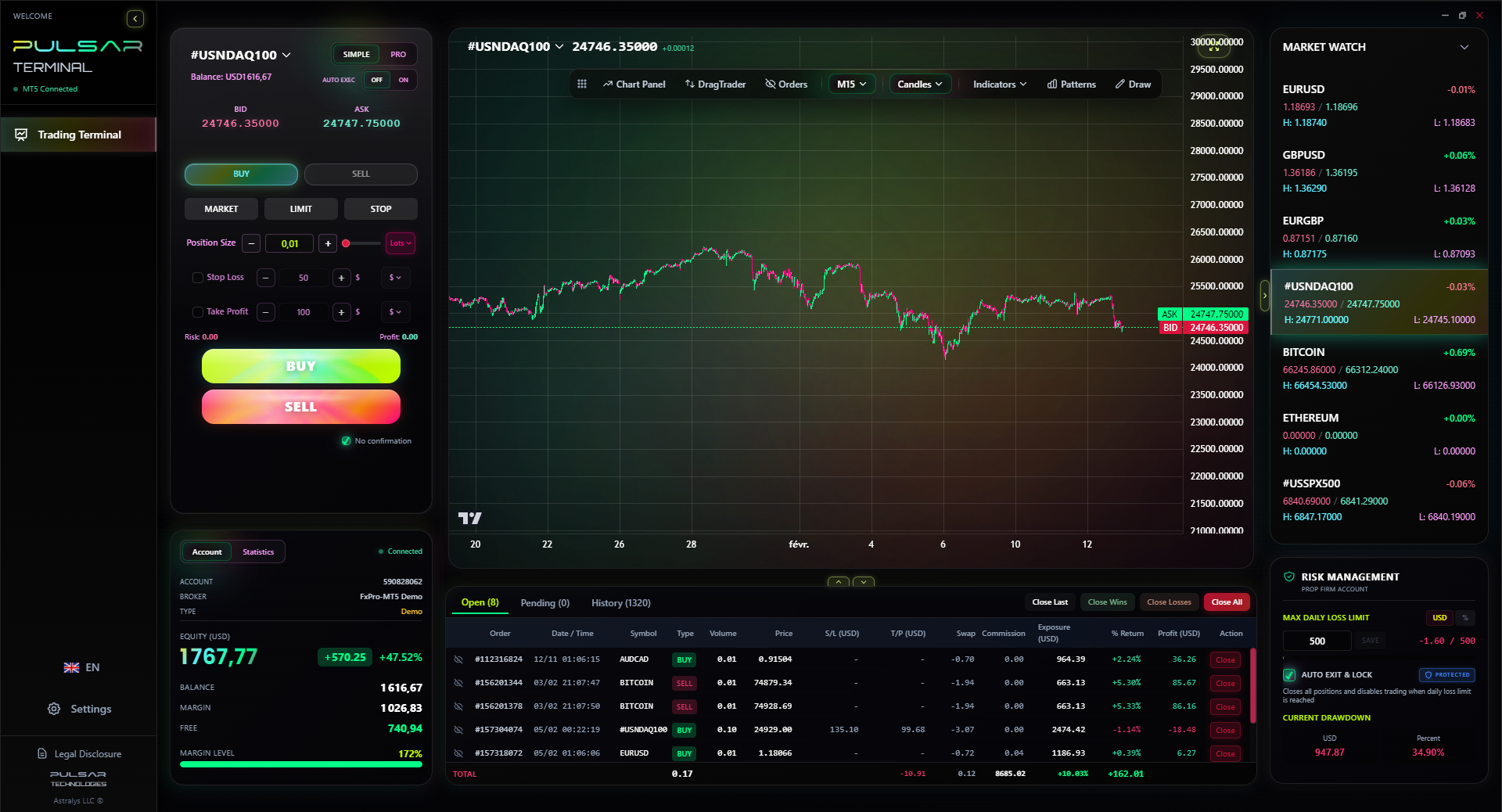
Sticking to a strict daily loss limit is critical for survival, and Pulsar Terminal's prop firm daily loss protection feature automates this, cutting all trades if your loss hits a preset threshold.
Pulsar Terminal
Lo strumento MT5 tutto-in-uno: ordini drag-and-drop, multi-TP/SL, trailing stop, grid trading, Volume Profile e protezione prop firm. Usato da oltre 1.000 trader ogni giorno.
“Your edge as a Nigerian trader is your perspective on emerging market fundamentals, not a secret indicator.”
Where is all this going? The Nigeria forex trading global scene is maturing, fast. The CBN's 2025 code is a step towards more structure. Daily FX turnover is now over $430 million. This growth attracts better brokers and better technology.
Your edge as a Nigerian trader isn't some secret indicator. It's your perspective. You live in a major emerging market. You feel the impact of oil prices, USD shortages, and CBN policy on the Naira firsthand. That's macro insight someone in Ohio will never have. Understand how these local fundamentals feed into pairs like USD/NGN (if you can access it) or commodity currencies like CAD and AUD.
Technology is your equalizer. With a laptop and a decent connection, you have the same charts as a hedge fund in London. Use that power to educate yourself, not just to place trades. Backtest strategies. Keep a journal. Analyze your mistakes.
The community is growing. Connect with other serious traders. Share knowledge on risk management, not just signal chasing. The 300,000 of us can build a more informed, resilient trading culture.
Forex trading global from Nigeria is a marathon, not a sprint. It's a brutal, rewarding test of discipline. Manage your risks, choose your brokers wisely, trade the sessions that suit your life, and never stop learning. The market will always be there tomorrow. Your job is to make sure your account is too.
💡 Consiglio di Winston
The market's job is to find the most efficient way to prove you wrong. Your job is to have a plan for when it does.
FAQ
Q1Is forex trading legal and safe in Nigeria?
It's legal for individuals, but the retail space is poorly regulated. 'Safe' depends entirely on you. Using internationally regulated brokers (FCA, ASIC) is the closest you get to safety. Avoid unregulated offshore platforms promising easy money.
Q2How do I fund my international forex trading account from Nigeria?
It's a challenge. Direct bank card deposits are often blocked. The most common methods now are through cryptocurrency transfers (like USDT) or third-party payment processors that specialize in FX for Nigerians. Expect fees of 1-3%.
Q3What is the best time of day to trade forex in Nigeria?
The London session (9 AM - 6 PM Nigerian time) and the London-New York overlap (2 PM - 6 PM) offer the highest liquidity and best trading opportunities. The Asian session (midnight - 9 AM) is quieter and less ideal for active strategies.
Q4How much money do I need to start forex trading in Nigeria?
You can start with as little as $50-$100 with some brokers. However, I strongly advise starting with at least $500-$1000. This allows for proper position sizing and risk management (the 1% rule) without being wiped out by a couple of bad trades or the spread.
Q5Do I pay tax on my forex trading profits in Nigeria?
Yes. Profits are generally subject to Capital Gains Tax (CGT) at a rate of 10%, payable to the FIRS. If trading is your primary business, it's considered taxable income. Keep detailed records of all your trades for tax purposes.
Q6What use should I use as a beginner in Nigeria?
Use the lowest use you can. Even if your broker offers 1:1000, start with 1:10 or 1:20. High use is the fastest way to destroy an account. Focus on learning to trade, not on amplifying your mistakes.
Q7Can I trade the Naira (NGN) on forex platforms?
Generally, no. The Naira is not a freely convertible currency on the global retail forex market. You might find USD/NGN as a CFD with some international brokers, but liquidity is low and spreads are very wide. It's not a recommended pair for beginners.
Lezione del Prof. Winston
Punti chiave:
- ✓Regulation is your first line of defense. Never trade with an unlicensed broker.
- ✓Risk a maximum of 1% of your account per trade. No exceptions.
- ✓Trade the London session (9 AM - 6 PM WAT) for the best liquidity.
- ✓Use use below 1:50, even if more is offered.
- ✓Swing trading is more forgiving of local infrastructure challenges than scalping.
Quanto è stato utile questo articolo?
Clicca su una stella
Analisi Trading Settimanali
Analisi e strategie settimanali gratuite. Nessuno spam.
Sull'autore
Olumide Adeyemi
Pioniere del Trading in Africa Occidentale
Uno degli educatori di trading forex più attivi in Nigeria. 8 anni di esperienza di trading da Lagos. Specializzato in strategie a basso capitale e sfide prop firm per trader africani.
Commenti
Avviso di rischio
Il trading di strumenti finanziari comporta rischi significativi e potrebbe non essere adatto a tutti gli investitori. Le performance passate non garantiscono risultati futuri. Questo contenuto è fornito solo a scopo educativo e non deve essere considerato un consiglio di investimento. Conduci sempre le tue ricerche prima di fare trading.
Potrebbe interessarti anche

Cara Trading Forex Sukses: 7 Prinsip dari Trader Profesional
Cara trading forex sukses dengan 7 prinsip trader pro: manajemen modal, disiplin, journal trading, backtest. Data nyata, bukan janji profit palsu.
Jam Trading Forex Terbaik untuk Trader Indonesia: Panduan Lengkap dengan Tabel Waktu
Panduan jam trading forex untuk trader Indonesia. Tabel 4 sesi dunia, jam emas 20:00-00:00, sesi mana yang harus dihindari. Data akurat + tips dari trader berpengalaman.
Top 5 Sàn Forex Uy Tín Nhất 2026: Review Jujur dari Trader Indonesia
Top 5 sàn forex uy tín 2026 untuk trader Indonesia. Review jujur: spread, deposit, withdraw, dukungan lokal. Exness, XM, IC Markets & lebih.
Scarica Pulsar Terminal
Tutti questi calcolatori sono integrati in Pulsar Terminal con dati in tempo reale dal tuo conto MT5.
Scarica Pulsar Terminal