


Here's a statistic that should make you pause: the average retail trader loses money.
James Mitchell
Analista Trading Senior
☕ 10 min di lettura
Cosa imparerai:
- 1What Exactly Are You Paying For?
- 2Free vs. Paid: Is the Juice Worth the Squeeze?
- 3Spotting a Scam: The Unforgivable Red Flags
- 4The Mentor's Method: Using a Newsletter as a Tool, Not a Crutch
- 5Where to Get Real Insight (Without the Bill)
- 6The Endgame: From Consumer to Creator
- 7The Bottom Line: Should You Subscribe?

Here's a statistic that should make you pause: the average retail trader loses money. Yet, the forex 'guru' industry selling signals and newsletters is worth billions. I've subscribed to newsletters costing from $0 to $497 a month. The most expensive one was, ironically, the one that nearly blew up my account following its 'high-conviction' EUR/USD call. Let's cut through the marketing and look at what a forex trading newsletter actually is, what it can (and absolutely cannot) do for you, and how to separate the rare useful insight from the expensive noise.
A forex trading newsletter isn't one thing. It's a format that delivers information, and the value is entirely in the content type. Most fall into three buckets, and understanding this is your first line of defense.
The Signal Service
This is the most common offering, especially from flashy Instagram traders. You get an email or SMS with an entry price, stop loss, and take profit for a currency pair. The promise is passive income. The reality is you have zero context on the market structure, the trader's reasoning, or their risk management. You're blindly following a stranger's order. I tried one in 2019 that sent 3-5 signals daily. The win rate looked good on paper, but the risk-to-reward was awful - often going for 10 pips profit with a 30-pip stop. You'd win three trades to lose one and still be down. It's a great way to pay for the privilege of getting a margin call.
The Analysis Digest
This is where some real value can hide. Instead of signals, you get a written breakdown of market drivers: central bank commentary, economic data forecasts, technical levels on major pairs. A good one teaches you how to think. They might say, 'The Fed is hawkish, but EUR/USD is finding support at this multi-month trendline. A break below 1.0750 could target 1.0650.' They give you the puzzle pieces, not just the answer. This forces you to make your own plan, which is the entire point of trading.
The Hybrid (The Most Dangerous)
These mix signals with 'analysis' to appear legitimate. They'll spend three paragraphs talking about inflation trends, then finish with 'Therefore, BUY GBP/USD at 1.2550, SL 1.2500, TP 1.2700.' It's psychological bait. The analysis makes you trust their expertise, making you more likely to pull the trigger on their signal without your own confirmation. This is the model used by most high-priced services.

Warning: Any newsletter that guarantees a specific monthly return percentage (e.g., 'Make 20% per month!') is running a scam. Period. Trading doesn't work like that, and reputable sources would never make that claim.
Let's get this out of the way: some of the best market analysis in the world is free. The trading desks of major banks like JP Morgan or Goldman Sachs publish daily notes. Financial news outlets like Reuters and Bloomberg have dedicated forex sections. You're not paying for better information with a $200/month newsletter; you're often paying for packaging and hype.
The Free Tier (Your Foundation):
- Economic Calendars: ForexFactory, Investing.com. Essential for seeing scheduled event risk.
- Central Bank Speeches: Watch the Fed, ECB, BOE websites directly. Hear it from the source.
- Broker Research: Many top brokers like Pepperstone or IC Markets provide decent daily market commentary from their in-house analysts at no extra cost. It's a good starting point.
The paid newsletter's supposed edge is 'proprietary analysis' or 'institutional flow.' Sometimes it's real. Often, it's just a guy in a basement redrawing lines you could see on your own chart. I paid $97/month for a service that touted 'order flow data.' Turns out, it was just a fancy histogram next to the price that I later learned to read myself using a free Volume Profile tool.
When Paid Might Make Sense: Only if the service saves you significant time on research you'd do anyway. If a newsletter aggregates global news, summarizes key bank reports, and clearly marks major support/resistance levels in one 10-minute read, that's a time-saver. You're paying for curation, not magic. The moment it tries to tell you what to trade instead of helping you understand why markets are moving, its value plummets.

💡 Consiglio di Winston
If a newsletter's trade idea is so good, why are they selling it for $99 a month instead of trading it with their own millions? Think about that.
“You're not paying for better information with a $200/month newsletter; you're often paying for packaging and hype.”
After 12 years, I've seen every trick. Here's your checklist. If a newsletter hits even one of these points, close the tab.
- Pictures of Cars, Mansions, or Wads of Cash: This is the oldest play in the book. It appeals to greed, not intellectual curiosity about the markets. Real traders don't flaunt; they're too busy managing risk.
- No Track Record, Only Testimonials: A verified, time-stamped track record (with losses shown!) is non-negotiable. Anyone can fabricate a 'John D. made $5,000 in a week!' quote.
- Pressure to Act NOW: 'Subscription price doubles at midnight!' 'Only 10 spots left!' This is pure marketing coercion. A legitimate service is confident enough to let you subscribe anytime.
- Vague Language, No Specifics: If their promotional material is full of phrases like 'unlock profits' or 'master the markets' but never shows a single chart with a clear, past trade idea, they have nothing to sell but hope.
- They Claim It's 'Easy' or 'Automated': Trading is not easy. A newsletter that suggests you can just follow along and turn off your brain is setting you up for catastrophic failure when a trade goes south and you don't know why.
My worst experience? A service that used all of the above. I was younger, dumber, and paid $297 for three months. The 'head analyst' was just forwarding basic Reuters headlines with his own bullish/bearish spin. I lost $1,200 following two of his gold trades before I wised up. The education was expensive, but the lesson was permanent: trust your own analysis first, last, and always.

So, should you use a forex trading newsletter? Yes, but not how they want you to. Don't let it become your strategy. Let it be one input among many in your own research process.
Step 1: Gather Intel, Not Orders. Read the analysis. Note the key levels they mention (e.g., 'major resistance at 1.0850'). Pull up your own chart. Do you see that level? Is it confluent with a Fibonacci retracement or a previous daily high? Use their observation to enhance your own chart reading.
Step 2: The Counter-Argument Test. Find another source with a different view. If Newsletter A is bullish on the AUD because of iron ore prices, find a piece (maybe from a free broker report) discussing China's weak demand. This forces you to weigh both sides, which is what professional traders do all day.
Step 3: Never, Ever Blindly Execute. This is the golden rule. Even if you decide the newsletter's trade idea is sound, you must fit it into your plan. Does the suggested position size align with your risk-per-trade? Does the stop loss placement make sense for your swing trading style? You are the captain. The newsletter is just a weather report.

Pro Tip: Create a 'Journal of Other People's Ideas.' When you read a compelling analysis, note the pair, the thesis, the key levels, and the date. Don't trade it. Just watch it. Over time, you'll see which analysts have a better read on the market and, more importantly, you'll learn to critique their thinking, which sharpens your own.
💡 Consiglio di Winston
The best newsletter in the world can't fix poor position sizing. A brilliant call means nothing if you risk 5% of your account on it and get stopped out by normal volatility.

“The moment a newsletter tries to tell you *what* to trade instead of helping you understand *why* markets are moving, its value plummets.”
Forget the gurus. Build your own information network from these credible, often free, sources.
| Source | What You Get | The Catch |
|---|---|---|
| Central Bank Websites & Speeches | The purest intent. Hear what Powell or Lagarde actually say, not a newsletter's spin. | Can be dense and full of jargon. You need to learn the key phrases. |
| Bloomberg/Reuters Terminal (Free Headlines) | You don't need the $24k/year terminal. Their free websites have breaking news that moves markets in real-time. | You miss the deep analyst notes and chat functions. |
| ForexLive.com | Real-time commentary, analysis, and a feed of economic data results as they hit. The tone is direct and trader-focused. | The pace is fast. Can be overwhelming for beginners. |
| Your Broker's Platform | Many, like Exness or XM, have integrated news feeds and market analysis from providers like Acuity or Trading Central. | Quality varies by broker. It's often basic. |
| TradingView Ideas & Scripts | A massive community of traders sharing chart ideas. You can find brilliant technical analysis for free. | 99% of it is garbage. You must filter heavily and never follow anyone blindly. |
The biggest shift in my career came when I stopped looking for a single 'source of truth' and started building a mosaic from 5-6 of these outlets. The truth is usually in the middle of conflicting reports.
When you're synthesizing analysis from multiple sources, clear visualization of key levels and market structure on your charts is non-negotiable.
Pulsar Terminal
Lo strumento MT5 tutto-in-uno: ordini drag-and-drop, multi-TP/SL, trailing stop, grid trading, Volume Profile e protezione prop firm. Usato da oltre 1.000 trader ogni giorno.
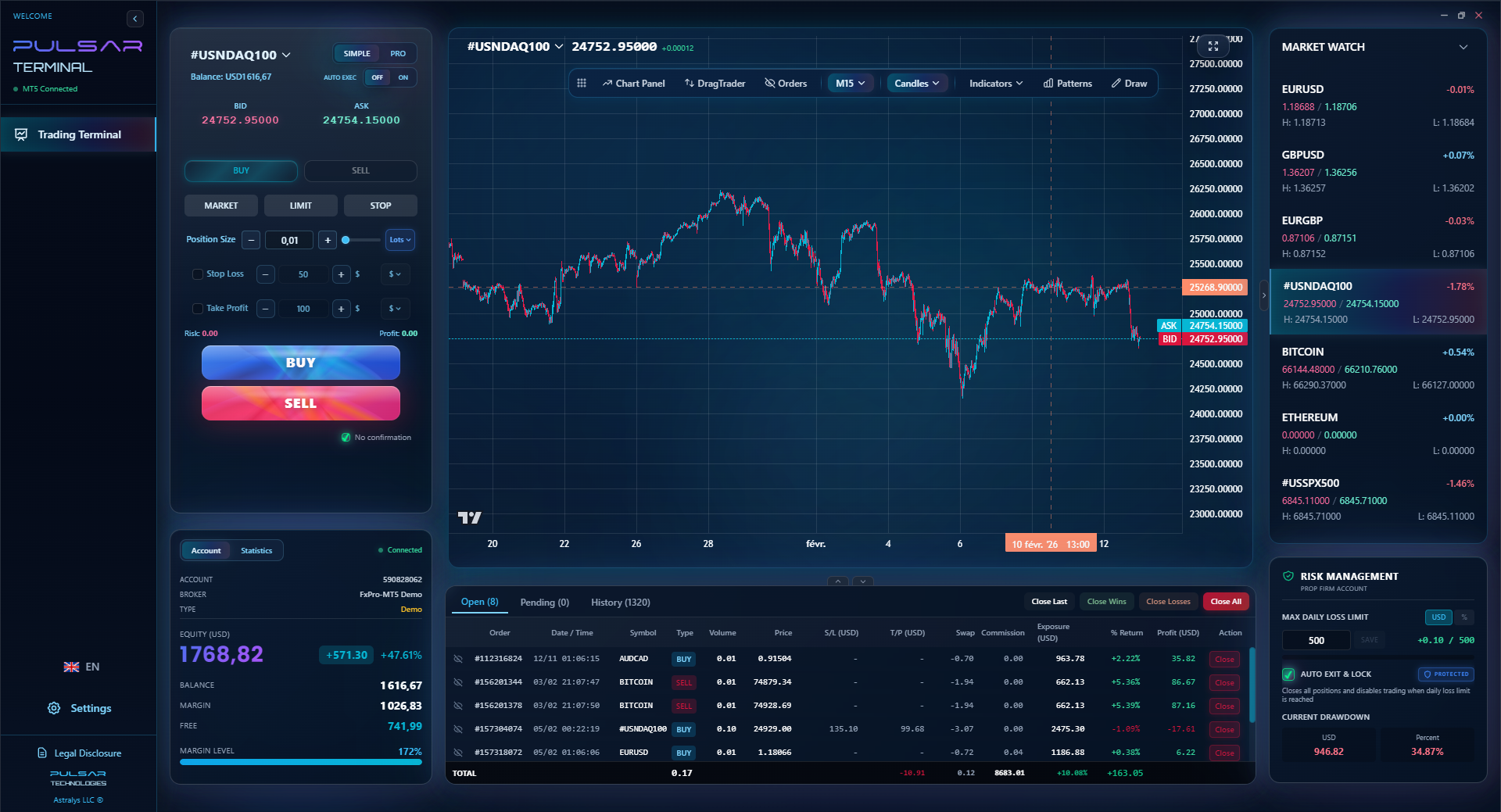
, relying on any external newsletter is a ceiling on your growth. The goal isn't to find the best newsletter; it's to internalize the skills so you don't need one. Here's how to start building that self-sufficiency.
Become a Calendar Ninja. Don't just look at the ForexFactory calendar. Understand the impact of each event. A US Core PCE print moves markets more than a German Ifo Business Climate survey. Know why. Anticipate the volatility. This knowledge alone will save you from getting stopped out on nonsense noise.
Learn to Read Price Action. All the news in the world is filtered through price. If the ECB is dovish but EUR/USD rockets higher, the market is telling you something. Newsletters explain the news; you need to learn to read the reaction. This is where tools that help you visualize market structure, beyond simple candlesticks, become useful.
Do Your Own Post-Mortem. At the end of each week, pick one major move. Why did GBP/USD fall 200 pips? Go back and read the news from that day. Look at the chart. See where it broke key levels. This reverse-engineering is more educational than reading 100 pre-market analyses. You're training your brain to connect cause and effect in the market, which is the core of discretionary trading.
Stopping the search for a magic bullet newsletter is the first step toward becoming a real trader. The second step is committing to the daily, unglamorous work of building your own understanding.
💡 Consiglio di Winston
Your own trading journal is the only newsletter you should read religiously. It tells you the unvarnished truth about your only controllable variable: yourself.

“The most valuable newsletter you'll ever read is the one you write for yourself in your trading journal.”
It's a conditional 'maybe,' heavily skewed toward 'no.'
Consider a paid forex trading newsletter only if:
- You treat it as a curated news digest, not a signal service.
- It saves you more than its monthly cost in research time (value your time at a realistic hourly rate).
- It consistently provides clear, testable market theses you can evaluate on your own charts.
- It has a transparent, verifiable long-term track record of analysis (not just winning trades).
For 95% of traders, especially those starting out, the money is better spent elsewhere. Put that $50-$300 a month into a better trading course, books, or simply leave it in your account as additional risk capital. The free resources available today are staggering. Your job is to filter them, not pay a premium for a filtered list that comes with an agenda.
The most valuable newsletter you'll ever read is the one you write for yourself in your trading journal. That's the only analysis that truly matters, because it's based on your actions, your psychology, and your direct interaction with the market. Everything else is just background noise. Start treating it that way, and you'll be ahead of the crowd who's still waiting for the next 'sure thing' email to hit their inbox.

FAQ
Q1What is the best free forex trading newsletter?
There's no single 'best.' Build a mix. Start with the free daily commentary from a major broker like Pepperstone or IC Markets. Combine it with real-time headlines from ForexLive and the economic calendar from ForexFactory. This trio gives you analysis, news, and event schedules without spending a dime.
Q2Can you make money following forex newsletter signals?
In the short term, maybe. In the long run, almost certainly not. You have no edge. You don't understand the trade rationale, so you can't manage it properly when it goes against you. You'll also be emotionally detached, making it easy to break rules. It's a recipe for inconsistent results and eventual large losses.
Q3How can I verify a newsletter's track record?
Demand a live, verifiable myfxbook or fxblue link that shows all trades, including losers, in real-time. Be wary of PDF statements or 'screenshots.' A real track record is transparent and third-party verified. If they can't or won't provide this, assume their performance claims are fabricated.
Q4Are bank research newsletters worth it for retail traders?
Their content is high-quality, but it's often written for institutional clients with different timeframes and goals. The jargon can be thick. For a retail trader, the key takeaway is usually the broad thematic view (e.g., 'USD bullish over Q3'), not their specific trade recommendations, which may involve instruments you can't access.
Q5What's the biggest mistake traders make with newsletters?
Outsourcing their thinking. They use the newsletter as their trading plan instead of as one piece of research. This leads to impulsive entries, poor risk management, and a complete lack of understanding when a trade fails. You must always be the final decision-maker.
Q6Should I use multiple newsletters?
Yes, but for research, not signals. Using 2-3 can help you see conflicting viewpoints, which is healthy. It forces you to analyze the disagreement and form your own conclusion. Just ensure you're not paying for all of them - mix free and paid sources.
Lezione del Prof. Winston
Punti chiave:
- ✓Free broker research often beats paid guru newsletters.
- ✓Never let a newsletter dictate your position size or risk.
- ✓Verify track records with third-party links, not testimonials.
- ✓Use analysis as a tool for your plan, not as your plan.
Quanto è stato utile questo articolo?
Clicca su una stella
Analisi Trading Settimanali
Analisi e strategie settimanali gratuite. Nessuno spam.
Sull'autore
James Mitchell
Analista Trading Senior
Con base a New York e oltre 9 anni di esperienza nel trading. Si occupa delle principali coppie USD, sfide delle prop firm e del contesto normativo statunitense.
Commenti
Avviso di rischio
Il trading di strumenti finanziari comporta rischi significativi e potrebbe non essere adatto a tutti gli investitori. Le performance passate non garantiscono risultati futuri. Questo contenuto è fornito solo a scopo educativo e non deve essere considerato un consiglio di investimento. Conduci sempre le tue ricerche prima di fare trading.
Potrebbe interessarti anche

Cara Trading Forex Sukses: 7 Prinsip dari Trader Profesional
Cara trading forex sukses dengan 7 prinsip trader pro: manajemen modal, disiplin, journal trading, backtest. Data nyata, bukan janji profit palsu.
Jam Trading Forex Terbaik untuk Trader Indonesia: Panduan Lengkap dengan Tabel Waktu
Panduan jam trading forex untuk trader Indonesia. Tabel 4 sesi dunia, jam emas 20:00-00:00, sesi mana yang harus dihindari. Data akurat + tips dari trader berpengalaman.
Top 5 Sàn Forex Uy Tín Nhất 2026: Review Jujur dari Trader Indonesia
Top 5 sàn forex uy tín 2026 untuk trader Indonesia. Review jujur: spread, deposit, withdraw, dukungan lokal. Exness, XM, IC Markets & lebih.
Scarica Pulsar Terminal
Tutti questi calcolatori sono integrati in Pulsar Terminal con dati in tempo reale dal tuo conto MT5.
Scarica Pulsar Terminal