


It was April 7, 2026.

Olumide Adeyemi
Pioniere del Trading in Africa Occidentale ·  Nigeria
☕ 13 min di lettura
Cosa imparerai:
- 1The Nigerian Context: Costs, Rules, and Reality
- 2Strategy 1: Price Action and Market Structure (The Foundation)
- 3Strategy 2: Momentum Trading with Moving Averages
- 4Strategy 3: The Breakout Fade (For Ranges)
- 5The Execution Killer: Risk Management (Not a Strategy, But THE Strategy)
- 6Putting It All Together: A Sample Week
- 7What Doesn't Work (And Why You Fail)
It was April 7, 2026. The Naira had just hit ₦1,386 to the dollar on the official window. My phone was buzzing with messages from a trader in Lagos who'd just blown a $2,000 account. He'd gone all-in on a USD/NGN short, convinced the CBN would intervene. They didn't. He got margin called at 3:15 PM WAT, right in the middle of the London-New York overlap - the most liquid, most dangerous time of day. His story isn't unique. It's the standard. Most Nigerian traders lose because they chase magic systems, ignore costs, and treat use like free money. Let's talk about what actually works.
Before you place a single trade, you need to understand the playing field. It's not just charts and candles. It's taxes, bank restrictions, and broker fine print that will eat your profits if you're not careful.
The 10% Tax You Can't Ignore
You make a profit? The taxman wants his share. Nigeria slaps a 10% capital gains tax on your gross trading profits. That's right, gross. Not net after losses. If you make ₦500,000 in a month but have ₦300,000 in losing trades, you still pay tax on the ₦500,000. This single rule changes your entire profit calculation. A strategy that nets 15% a year before tax becomes 5% after tax and costs. You're not just trading against the market; you're trading against the government's cut.
Funding Your Account Is Half the Battle
The CBN has made it clear: using the official FX window to fund a trading account is a no-go. Many local banks have also tightened up on Naira card transactions for international brokers. Your funding options boil down to domiciliary accounts (if you have one), e-wallets like Neteller or Skrill, or crypto. Each has fees and delays. That ₦1,000 deposit fee might not seem like much, but do it ten times a year and you've just wiped out a month's potential profits from a small account.

Warning: Starting with less than $500 is a recipe for disaster. I see it all the time. A guy deposits ₦30,000 (about $22), gets 1:500 use, and is basically one bad trade from zero. The spreads and commissions alone will choke a micro account. A realistic starting point for practicing real risk management is $500 to $1,000. If that sounds like a lot, trading might not be for you right now.
Broker Choice Is a Survival Decision
You're allowed to use international brokers, and you should. Look for those regulated by top-tier authorities like the UK's FCA or Australia's ASIC. Why? Because when things go wrong - a platform glitch, a withdrawal issue - you have somewhere to complain. A broker like Pepperstone or IC Markets, with their tight spreads and solid execution, gives you a fighting chance on cost. I've seen the difference: trading EUR/USD with a 0.2 pip spread versus a 2.0 pip spread is the difference between a profitable scalping strategy and a losing one.

💡 Consiglio di Winston
Your first loss is your best loss. Taking a small, planned loss according to your 1% rule is a sign of professional discipline. Holding a losing trade hoping it will turn around is the signature move of an amateur.
“Starting with less than $500 is a recipe for disaster. The spreads and commissions alone will choke a micro account.”
Forget the fancy indicators for a second. The most reliable forex trading strategies that work are built on reading pure price action and understanding market structure. This is about identifying what the market is actually doing, not what an oscillator tells you it might do.
I learned this the hard way in 2018. I was loaded up with RSI, MACD, Stochastic - my chart looked like a rainbow. I shorted GBP/USD because the daily RSI was overbought. The price kept rising for another 300 pips. I lost 5% of my account waiting for a reversal that never came. The chart was screaming ‘uptrend’ with higher highs and higher lows, but I was ignoring it for a lagging indicator.
How to Trade It
First, identify the trend. Is the market making consistent higher highs and higher lows (uptrend) or lower highs and lower lows (downtrend)? On the 4-hour or daily chart. That's your bias. In an uptrend, you only look for buy setups. In a downtrend, only sells. It sounds simple, but 80% of retail traders fight the trend.
Second, find key levels: previous swing highs (resistance) and swing lows (support). These are where price tends to react. Your trade plan becomes: ‘Buy on a pullback to support in an uptrend, with a stop loss below the recent swing low.’

Example: EUR/USD is in a clear daily uptrend. It pulls back to a previous resistance level (which now acts as support) at 1.0850. You enter a buy order at 1.0852. Your stop loss goes at 1.0820 (30 pips below the swing). Your first profit target is the recent high at 1.0950. That's a 98-pip target for a 30-pip risk - a solid 3.2:1 reward-to-risk ratio. You can learn more about trading this major pair in our EUR/USD guide.
This method requires patience. You might only get 2-3 high-quality setups a week on a single pair. But the win rate and risk management are superior to chasing every blip on the 5-minute chart. It’s the core of effective swing trading.
“You're not just trading against the market; you're trading against the government's 10% cut on your gross profits.”
This is where we add one tool to our price action: the Exponential Moving Average (EMA). Specifically, the 20-period and 50-period EMAs on the 1-hour or 4-hour chart. This isn't about the crossover nonsense (when the 20 crosses the 50). That signal is always late. It's about using the EMAs as dynamic support and resistance in a trending market.
Here’s a real trade I took in March 2026 on XAU/USD (Gold). The daily chart showed a strong uptrend. On the 4-hour chart, price was riding above the rising 20 EMA. It pulled back, kissed the 20 EMA, and formed a bullish pin bar. Entry: $2,155. Stop loss: $2,138 (just below the 50 EMA). Target: $2,195. The trade ran to target in two days for a 40-pip profit. The key? The trend was established, and the EMA acted as a springboard.
The Rules
- Trend Filter: The 20 EMA must be above the 50 EMA for a buy bias (and sloping up). Below and sloping down for a sell bias. This keeps you on the right side of the medium-term momentum.
- Entry Trigger: Wait for price to pull back to the 20 EMA. Look for a candlestick reversal pattern (like a pin bar or engulfing bar) right at the EMA. That's your entry signal.
- Stop Loss: Place your stop loss below the 50 EMA (for buys) or above it (for sells). This gives the trade room to breathe.
- Take Profit: Aim for a risk-to-reward of at least 1:2. Take half your position off at the first target and trail the rest.
This strategy works brilliantly during the 1:00 PM to 6:00 PM WAT window when the UK and US sessions are active and trends get fuel. It fails horribly in a choppy, range-bound market. That's why you must first assess the market structure. If there's no clear trend, stay out. For more on trading gold with this approach, check our XAU/USD guide.
“You're not just trading against the market; you're trading against the government's 10% cut on your gross profits.”
Markets trend only about 30% of the time. The other 70%, they're ranging. In Nigeria, with all the local FX news and CBN announcements, USD/NGN and even major pairs can get stuck in tight ranges for days. The amateur move is to buy the ‘breakout’ immediately. The professional move is often to ‘fade’ it - to bet the breakout will fail initially.
Why? Because most first breakouts are false. They're run by algorithms to take out the stops sitting above resistance or below support. I got caught in this trap for years until I started tracking it. About 6 out of 10 breakouts of a well-defined range will get sucked back in.
How to Play the Fade
- Identify a clear range on the 1-hour or 4-hour chart. Two clear touches on the top (resistance) and bottom (support).
- When price spikes above resistance, don't buy. Wait. Watch for the price to close back INSIDE the range on the 1-hour candle.
- That close back inside the range is your signal to SELL. Your stop loss goes just above the wick of the false breakout candle.
- Your profit target is the opposite side of the range.
Let’s use a pip definition example: GBP/USD has been ranging between 1.2600 (support) and 1.2700 (resistance) for 3 days. Price suddenly spikes to 1.2725. You wait. The next 1-hour candle opens at 1.2720 and closes at 1.2695 - back inside the range. You sell at 1.2695. Stop loss at 1.2735 (40 pips). Target at 1.2610 (85 pips). You're risking 40 to make 85.

Pro Tip: This strategy requires high discipline. You must wait for the close of the candle. That intra-candle spike to 1.2725 will tempt you to jump in early. Don't. Let the market show you its hand. This is where a solid understanding of the spread is crucial, as wider spreads on exotic pairs can make this precise entry difficult.
💡 Consiglio di Winston
If you can't write down your trade plan - entry reason, exact stop loss, exact take profit, and position size - before you click 'buy,' you have no business being in the trade. No plan, no trade.
“Risking 1% does two things. It lets you survive a losing streak, and it removes emotion.”
You can have the best entry system in the world. Without iron-clad risk management, you will lose. Full stop. This is the number one reason Nigerian traders blow up. They use 1:1000 use not as a tool, but as a lottery ticket.
Here’s my non-negotiable rule: Never risk more than 1% of your account equity on a single trade. For a $1,000 account, that's $10. Not $50, not $100. Ten dollars.
How does that work with a trade? You use our position size calculator. Let's say you want to buy USD/JPY at 151.50, with a stop loss at 151.20. That's a 30-pip risk. If your account is $1,000, your max loss is $10.
Pip value for USD/JPY is roughly $1 per 10,000 units (a mini lot). To find your position size: ($10 risk) / (30 pips) = $0.333 per pip. Since 1 pip on a mini lot is $1, you need to trade 0.33 mini lots, or 3,300 units. That's your position size. Not 1 lot (100,000 units), which would risk over $300.
The Psychology of 1%
Risking 1% does two things. First, it lets you survive a losing streak. You can lose 10 trades in a row and still only be down 10% of your account. You're still in the game. Second, it removes emotion. A $10 loss doesn't make you angry or desperate. You can think clearly about the next trade. A $100 loss on that same account? That triggers revenge trading, and that's how accounts get wiped.
I violated this rule in 2020. I was on a hot streak, up 15% for the month. I got cocky. I saw a ‘sure thing’ on a EUR news event and risked 5% of my account. The news was a dud, the trade went sideways, then slowly against me. I watched it bleed, refusing to take the $500 loss because it was ‘too big.’ I got a margin call two days later. That single trade erased my entire month's profits and then some. I broke my own rule, and the market broke me.
“Risking 1% does two things. It lets you survive a losing streak, and it removes emotion.”
Let's walk through a hypothetical week for a Nigerian trader with a $2,000 account, trading during our optimal 1-6 PM WAT window.
Monday: Market is choppy. No clear trend on EUR/USD or GBP/USD. You identify a range on USD/CAD. You wait. No trade.
Tuesday: Gold (XAU/USD) shows a strong daily uptrend. On the 4-hour, it pulls back to the 20 EMA. You get a bullish pin bar at $2,180. You calculate your 1% risk ($20). Stop loss is 25 pips away at $2,175. Your position size is $20 / 25 = $0.80 per pip. You buy 0.08 lots (8,000 units). You set two targets: half at $2,190 (1:2 risk/reward) and half at $2,200.
Wednesday: Your first gold target is hit. You move your stop loss on the remaining half to breakeven. The trend continues. You might use a trailing stop to lock in profits.
Thursday: EUR/USD breaks out of a range to the upside. You wait for the close. The candle closes back inside the range. You execute a fade sell, risking 1% again.
Friday: You review. You took two trades, risked 2% total of your account. One was a full winner (+2% on the first half, still running on the second). One was a small loser (-1%). Net for the week: roughly +1.5% after costs. That's +30% annualized if you can maintain that discipline. That's how real, sustainable growth happens.
This isn't sexy. It's boring. But boring pays the bills. Chasing 50% a month leads to zero. Aiming for 2-5% a month, compounded, leads to financial freedom. The tools you use matter. Managing multiple targets and trailing stops manually is stressful. Having a platform that can automate partial closures and move stops to breakeven removes emotion and error.
💡 Consiglio di Winston
Spend 80% of your time analyzing losing trades, not admiring winners. Your losses contain all the lessons you need to stop repeating expensive mistakes.
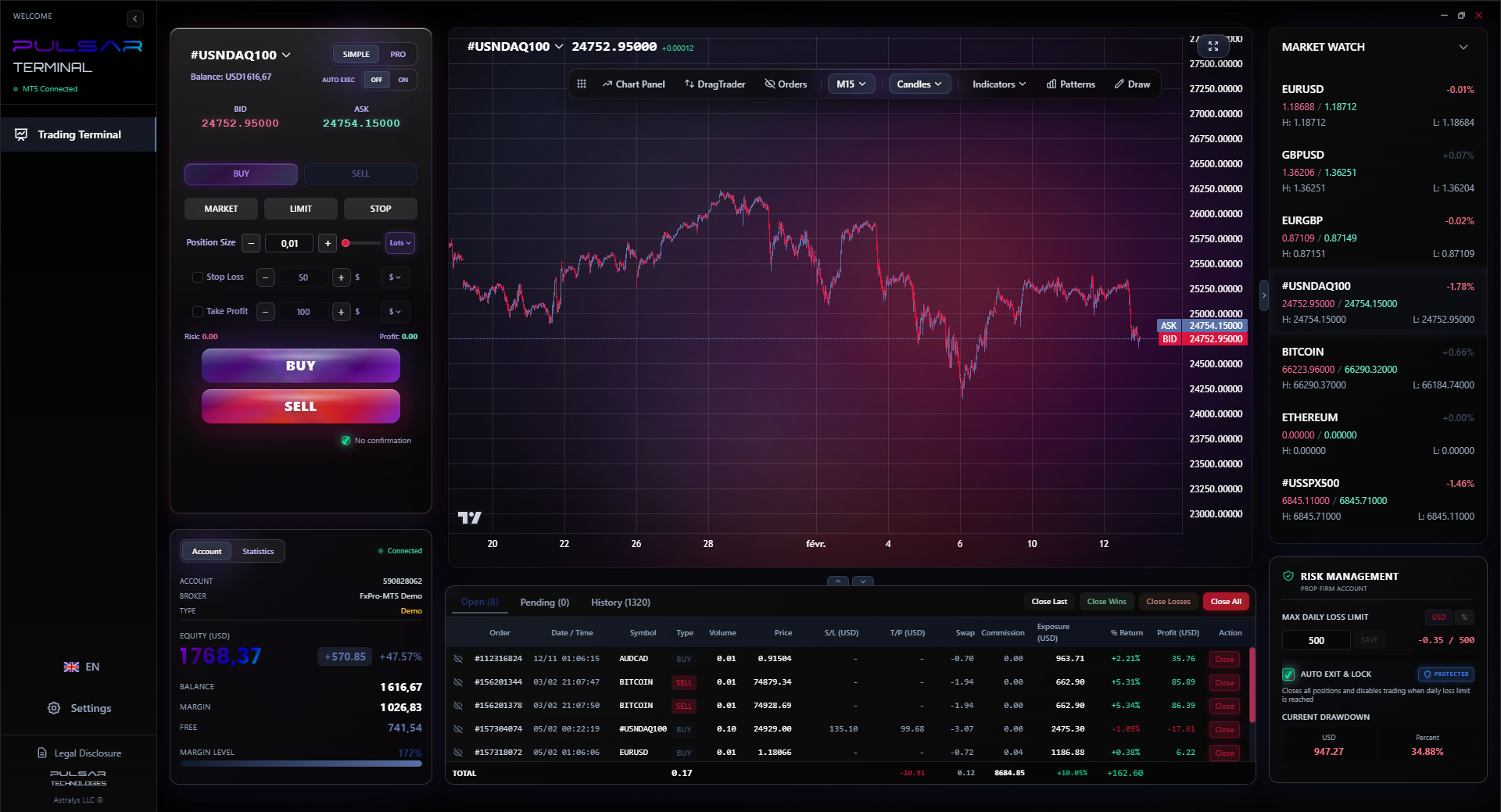
Manually managing multiple profit targets and moving stops to breakeven on MT5 is error-prone, but Pulsar Terminal automates these precise risk management actions with a single click.
Pulsar Terminal
Lo strumento MT5 tutto-in-uno: ordini drag-and-drop, multi-TP/SL, trailing stop, grid trading, Volume Profile e protezione prop firm. Usato da oltre 1.000 trader ogni giorno.
“Boredom is not a trading signal. Activity does not equal profitability.”
Let's be brutally honest about the garbage that gets sold to new traders in Nigeria.
The ‘Sure-Fire’ Indicator System: Anybody selling you a single indicator that ‘turns green for buy, red for sell’ is lying. Markets are probabilistic. No tool predicts the future. I've bought these systems. They work in a backtest on specific past data. They fail in real-time because the market changes.
Copy Trading Without Due Diligence: Copy trading can be a learning tool, but blindly following a ‘guru’ on a social platform is suicide. You don't know their risk management, their account size, or their long-term track record. By the time you see their ‘win,’ the move is often over.
Trading Off Telegram Signals: The delay alone kills you. The signal provider buys at 1.0850. By the time you get the message, price is at 1.0865. Your risk/reward is instantly ruined. Plus, you have no idea why they took the trade, so you can't manage it when it goes negative.
Over-Trading: This is the silent killer. No clear setup? Stay out. Boredom is not a trading signal. I used to force trades to ‘be in the market.’ I’d trade 10 times a week and end up down 3%. Now I might trade twice a week and end up up 2%. Activity does not equal profitability.
Ignoring Fundamentals Completely: As a Nigerian, you MUST have a sense for CBN policy, oil prices, and Naira liquidity. A major CBN announcement can blow through any technical support or resistance level you've drawn. You don't need to be an economist, but know when major news is scheduled (like MPC meetings) and reduce your position size or stay out entirely.
The common thread in all these failures? A lack of personal responsibility and a desperate search for an easy answer. There isn't one. The forex trading strategies that work require you to do the work: analyze, plan, execute, review. Every single day.
FAQ
Q1What is the best time of day to trade forex in Nigeria?
The most liquid and often best time is between 1:00 PM and 6:00 PM West Africa Time (WAT). This covers the overlap of the London session (which opens at 1 PM WAT) and the New York session (which opens at 2 PM WAT). Higher liquidity means tighter spreads and cleaner price action, which is crucial for the strategies discussed.
Q2How much money do I really need to start forex trading in Nigeria?
While some brokers accept as little as $5, starting with less than $500 is a major handicap. With a small account, you're forced to use excessive use to make meaningful profits, which exponentially increases your risk of a margin call. A $500-$1,000 starter account allows you to risk 1% ($5-$10 per trade) and trade sensible position sizes while absorbing normal losses.
Q3Can I use my Nigerian Naira card to fund an international broker?
It's becoming increasingly difficult. Many Nigerian banks have restrictions on using Naira cards for international merchant transactions, which includes most offshore brokers. The most reliable methods now are funding a domiciliary account first, then transferring, or using e-wallets (Neteller, Skrill) or cryptocurrency (USDT) where the broker accepts it.
Q4Do I have to pay tax on my forex trading profits?
Yes. Nigerian law requires you to pay a 10% Capital Gains Tax on your gross trading profits. This is your legal responsibility, regardless of whether your broker is local or international. Keep detailed records of all your trades for tax purposes.
Q5Is the Moving Average Crossover strategy profitable?
The classic 'when the 20-period crosses above the 50-period, buy' signal is notoriously lagging and results in many false signals. It's not a reliable standalone strategy. As outlined in this article, a better approach is to use moving averages as dynamic support/resistance in a confirmed trend, not as crossover triggers.
Q6What's more important, the entry strategy or risk management?
Risk management, 100 times out of 100. A mediocre entry with excellent risk management (1% rule, good reward-to-risk ratios) can be profitable. A brilliant entry with terrible risk management (risking 10% per trade) will blow up your account. Always focus on preserving capital first.
Q7Should I trade the USD/NGN pair?
It's extremely volatile and heavily influenced by CBN policy and local dollar liquidity, which can be hard to track. For most retail traders, it's riskier than major pairs like EUR/USD or GBP/USD which have deeper, more liquid global markets and cleaner technical patterns. Start with the majors.
Lezione del Prof. Winston
Punti chiave:
- ✓Never risk more than 1% of account equity per trade.
- ✓Identify the trend first; never fight the higher timeframe structure.
- ✓Wait for price to close back inside a range before fading a breakout.
- ✓Use EMAs as dynamic support/resistance, not as crossover signals.
- ✓The optimal trading window in Nigeria is 1:00 PM - 6:00 PM WAT.
Quanto è stato utile questo articolo?
Clicca su una stella
Analisi Trading Settimanali
Analisi e strategie settimanali gratuite. Nessuno spam.
Sull'autore
Olumide Adeyemi
Pioniere del Trading in Africa Occidentale
Uno degli educatori di trading forex più attivi in Nigeria. 8 anni di esperienza di trading da Lagos. Specializzato in strategie a basso capitale e sfide prop firm per trader africani.
Commenti
Avviso di rischio
Il trading di strumenti finanziari comporta rischi significativi e potrebbe non essere adatto a tutti gli investitori. Le performance passate non garantiscono risultati futuri. Questo contenuto è fornito solo a scopo educativo e non deve essere considerato un consiglio di investimento. Conduci sempre le tue ricerche prima di fare trading.
Potrebbe interessarti anche

Cara Trading Forex Sukses: 7 Prinsip dari Trader Profesional
Cara trading forex sukses dengan 7 prinsip trader pro: manajemen modal, disiplin, journal trading, backtest. Data nyata, bukan janji profit palsu.
Jam Trading Forex Terbaik untuk Trader Indonesia: Panduan Lengkap dengan Tabel Waktu
Panduan jam trading forex untuk trader Indonesia. Tabel 4 sesi dunia, jam emas 20:00-00:00, sesi mana yang harus dihindari. Data akurat + tips dari trader berpengalaman.
Top 5 Sàn Forex Uy Tín Nhất 2026: Review Jujur dari Trader Indonesia
Top 5 sàn forex uy tín 2026 untuk trader Indonesia. Review jujur: spread, deposit, withdraw, dukungan lokal. Exness, XM, IC Markets & lebih.
Scarica Pulsar Terminal
Tutti questi calcolatori sono integrati in Pulsar Terminal con dati in tempo reale dal tuo conto MT5.
Scarica Pulsar Terminal