


Everyone's trying to sell you the 'ultimate' forex trading tool that promises to make you rich.

Olumide Adeyemi
Pioniere del Trading in Africa Occidentale ·  Nigeria
☕ 10 min di lettura
Cosa imparerai:
- 1The Trading Platform: Your Non-Negotiables
- 2Core Charting Tools: Less is More
- 3Trade Management: The Tools That Protect Your Money
- 4Analytical Software & The 'Smart Money' Myth
- 5The Only Calculator You Really Need
- 6The Nigerian Trader's Reality: Power, Data & Psychology
- 7Putting It All Together: Building Your Toolkit
Everyone's trying to sell you the 'ultimate' forex trading tool that promises to make you rich. The truth is, most of it is noise. I've spent over a decade and more money than I care to admit on flashy indicators and 'smart money' software that just didn't work. The right tools don't make you a profitable trader, but the wrong ones will definitely make you a losing one. Let's cut through the hype and talk about what you actually need on your screen.
Your platform is your cockpit. If it's clunky or unreliable, you're crashing before takeoff. For us in Nigeria, you need to think about three things beyond just the charts: execution speed, deposit/withdrawal ease, and stability during our sometimes shaky internet.
I made a costly mistake early on. I was using a platform with beautiful charts but terrible execution. I entered a short on GBP/NGN (yes, you can trade it with some brokers) at 1,520. The price was there, I clicked, and my order filled at 1,523. A 3-pip slip on a currency pair that might only move 15 pips a day. That trade was dead on arrival. I lost simply because my platform was slow.
Now, my checklist is simple. First, MetaTrader 4 or 5. It's the standard for a reason. Every broker supports it, and every tool you'll ever need is built for it. Don't get fancy here. Second, check the broker's local payment channels. Can you fund with your Nigerian debit card or a direct bank transfer without crazy fees? I use brokers like Exness and IC Markets specifically because their local agent networks make Naira deposits a breeze.

Warning: Never, ever trade on a platform that doesn't offer a reliable demo account. Test everything - order execution, chart loading times, even how it behaves when you switch from Wi-Fi to mobile data. Your livelihood depends on it.
The Mobile App Test
You won't always be at your desk. Maybe there's a power cut (you know how it is), or you're stuck in traffic. Your platform's mobile app must be solid. Can you place a trade, modify a stop-loss, and see your profit and loss clearly? If not, that's a deal-breaker. I've closed trades from my phone more times than I can count. It's not ideal, but it's a reality of trading from Nigeria.
“The right tools don't make you a profitable trader, but the wrong ones will definitely make you a losing one.”
This is where new traders drown. They load 15 indicators on one chart, creating a rainbow of confusion that tells them nothing. I've been there. My chart looked like a Christmas tree, and my account looked like a charity donation.
You only need a few categories of tools, and you need to understand what each one tells you - and, more importantly, what it doesn't.
Price Action Tools: These are free and built into MT4/MT5.
- Support & Resistance Lines: Your foundation. Not a fancy tool, just horizontal lines. Marking clear swing highs and lows does more for your trading than any paid indicator.
- Trendlines: Again, simple. Connecting higher lows in an uptrend or lower highs in a downtrend.
- Fibonacci Retracement: The only 'fancy' drawing tool I use daily. In a strong trend, price often pulls back to the 38.2%, 50%, or 61.8% level before continuing. It gives you a potential area to look for entries. Don't overcomplicate it.
Momentum & Confirmation Indicators: I use two, max.
- Moving Averages: I keep a simple 50-period and 200-period Exponential Moving Average (EMA) on my daily chart. They help me see the broader trend at a glance. Is price above both? Likely an uptrend. Below both? Downtrend. That's it.
- The RSI Indicator: My go-to for spotting potential reversals or overextended markets. I look for divergence (when price makes a new high but RSI doesn't) or when it crosses above 30 (from oversold) or below 70 (from overbought). It's a filter, not a signal.
I almost never use the MACD indicator anymore. It's just a slower version of information price and moving averages already give you. Strip your charts back. A clean chart helps you see what the market is doing, not what an indicator is guessing it might do.

💡 Consiglio di Winston
The fanciest tool in the world is useless if you don't understand the market's language - price action. Learn to read a naked chart first.
“A clean chart helps you see what the market is doing, not what an indicator is guessing it might do.”
Entry is easy. Managing the trade is where you make or lose money. The right tools here are non-negotiable for survival.
The Stop-Loss (SL) and Take-Profit (TP): This isn't a tool you add, it's a discipline. Every single trade must have these set the moment you enter. Your trading platform's order window is the most important tool you have. I set my SL based on the chart - just beyond a recent swing point or a key support/resistance level. My TP is usually set at a 1:1.5 or 1:2 risk-to-reward ratio. I calculate this using my position size calculator before I even think about clicking 'buy'.
The Trailing Stop: A game-saver. Let's say you're in a long trade on XAU/USD and it's running in your favor. A trailing stop automatically moves your stop-loss up as the price climbs, locking in profit. Most platforms have this. I didn't use it for years, and I watched countless winning trades turn into break-evens or losers. Now, I activate a trailing stop once a trade is in profit by at least 1.5x my risk.
The Pending Order: Limit and Stop orders. Don't just market-buy everything. If I see EUR/USD pulling back to a key support level, I'll set a buy limit order just above it. This means I get my price even if I'm not staring at the screen. It removes emotion.

Pro Tip: Get familiar with 'Breakeven' stops. Once a trade moves in your favor by the amount of your initial risk, move your stop-loss to your entry price. This turns a risky trade into a risk-free one. It's a psychological lifesaver.
These tools are boring. They're not flashy. But they are the difference between a hobbyist and a professional. They automate your discipline.
Managing multiple trades and complex exits is stressful, but tools like Pulsar Terminal automate trailing stops and partial closures directly on your MT5, turning manual stress into automated discipline.
Pulsar Terminal
Lo strumento MT5 tutto-in-uno: ordini drag-and-drop, multi-TP/SL, trailing stop, grid trading, Volume Profile e protezione prop firm. Usato da oltre 1.000 trader ogni giorno.
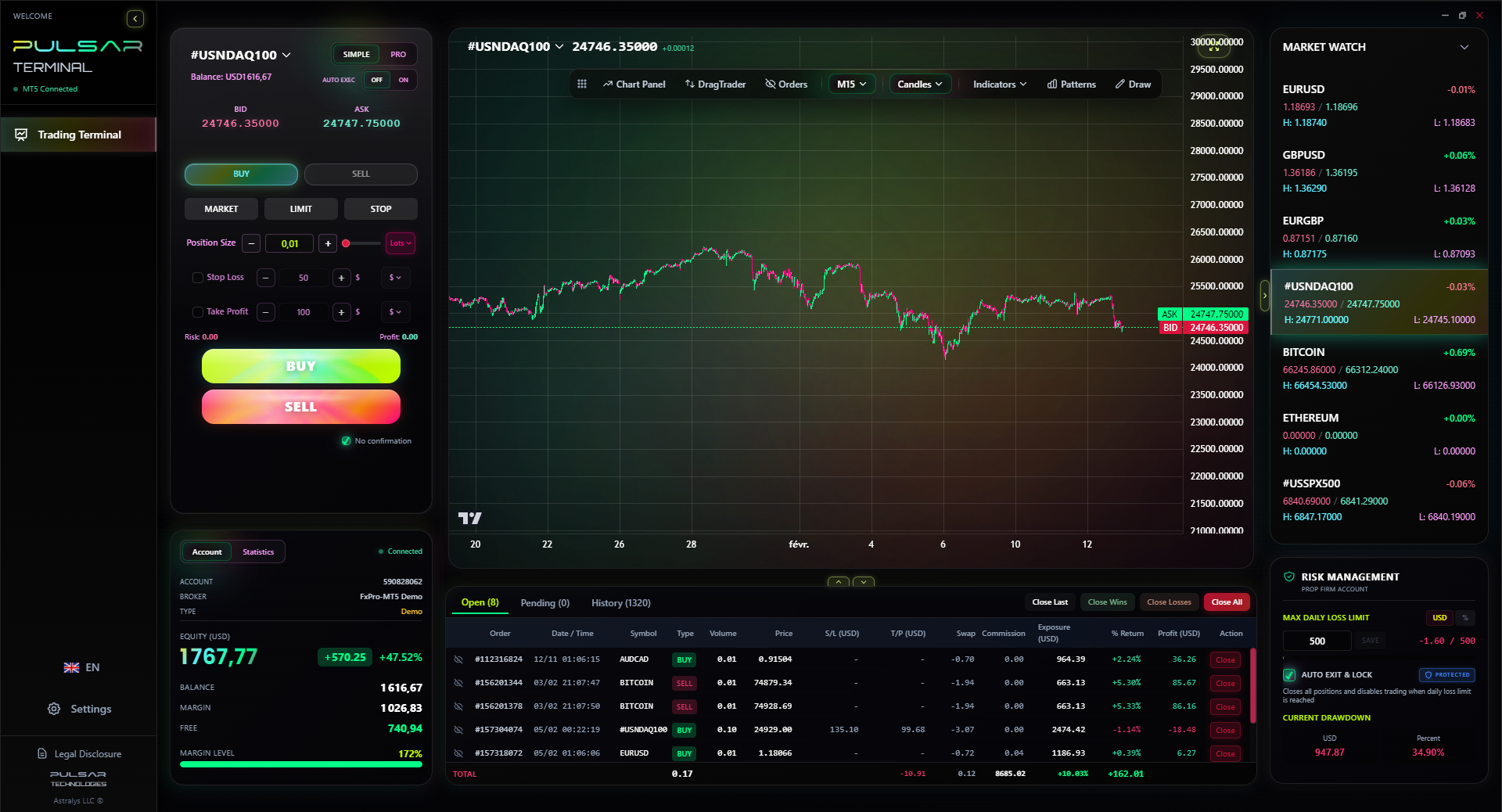
“A clean chart helps you see what the market is doing, not what an indicator is guessing it might do.”
This is the big-ticket item where traders get scammed. You'll see ads for software that claims to show you where the 'banks' are placing their orders (Order Flow), or tools that automatically detect 'institutional supply and demand zones.'
I bought one. It cost me $1,200. For a year, I traded based on its colorful boxes and arrows. My results were inconsistent at best. The problem? It was just repackaging basic support and resistance with a fancy algorithm. It lagged. By the time it drew a 'bank entry zone,' the move was often half over.
Here's the hard truth: No software can reliably predict the future. The tools that have real value are those that help you organize information the market is already giving you.
Economic Calendars: This is crucial. You need to know when major data (like US Non-Farm Payrolls or our own Central Bank of Nigeria MPC meetings) is coming out. I use the free calendar on ForexFactory. I don't trade during high-impact news events. The spreads widen, execution is terrible, and it's just a coin flip. This tool helps me avoid unnecessary risk.
Correlation Matrices: These show you how currency pairs move in relation to each other. Did you know EUR/USD and GBP/USD often move in the same direction? If you're long both, you're not diversified, you're doubled down on the same bet. A quick check on a free correlation website can save you from a correlated blow-up.
Save your money. The 'secret' isn't in a $500/month subscription. It's in your ability to read a clean chart and manage your risk. Fancy tools often just give you more ways to confuse yourself.
“Your generator, your data plan, and your own mindset are part of your toolkit in Nigeria.”
Forget complex algorithms. The most important calculation you will ever do is for your position size. Getting this wrong is the fastest way to a margin call.
Here's the formula I use for every trade: Position Size = (Account Risk in $) / (Stop-Loss Distance in Pips * Pip Value)
Let me give you a real example from last month. My account was at $2,000. My rule is to risk no more than 1% per trade. So, my Account Risk is $20. I wanted to sell USD/JPY. My entry was at 151.50, and my stop-loss was at 151.80. That's a Stop-Loss Distance of 30 pips. On USD/JPY, a 1-pip move on a standard lot is about $10. So, for a 0.01 mini lot, the Pip Value is $0.10. My calculation: $20 / (30 pips * $0.10) = $20 / $3 = 6.66. So, I could trade a position size of 0.066 lots. I'd round down to 0.06 lots to be safe.

Example:
- Account Balance: $1,000
- Risk per Trade (1%): $10
- Trade: Buy EUR/USD at 1.0850, SL at 1.0820 (30 pips)
- Pip Value for 0.01 lot on EUR/USD: ~$0.10
- Calculation: $10 / (30 * $0.10) = $10 / $3 = 3.33
- Position Size: 0.033 lots.
Doing this manually every time is a pain. That's why I built a simple spreadsheet that does it for me. Even better, use a free online position size calculator. This isn't optional work. It's the bedrock of professional trading. A good trade with bad position sizing is still a bad trade.
💡 Consiglio di Winston
Your first profitable tool shouldn't be an indicator, it should be a calculator. Know your position size to the decimal before you click 'buy'.
“Your generator, your data plan, and your own mindset are part of your toolkit in Nigeria.”
Our environment is a trading tool we often forget to account for. Your generator, your data plan, and your own mindset are part of your toolkit.
The Infrastructure Tool Kit:
- A UPS/Inverter: This is as important as your monitor. A sudden power cut during a trade can mean you can't adjust your stop or take profit. I lost $150 once because the light went out and my laptop died while I was in a trade. A basic UPS that gives you 30 minutes to manage or close positions is a mandatory business expense.
- Dual Data Source: Relying on only one ISP is risky. Have a mobile hotspot ready to go (like your phone's data). The small cost of extra data is nothing compared to the loss from missing a market move.
The Psychological Tools:
- A Trading Journal: This is your most valuable analytical tool, and it's free. I use a Google Sheet. For every trade, I record: pair, direction, entry/exit, why I took it (screenshot the chart), my emotional state, and the outcome. Reviewing this weekly shows you your real patterns - not what you think you're doing. You'll see if you're revenge trading, overtrading, or consistently missing your scalping strategy targets.
- Routine & Ritual: Start your day the same way. Check the economic calendar. Look at the daily charts of your main pairs. This ritual puts you in a 'trading mode' and reduces impulsive decisions.
Your environment will test you. Planning for it turns those challenges from account-killers into minor inconveniences.
💡 Consiglio di Winston
In Nigeria, your generator is a trading tool. A reliable power backup is a non-negotiable business expense, not a luxury.
“Your greatest tool will always be your own disciplined mind.”
You don't need everything at once. Start simple and add only what you understand and truly need.
Phase 1: The Survival Kit (Month 1-3)
- A reliable broker platform (MT5).
- The free economic calendar.
- A position size calculator/spreadsheet.
- A trading journal.
- Focus on drawing support/resistance lines and trendlines.
Phase 2: The Efficiency Kit (Month 4-12)
- Add one or two indicators (like RSI) to your clean charts as a confirmation filter.
- Start using pending orders and trailing stops.
- Implement the 'breakeven stop' rule religiously.
- Analyze your trading journal monthly to find your weak spots.
Phase 3: The Refinement Kit (Year 1+)
- Now you can explore more advanced concepts if they suit your style, like swing trading setups or deeper order flow analysis.
- Consider tools that automate your journaling or provide faster market scanning, but only after you have a proven, manual process.
Avoid the temptation to jump to Phase 3. I did, and it set me back years. Master the basics on a demo account. Then, move to a live account with very small sizes. The tools are there to serve your strategy, not define it. Your greatest tool will always be your own disciplined mind.
FAQ
Q1What is the most important forex trading tool for a beginner in Nigeria?
Hands down, a proper demo account on a stable platform like MT4/5. It's free. Use it to practice executing trades, setting stop-losses, and using the platform's basic tools (like drawing lines) without risking a single Naira. Master the platform before you even think about real money.
Q2Are paid indicators and trading robots (EAs) worth it?
In my 12 years, I've never seen one that works consistently in the long run. They're often built on past data and fail when market conditions change. The sellers make money from selling the dream, not from trading. Your money is better spent on a good internet connection, a UPS, and education on price action and risk management.
Q3How much should I spend on trading tools when starting?
Almost nothing. Your broker's free platform (MT4/5) has all the essential charting tools. Use free economic calendars and a free position size calculator. The only initial costs should be for reliable infrastructure - a decent computer, stable internet, and a battery backup. Consider tools an expense only after you are consistently profitable and you've identified a specific task you need to automate or improve.
Q4Which is better for Nigerians, MT4 or MT5?
For pure forex trading, MT4 is perfectly fine and is simpler. MT5 has more timeframes and allows trading stocks and futures, but it's slightly more complex. Most brokers here offer both. I'd start with MT4 for its simplicity and because every tutorial and indicator out there is compatible with it. You can always switch to MT5 later.
Q5How do I handle trading during Nigerian power outages?
Plan for it. A UPS is mandatory. Also, set stop-loss and take-profit orders on EVERY trade the moment you enter. That way, if the power goes out, your trade is still protected. Use your mobile phone as a hotspot and have your broker's mobile app installed and ready to go. Trading without these safeguards is gambling.
Q6Can I trade forex successfully with just my phone?
For analysis and monitoring, yes. For active trading, I don't recommend it as your primary method. The screen is too small for detailed chart analysis, and a misclick can be costly. Use your phone for checking positions, managing stops, or entering pre-planned trades when you're away from your desk. But your main analysis and planning should be done on a larger screen.
Q7What's one tool I'm probably not using but should be?
Your trading journal. It's not a software package; it's a habit. Writing down why you took a trade forces clarity. Reviewing your losses shows you your recurring mistakes. It's the only tool that gives you direct feedback on yourself - the most important component in your trading system.
Lezione del Prof. Winston
Punti chiave:
- ✓Master your platform's basic order tools before buying anything.
- ✓Risk 1% or less per trade, calculated before entry.
- ✓A trading journal is your most valuable analytical tool.
- ✓In Nigeria, a UPS is as critical as your trading software.
- ✓Avoid paid 'magic' indicators; they sell hope, not results.
Quanto è stato utile questo articolo?
Clicca su una stella
Analisi Trading Settimanali
Analisi e strategie settimanali gratuite. Nessuno spam.
Sull'autore
Olumide Adeyemi
Pioniere del Trading in Africa Occidentale
Uno degli educatori di trading forex più attivi in Nigeria. 8 anni di esperienza di trading da Lagos. Specializzato in strategie a basso capitale e sfide prop firm per trader africani.
Commenti
Avviso di rischio
Il trading di strumenti finanziari comporta rischi significativi e potrebbe non essere adatto a tutti gli investitori. Le performance passate non garantiscono risultati futuri. Questo contenuto è fornito solo a scopo educativo e non deve essere considerato un consiglio di investimento. Conduci sempre le tue ricerche prima di fare trading.
Potrebbe interessarti anche

Cara Trading Forex Sukses: 7 Prinsip dari Trader Profesional
Cara trading forex sukses dengan 7 prinsip trader pro: manajemen modal, disiplin, journal trading, backtest. Data nyata, bukan janji profit palsu.
Jam Trading Forex Terbaik untuk Trader Indonesia: Panduan Lengkap dengan Tabel Waktu
Panduan jam trading forex untuk trader Indonesia. Tabel 4 sesi dunia, jam emas 20:00-00:00, sesi mana yang harus dihindari. Data akurat + tips dari trader berpengalaman.
Top 5 Sàn Forex Uy Tín Nhất 2026: Review Jujur dari Trader Indonesia
Top 5 sàn forex uy tín 2026 untuk trader Indonesia. Review jujur: spread, deposit, withdraw, dukungan lokal. Exness, XM, IC Markets & lebih.
Scarica Pulsar Terminal
Tutti questi calcolatori sono integrati in Pulsar Terminal con dati in tempo reale dal tuo conto MT5.
Scarica Pulsar Terminal