


If you've been told forex trading in Nigeria is a quick, unregulated free-for-all where you can get rich overnight, you've been sold a dangerous fantasy.

Olumide Adeyemi
Pioniere del Trading in Africa Occidentale ·  Nigeria
☕ 14 min di lettura
Cosa imparerai:
- 1Is Forex Trading Legal in Nigeria? (The Real Answer)
- 2The Real Costs & Taxes Nobody Tells You About
- 3How to Fund & Withdraw: A Step-by-Step Guide (2026)
- 4Building a Strategy That Works From Nigeria
- 5Risk Management: Your Survival Manual
- 6Common Pitfalls & How I Messed Up (So You Don't Have To)
- 7Essential Glossary: Speak the Language
- 8Your First Steps: A Realistic Checklist
If you've been told forex trading in Nigeria is a quick, unregulated free-for-all where you can get rich overnight, you've been sold a dangerous fantasy. The truth is messier, full of real costs and specific rules that nobody talks about until you get a tax bill or your deposit fails. I learned this the hard way, losing money not just on bad trades, but on avoidable mistakes with funding and compliance. This isn't another hype piece. Consider this your personal, no-BS forex wiki. I'm going to lay out exactly how it works here, from the legal grey areas to the 10% tax you can't avoid, so you can trade with your eyes wide open.
This is the first question everyone asks, and the answer is more nuanced than a simple yes or no. Yes, it's legal for you, as an individual Nigerian resident, to trade forex with your own money. No, the online retail forex market you're participating in is not specifically regulated by Nigerian law in a way that protects you. The Central Bank of Nigeria (CBN) and the Securities and Exchange Commission (SEC) are our main financial watchdogs. The CBN cares about banks and institutional forex flows. The SEC? They put out a warning back in 2018 that still stands: the online retail forex trading space is unregulated and "susceptible to abuse." That's regulator-speak for 'you're on your own, buddy.'
What this means for you is critical. You have zero protection from the Nigerian government if your broker disappears with your money. None. This makes your choice of broker the most important financial decision you'll make, more important than your first trade. You must use a broker regulated by a top-tier foreign authority. I'm talking about the UK's FCA, Australia's ASIC, or Cyprus's CySEC. These bodies have client money protection rules. I made the mistake early on of using a 'local' platform with flashy ads. When they had 'liquidity issues,' my withdrawal was stuck for months. Never again. Now, I only use brokers with solid international reputations, and I always check their license number on the regulator's official website. You can read detailed breakdowns of brokers that work well from Nigeria, like Exness or IC Markets, to understand their specific pros and cons.

Warning: The CBN has explicitly banned using the official foreign exchange windows to fund trading accounts. Trying to move money from your bank for 'forex trading' is a surefire way to get your transaction flagged or your account frozen. Your funding has to come from other, personal sources.
Forget just spreads and commissions. The real cost of trading from Nigeria has layers. Let's break down the silent profit killers.
First, the big one: Tax. The Federal Inland Revenue Service (FIRS) expects a 10% Capital Gains Tax on your gross forex trading profits. Gross. That means before you deduct any losses, spreads, or fees. If you make N1,000,000 in profit this year, you owe N100,000. It doesn't matter if your broker is in Vanuatu and your money is in a USD account offshore. You are a Nigerian tax resident trading, so you're liable. I learned this lesson painfully. I had a great year in 2022, withdrew a chunk of profit, and spent it. Come tax season, I had to scramble to pay a hefty bill from savings I'd already allocated elsewhere. Now, I set aside 10% of every single profitable withdrawal immediately. It's not an option.
Second, funding costs. Nigerian banks have made it incredibly difficult to fund international broker accounts directly with Naira cards. Transactions are often declined or limited. The workaround? Cryptocurrency and fintech apps. You buy USDT with Naira on a local peer-to-peer (P2P) platform, then send it to your broker that accepts crypto deposits. Sounds simple, but each step has a cost: the P2P rate is always worse than the official rate (a 2-5% spread), and the blockchain network fee. What you think is a $100 deposit might cost you NGN 160,000 instead of NGN 153,500. That's an instant 4% loss before you even place a trade. You must factor this into your risk management. A trade that has a 2% profit target might only break even after funding costs.

Example: You want to deposit $500.
- Official Rate: ~NGN 1,535/$ = NGN 767,500
- P2P Rate (premium): ~NGN 1,600/$ = NGN 800,000
- Your extra cost: NGN 32,500 (4.2%) That means your first 4.2% of profit on that deposit just covers getting your money in the game.
Finally, the market cost. The global forex market is massive, with a daily turnover of over $9.6 trillion. That liquidity is good, but your access to it as a retail trader comes with the spread - the difference between the buy and sell price. On major pairs like EUR/USD, it can be tight (under 1 pip). On exotics or during volatile news events, it can widen dramatically, swallowing your potential profit. Always check the typical spread for your instrument before you trade. A strategy that works on a 0.8-pip spread can be a loser on a 3-pip spread.

💡 Consiglio di Winston
Your first profit target should always be to recover your funding costs. That's your true breakeven point.
“Your choice of broker is a more important financial decision than your first trade.”
This is the most practical headache for Nigerian traders. Here’s the current, working method as of 2026, born from many failed attempts.
Step 1: Choose a Crypto-Friendly, Reputable Broker. This is non-negotiable. Your broker must accept deposits via USDT (Tron TRC-20 network is cheapest) or another major cryptocurrency. Most top international brokers do. I personally use this method with brokers like XM and Pepperstone via their crypto payment partners.
Step 2: On-Ramp Naira to USDT. Use a trusted Nigerian P2P platform (e.g., Binance P2P, Bybit P2P). Create a sell ad stating you want to buy USDT with Naira. You'll get offers from buyers. Transfer the Naira from your bank app to their account, confirm receipt, and they release the USDT to your crypto wallet on the exchange. Safety tip: Only trade with merchants with high completion rates and good reviews. Screenshot everything.
Step 3: Transfer to Broker. In your broker's deposit section, select 'Cryptocurrency' or 'USDT.' They will generate a unique wallet address. Double-check, triple-check this address. One wrong character and your money is gone forever. Send a test amount first (like $10). Once confirmed, send the rest.
Step 4: Trading & Withdrawal. Trade as normal. When you want to withdraw, the process reverses. Request a withdrawal in crypto from your broker to your external crypto wallet. Then, on the P2P platform, create a buy ad to sell your USDT for Naira. Someone will send Naira to your bank account, you release the USDT, and you're done.

Pro Tip: Keep separate records of every single P2P transaction: sender name, amount, date, transaction reference. You'll need this for your own accounting and if any bank queries the inflows. The banks are watching these flows closely.
Your location and market access dictate your strategy. You can't just copy a London day trader. You need to account for internet reliability, power outages, and the fact that the most liquid sessions (London and New York) are in our afternoon/evening.
Start With Your Lifestyle
Are you a student, a 9-5 worker, or trading full-time? Your available hours are your trading session. If you're busy until 5 PM, the New York open (2 PM Nigerian time) is your sweet spot. I used to force myself to trade the Asian session at 4 AM before my old job. I was tired, liquidity was low, and I took stupid trades just to feel active. I lost NGN 300,000 in two months doing that. When I switched to analyzing during my lunch break and executing in the London/New York overlap, my performance turned around.
Choose Your Weapon (Trading Style)
- Swing Trading: This is the most suitable style for many Nigerians. You hold trades for days or weeks. You don't need to be glued to the screen, which is perfect for dealing with our infamous power cuts (I've been stopped out during 'NEPA take light' more times than I can count). It requires patience and a focus on higher timeframes like the 4-hour and daily charts. Learn more about the mindset in our guide to swing trading.
- Scalping: The opposite end. Quick in-and-out trades for 5-20 pips. This requires a rock-solid internet connection, a broker with ultra-low latency and tight spreads, and the ability to focus intensely for short bursts. If you have a stable generator/inverter and fiber internet, it's possible. But the stress and transaction costs are high. See the specific techniques in our scalping strategy guide.
Keep Your Analysis Simple
You don't need 20 indicators. I trade price action with two confirmations: the RSI indicator for momentum and the MACD indicator for trend shifts. That's it. More than that, and you get analysis paralysis. Draw your support and resistance lines, mark key daily/weekly levels, and wait for the price to react to them. This forex wiki principle is universal: complexity is the enemy of execution.
💡 Consiglio di Winston
If you wouldn't show the trade and your reasoning to a skeptical friend, you shouldn't take it. Self-accountability is key.
“Action for the sake of action is a tax on your account.”
This is the chapter that separates the survivors from the blown accounts. In Nigeria, where every Naira counts, reckless risk-taking isn't just stupid, it's irresponsible.
The 1% Rule is Gospel. Never, ever risk more than 1% of your trading capital on a single trade. If you have an account balance of NGN 500,000, your maximum risk per trade is NGN 5,000. This isn't a suggestion. I violated this early on. I was confident on a EUR/USD setup and risked 5%. The trade went against me. Losing NGN 25,000 in minutes didn't just hurt financially, it destroyed my psychology for weeks. I became scared and hesitant on subsequent, valid setups. Stick to 1%. Use a position size calculator for every single trade to make it mechanical.
Understand use, Really. use of 1:500 sounds exciting. It's a death trap for the inexperienced. It amplifies both gains AND losses. A 20-pip move against you on a highly leveraged trade can wipe out a huge chunk of your capital. Start with low use (1:10 or 1:20) to learn how price moves affect your equity. A margin call happens when your losses eat up your required margin. High use brings that moment much, much closer.
Always Use a Stop-Loss (SL). This is non-negotiable. Your stop-loss is your pre-planned exit for being wrong. Setting it based on where the trade idea is invalidated (e.g., below a key support level) is better than an arbitrary number. And a Take-Profit (TP) is just as important. Greed makes you move your TP further away. Discipline means you take the profit the market gives you and walk away. Having multiple TP levels can help - taking partial profits at the first target and letting the rest run.
Warning: Emotional trading during periods of Naira volatility is a major killer. When you see the USD/NGN rate spiking on the news, the urge to jump into USD pairs can be overwhelming. This is reactive, not strategic. You will often buy the top. Trade your plan, not the headlines.
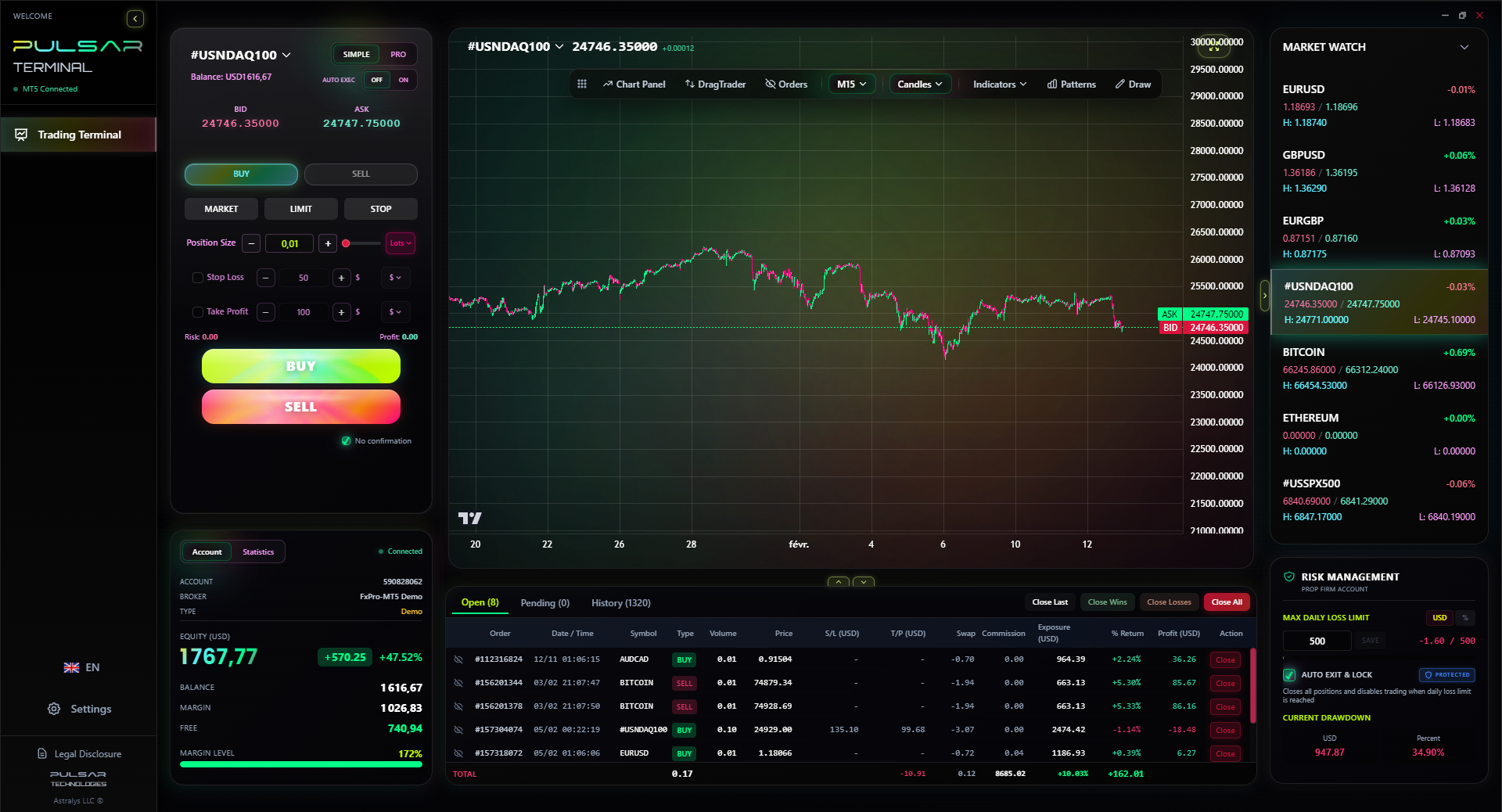
Managing multiple take-profit levels and trailing stops manually is stressful; Pulsar Terminal automates these advanced order types directly on your MT5 platform.
Pulsar Terminal
Lo strumento MT5 tutto-in-uno: ordini drag-and-drop, multi-TP/SL, trailing stop, grid trading, Volume Profile e protezione prop firm. Usato da oltre 1.000 trader ogni giorno.
Let me be the cautionary tale. Here are my most expensive lessons, paid for in real Naira.
Pitfall 1: Changing Timeframes to Justify a Bad Trade. I entered a sell on Gold (XAU/USD) based on the 1-hour chart. It immediately went against me. Instead of admitting I was wrong and taking the small loss, I switched to the 4-hour chart, then the daily, looking for a reason to hold on. 'Look, the daily trend is still bearish!' I thought. I ignored the clear buying momentum on the lower timeframe. The loss grew from a planned $50 to over $300. The lesson: Enter and exit on the same timeframe you used for your analysis.
Pitfall 2: Not Accounting for Spread on Entry/Exit. I developed a scalping strategy that aimed for 7-pip profits. Backtested, it looked great. In live markets, I kept hitting 5-pip profits or small losses. Why? I forgot to account for the 2-pip spread. My '7-pip target' was actually a 5-pip move after costs. My edge was illusory. Always deduct the typical spread from your expected profit target when calculating your risk-reward.
Pitfall 3: Overtrading During Quiet Periods. The Asian session can be slow. Boredom is a trader's enemy. I'd start looking at minor pairs, drawing lines everywhere, and convincing myself I saw a pattern. I'd take low-probability trades just to 'do something.' These trades almost always lost. Now, if the market is quiet, I step away. I use that time to review my journal or study macroeconomic calendars. Action for the sake of action is a tax on your account.
Pitfall 4: Ignoring the True Cost of a 'Free' VPS. Many prop firms or brokers offer 'free' VPS (Virtual Private Server) for faster trade execution. What they don't tell you is that running a trade platform 24/7 on a VPS can lead to slippage or missed connections if the server is overloaded. For swing trades, it's fine. For scalping, it can be the difference between a win and a loss. Sometimes, paying for a dedicated, high-quality VPS is a necessary business expense.
“Complexity is the enemy of execution. You don't need 20 indicators.”
You can't play the game if you don't know the rules. Here are the core terms from this forex wiki you must understand cold.
- Pip: The smallest price move a currency pair can make. For most pairs, it's 0.0001. If EUR/USD moves from 1.0850 to 1.0851, it moved 1 pip. It's how you measure profit and loss. Learn the full details on our pip definition page.
- Spread: The difference between the Bid (sell) price and the Ask (buy) price. It's the broker's commission. A 1.2-pip spread on EUR/USD means the price has to move 1.2 pips in your favor just to break even. More on spread here.
- Lot Size: A standard lot is 100,000 units of the base currency. A mini lot is 10,000, a micro lot is 1,000. This determines how much each pip movement is worth in your account currency.
- Margin: The collateral you need to open and hold a leveraged position. It's not a cost, it's a good-faith deposit.
- use: Borrowed capital from your broker to control a larger position. Expressed as a ratio (e.g., 1:100).
- Stop-Loss (SL): An order to automatically close a losing trade at a predetermined price to limit risk.
- Take-Profit (TP): An order to automatically close a winning trade at a predetermined price to secure profit.
- Going Long: Buying a currency pair, betting its value will rise.
- Going Short: Selling a currency pair, betting its value will fall.
Understanding these isn't academic. It's the difference between saying "I lost money" and knowing exactly how and why you lost: "I risked 1.5% on a micro lot, my stop-loss was 15 pips away, but the spread widened during the news and I was stopped out prematurely." That level of clarity is where learning begins.
💡 Consiglio di Winston
The most important line on your chart isn't a trendline; it's the horizontal line marking your pre-determined stop-loss.
Ready to start? Don't jump in. Walk through this list.
- Education First: Spend at least 3 months learning. Not from Instagram gurus, but from established sources. Understand charts, economic calendars, and risk management. Paper trade.
- Broker Selection: Research and choose a reputable, internationally regulated broker that accepts Nigerian clients and crypto deposits. Verify their license.
- Start Small: Fund your live account with an amount you are 100% prepared to lose. This is your tuition fee. NGN 50,000-100,000 is a sensible start. Not NGN 1,000,000.
- Define Your Strategy: Choose one trading style and one or two currency pairs. Master them. Don't jump from EUR/USD to USD/JPY to Gold in one day.
- Implement Risk Rules: Set your 1% risk rule. Use the position size calculator for every trade. Place your SL and TP immediately when you enter.
- Keep a Journal: Record every trade: entry/exit, reason, screenshot, emotional state. Review it weekly. This is your single best tool for improvement.
- Plan for Taxes: Open a separate savings pot. Put 10% of every net withdrawal into it. When FIRS comes calling, you're ready.
Trading from Nigeria is a marathon with unique hurdles. It's not easy, but it is possible with extreme discipline, continuous learning, and a brutally honest assessment of your own mistakes. This forex wiki is your starting point. Now, go do the work.
FAQ
Q1Do I need to pay tax on forex trading profits in Nigeria?
Yes. The FIRS levies a 10% Capital Gains Tax on your gross forex trading profits. This is a legal requirement for Nigerian tax residents, regardless of where your broker is located.
Q2What is the best way to fund my forex trading account from Nigeria in 2026?
The most reliable method is via cryptocurrency (typically USDT). Convert your Naira to USDT on a local P2P platform, then transfer the USDT to a crypto-friendly international broker. Direct bank card deposits to offshore brokers are often blocked or limited.
Q3Is forex trading a scam in Nigeria?
Forex trading as a global financial market is not a scam. However, the space in Nigeria is rife with scam brokers, fake educators, and get-rich-quick schemes. Trading with an unregulated 'bucket shop' broker is a scam. The activity itself is legitimate if done through proper, regulated channels with realistic expectations.
Q4How much money do I need to start forex trading in Nigeria?
You can start with a very small amount due to micro and nano accounts. Many brokers allow you to open an account with as little as $10 (approx. NGN 15,350). However, a more practical starting capital that allows for sensible risk management is between $100 and $500 (NGN 153,500 - 767,500). Remember, you should only risk money you can afford to lose completely.
Q5Which forex broker is best for Nigerians?
There is no single 'best' broker. The best broker for you is one that is regulated by a top-tier authority (like FCA, ASIC), offers reliable crypto deposit/withdrawal options, has competitive spreads on the pairs you trade, and provides a stable trading platform. It's crucial to do your own research on brokers like Exness, IC Markets, or XM to see which fits your specific needs.
Q6Can I trade forex with my phone in Nigeria?
Absolutely. Most brokers offer full-featured mobile apps for MT4/MT5. This is actually a major advantage, allowing you to monitor trades and manage positions even during power outages (with mobile data). However, for deep chart analysis, a computer is still recommended.
Q7What time does the forex market open in Nigeria?
The forex market is open 24 hours a day from Monday to Friday. The key trading sessions are: Asian (Tokyo) session starts around 1:00 AM Nigerian time, London session starts around 8:00 AM, and the New York session starts around 2:00 PM. The most volatility often occurs during the London/New York overlap (2 PM - 5 PM Nigerian time).
Lezione del Prof. Winston
Punti chiave:
- ✓Risk a maximum of 1% per trade, no exceptions.
- ✓Factor in the 4-5% P2P premium on deposits.
- ✓Set aside 10% of profits immediately for tax.
- ✓Trade your plan, not Naira volatility headlines.
- ✓Choose FCA/ASIC regulated brokers only.
Quanto è stato utile questo articolo?
Clicca su una stella
Analisi Trading Settimanali
Analisi e strategie settimanali gratuite. Nessuno spam.
Sull'autore
Olumide Adeyemi
Pioniere del Trading in Africa Occidentale
Uno degli educatori di trading forex più attivi in Nigeria. 8 anni di esperienza di trading da Lagos. Specializzato in strategie a basso capitale e sfide prop firm per trader africani.
Commenti
Avviso di rischio
Il trading di strumenti finanziari comporta rischi significativi e potrebbe non essere adatto a tutti gli investitori. Le performance passate non garantiscono risultati futuri. Questo contenuto è fornito solo a scopo educativo e non deve essere considerato un consiglio di investimento. Conduci sempre le tue ricerche prima di fare trading.
Potrebbe interessarti anche

Cara Trading Forex Sukses: 7 Prinsip dari Trader Profesional
Cara trading forex sukses dengan 7 prinsip trader pro: manajemen modal, disiplin, journal trading, backtest. Data nyata, bukan janji profit palsu.
Jam Trading Forex Terbaik untuk Trader Indonesia: Panduan Lengkap dengan Tabel Waktu
Panduan jam trading forex untuk trader Indonesia. Tabel 4 sesi dunia, jam emas 20:00-00:00, sesi mana yang harus dihindari. Data akurat + tips dari trader berpengalaman.
Top 5 Sàn Forex Uy Tín Nhất 2026: Review Jujur dari Trader Indonesia
Top 5 sàn forex uy tín 2026 untuk trader Indonesia. Review jujur: spread, deposit, withdraw, dukungan lokal. Exness, XM, IC Markets & lebih.
Scarica Pulsar Terminal
Tutti questi calcolatori sono integrati in Pulsar Terminal con dati in tempo reale dal tuo conto MT5.
Scarica Pulsar Terminal