


My screen was a sea of red.

David van der Merwe
Trader dei Mercati Emergenti ·  South Africa
☕ 10 min di lettura
Cosa imparerai:
- 1What Exactly is a Funded Forex Account? (It's Not a Broker)
- 2The South African Reality: Regulation, Rands, and Getting Paid
- 3Inside the Prop Firm Challenge: The Rules That Make or Break You
- 4The Real Numbers: Fees, Splits, and What You Actually Take Home
- 5Trading Strategies That Actually Pass (And Keep) Funded Accounts
- 6You Passed! Now, How to Not Blow Your Funded Account
- 7Picking a Prop Firm: What to Look For in South Africa

My screen was a sea of red. It was March 2020, and the EUR/USD had just ripped through my stop loss, taking out a 2.5% chunk of my personal account. I was frustrated, undercapitalized, and stuck. That loss, about R4,000 at the time, was the final push I needed. I stopped trying to scrape together more of my own money and started looking seriously at other people's capital. That's the promise of a funded forex account: trading significant size without risking your life savings. But here in SA, with our unique market and regulations, it's not as simple as just signing up. Let me walk you through what it really takes, the good and the ugly, from someone who's been through the evaluation grind and come out the other side.
First things first, let's clear up a major point of confusion. A funded account doesn't come from your standard broker like Exness or IC Markets. Those are for your own money. A funded account is offered by a proprietary trading firm, or 'prop firm'. Their business model is simple: they find talented traders and give them capital. In return, they take a cut of the profits.
You don't just get the capital, though. You have to prove you can handle it first. This is where the 'challenge' or 'evaluation' comes in. You pay a one-time fee (think of it as an audition fee) to trade a simulated account with specific rules. Pass those rules, and you 'graduate' to a live, funded account with the firm's real money.

Warning: That fee is gone, no matter what. It's a sunk cost to enter the evaluation. It doesn't get added to your account, and you don't get it back if you fail. I learned this the hard way on my first attempt, blowing R1,200 on a challenge because I treated it like a demo account. It's not. The psychological pressure is real.
The appeal for us in South Africa is massive. You can access $10,000, $50,000, even $200,000 in trading capital without converting and risking huge amounts of your own ZAR. You're trading the firm's capital, so your maximum loss is limited to that initial challenge fee. Your potential profit, however, is a share of the much larger gains you make.
This is where you need to pay close attention. The prop firm space is largely unregulated, both globally and here. The Financial Sector Conduct Authority (FSCA) regulates brokers, but most prop firms aren't classified as brokers. They're often registered as financial technology or software companies. This doesn't automatically mean they're scams, but it does mean you have less regulatory protection.
Payment Methods and Currency
You'll almost always pay your challenge fee in US Dollars. Luckily, most firms accept ZAR payments via credit/debit card or local EFT through payment processors. When you get paid your profit split, it typically comes in USD via platforms like PayPal, Skrill, or direct wire transfer. You'll then convert it to ZAR through your bank or a forex service. Factor in those conversion fees and the bank's spread; they can eat into your profits.
Tax Implications
This is critical. The South African Revenue Service (SARS) sees your profit share from a funded account as income. It's not capital gains from your personal investments. You must declare this income in your annual tax return. I keep a detailed log of every single payout for this reason. Don't get caught out thinking it's 'free money' – SARS will want their share.

Pro Tip: Before you pay a cent to any prop firm, search the FSCA's warning list. If a firm is promising guaranteed returns or sounds like a pyramid scheme, it probably is. Stick with the well-known, established names that have been around for a few years and have transparent payout records.
“The evaluation fee isn't a deposit; it's a sunk cost for an audition. Treat it as such.”
This is the gatekeeper. Every firm has slightly different rules, but the core principles are universal. They're designed to see if you can manage risk consistently, not just hit a lucky trade.
1. The Profit Target: This is the most straightforward. You might need to make 8% or 10% profit on the evaluation account. But here's the catch: you usually have to do it within a time limit, like 30 days.
2. The Daily Loss Limit: This is the killer for most new traders. It's usually around 5% of your account's starting balance. If your account equity drops 5% from the starting balance or from the previous day's closing balance, you fail. This forces you to cut losses immediately. You can't just ride out a bad day hoping it turns around.
3. The Maximum Drawdown: This is your overall loss limit, often set at 10%. Your account equity (balance + floating P/L) can never fall more than 10% below the starting balance. This rule, combined with the daily loss, is what makes a scalping strategy so popular for these challenges – it keeps risk per trade tiny.
My Personal Experience: I passed a $50,000 challenge with a 10% profit target. My strategy was simple: I only aimed for 0.5% per day. I used a strict position size calculator to ensure no single trade could lose more than 1% of the account. I hit the target in 14 trading days by being boring and consistent. The temptation to go for a 'home run' trade when you're at 9.5% is immense, but that's how you trigger the max drawdown rule and blow it.

💡 Consiglio di Winston
Your first goal in a challenge isn't to hit the profit target. It's to survive the first week without touching the daily loss limit. Survival first, profits second.
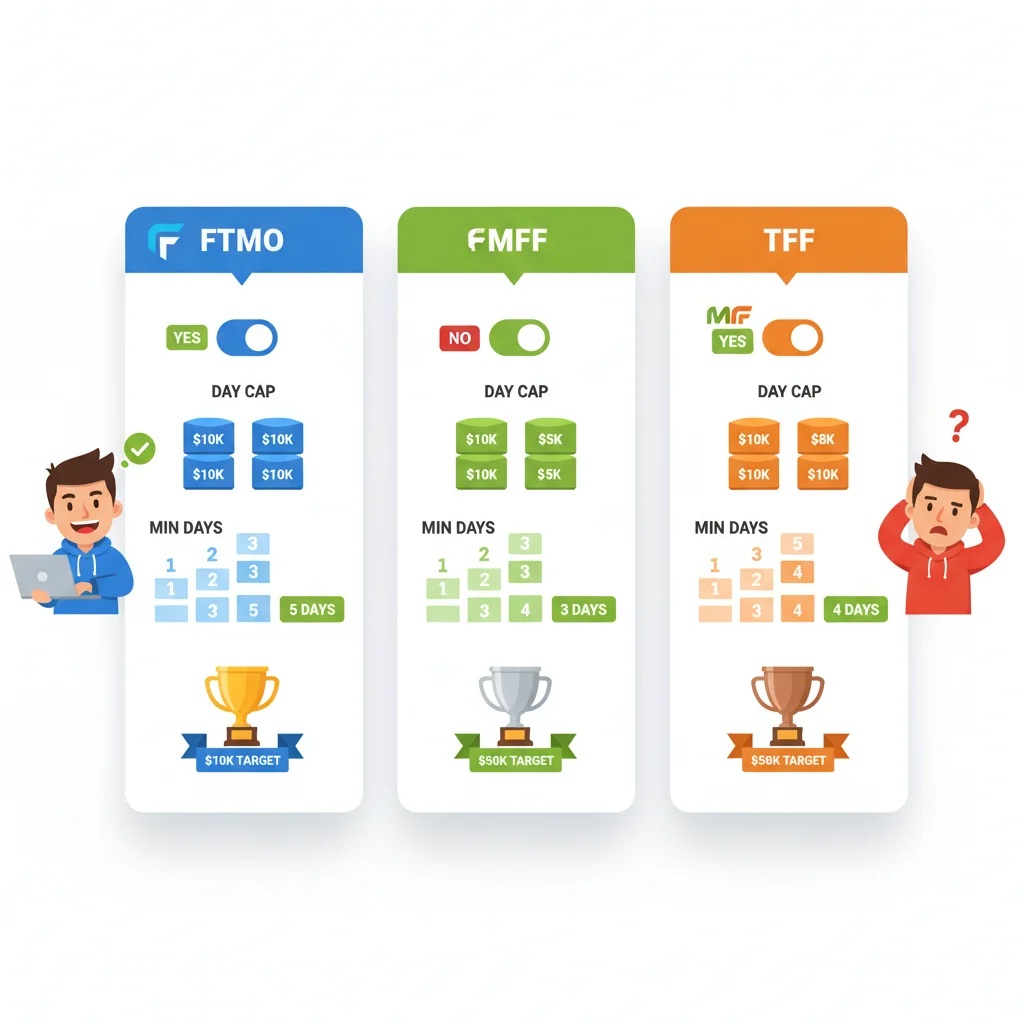
Let's talk numbers, because this is where the marketing gloss meets reality.
The Challenge Fee: This is your ticket. For a $10,000 account, it might be $99. For a $100,000 account, it could be $500. Some firms offer monthly subscription models instead. There are often discounts or 'free retry' offers if you fail but come close.
The Profit Split: Once funded, you don't get to keep 100% of what you make. The standard split starts at 80/20 in your favor for the first few payouts. After proving yourself, it can scale to 90/10. Some firms even offer 100% for top performers. The firm takes their cut first, then you get paid.
Other Hidden Costs:
- Platform Fees: Some firms charge a small monthly fee for the trading platform (MT4/MT5), but many don't.
- Inactivity Fees: If you don't trade for a month or two, you might get charged.
- Data Fees: For certain markets, you might pay for live data feeds.

Example: Let's say you pass a $50,000 challenge. You make a 6% profit in your first month, which is $3,000.
- With an 80/20 split, the firm takes $600.
- Your share is $2,400 (USD).
- Converted to ZAR at, say, R18.50/$, that's R44,400.
- Minus bank fees and potential tax. That's your real take-home. It's not the full $3,000, but it's trading with only your initial $250 challenge fee at risk.
“Passing the challenge is just the license. Now you have to drive the car without crashing it.”
You can't just use your usual strategy. You have to adapt to the challenge rules, especially the daily loss limit. Here’s what works.
Scalping and Day Trading: This is the most common path. Small, frequent profits that add up while keeping drawdown extremely tight. The key is a high win rate strategy with a positive risk-reward. You're managing the daily loss limit every single day. A tool like a MACD indicator or RSI indicator on lower timeframes can be useful here, but discipline is everything.
Swing Trading with Tighter Stops: If you're a swing trading fan, you can still make it work. But your position sizing must be much smaller than you're used to. A 2% stop loss on a personal account might be fine, but on a prop challenge, that's half your daily loss allowance in one trade. You'd need to reduce your stop to 0.5% or 1% and adjust your position size accordingly.
The Mental Shift: The biggest change isn't technical, it's psychological. You're not trading to get rich on one trade. You're trading to pass a test. Your goal is consistency and survival. I had a perfect setup on XAU/USD during my challenge, but it would have required a 2.5% stop loss. I skipped it. It went on to be a winner, but taking it would have violated my number one rule: protect the account first.
Managing multiple take-profit levels and trailing stops manually on MT5 is a hassle during fast markets. This is where automation or smart tools save you from emotional mistakes.
Congratulations are premature. Passing the challenge is just the license. Now you have to drive the car without crashing it. The rules usually relax slightly, but the core principles remain. The biggest trap is what I call 'funded account syndrome'.
You've been trading ultra-conservatively for a month to pass. Now you have real capital. The urge to 'let it ride' on a big idea is overwhelming. This is how 80% of people lose their funded status in the first three months. They forget the discipline that got them there.
The Scaling Plan: Most firms will increase your capital if you perform well over 3-6 months. This should be your new goal, not a single massive payout. Aim for consistent 3-5% months, not a 30% moonshot.
Withdrawals: Withdraw your profit share regularly. It does two things: it locks in your gains so you can't lose them back, and it gives you a psychological reward. Seeing real money hit your South African bank account is the ultimate validation.
Ongoing Rules: You'll still have a maximum drawdown limit (often increased to 12-15%) and a daily loss. A trailing stop or breakeven function becomes your best friend here to lock in profits on winning trades and protect the account from turning winners into losers. Without automated tools, you're glued to the screen.
I made this mistake early on. I passed a challenge, made a 4% profit in week one, got overconfident, and took a huge position on a EUR/USD news play. The spread widened massively, I got stopped out for a 6% loss in seconds, and hit my daily and max drawdown. Account lost. All that work, gone because I got greedy with 'their' money. It felt like my money at that point, but it wasn't.
💡 Consiglio di Winston
When you get funded, withdraw your first profit share immediately. It changes the psychology from 'playing with the firm's money' to 'securing my income.'

Managing the strict daily loss and drawdown rules of a prop firm is a full-time job, which is why automating your trade management with Pulsar Terminal is a game-saver.
Pulsar Terminal
Lo strumento MT5 tutto-in-uno: ordini drag-and-drop, multi-TP/SL, trailing stop, grid trading, Volume Profile e protezione prop firm. Usato da oltre 1.000 trader ogni giorno.

“The prop firm doesn't want a hero. They want a consistent, boring risk manager.”
With new firms popping up all the time, due diligence is non-negotiable. Here’s your checklist.
| Feature | What to Look For | Red Flag |
|---|---|---|
| Payout Proof | Active, verifiable payout records from real traders on social media or forums. | No public evidence of anyone getting paid. |
| Customer Support | Responsive support, preferably with live chat. Test them before you pay. | Only email support with 5-day response times. |
| Platform & Tools | MT4/MT5 access. Bonus if they allow useful add-ons or have a good user dashboard. | Proprietary, clunky platform you've never heard of. |
| Rule Clarity | Clear, easy-to-understand rules for the challenge and funded stage. | Vague rules that seem open to interpretation. |
| Underlying Broker | Do they disclose who their liquidity provider/broker is? Is that broker reputable? | Complete secrecy about where the trades are executed. |
Stick with the Majors: For your first attempt, use one of the larger, internationally recognized firms. They have a reputation to uphold. While exploring reviews for brokers like XM or Pepperstone is good for your own accounts, for prop firms, look for dedicated review sites and trader communities.
Final Thought: A funded forex account isn't a lottery ticket. It's a professional audition. It rewards the disciplined, the patient, and the risk-averse. For a South African trader, it can be a legitimate path to trading larger capital without the forex reserve limits and heavy personal risk. But go in with your eyes open, respect the rules, and never forget that the goal is to be a consistent profit-maker, not a hero.
FAQ
Q1Is a funded forex account legal in South Africa?
Yes, participating in a proprietary trading firm's program is legal. However, the firms themselves are often not directly regulated by the FSCA as brokers. You are entering a contractual agreement with a company, so it's crucial to choose a reputable one. Always check the FSCA's public warnings list first.
Q2How much does it cost to get a funded account?
You don't buy the account. You pay a one-time evaluation fee, which is typically between $50 and $1,000 depending on the account size you're challenging for ($10k to $200k+). This fee is non-refundable and is your only financial risk if you fail the challenge.
Q3Can I use a robot or EA to pass the challenge?
Most prop firms explicitly forbid the use of fully automated trading systems (EAs) during the evaluation phase. They want to assess your trading skill and risk management. Some allow them on the live funded account, but it's rare for the challenge. Always read the rules.
Q4What's the difference between a daily loss and maximum drawdown?
A daily loss limit measures your loss from the previous day's closing balance. A maximum drawdown measures your total loss from the account's starting balance. You can violate the daily limit in a single bad day. You violate the max drawdown through a series of losses over time. Both will fail you.
Q5How and when do I get paid from a funded account?
Payouts are usually monthly. You request a withdrawal of your profit share (e.g., 80% of the profits you made that month). The firm processes it, often within 5-10 business days, and sends it to you via PayPal, Skrill, or bank wire in USD. You then convert it to ZAR.
Q6What happens if I hit the profit target very quickly?
Great job! Most firms will still require you to complete the minimum trading period (often 5-10 trading days) to prove consistency. You can't just make one huge trade and stop. You must continue trading (often with very small sizes) until the minimum days are met, without breaking any other rules.
Q7Can I lose more money than my challenge fee?
No. Your maximum loss is always limited to the fee you paid for the evaluation. When you are trading the live funded account, you are trading the firm's capital. If you blow that account, you lose the account, but you don't owe the firm any money beyond your initial fee.
Lezione del Prof. Winston
Punti chiave:
- ✓Your max risk is the challenge fee, never more.
- ✓The daily loss limit is your #1 rule, not the profit target.
- ✓Scale profits slowly; greed blows more accounts than bad analysis.
- ✓Withdraw profits regularly to make them real and reset your mindset.
Quanto è stato utile questo articolo?
Clicca su una stella
Analisi Trading Settimanali
Analisi e strategie settimanali gratuite. Nessuno spam.
Sull'autore
David van der Merwe
Trader dei Mercati Emergenti
Trader con base a Johannesburg con 11 anni di esperienza nelle valute dei mercati emergenti. Specializzato in coppie ZAR, trading regolamentato dalla FSCA e analisi del mercato sudafricano.
Commenti
Avviso di rischio
Il trading di strumenti finanziari comporta rischi significativi e potrebbe non essere adatto a tutti gli investitori. Le performance passate non garantiscono risultati futuri. Questo contenuto è fornito solo a scopo educativo e non deve essere considerato un consiglio di investimento. Conduci sempre le tue ricerche prima di fare trading.
Potrebbe interessarti anche

Cara Trading Forex Sukses: 7 Prinsip dari Trader Profesional
Cara trading forex sukses dengan 7 prinsip trader pro: manajemen modal, disiplin, journal trading, backtest. Data nyata, bukan janji profit palsu.
Jam Trading Forex Terbaik untuk Trader Indonesia: Panduan Lengkap dengan Tabel Waktu
Panduan jam trading forex untuk trader Indonesia. Tabel 4 sesi dunia, jam emas 20:00-00:00, sesi mana yang harus dihindari. Data akurat + tips dari trader berpengalaman.
Top 5 Sàn Forex Uy Tín Nhất 2026: Review Jujur dari Trader Indonesia
Top 5 sàn forex uy tín 2026 untuk trader Indonesia. Review jujur: spread, deposit, withdraw, dukungan lokal. Exness, XM, IC Markets & lebih.
Scarica Pulsar Terminal
Tutti questi calcolatori sono integrati in Pulsar Terminal con dati in tempo reale dal tuo conto MT5.
Scarica Pulsar Terminal