


You've seen the ads, right? 'Trade with 1:500 use and turn R1,000 into R500,000!' It sounds like a shortcut to a beach house in Umhlanga.

David van der Merwe
Trader dei Mercati Emergenti ·  South Africa
☕ 9 min di lettura
Cosa imparerai:
- 1use 101: It's Just Borrowed Money (With Strings Attached)
- 2Decoding the Ratios: From 1:10 to 1:2000
- 3The Local Rules: What the FSCA Says About use
- 4Putting It in Rands: Two Trade Examples
- 5How to Use use Without It Using You
- 6Common use Pitfalls (I've Fallen Into Most of These)
- 7use by Trading Style: Scalping vs. Swing Trading
You've seen the ads, right? 'Trade with 1:500 use and turn R1,000 into R500,000!' It sounds like a shortcut to a beach house in Umhlanga. But before you get carried away, let's get real. How does use work in forex, and more importantly, how can it work for you without wiping out your hard-earned rands? I've been on both sides of this trade - I've made a month's salary in an afternoon, and I've also watched a position evaporate my profits in minutes because I got greedy with the use slider. Let's break it down, from the JSE to your broker's platform.
At its core, use is simply using borrowed capital to increase your potential return. In forex, your broker lends you money to control a much larger position than your account balance would normally allow. Think of it like buying a car. You put down a R50,000 deposit (your margin) to drive off with a R500,000 car (your position). The bank (your broker) fronts the rest. That's 1:10 use.
In trading terms, if you have R10,000 in your account and use 1:50 use, you can control a position worth R500,000. Every price movement is magnified 50 times on your profit or loss relative to your initial capital. This is the fundamental answer to 'how does use work in forex?' It's an amplifier.

Warning: This borrowed money isn't free. The 'strings attached' are called a margin call. If your trade moves against you and your losses eat into the required margin, your broker will automatically close your position to protect their loan. It's not a suggestion; it's a forced exit.
I learned this the hard way early on. I went long on USD/ZAR with most of my account at 1:100 use. A sudden bout of rand strength caused a 1% move against me. On the full position, that was a 1% loss. But on my margin? That 1% market move translated to a 100% loss of my trading capital. Poof. Gone. I was left staring at a screen, wondering what just happened. That's use in its most brutal form.

💡 Consiglio di Winston
Your first adjustment on any losing trade should be to check if you used too much use, not to question your analysis.
You'll see use offered as a ratio. Here’s what those numbers actually mean for your trade size.
| use Ratio | Margin Required | What R10,000 Can Control |
|---|---|---|
| 1:10 | 10% | R100,000 |
| 1:50 | 2% | R500,000 |
| 1:100 | 1% | R1,000,000 |
| 1:500 | 0.2% | R5,000,000 |
The Sweet Spot (It's Lower Than You Think)
For most retail traders, especially when starting, 1:50 to 1:100 is more than enough. It gives you flexibility without insane risk. Using 1:500 or higher is like driving a F1 car to the Pick n Pay - overpowered for the task and likely to end in a crash. I use 1:30 for my core swing trading positions. It lets me sleep at night.
Why Brokers Offer Crazy High use
Offshore brokers might offer 1:1000 or even 1:2000. It's a marketing tool to attract clients who confuse high use with high skill. Remember, their risk systems are designed to liquidate you before they lose money. That ultra-high use just gets you to that margin call point faster. A good broker like IC Markets or Pepperstone offers sensible maximums (like 1:500) with strong execution.

Pro Tip: Your use setting is not a badge of honour. The best traders I know use the lowest use that allows them to execute their strategy effectively. They grow their account through consistency, not reckless magnification.
“use doesn't improve a bad trade; it just makes the funeral more expensive.”
This is critical for South African traders. The Financial Sector Conduct Authority (FSCA) regulates brokers operating here to protect you. As of now, the FSCA has not implemented hard use caps like the EU's 1:30 for major pairs. However, they mandate strict risk warnings and require brokers to assess a client's knowledge and experience.
In practice, this means:
- A locally licensed broker (like one registered with the FSCA) will ask you about your trading experience, income, and risk tolerance before approving you for high use.
- They are required to provide clear warnings about the risks of leveraged trading.
- The responsibility is shared. You can't just click 'I agree' and plead ignorance later.
Many South Africans also use globally regulated brokers (like the ASIC-regulated Pepperstone). These entities often apply the stricter rules of their home jurisdiction. The key takeaway? Just because you can access 1:500 use from an offshore entity doesn't mean you should. Always check who regulates your broker. An FSCA-registered broker has to play by local rules and offers a clearer path for dispute resolution if something goes wrong.
Let's make this concrete with the South African rand. Assume your account balance is R20,000.
Example 1: The Conservative Trade (USD/ZAR)
- You buy 1 standard lot of USD/ZAR (ZAR 1,000,000).
- At 1:50 use, required margin is roughly R20,000 (ZAR 1,000,000 / 50).
- USD/ZAR moves from 18.5000 to 18.6000, a 1000 pip gain.
- Profit: 1000 pips * ZAR 10 per pip (for USD/ZAR) = R10,000 profit.
- Return on your used margin: (R10,000 / R20,000) = 50%.
That's a fantastic trade. You used your entire account as margin for one position (risky, but let's assume it was part of a plan).
Example 2: The Reckless Trade (EUR/USD)
- You buy 5 standard lots of EUR/USD (EUR 500,000) with the same R20,000.
- At 1:500 use, required margin is only about R1,400. You think, 'Great! I have plenty left.'
- EUR/USD drops by 40 pips (from 1.0800 to 1.0760).
- Loss: 5 lots * 40 pips * $10 per pip = $2,000 loss (approx. R36,000).
See the problem? Your loss (R36,000) exceeds your entire account balance (R20,000). Your broker's system will have liquidated you long before the loss got that big to protect themselves. You'd be looking at a total loss of your R20,000 account. This is why using a position size calculator is non-negotiable. It bases your lot size on your risk, not your available use.
💡 Consiglio di Winston
If you feel a thrill when you open a highly leveraged position, that's not confidence. It's gambling adrenaline. Dial it down.
“The best traders use the lowest use that allows them to execute their strategy.”
use is a tool. A chainsaw can build a house or cut your leg off. Here’s how to be a carpenter, not a casualty.
Rule 1: Risk Per Trade is King
Decide what percentage of your account you're willing to lose on a single trade before you even look at the chart. For me, it's never more than 1-2%. If I have a R50,000 account, my maximum risk is R1,000 per trade. I then use my stop-loss distance to calculate the correct position size. This automatically limits my effective use.
Rule 2: Lower use, Higher Sleep Quality
Set your account use to a maximum of 1:100. This acts as a speed governor. You can still use less (e.g., trade a 0.5 lot instead of a 5 lot), but you can't accidentally go to 1:500 in a moment of madness.
Rule 3: Understand Correlation
Going long on USD/ZAR and short on EUR/USD at high use is effectively a double bet on dollar strength. If you're wrong, losses compound fast. It's not diversification.

Example: You risk 1% on a USD/ZAR trade. You then open a similar-sized trade on GBP/ZAR, thinking it's a different pair. But both are driven by global dollar sentiment and rand volatility. You're not risking 1% + 1% = 2%. In a risk-off event, they could both move against you in sync, and your effective risk could be closer to 4-5%. This is where a tool that helps you visualize exposure is key.
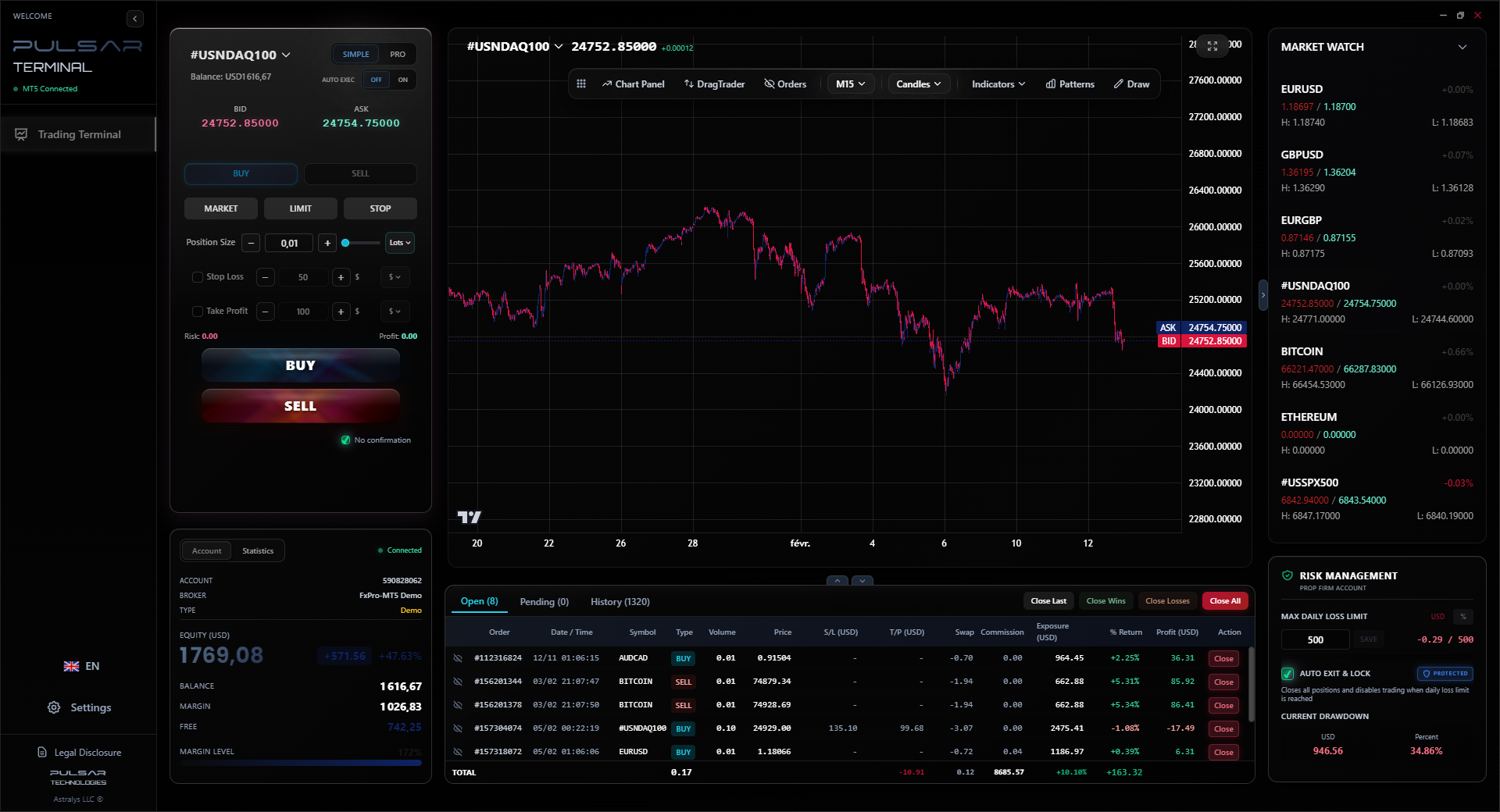
Managing multiple trades and their collective risk is where discipline meets technology. Setting individual stop-losses is step one. Having a dashboard that shows your total account exposure and can automate advanced exit strategies - like moving stops to breakeven or trailing a stop - is what separates the pros from the hopefuls. This kind of active trade management is crucial when using use.
When managing multiple leveraged trades, manually adjusting stops and tracking total exposure is a nightmare; Pulsar Terminal automates trailing stops, breakeven moves, and shows your real-time risk across all positions right on your MT5 chart.
Pulsar Terminal
Lo strumento MT5 tutto-in-uno: ordini drag-and-drop, multi-TP/SL, trailing stop, grid trading, Volume Profile e protezione prop firm. Usato da oltre 1.000 trader ogni giorno.
Let me save you some money and heartache.
Pitfall 1: Overleveraging on 'Sure Things'. There's no such thing. I once piled into a gold (XAU/USD) breakout with 1:200 use because the setup looked perfect. A false spike reversed and took out my stop, nuking 8% of my account in seconds. The setup was good, but my use was suicidal.
Pitfall 2: Adding to a Losing Position (Averaging Down). This is the quickest way to turn a small loss into a margin call. Doubling your position size to lower your average entry price also doubles your risk. It's an ego play, not a trading strategy.
Pitfall 3: Ignoring Volatility. The USD/ZAR can move 200 pips on a busy news day. The EUR/CHF might move 20. Using the same lot size and use on both is insane. Adjust your position size for the instrument's typical volatility. A calm pair like EUR/USD might handle slightly higher use than the wild rand pairs.
Pitfall 4: Confusing use with Buying Power. Just because you can open a R5 million position doesn't mean you should. Your available buying power is not a target to be used. Leave most of it unused, like an emergency fund.
The antidote to all these pitfalls is a written trading plan that specifies your maximum use, risk per trade, and the conditions for entry and exit. Your plan is your boss. use is the excitable intern.
💡 Consiglio di Winston
Treat your maximum use setting as a personal law. Write it in your trading plan and never, ever break it. No exceptions.
“High use on a small account doesn't increase your potential, it just shortens your timeline to zero.”
Your trading strategy should dictate your use, not the other way around.
For Scalpers (scalping strategy): Scalpers aim for small, frequent profits (5-10 pips). Because their profit target is small, they often use higher use (e.g., 1:100 to 1:200) to make those small moves meaningful in rand terms. However, their stop-losses are equally tight. The risk (in pips) is controlled, so the higher use is applied to a very small price range. It's high-wire act and requires intense focus and discipline.
For Swing Traders (swing trading): This is my home base. Swing trades hold for days to weeks, aiming for moves of 100-300 pips. Because the potential gain is larger, you don't need high use. I typically use 1:20 to 1:50. The wider stop-loss (to withstand market noise) means a highly leveraged position would require a massive margin commitment and create unbearable equity swings. Lower use lets you breathe and hold the trade through normal retracements.
For Long-Term Investors: If you're taking a multi-month view on a currency, use use of 1:10 or less. You're not trying to maximize short-term returns; you're trying to get a leveraged exposure to a long-term trend without getting shaken out by volatility. Your enemy here is the swap/rollover cost, not daily fluctuations.
FAQ
Q1What is the maximum legal use in South Africa?
The FSCA hasn't set a specific numerical cap like some other regions. Instead, they require brokers to assess client suitability and provide clear risk warnings. In practice, FSCA-licensed brokers may offer up to 1:100 or 1:200 for retail clients, but you'll have to demonstrate knowledge to access the higher end. The real limit is your own risk management, not the regulator's rulebook.
Q2Can I lose more money than I deposit with use?
With a reputable broker that has automatic liquidation (margin call) procedures, you generally cannot lose more than your account balance. Their system will close your positions before your loss exceeds your deposited funds. However, in extreme market gaps (like a major news event that opens the market far beyond your stop-loss), it's theoretically possible to have a negative balance. Most major brokers now offer negative balance protection as a standard feature to prevent this.
Q3Is 1:500 use too high for a beginner?
Absolutely, yes. It's a trap. Beginners should start with a demo account and then use real money with use no higher than 1:20 or 1:30. This forces you to focus on learning analysis and risk management, rather than getting addicted to the adrenaline rush of massive, fleeting gains (and inevitable losses).
Q4How is use different from margin?
They are two sides of the same coin. use is the ratio (e.g., 1:50). Margin is the amount of your own money you must put up to open that leveraged position. If you want to control R500,000 with 1:50 use, your required margin is R500,000 / 50 = R10,000. Margin is your collateral for the loan.
Q5Should I use high use on a small account?
This is the most tempting mistake. The thinking is 'I need high use to grow my small account quickly.' In reality, high use on a small account simply increases the speed at which you are likely to blow it up. It's better to grow a small account slowly with disciplined, low-use trades than to vaporize it trying to get rich overnight.
Q6Do professional traders use high use?
Rarely in the way retail traders imagine. Institutional traders might use use, but it's calculated based on massive capital pools and sophisticated risk models. A prop firm trader might use higher use, but they are also often subject to strict daily loss limits (e.g., 5% of their allocated capital). The common thread is controlled, calculated risk, not maximum available use.
Lezione del Prof. Winston
Punti chiave:
- ✓Start with use no higher than 1:30 on a live account.
- ✓Never risk more than 2% of your capital on a single trade.
- ✓Use a position size calculator for every entry.
- ✓Higher use is needed for scalping, lower for swing trading.
Quanto è stato utile questo articolo?
Clicca su una stella
Analisi Trading Settimanali
Analisi e strategie settimanali gratuite. Nessuno spam.
Sull'autore
David van der Merwe
Trader dei Mercati Emergenti
Trader con base a Johannesburg con 11 anni di esperienza nelle valute dei mercati emergenti. Specializzato in coppie ZAR, trading regolamentato dalla FSCA e analisi del mercato sudafricano.
Commenti
Avviso di rischio
Il trading di strumenti finanziari comporta rischi significativi e potrebbe non essere adatto a tutti gli investitori. Le performance passate non garantiscono risultati futuri. Questo contenuto è fornito solo a scopo educativo e non deve essere considerato un consiglio di investimento. Conduci sempre le tue ricerche prima di fare trading.
Potrebbe interessarti anche

Cara Trading Forex Sukses: 7 Prinsip dari Trader Profesional
Cara trading forex sukses dengan 7 prinsip trader pro: manajemen modal, disiplin, journal trading, backtest. Data nyata, bukan janji profit palsu.
Jam Trading Forex Terbaik untuk Trader Indonesia: Panduan Lengkap dengan Tabel Waktu
Panduan jam trading forex untuk trader Indonesia. Tabel 4 sesi dunia, jam emas 20:00-00:00, sesi mana yang harus dihindari. Data akurat + tips dari trader berpengalaman.
Top 5 Sàn Forex Uy Tín Nhất 2026: Review Jujur dari Trader Indonesia
Top 5 sàn forex uy tín 2026 untuk trader Indonesia. Review jujur: spread, deposit, withdraw, dukungan lokal. Exness, XM, IC Markets & lebih.
Scarica Pulsar Terminal
Tutti questi calcolatori sono integrati in Pulsar Terminal con dati in tempo reale dal tuo conto MT5.
Scarica Pulsar Terminal