


Most traders use the RSI completely wrong.

David van der Merwe
Trader dei Mercati Emergenti ·  South Africa
☕ 10 min di lettura
Cosa imparerai:
- 1RSI Basics: What It Really Measures (And What It Doesn't)
- 2Three Practical Ways to Use RSI (Beyond 70/30)
- 3RSI Settings for ZAR Pairs and Our Market Volatility
- 4Common RSI Mistakes (And How to Avoid Them)
- 5Building a System: Combining RSI With Other Tools
- 6The South African Context: FSCA, Brokers & Costs
Most traders use the RSI completely wrong. They see it hit 70, they sell. It hits 30, they buy. And then they watch the trend rip right through their stop-loss while the indicator stays pinned in 'overbought' territory for weeks. I lost a lot of money learning that lesson the hard way. The truth is, the RSI isn't a simple buy/sell signal. It's a momentum gauge, and understanding how it works in forex trading - especially with our volatile ZAR pairs - is what separates the rookies from the consistent performers. Let me show you the right way.
The Relative Strength Index (RSI) was created by J. Welles Wilder back in 1978. That's older than the internet, but it's stuck around for a reason. Forget the complicated name. At its core, it simply measures the speed and size of recent price changes. It spits out a number between 0 and 100.
The standard setting is 14 periods. On a 1-hour chart, that's the last 14 hours. On a daily chart, it's the last 14 days. The formula compares the average gains on 'up' periods to the average losses on 'down' periods over that window. A higher RSI means recent gains have been stronger than recent losses. Simple.
Here's the first big misconception: RSI does NOT measure whether a currency is 'strong' or 'weak' in the fundamental sense. A soaring RSI on USD/ZAR doesn't mean the US economy is crushing South Africa's. It just means the price has been going up fast recently. This is crucial for forex, where prices are relative.

Warning: The 70/30 levels are not magic lines. In a roaring bull trend, like USD/ZAR during a risk-off period, the RSI can camp above 70 for a long time. Selling just because it's 'overbought' is a great way to get run over. I learned this in 2020, shorting USD/ZAR at 16.80 because the RSI was at 78. It proceeded to rally to 19.35. That hurt.
The real value of the basic RSI is identifying when a move might be getting tired, not when it's guaranteed to reverse. Think of it like a car's tachometer. Hitting the redline doesn't mean the engine will blow up immediately, but it tells you you're pushing it hard.

💡 Consiglio di Winston
Professor Winston always said, 'An indicator in overbought territory is like a runner at full sprint. It tells you they're exerting maximum effort, not that they're about to collapse.' Don't bet against strength just because a number is high.
If you only use the overbought/oversold lines, you're using a fraction of the RSI's power. Here are the methods that actually make money.
1. RSI Divergence: Spotting Exhaustion Before the Turn
This is my favourite RSI technique. Divergence happens when the price makes a new high (or low), but the RSI fails to make a corresponding new high (low). It shows the momentum behind the move is fading, even if price hasn't turned yet.
Bullish Divergence: Price makes a lower low, but RSI makes a higher low. Suggests selling pressure is weakening. Bearish Divergence: Price makes a higher high, but RSI makes a lower high. Suggests buying pressure is weakening.
I caught a nice reversal on EUR/USD using this in early 2023. Price made a marginal new high at 1.1035, but the RSI on the 4-hour chart peaked at 65, well below its prior peak of 72. That was a clear bearish divergence. I entered a short at 1.1020 with a stop at 1.1075. The pair dropped 180 pips over the next few days. The divergence gave me the confidence to take the trade against the recent high.
2. The 50 Level as a Trend Filter
This is brutally simple but effective. In an uptrend, the RSI tends to find support around the 40-50 zone. In a downtrend, it finds resistance around the 50-60 zone. A cross above 50 can signal a shift to bullish momentum, while a cross below 50 suggests bearish momentum is taking over. Don't use it as a standalone entry, but use it to filter trades. If you're looking for buys, wait for pullbacks that hold above 40-45 on the RSI. It keeps you trading with the underlying momentum.
3. Failure Swings (The Hidden Gem)
A failure swing is a classic pattern within the RSI itself.
- Bearish Failure Swing: RSI goes above 70, pulls back, rallies again but fails to reach 70, then breaks below its prior pullback low. It's a sell signal.
- Bullish Failure Swing: RSI goes below 30, bounces, dips again but fails to reach 30, then breaks above its prior bounce high. It's a buy signal.
These often occur before price breaks key support or resistance, giving you an early heads-up. They work well on the 1-hour and 4-hour charts for our market hours.

Pro Tip: Combine RSI divergence with a trend-confirming tool like the MACD indicator. If both show divergence, your signal is much stronger. Never rely on RSI alone.
“RSI divergence gave me the confidence to take a trade against a recent price high, and it paid off 180 pips later.”
South African traders have a unique playground: the ZAR pairs. USD/ZAR, EUR/ZAR, GBP/ZAR. They're liquid, but they can move like a springbok on caffeine. The standard 14-period RSI can get extremely whippy on these pairs, especially on lower timeframes.
Here’s what I’ve tested:
- For Scalping USD/ZAR (M5-M15 charts): A shorter period like 7 or 9 reacts faster. But be careful, you’ll get many more false signals. This is only for very quick scalping strategy plays with tight stops. I don't recommend this for beginners.
- For Swing Trading (H4-Daily charts): I actually lengthen the period. Using a 21 or even 25-period RSI smooths out the noise and helps you see the real momentum shifts. It keeps you out of choppy, false moves. This is my go-to for swing trading ZAR pairs.
- For Major Pairs (EUR/USD, GBP/USD): The standard 14 works just fine on H1 and above.
A Local Reality Check: Our market is heavily influenced by global risk sentiment and local politics/news. An RSI reading on USD/ZAR can be completely invalidated by a sudden SARB announcement or a shift in commodity prices. Always check the economic calendar. No indicator is bulletproof against headline risk.

Example: On a 21-period RSI (H4 chart), USD/ZAR might show an oversold reading at 30. On a standard 14-period RSI on the same chart, it might already be at 25. The 21-period setting gives you a slightly slower, more conservative signal, which can be better for our volatile environment.
💡 Consiglio di Winston
Winston's rule: If you see a beautiful RSI divergence on the chart, wait for price to confirm it with a close beyond a recent swing point. Let price do the talking, not just the oscillator.
I've made these, you'll probably make them, but let's try to minimise the damage.
- Trading Solely on Overbought/Oversold in a Trend: This is the #1 account killer. In 2021, during a sustained EUR/ZAR downtrend, the RSI was below 30 for what felt like forever. Buying every 'oversold' bounce was a recipe for small wins and one huge loss when the trend continued. In a strong trend, wait for the RSI to move back towards 50 (but not necessarily cross it) as a potential pullback entry in the trend's direction.
- Ignoring Timeframe Context: An RSI can be overbought on the 15-minute chart but still be rising and healthy on the 4-hour chart. Which one matters more? The higher timeframe usually wins. If you're taking a sell signal on the 1-hour because RSI is at 75, but the daily chart RSI is strong and above 50, you're fighting a much bigger current.
- Not Using a Stop-Loss: "The RSI is oversold, it has to bounce!" Famous last words. Always use a stop-loss. Always. I don't care how perfect the setup looks. A widening spread during news or a flash crash can blow through your level before a bounce happens. Use a position size calculator to make sure your risk is always controlled.
- Using RSI on Very Low Liquidity Pairs or Times: Trying to use RSI on an exotic pair during off-hours (like Asian session for ZAR) is pointless. The spreads are wide, the moves are erratic, and the indicator readings are garbage.
My own painful lesson? I once averaged into a losing USD/ZAR short because the RSI was 'extremely overbought' at 85 on the daily. I ignored the fundamental driver (a hawkish Fed). The RSI stayed overbought, and my losses mounted until I got a margin call. The indicator was right about the momentum being strong, but I was wrong to fight it.
Managing the risk on those RSI divergence or failure swing trades is critical, and Pulsar Terminal lets you set advanced stop-loss and take-profit orders directly on your MT5 charts.
Pulsar Terminal
Lo strumento MT5 tutto-in-uno: ordini drag-and-drop, multi-TP/SL, trailing stop, grid trading, Volume Profile e protezione prop firm. Usato da oltre 1.000 trader ogni giorno.
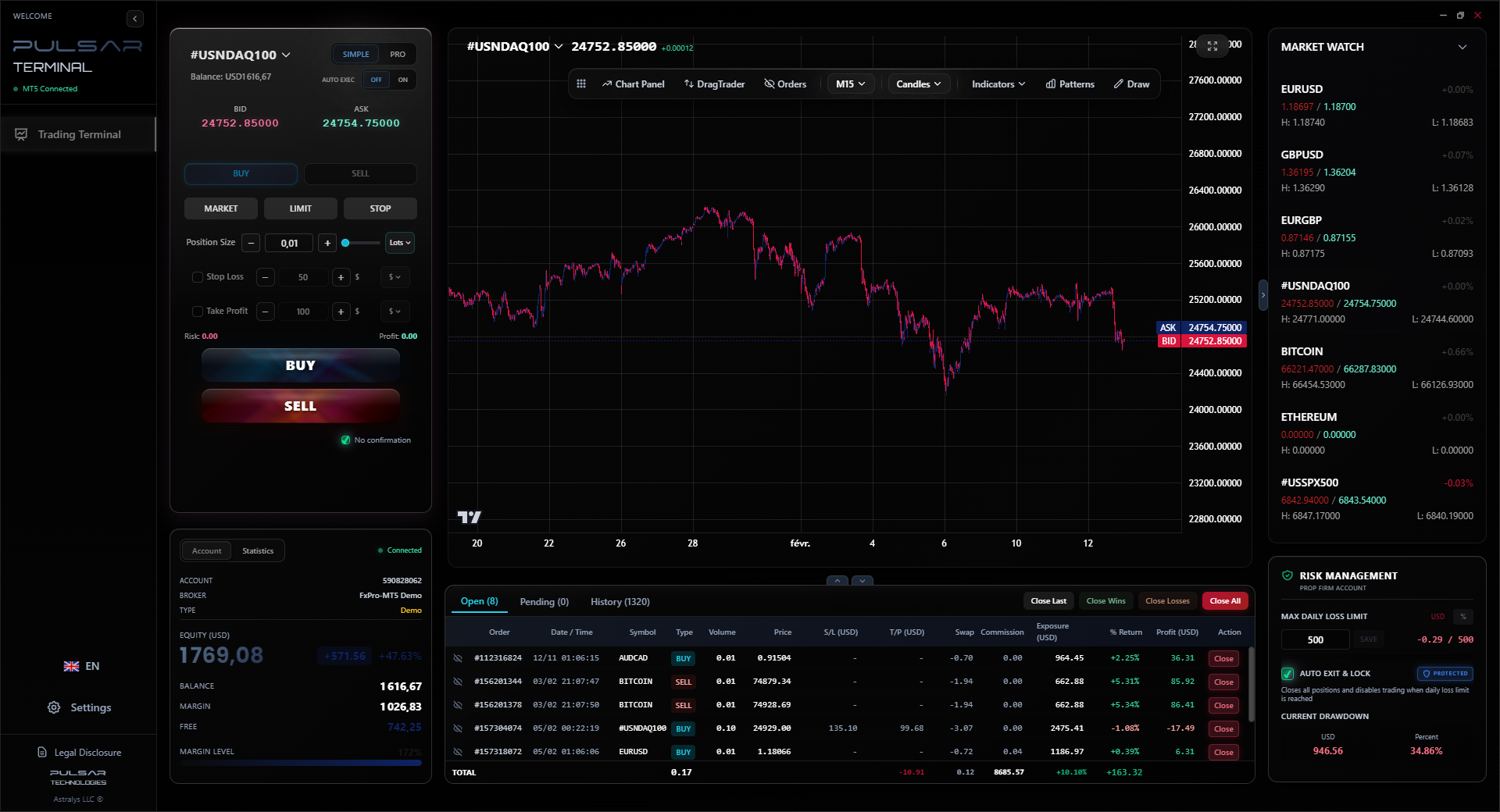
“In a strong trend, the RSI can camp above 70 for a long time. The indicator was right about the momentum, but I was wrong to fight it.”
RSI is a fantastic sidekick, but it shouldn't be the hero. You need other tools to build a complete trading plan.
My Preferred Combo for ZAR Pairs:
- Trend Identification: I use a simple 50 and 200-period Exponential Moving Average (EMA) on the H4 chart. Is price above both? General trend is up. Below both? Trend is down. This tells me which direction I should be biased towards.
- Momentum Entry with RSI: In an uptrend (price > 50 & 200 EMA), I look for pullbacks where the RSI (21-period) dips to the 40-50 area and starts turning back up. That's my potential buy zone. In a downtrend, I look for rallies where the RSI gets to 50-60 and rolls over.
- Confirmation with Price Action: I won't pull the trigger unless I see a price action signal at that RSI level - a bullish engulfing candle for a buy, or a bearish pin bar for a sell.
- Volume (If Available): On brokers that offer good volume data, I like to see volume pick up on the confirming candle. It adds conviction.
Table: A Simple RSI-Based Framework
| Your Bias | RSI Zone to Watch | What You're Looking For | What to Avoid |
|---|---|---|---|
| Bullish (Uptrend) | 40 - 50 | RSI holding above 40, turning up with a bullish candle. | Selling because RSI is above 70. |
| Bearish (Downtrend) | 50 - 60 | RSI holding below 60, turning down with a bearish candle. | Buying because RSI is below 30. |
| Ranging Market | 30 - 70 | Fade the extremes: sell near 70, buy near 30. | Trading breakouts. |
This framework forces you to think in terms of probability, not certainty. It aligns the momentum (RSI) with the trend and a concrete price signal. For more on pairing momentum indicators, see our guide on the RSI indicator and its common uses.
💡 Consiglio di Winston
He'd remind us, 'Your broker's spread is part of the trade's equation. A 50-pip profit target with a 30-pip spread on USD/ZAR leaves little room for the RSI to be wrong.' Always trade cost-aware.
Trading with RSI or any strategy happens within a real-world framework. Here’s the local lay of the land.
Regulation is Key: Always, always use a broker regulated by the Financial Sector Conduct Authority (FSCA). It’s your only real protection. You can check their register online. Some international brokers like Pepperstone and IC Markets have FSCA licenses, which is a good sign. If a broker isn't FSCA-regulated, the authority can't help you if something goes wrong.
use & Risk: There's talk of use caps, but as of now, you can still find high use (like 1:500 or more). This is a double-edged sword. High use on a volatile pair like USD/ZAR can amplify RSI-based trades quickly - both wins and losses. Manage it ruthlessly.
The Cost of Doing Business:
- Spreads: On USD/ZAR, expect spreads from 30 to 80 pips on standard accounts. On ECN/raw accounts, it can be 10-20 pips plus a commission. Every pip matters, so factor this into your profit targets and stops. A 10-pip stop on a pair with a 30-pip spread is suicide.
- Commissions: Raw accounts charge commissions. E.g., $3.50 per lot per side. On a 1-lot trade in USD/ZAR, you need the price to move about 7 pips just to break even on the round-turn commission.
- Minimum Deposits: You can start with very little (R150 or so), but to trade ZAR pairs with sensible position size, a realistic starting capital is R5,000 to R20,000. Starting with R500 means your position size will be microscopic, or your risk will be astronomically high.
Taxes: Yes, your trading profits are taxable as income in South Africa. Keep a detailed log of all your trades. The RSI might find your entries, but SARS will find you if you don't keep records.
FAQ
Q1What is the best RSI setting for forex trading?
There's no single 'best' setting. The standard 14-period works well for general use on major pairs like EUR/USD. For volatile pairs like ZAR crosses, I prefer a longer 21-period on H4 or daily charts to filter out noise. For quick scalps, some use 7 or 9, but it's advanced and risky. Start with 14 on H1 and adjust based on your style.
Q2Can RSI be used for scalping in forex?
Yes, but it's tricky. On very short timeframes (like 1 or 5-minute charts), RSI can give many false signals due to market noise. If you scalp, use a shorter RSI period (like 7) and combine it with strong support/resistance levels and tight stop-losses. It's a high-intensity method not suited for beginners. Read our dedicated scalping strategy guide first.
Q3What does RSI divergence mean, and is it reliable?
Divergence means price and RSI momentum are moving in opposite directions (e.g., price makes a new high, but RSI makes a lower high). It signals potential trend exhaustion. It's a powerful concept but not 100% reliable - it can last a long time before price reverses. Use it as a warning sign to look for other confirming signals (like a break of a trendline) before acting. It's more reliable on higher timeframes (H4, Daily).
Q4Is an RSI above 70 always a sell signal?
Absolutely not. This is the most common mistake. In a strong bullish trend, the RSI can remain above 70 for extended periods. Selling solely because RSI is above 70 is called 'fighting the trend' and is a great way to lose money. Treat an RSI above 70 as a sign of strong bullish momentum, not an automatic sell trigger. Look for bearish divergence or a failure swing for a potential sell signal within that overbought context.
Q5How do I use RSI with gold (XAU/USD) trading?
Gold often exhibits strong trends and momentum. The standard 14-period RSI works, but like with forex, avoid simply buying/selling at 30/70 in a strong trend. Pay close attention to divergence on gold, as it can be an excellent leading indicator for reversals. Also, note that gold can be less liquid during certain sessions, which can affect RSI readings. Check out our specific XAU/USD guide for more on trading gold.
Q6Do South African brokers offer good platforms for using RSI?
Most international and local FSCA-regulated brokers offer MetaTrader 4 or 5 (MT4/MT5), which have the RSI indicator built-in and are fully customisable. The platform itself isn't usually the issue. The key is choosing a broker with reliable execution and fair costs, like those reviewed in our Exness review or XM review, so your RSI signals aren't ruined by slippage or huge spreads.
Lezione del Prof. Winston
Punti chiave:
- ✓RSI measures momentum speed, not absolute value.
- ✓Divergence warns of exhaustion; price action confirms the turn.
- ✓In trends, use RSI 40-60 zones, not 30-70 extremes.
- ✓Adjust RSI period: 21+ for volatile ZAR pairs.
- ✓Never use RSI without a stop-loss.
Quanto è stato utile questo articolo?
Clicca su una stella
Analisi Trading Settimanali
Analisi e strategie settimanali gratuite. Nessuno spam.
Sull'autore
David van der Merwe
Trader dei Mercati Emergenti
Trader con base a Johannesburg con 11 anni di esperienza nelle valute dei mercati emergenti. Specializzato in coppie ZAR, trading regolamentato dalla FSCA e analisi del mercato sudafricano.
Commenti
Avviso di rischio
Il trading di strumenti finanziari comporta rischi significativi e potrebbe non essere adatto a tutti gli investitori. Le performance passate non garantiscono risultati futuri. Questo contenuto è fornito solo a scopo educativo e non deve essere considerato un consiglio di investimento. Conduci sempre le tue ricerche prima di fare trading.
Potrebbe interessarti anche

Cara Trading Forex Sukses: 7 Prinsip dari Trader Profesional
Cara trading forex sukses dengan 7 prinsip trader pro: manajemen modal, disiplin, journal trading, backtest. Data nyata, bukan janji profit palsu.
Jam Trading Forex Terbaik untuk Trader Indonesia: Panduan Lengkap dengan Tabel Waktu
Panduan jam trading forex untuk trader Indonesia. Tabel 4 sesi dunia, jam emas 20:00-00:00, sesi mana yang harus dihindari. Data akurat + tips dari trader berpengalaman.
Top 5 Sàn Forex Uy Tín Nhất 2026: Review Jujur dari Trader Indonesia
Top 5 sàn forex uy tín 2026 untuk trader Indonesia. Review jujur: spread, deposit, withdraw, dukungan lokal. Exness, XM, IC Markets & lebih.
Scarica Pulsar Terminal
Tutti questi calcolatori sono integrati in Pulsar Terminal con dati in tempo reale dal tuo conto MT5.
Scarica Pulsar Terminal