


I remember my first 'real' trade back in 2012.

David van der Merwe
Trader dei Mercati Emergenti ·  South Africa
☕ 10 min di lettura
Cosa imparerai:
I remember my first 'real' trade back in 2012. I was convinced the USD/ZAR was going to break above 11.00. I threw R15,000 into a long position at 10.85, using max use. I didn't have a stop loss. 'It'll come back,' I told myself as it dropped to 10.70. It didn't come back. It went to 10.50. I watched my screen, paralyzed, as my account bled out. I lost R4,200 in a single afternoon. That experience taught me the first, hardest lesson about success in this game: most people are set up to fail before they even place an order. Let's talk about why, and more importantly, how you can be in the minority.
Everyone talks about the '90% fail' statistic. In South Africa, we have a more specific, and frankly, more depressing number. A 2020 survey by Forex to Stocks found that 69% of South African forex-only traders admitted to losing money. Let that sink in. Nearly 7 out of every 10 people trying this lose. The majority of those losses were under R10,000, which tells you it's often the smaller, newer accounts getting wiped out first.
What's even more telling is the comparison. That same survey showed stocks-only traders had a 69% chance of making money. The probability of success for a forex trader was roughly half that of a stocks trader. Why? use, emotion, and the 24/5 nature of the market amplify every mistake. Forex doesn't forgive sloppiness. A bad stock pick might drift down 10% over a month. A bad forex trade with use can wipe you out in an hour.

Warning: Don't confuse activity with profitability. I've seen guys place 50 trades a week, bragging about their 'win rate,' while quietly hemorrhaging money on spreads and commissions. The only number that matters is your net profit at the end of the month.
These stats aren't meant to scare you off. They're a reality check. If you walk into a casino, you should know the house edge. If you walk into the forex market, you should know that the odds, for the average unprepared retail trader, are stacked about as favorably.
“Nearly 7 out of every 10 South African forex-only traders lose money. The odds are not in your favour by default.”
The use Trap
This is the big one, especially with brokers offering insane ratios like 1:2000. I get it. You see R5,000 in your account and think, 'With 1:500 use, I can control R2.5 million! One good move and I'm set!' That's not trading. That's gambling with a financial detonator. I used a position size calculator religiously after my early blow-up. If your trade size is too big, a normal 20-pip move against you becomes a catastrophe. Your psychology shatters. You either panic-close or freeze and watch the margin call hit. High use doesn't create success. It accelerates failure.
The Cost of Doing Business
You think the market has to move in your favour to make money? Wrong. It has to move enough to cover your costs first. Let's break down a typical R10,000 trade on USD/ZAR with a decent broker like Pepperstone:
- Spread: Say 5 pips. That's R50 gone before you start.
- Commission: Maybe $7 (about R130) per lot round turn.
- Swap: Hold it overnight? Could be another few rand against you.
Your trade is already R180 in the hole. The market needs to move 18 pips in your favour just to break even. Most beginners have no clue about this silent tax. They take 10-pip profits and wonder why their account never grows.
The Strategy-of-the-Month Club
I fell for this. One week I was a scalper, the next a swing trader using MACD indicator divergences, the next I was trying some complicated grid system. No consistency. No edge. Just chasing the next YouTube guru's 'secret.' A profitable scalping strategy requires a different mindset and tools than swing trading. Jumping between them guarantees you'll master none.
The Lone Wolf Syndrome
Too many traders sit in a dark room, staring at charts, talking to no one. They don't keep a journal. They don't review their trades. They don't have a mentor or a community to call them out on their nonsense. I didn't start making consistent progress until I began writing down every single trade: my reasoning, my emotion, the outcome. The patterns of my own stupidity became painfully clear.

💡 Consiglio di Winston
If you can't articulate your edge in one sentence, you don't have one. 'Buying low and selling high' is not an edge. 'Trading bullish [RSI indicator](/en/indicators/rsi) divergences off the 4-hour chart support in EUR/USD during London session' is getting closer.
“High use doesn't create success. It accelerates failure.”
They treat it like a business, not a lottery ticket. Here's the difference.
Risk Management is Their Religion. They risk 1-2% of their capital on any single trade. No exceptions. A losing streak of 10 trades? That's a 10-20% drawdown, painful but survivable. They know their maximum daily loss limit and they stop trading when they hit it. They use stop losses on every single trade, not as a suggestion, but as a non-negotiable exit order. Tools that automate this, like setting a trailing stop or a breakeven point, are part of their core toolkit.
They Specialize. They don't trade 28 pairs. They find two or three they understand intimately - often the majors like EUR/USD or a commodity pair like XAU/USD. They know how these pairs behave during London open, during US data releases, during Asian session lows. They have a documented edge in these specific markets.
They Master Their Psychology. They have a pre-trade checklist. They know their emotional triggers (revenge trading after a loss was mine). They take breaks. They understand that a losing trade is not a personal failure, it's a cost of doing business. The goal isn't to be right. The goal is to make money over a series of trades.
They Keep It Simple. Their charts aren't a rainbow of 15 indicators. They might use price action, support/resistance, and one or two key indicators like the RSI indicator for confluence. More time is spent on planning and review than on staring at live charts.

Pro Tip: Your trading plan is worthless if it's not written down. It should answer: What pairs do I trade? What's my setup? What's my entry/exit rules? What's my risk per trade? What's my daily loss limit? Print it out. Stick it next to your screen.
“High use doesn't create success. It accelerates failure.”
Trading in South Africa is legal and regulated, which is a good thing. The Financial Sector Conduct Authority (FSCA) is the main watchdog. They force brokers to segregate client funds, which means your money is (supposedly) safe if the broker goes belly up.
Always, and I mean always, check if your broker is FSCA licensed. Big names like IG, AvaTrade, and XM have local licenses. Why does this matter? If you have a dispute, you have a local authority to complain to. Try getting the Cyprus SEC or some offshore regulator to care about your R5,000 problem.
There's a new Conduct of Financial Institutions (COFI) Bill coming around 2026. It'll likely tighten things up further. The trend is towards more protection, which is great for the serious trader. It weeds out the shady bucket shops.
That said, regulation protects you from fraud; it does not protect you from yourself. The FSCA won't refund you because you blew your account on a bad EUR/ZAR trade. That's on you.

Example: Let's say you deposit R10,000 with an international broker. Your local bank might hit you with a R250-350 fee to receive that foreign currency back. With an FSCA-licensed broker, your deposits and withdrawals are in ZAR, avoiding those conversion fees. It adds up.
💡 Consiglio di Winston
Your first profit target should always be to get your stop loss to breakeven. Protecting capital is job one. Making money is job two.
“The only number that matters is your net profit at the end of the month.”
This is where many SA traders get murdered. You think you made a 50 pip profit? Let's do the real math.
| Cost Type | Example on USD/ZAR (1 Lot) | Impact on R10k Account |
|---|---|---|
| Spread | 5 pips = ~R50 | Instant 0.5% loss on entry |
| Commission | $7 round turn = ~R130 | Another 1.3% gone |
| Swap (7 days) | -$15 = ~R280 | Eats into longer-term holds |
| Inactivity Fee | $50 after 3 months | Penalty for not trading (or losing)! |
| Bank Fees | R250+ for int'l transfer | Erodes your deposit/withdrawal |
See the problem? On that one lot trade, you're down R180 before the market even breathes. You need almost 20 pips of favourable movement just to reach zero. This is why scalping tiny moves on exotic pairs is a fool's errand for most. The spread alone makes it statistically near-impossible.
Brokers like IC Markets or Exness offer raw spread accounts with low commissions, which can be better for active traders. But you need to do the math for your own strategy. Choose the wrong account type for your style, and you're just making your broker rich.
And for the love of all things holy, don't ignore swap rates if you're holding trades for weeks. I once held a AUD/JPY short over a weekend and got absolutely crushed by the swap. The 60-pip profit I thought I had turned into a 10-pip loss after fees. A painful lesson in reading the fine print.
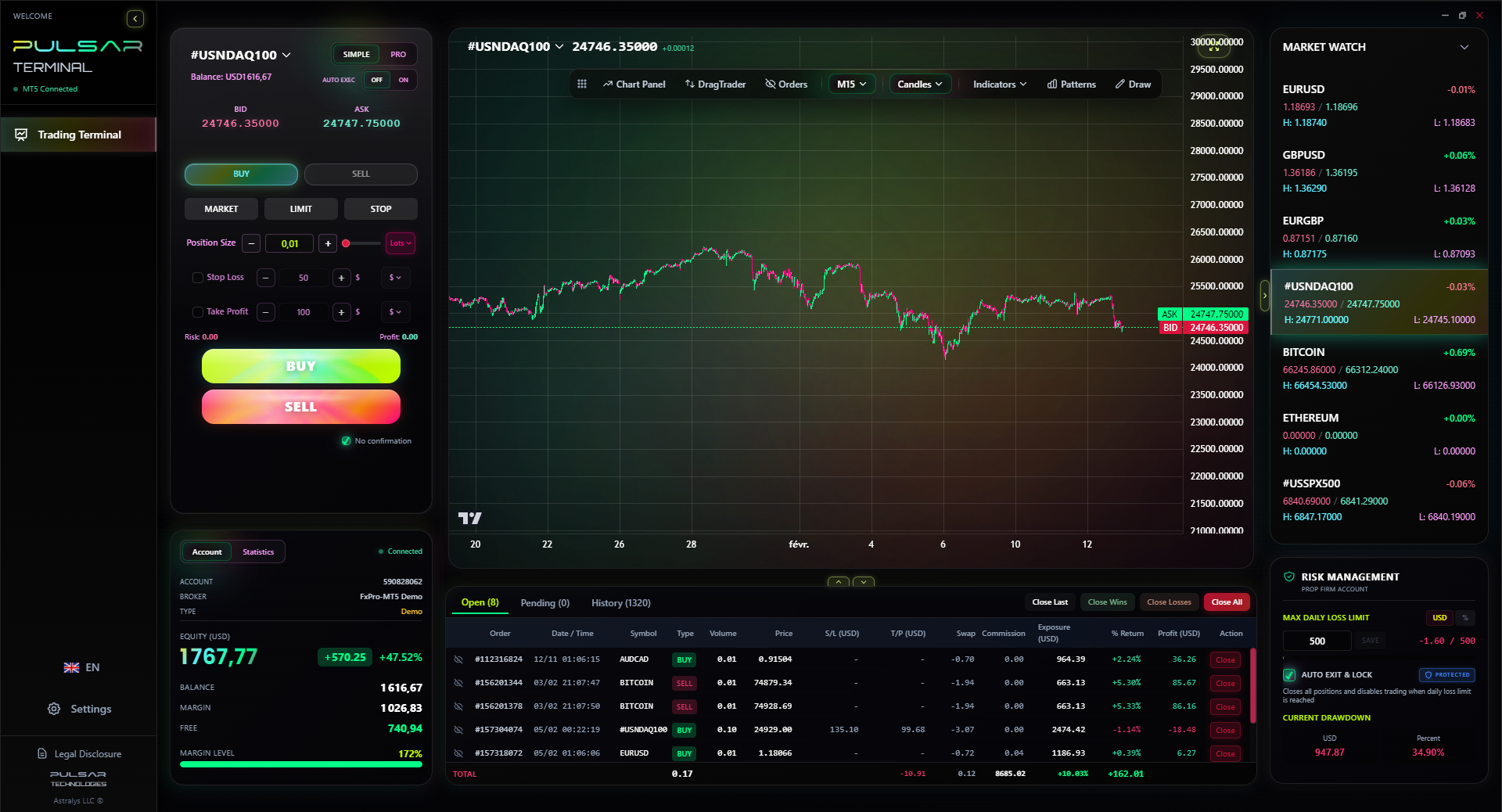
Managing complex trades and strict risk rules manually is how mistakes happen; a tool like Pulsar Terminal automates multi-TP/SL, trailing stops, and daily loss limits directly on your MT5, enforcing the discipline the successful 30% have.
Pulsar Terminal
Lo strumento MT5 tutto-in-uno: ordini drag-and-drop, multi-TP/SL, trailing stop, grid trading, Volume Profile e protezione prop firm. Usato da oltre 1.000 trader ogni giorno.
“The only number that matters is your net profit at the end of the month.”
Forget the Lamborghini dreams. Let's build a real, sustainable trading business.
Phase 1: The Demo Grind (3-6 Months Minimum) Don't you dare touch real money. Use this time to:
- Learn your platform (MT4/MT5) inside out.
- Test one strategy. Backtest it, then forward-test it on demo for at least 100 trades.
- Practice strict risk management with fake money until it's muscle memory.
- Keep a detailed trading journal. If you can't be disciplined with monopoly money, you have zero chance with real rands.
Phase 2: The Micro-Account Reality (6+ Months) Start with the smallest amount your broker allows. For XM, that's like $5 (R100). Seriously. The goal here is not to make money. The goal is to execute your plan perfectly under the pressure of real, albeit tiny, financial risk. Can you take a stop loss when it's real? Can you walk away after hitting your daily loss limit? This phase is about validating your psychology.
Phase 3: Graduated Scaling Only after 6+ months of consistent, profitable micro-account trading should you add more capital. And you scale slowly. Add another R5,000. Prove you can handle it. Then add more. This is how you avoid the classic 'win big on demo, deposit R50k, lose it all in a month' horror story.
Get the Right Tools: The market is faster and more competitive than ever. The successful traders use technology to their advantage. This means having a platform that lets you manage risk efficiently - placing orders quickly, setting multiple take-profits, automating stop adjustments. Manual trading on a basic platform puts you at a structural disadvantage against everyone who isn't.
Your first year's goal should be: Don't lose money. Your second year's goal: Achieve a consistent return that beats a savings account. Anything beyond that is a bonus. This slow, boring approach is what the 30% do. The other 70% are too busy chasing the big score that never comes.
💡 Consiglio di Winston
Review your trading journal on Sunday night, not Monday morning. Plan your week when the market is closed and your emotions are flat. It prevents reactive, stupid decisions.
“The FSCA protects you from fraud; it does not protect you from yourself.”
So, how many forex traders are successful in South Africa? Based on the data, about 30% don't lose money. But 'not losing' is a low bar. The percentage that are truly successful - making consistent, liveable returns year after year - is probably in the low single digits.
But here's the thing: that number isn't fixed by fate. It's a function of preparation, discipline, and mindset. The market doesn't care about your hopes, your bills, or your 'gut feeling.' It's a probabilistic game.
You can choose to be part of the 70% who fund the market with their losses. Or you can choose the harder, slower, more disciplined path of the minority. It starts with accepting the brutal odds, respecting the costs, and committing to the unsexy work of risk management and continuous learning.
I lost a lot of money learning this the hard way. You don't have to. The blueprint for success isn't a secret. It's just ignored by most because it requires patience and hard work, not magic. Which group do you want to be in?
FAQ
Q1Is it true that 90% of forex traders fail?
The often-cited 90% figure is a global estimate. In South Africa, a specific 2020 survey found 69% of forex-only traders lost money. The real percentage who 'fail' (i.e., give up or blow accounts) is undoubtedly high, likely between 70-80%. The key takeaway is the majority lose, making risk management your #1 priority.
Q2What is the most common mistake new South African traders make?
Using excessive use. Seeing brokers offer 1:500 or 1:1000, they trade too large relative to their account. A small move against them triggers a margin call or forces a panic exit. They confuse the ability to control a large position with the wisdom to do so.
Q3How much money do I need to start forex trading in South Africa?
You can start with very little. Brokers like XM allow $5 deposits. However, starting capital is less important than starting correctly. Begin with a micro account (under R1000) to practice real execution under pressure. The amount should be money you can afford to lose completely while you learn.
Q4Are FSCA-regulated brokers safer?
Yes, significantly. An FSCA license means the broker must follow South African law, including segregating your client funds from their operating funds. It gives you a local recourse for disputes. While you can use international brokers, an FSCA-regulated one (like many we review, such as FP Markets) simplifies banking and adds a layer of protection.
Q5Can I make a living from forex trading in SA?
A very small number of people do. It requires substantial, well-managed capital (think R500,000+), years of proven consistency, and the discipline of a surgeon. For 99% of people, it should be treated as a speculative side activity, not a primary income. Aim for supplemental income first; a living wage is a distant, advanced goal.
Q6What's more important: a high win rate or risk-reward ratio?
Risk-reward, every time. You can be profitable with a 40% win rate if your average winner is 3 times bigger than your average loser. I know traders with 60%+ win rates who lose money because they let losses run and cut winners short. Focus on keeping losses small (pip definition) and letting winners ride.
Q7How long does it take to become a consistently profitable trader?
Assume 2-3 years of dedicated study and practice. The first year is often about losing money and learning lessons. The second year is about breaking even. Consistency often comes in the third year, if you've survived and learned from the first two. There are no shortcuts.
Lezione del Prof. Winston
Punti chiave:
- ✓69% of SA forex traders lose money based on 2020 data.
- ✓Risk over 2% per trade puts you in the failure cohort.
- ✓Real costs (spread, commission) require 20+ pip moves just to break even.
- ✓Success requires a minimum 2-3 year learning curve.
- ✓Specialize in 2-3 pairs, not 28.
Quanto è stato utile questo articolo?
Clicca su una stella
Analisi Trading Settimanali
Analisi e strategie settimanali gratuite. Nessuno spam.
Sull'autore
David van der Merwe
Trader dei Mercati Emergenti
Trader con base a Johannesburg con 11 anni di esperienza nelle valute dei mercati emergenti. Specializzato in coppie ZAR, trading regolamentato dalla FSCA e analisi del mercato sudafricano.
Commenti
Avviso di rischio
Il trading di strumenti finanziari comporta rischi significativi e potrebbe non essere adatto a tutti gli investitori. Le performance passate non garantiscono risultati futuri. Questo contenuto è fornito solo a scopo educativo e non deve essere considerato un consiglio di investimento. Conduci sempre le tue ricerche prima di fare trading.
Potrebbe interessarti anche

Cara Trading Forex Sukses: 7 Prinsip dari Trader Profesional
Cara trading forex sukses dengan 7 prinsip trader pro: manajemen modal, disiplin, journal trading, backtest. Data nyata, bukan janji profit palsu.
Jam Trading Forex Terbaik untuk Trader Indonesia: Panduan Lengkap dengan Tabel Waktu
Panduan jam trading forex untuk trader Indonesia. Tabel 4 sesi dunia, jam emas 20:00-00:00, sesi mana yang harus dihindari. Data akurat + tips dari trader berpengalaman.
Top 5 Sàn Forex Uy Tín Nhất 2026: Review Jujur dari Trader Indonesia
Top 5 sàn forex uy tín 2026 untuk trader Indonesia. Review jujur: spread, deposit, withdraw, dukungan lokal. Exness, XM, IC Markets & lebih.
Scarica Pulsar Terminal
Tutti questi calcolatori sono integrati in Pulsar Terminal con dati in tempo reale dal tuo conto MT5.
Scarica Pulsar Terminal