


I remember watching the USD/NGN chart in February 2024, my cursor hovering over the sell button at ₦1,540.

Olumide Adeyemi
Pioniere del Trading in Africa Occidentale ·  Nigeria
☕ 10 min di lettura
Cosa imparerai:
- 1The Basic Math: Pips, Points, and Why They Matter
- 2The Nigerian Twist: Naira Pairs, Taxes, and Real Costs
- 3A Step-by-Step Calculation with Real Numbers
- 4use: The Double-Edged Sword in Your P&L
- 5Practical Tools: From MT5 to Your Notebook
- 6Mistakes I've Made (So You Don't Have To)
- 7Your Weekly P&L Checklist
I remember watching the USD/NGN chart in February 2024, my cursor hovering over the sell button at ₦1,540. The spread was wide, the market felt jumpy, and I was trying to calculate my potential loss if this move against the CBN's reforms went wrong. That moment, more than any other, drilled into me that knowing how to calculate forex profit and loss isn't just math - it's survival. In Nigeria's volatile market, where the Naira can swing hundreds of pips in a session, a miscalculation can wipe out your capital before you even understand what happened.
Forget the fancy jargon for a second. At its core, a profit and loss calculation answers one question: did I make money or lose money on this trade? The building block is the pip. For most pairs, a pip is 0.0001. For USD/JPY, it's 0.01. For USD/NGN? It's ₦0.01. That's right, one kobo.
Here's where new traders get tripped up. A pip is a price movement. Your profit depends on how much currency you traded (your position size). If USD/NGN moves from ₦1,500.00 to ₦1,500.50, it moved 50 pips. If you bought $1,000 (a 0.01 lot micro lot), you made 50 pips * $10 (the pip value for a standard lot is $10, so for a micro lot it's $0.10) = $5. Simple.

Example: Trade: BUY 0.05 lots EUR/USD at 1.0850 Exit: SELL at 1.0900 Price Difference: 1.0900 - 1.0850 = 0.0050 (50 pips) Pip Value for 0.05 lots: ($10 per standard lot) * 0.05 = $0.50 per pip. Gross Profit: 50 pips * $0.50 = $25.
Now, convert that to Naira at your withdrawal rate. If your broker gives you ₦1,480/$, that $25 becomes ₦37,000. That conversion is your real bottom line. Always, always think in your local currency first. I learned this the hard way early on, celebrating a $300 profit only to realize fees and a poor conversion rate netted me just ₦380,000 when I expected over ₦400,000. The market doesn't care about your expectations.
To avoid these mental errors, use a position size calculator religiously. It does the heavy lifting so you can focus on the trade.

💡 Consiglio di Winston
Your first calculation before any trade should be 'How much am I willing to lose?' Not 'How much can I make?'. The loss number is the one you control.
“In Nigeria's volatile market, a miscalculation can wipe out your capital before you even understand what happened.”
Trading USD/NGN or EUR/NGN changes the game. The pip is a kobo, but the volatility is insane. A 100-pip move on USD/NGN is ₦1. That might not sound like much until you realize the pair can move 500 pips (₦5) in a day. Your profit and loss calculations need to account for this wild swing.
The 10% Tax Man
This is non-negotiable. The Federal Inland Revenue Service (FIRS) wants 10% of your gross trading profits as Capital Gains Tax. Gross profit means your total winning trades for the year, not your net after losses. You can deduct losses, but the paperwork is yours to handle.
Let's say you made a total of ₦2,000,000 in profitable trades in a year. Your losing trades totaled ₦500,000. Your net profit is ₦1,500,000. Your taxable amount? You calculate tax on the gross gains minus allowable expenses (like verified data subscriptions, trading platform fees). If we assume no deductions, tax is 10% of ₦2,000,000 = ₦200,000. Your real take-home net becomes ₦1,500,000 - ₦200,000 = ₦1,300,000. Factor this in from the start. A 10% win isn't a 10% win anymore.
The Hidden Cost: Spreads and Funding
Naira pairs often have massive spreads. I've seen USD/NGN with a 50-pip spread during low liquidity. That means the price needs to move 50 pips in your favor just to break even. Your profit calculation starts at -50 pips. Always check the live spread before entering.
Funding your account is another headache. With bank card restrictions, you might use a fintech wallet or crypto. Each conversion (NGN -> USDT -> USD) has a fee. That fee comes straight out of your starting capital, skewing your risk/reward from the jump. If you deposit ₦150,000 but only $95 hits your account after fees, you've already taken a 5% loss before placing a single trade. Your calculations must be based on the capital that actually lands in your trading account, not what left your bank.
“Always, always think in your local currency first. The market doesn't care about your expectations.”
Let's walk through a full trade on a major pair, then on USD/NGN. We'll use a broker like Exness or IC Markets as an example, as they're popular here.
Trade 1: EUR/USD (Standard Account)
- Account Currency: USD
- Trade: BUY 0.1 lots EUR/USD
- Entry Price: 1.0725
- Exit Price: 1.0775
- Spread at Entry: 0.8 pips (no commission)
- Swap Fee (held 2 nights): -$0.48
- Price Movement: 1.0775 - 1.0725 = 0.0050 (50 pips)
- Gross Pip Profit: 50 pips
- Pip Value: $1 per pip for 0.1 lots ($10 * 0.1)
- Gross Profit in USD: 50 pips * $1 = $50
- Subtract Costs: $50 - $0.48 (swap) = $49.52. (The spread cost is absorbed as the price moved past the breakeven point).
- Convert to Naira (at ₦1,480/$): $49.52 * 1,480 = ₦73,289.60
Trade 2: USD/NGN (This is where it gets real)
- Account Currency: USD (common for int'l brokers)
- Trade: SELL 0.01 lots USD/NGN (This is selling $1,000)
- Entry Price: ₦1,520.00
- Exit Price: ₦1,510.50
- Spread at Entry: 30 pips (₦0.30)
- Commission: None (built into spread)
- Price Movement: 1,520.00 - 1,510.50 = ₦9.50 (950 pips!)
- Gross Pip Profit: 950 pips
- Pip Value in USD: Tricky. Your profit is in Naira, but your account is in USD. The broker calculates it. For a 0.01 lot ($1,000), a 1 pip move (₦0.01) on USD/NGN is worth $0.01 * (1,000 / Entry Price). Let's simplify: Profit in Naira = (Pips * Trade Size in USD) / 100. (950 pips * $1000) / 100 = ₦9,500.
- Gross Profit in Naira: ₦9,500
- Subtract Spread Cost: The spread was 30 pips. Cost = (30 * $1000) / 100 = ₦300.
- Net Profit in Naira: ₦9,500 - ₦300 = ₦9,200
- Broker Converts to USD for your account: ₦9,200 / ₦1,510.50 (exit price) ≈ $6.09
See the difference? The Naira trade generated a huge pip gain and a decent Naira sum, but the final USD credit feels small because the Naira is the variable. This complexity is why you must understand the calculation.

Warning: Never trust a broker's "estimated profit" window blindly, especially on exotic pairs like Naira pairs. Do the rough math yourself. I once had a platform glitch on a GBP/NGN trade that showed a profit 20% higher than reality. My own calculation saved me from a bad exit decision.
“Always, always think in your local currency first. The market doesn't care about your expectations.”
use of 1:500 or 1:1000 isn't a magic wand. It's a risk multiplier that directly amplifies your profit AND loss calculations. This is the most common way Nigerian traders blow up accounts.
Here's the reality: If you have ₦100,000 and use 1:500 use, you control ₦50,000,000 in the market. A 0.2% move against you wipes out your entire capital. Your profit and loss are calculated on the full leveraged position, not your deposit.
Example with Pain:
- Capital: $100 (₦~148,000)
- use: 1:500
- Position: BUY 0.5 lots EUR/USD (Controlling $50,000)
- Pip Value: $5 per pip
- Market moves 25 pips against you.
- Loss: 25 pips * $5 = $125.
You've lost $125 on a $100 account. You're not just at zero; you're in negative balance if your broker doesn't have negative balance protection. That trade is a margin call and a closed account. The calculation showed a $125 loss, but the real loss was 125% of your risk capital.
use lets you make meaningful money from small Naira deposits, but it demands microscopic stop-losses and surgical precision in your position size calculator inputs. A good rule I follow now: I calculate my position size as if I had no use, then maybe allow 2-3x for entry precision. If my strategy needs 1:100 to work, the strategy is the problem.
💡 Consiglio di Winston
If you can't instantly state your exact stop-loss in Naira and what that loss means as a percentage of your account, you have no business entering the trade. Sentiment has already overruled your math.
“use of 1:500 isn't a magic wand. It's a risk multiplier that directly amplifies your profit AND loss calculations.”
You don't need to be a math genius. You need discipline to use the tools.
1. The Trading Platform: MT4/MT5 shows running P&L. Understand what it's showing. Is it in pips? In account currency? Does it include swaps? On a XM or Pepperstone MT5, you can usually see profit in money and pips. Right-click on the terminal to customize the columns.
2. Trading Journals (Non-Negotiable): I use a simple Google Sheet. Columns for: Pair, Direction, Entry, Exit, Pips, Profit (USD), Profit (NGN), Fees, Swap, Notes. At the end of the month, I sum the Naira column. That's my real performance. I can look back and see that my scalping strategy on EUR/USD has an average win of ₦12,000 but a 45% win rate, while my swing trading on XAU/USD has an average win of ₦75,000 with a 60% win rate. This data is gold.
3. Economic Calendars: Your profit on a USD/NGN trade can be obliterated or doubled by a CBN announcement. Factor in event risk. If you're holding over a MPC meeting date, your potential loss calculation should include a 300-500 pip gap risk.
4. Broker Statements: Download them monthly. Reconcile them with your journal. This is how you catch errors and prepare for tax season. The FIRS won't accept "my broker platform said" as an excuse.
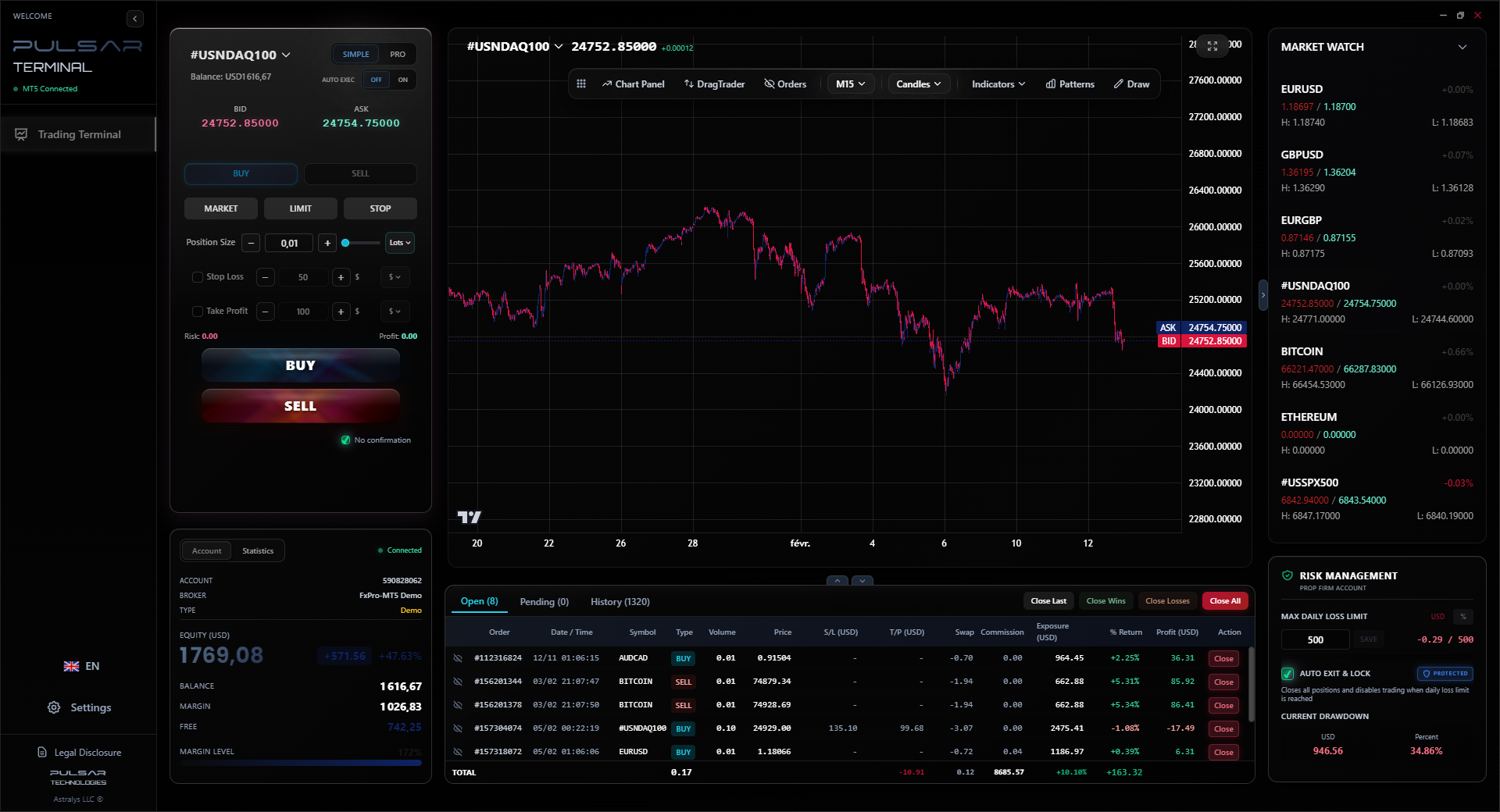
Manually calculating risk for multiple trades is tedious; Pulsar Terminal's drag-and-drop order tools let you set precise stop-loss and take-profit levels in seconds, locking in your calculated risk before emotion hits.
Pulsar Terminal
Lo strumento MT5 tutto-in-uno: ordini drag-and-drop, multi-TP/SL, trailing stop, grid trading, Volume Profile e protezione prop firm. Usato da oltre 1.000 trader ogni giorno.
“use of 1:500 isn't a magic wand. It's a risk multiplier that directly amplifies your profit AND loss calculations.”
Let me be the cautionary tale.
Mistake 1: Ignoring Swap Fees on Long-Term Holds. In 2020, I held a sell position on AUD/JPY for 3 weeks for a 120-pip gain. I was proud of my ₦85,000 profit. The statement showed a ₦72,000 profit. The difference? Negative swap fees that chipped away ₦13,000. I never factored them into my initial calculation.
Mistake 2: Miscalculating Position Size on a New Pair. I traded GBP/NZD once, a pair with a wild pip value. I used my standard 0.1 lot size. A 40-pip loss, which I'd shrug off on EUR/USD ($40), turned into a $120 loss because the pip value was triple. My calculation was off by 300% because I didn't check the pip value first.
Mistake 3: Forgetting the Naira Conversion on Withdrawal. You calculate a trade perfectly, make $1,000. You think you've made ₦1,480,000. But your broker's withdrawal rate that day is ₦1,465/$, and there's a $25 withdrawal fee. You get: ($1000 - $25) * 1,465 = ₦1,427,875. That's a ₦52,125 "hidden" loss you didn't calculate. Always use a conservative conversion rate (like 1-2% below market) in your final P&L estimates.
Mistake 4: Not Accounting for Slippage. During the Naira's free fall in early 2024, I placed a market sell order on USD/NGN. My calculated entry was ₦1,525. My filled price was ₦1,522.50. That's 250 pips of negative slippage. My entire risk management plan, based on my calculated entry, was instantly invalid. In volatile markets, assume your execution will be worse than your limit price, and adjust your potential loss calculation upward by 10-20%.
“Profit and loss calculation is the difference between being a gambler and being a trader.”
Make this routine. Every Friday, before you shut down:
- Review Open Trades: What's the current unrealized P&L in Naira? Is any swap accumulating? Is the spread on these pairs still acceptable?
- Review Closed Trades: Enter them into your journal. Calculate the final Naira value using the actual conversion rate from your broker's statement.
- Check Costs: Add up all commissions, swaps, and spreads paid this week. Divide by your total profit. If your costs are eating more than 15-20% of your gross profits, your strategy is too costly. Maybe switch from a standard account to a raw spread account with a commission, like on IC Markets.
- Net Naira Figure: This is your only truth. ₦87,000 up. ₦23,000 down. Whatever it is, face it.
- Tax Provision: Set aside 10% of your weekly gross profits into a separate savings account. Don't wait till year-end.
Profit and loss calculation is the foundation. It's not sexy. It's not a secret indicator like the RSI or MACD. But it's the difference between being a gambler and being a trader. In Nigeria's market, with all its unique challenges, mastering this is your first and most important step toward staying in the game long enough to actually win.
FAQ
Q1How do I calculate profit on USD/NGN if my account is in USD?
The broker handles the conversion, but you can approximate it. First, calculate your profit in Naira: (Exit Price - Entry Price in Naira) * (Trade Size in USD * 100). Example: Buy $1000 at ₦1500, sell at ₦1510. Profit = (1510-1500) * ($1000*100) = ₦10 * 100,000 = ₦1,000,000. Then, the broker converts this to USD at the exit rate: ₦1,000,000 / ₦1510 ≈ $662.25. Remember to subtract the spread cost first.
Q2Is the 10% capital gains tax on forex profits really enforced in Nigeria?
Yes, absolutely. The FIRS is increasingly focused on digital and financial assets. While enforcement on individual retail traders has been spotty historically, the legal obligation is clear. With new SEC regulations bringing platforms under oversight, reporting could become automated. It's a serious business risk to ignore it. Set aside the tax from your profits.
Q3What's more important for my P&L: low spreads or low commissions?
It depends on your trading style. For scalpers taking many trades a day on majors like EUR/USD, low raw spreads (even 0.0 pips) with a small commission (e.g., $3.50 per lot) are cheaper overall. For a swing trader holding positions for days on a pair like XAU/USD, a slightly wider spread with no commission might be better, as you trade less frequently. You must calculate your typical cost per trade based on your average position size.
Q4How does use affect my profit and loss calculation?
use doesn't change the profit/loss per pip calculation. A 10-pip win on a 0.1 lot trade is $10, regardless of 1:10 or 1:1000 use. What use changes is the percentage impact on your account balance. That $10 win might be 1% of a $1000 account or 10% of a $100 account. The danger is that use allows you to open a position so large that a normal market move wipes out your deposit. Always calculate your position size based on your risk capital, not your leveraged buying power.
Q5Can I use a demo account to practice P&L calculations?
It's the best way to start. Open a demo with a broker like Exness or XM, trade your strategy, and then manually calculate every trade's P&L in a spreadsheet as if it were real Naira. Compare your manual calculations to the platform's. Do this for at least 50 trades. It will drill the process into your head without risking a kobo.
Q6Why does my profit in Naira sometimes differ from the broker's statement?
Two main reasons: 1) Fees: You might have forgotten swap/rollover fees, withdrawal fees, or inactivity fees. 2) Conversion Rate: The broker uses a specific rate for converting your USD profits to Naira upon withdrawal, which may be less favorable than the interbank rate you see online. Always use the broker's stated rate for your final calculations.
Lezione del Prof. Winston
Punti chiave:
- ✓Calculate P&L in Naira first; it's your real money.
- ✓Always deduct the 10% capital gains tax from gross profits.
- ✓Factor in Naira pair spreads (often 30-50 pips) before profit.
- ✓use amplifies percentage loss, not pip value.
- ✓Journal every trade with final Naira value.
Quanto è stato utile questo articolo?
Clicca su una stella
Analisi Trading Settimanali
Analisi e strategie settimanali gratuite. Nessuno spam.
Sull'autore
Olumide Adeyemi
Pioniere del Trading in Africa Occidentale
Uno degli educatori di trading forex più attivi in Nigeria. 8 anni di esperienza di trading da Lagos. Specializzato in strategie a basso capitale e sfide prop firm per trader africani.
Commenti
Avviso di rischio
Il trading di strumenti finanziari comporta rischi significativi e potrebbe non essere adatto a tutti gli investitori. Le performance passate non garantiscono risultati futuri. Questo contenuto è fornito solo a scopo educativo e non deve essere considerato un consiglio di investimento. Conduci sempre le tue ricerche prima di fare trading.
Potrebbe interessarti anche

Cara Trading Forex Sukses: 7 Prinsip dari Trader Profesional
Cara trading forex sukses dengan 7 prinsip trader pro: manajemen modal, disiplin, journal trading, backtest. Data nyata, bukan janji profit palsu.
Jam Trading Forex Terbaik untuk Trader Indonesia: Panduan Lengkap dengan Tabel Waktu
Panduan jam trading forex untuk trader Indonesia. Tabel 4 sesi dunia, jam emas 20:00-00:00, sesi mana yang harus dihindari. Data akurat + tips dari trader berpengalaman.
Top 5 Sàn Forex Uy Tín Nhất 2026: Review Jujur dari Trader Indonesia
Top 5 sàn forex uy tín 2026 untuk trader Indonesia. Review jujur: spread, deposit, withdraw, dukungan lokal. Exness, XM, IC Markets & lebih.
Scarica Pulsar Terminal
Tutti questi calcolatori sono integrati in Pulsar Terminal con dati in tempo reale dal tuo conto MT5.
Scarica Pulsar Terminal