


You want to know how to make profit in forex, right? Not just theory, but the real, actionable steps that work when your capital is in Naira and the market never sleeps.

Olumide Adeyemi
Pioniere del Trading in Africa Occidentale ·  Nigeria
☕ 10 min di lettura
Cosa imparerai:
You want to know how to make profit in forex, right? Not just theory, but the real, actionable steps that work when your capital is in Naira and the market never sleeps. I get it. I started with a $200 account from Lagos, made every mistake in the book, and learned the hard way. Profit isn't about luck or a secret signal. It's a business. This guide will walk you through the exact framework I wish I had when I began, tailored for our unique Nigerian context.
Before you place a single trade, you need the right headspace. Forex isn't a get-rich-quick scheme; it's a skill-based profession with a brutally high failure rate. The first profit you need to make is a profit in discipline.
I lost my first $500 in two weeks. I was over-leveraged, emotional, and chasing losses. I thought I could outsmart the market. The market doesn't care about your ego or your bills. It only responds to price. Your job is to follow it, not fight it.

Warning: The biggest threat to your account isn't a bad trade. It's revenge trading after a loss. I've blown accounts because I couldn't walk away for the day. Set a daily loss limit (e.g., 2-3% of your capital) and stick to it religiously. A tool like a position size calculator is useless if your emotions override the math.
Adopt the mindset of a casino, not a gambler. The casino knows the odds are in its favor over thousands of transactions. You need a strategy with a positive expectancy and the discipline to execute it, trade after trade, regardless of yesterday's result. Your P&L is a lagging indicator. Your process is everything.

💡 Consiglio di Winston
Your first profit target should be to survive for six months. Consistency beats home runs every time.
“Profit isn't about luck or a secret signal. It's a business.”
Think of trading as starting a small business. You need capital, tools, a business plan, and to understand your local operating environment.
Your Trading Capital
Start with money you can afford to lose completely. I'm serious. Don't fund your account with rent money or a loan. My first sustainable run began with $300 I'd saved specifically for this purpose. It's not about getting rich from $50; it's about learning to grow capital consistently. Many brokers like Exness or XM allow small deposits, which is perfect for the learning phase.
The Nigerian Tax Reality
Here’s a crucial local detail many ignore: you owe a 10% Capital Gains Tax on all gross forex profits to the FIRS. It applies whether your broker is in Seychelles or your money is in a USD account. You must declare it. Factor this into your profit targets. If you aim for a 20% return, remember that 2% of that belongs to the taxman.
Funding Your Account
You can't use official CBN windows to get dollars for trading. You'll fund your broker via methods like bank transfer, fintech apps, or crypto. Each has fees and processing times. Choose a broker with solid local payment options. I use brokers that accept direct NGN deposits to avoid double conversion fees.
Choosing Your Tools (Broker & Platform)
Your broker is your business partner. Regulation is non-negotiable. Since Nigeria lacks specific retail forex regulators, you must use internationally regulated brokers. Look for ASIC, FCA, FSCA, or CySEC licenses. IC Markets and Pepperstone are popular for good reason: tight spreads, reliable execution.
For platforms, MT4/MT5 is the standard here. It's stable, even with our sometimes-unreliable internet. Don't get distracted by flashy platforms until your strategy is rock solid.

Pro Tip: Open a demo account that mirrors the live conditions of your chosen broker (spreads, execution speed). A demo on a perfect, zero-latency server teaches you nothing about real trading.
“Your stop loss is your business insurance. It's the cost of being wrong.”
You need a clear, written plan for how to make profit in forex. A strategy answers three questions: When do I enter? When do I take profit? When do I admit I'm wrong?
Find Your Edge
Your edge is a repeatable market condition where probability favors you. It could be a price action pattern, a specific RSI indicator divergence, or a moving average crossover. Mine is simple: I trade breakouts from key consolidation levels during the London-New York session overlap (2-5 PM WAT). That's when liquidity is highest for pairs like EUR/USD.
Entry, Exit, and Stop Loss
Be specific. Don't say "I'll buy when it looks low." Say: "I will enter a long position if price pulls back to the 50-period EMA and forms a bullish pin bar on the 1-hour chart, with my stop loss 15 pips below the low of that bar."
Your stop loss is your business insurance. It's the cost of being wrong. Never move it further away hoping the market will turn. I learned this painfully on a USD/JPY trade. I entered at 109.50, placed a stop at 109.20. Price dropped to 109.25, I moved my stop to 109.00, thinking it would bounce. It didn't. I took a 70-pip loss instead of a 30-pip one. That loss hurt my account for weeks.
Timeframe Alignment
I use a top-down approach. I find the trend on the daily chart, wait for a setup on the 4-hour chart, and fine-tune my entry on the 1-hour. This keeps me trading in the direction of the larger flow. Trying to scalp against the daily trend is like swimming against a tidal wave.
“Your stop loss is your business insurance. It's the cost of being wrong.”
This is the most important section. You can have a mediocre strategy and excellent risk management and survive. The reverse is never true.
The 1% Rule (Or Less)
Never risk more than 1-2% of your total account balance on a single trade. If you have a $1,000 account, that's $10-$20 max risk per trade. This protects you from a string of losses wiping you out. Let's do the math: with 1% risk, you'd need 100 consecutive losses to blow your account. That's statistically improbable if you have any edge at all.
Position Sizing is Everything
Your position size is determined by your stop loss. Here’s a real example from last month:
- Account Balance: $2,000
- Risk per Trade: 1% = $20
- Trade: Buy GBP/USD
- Entry: 1.2600
- Stop Loss: 1.2570 (30 pips away)
- Value per Pip (for a standard lot): ~$10
- My Risk in Pips: 30 pips
- Calculation: $20 risk / 30 pips = $0.666 per pip.
- Therefore, my position size should be 0.07 lots (as $0.666 per pip is roughly the value for a 0.07 lot position).
I use a position size calculator for this every single time. No guessing.
use: A Double-Edged Sword
Brokers offer crazy use like 1:500 or even 1:1000. This is a trap for the inexperienced. use amplifies both gains and losses. With a 1:500 use on a $1,000 account, you control $500,000. A 20-pip move against you could wipe out your entire capital. I never use more than 1:10 or 1:20 for my actual traded position size. High available use is fine, but using it all is a recipe for a margin call.

Example: A $1,000 account with 1:100 use. You buy 1 standard lot of EUR/USD (controlling $100,000). A 100-pip move is a $1,000 gain or loss. That's 100% of your account in one move. Is that investing, or gambling?
💡 Consiglio di Winston
If you can't explain your trade setup in one simple sentence, you don't have a strategy. You have a hope.
“A loss is a fee for information. Pay the fee, learn, and move on.”
You need to read the market's language. There are two main dialects: technical and fundamental.
Technical Analysis: Reading the Charts
This is about price history and psychology. You're looking for patterns of support/resistance, trend, and momentum. I rely on a few key tools:
- Support & Resistance: Horizontal lines where price has reversed before. These are your map for potential entries and exits.
- Moving Averages: I use the 50 and 200 EMA to gauge trend. Price above both = general uptrend.
- Momentum Indicators: The MACD indicator helps me confirm trend strength and potential reversals. I don't use more than 2-3 indicators. More just creates confusion and conflicting signals.
Fundamental Analysis: The News Driver
This is about economic health. Central bank interest rate decisions, inflation data (like Nigeria's CPI), employment numbers, and geopolitical events move currencies. An easy rule: a country raising interest rates or with strong economic data often sees its currency strengthen. You must follow a forex economic calendar.
The Nigerian Angle
Our local news directly affects the Naira pairs (like USD/NGN, which you might find as a CFD). CBN policy announcements, FX reserve data (currently over $43 billion), and monthly FX turnover (which hit $8.6bn avg. in 2025) cause volatility. Even though you might trade major pairs, money flows from emerging markets like ours affect global dollar strength. Keep one eye on local financial news.
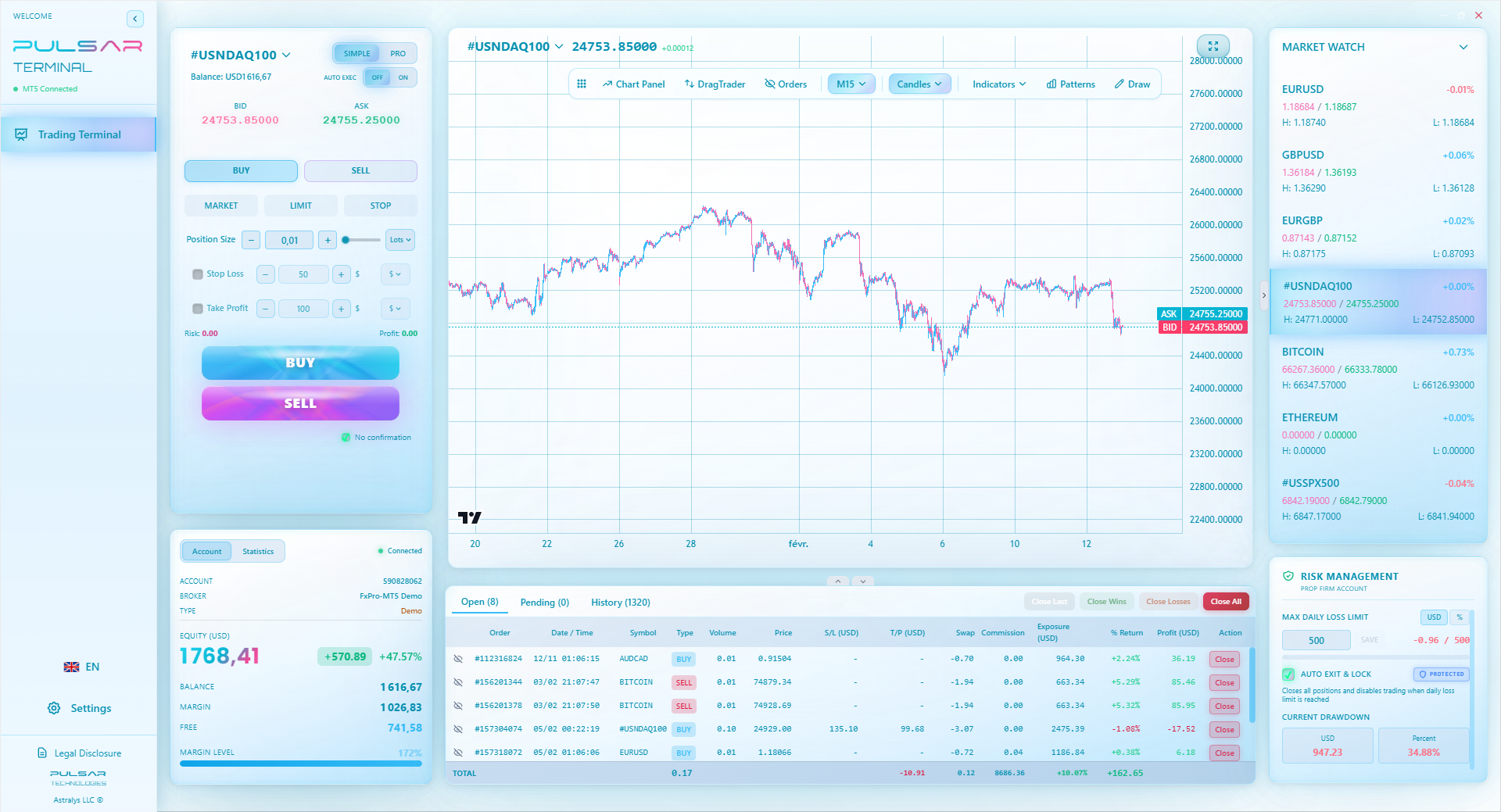
Executing a multi-target strategy with precise stop management is complex on basic MT5, but tools like Pulsar Terminal make it drag-and-drop simple.
Pulsar Terminal
Lo strumento MT5 tutto-in-uno: ordini drag-and-drop, multi-TP/SL, trailing stop, grid trading, Volume Profile e protezione prop firm. Usato da oltre 1.000 trader ogni giorno.
“A loss is a fee for information. Pay the fee, learn, and move on.”
Knowledge is useless without execution. This is where most fail.
The Trading Routine
My daily routine is boring, and that's the point.
- Pre-Market (8 AM WAT): Review the economic calendar. Check overnight price action on daily charts. No trading yet.
- Analysis (London Open, 10 AM WAT): Mark key support/resistance levels on my charts for the day. I have no bias.
- Trading Window (My edge hours): I only look for my specific setups during my predefined 3-4 hour window. If no setup appears, I do nothing. This is a win.
- Post-Trade: I journal every trade. Entry/exit reason, screenshot, emotional state. I review this weekly.
Handling Wins and Losses
Take profits methodically. You can use a risk-reward ratio. I aim for at least 1:1.5. If I risk 30 pips, my first profit target is 45 pips away. Sometimes I'll close half the position there and let the rest run with a trailing stop.
A loss is a fee for information. It tells you your analysis was wrong for that moment. Pay the fee, learn from the journal entry, and move on. The goal is to have a profitable month, not a profitable day.
Continuous Learning
The market changes. What worked last year may not work now. Dedicate time to review your journal, study new concepts (like swing trading principles), and backtest. But avoid strategy hopping. Give any method at least 50-100 trades before you judge it.
💡 Consiglio di Winston
The market will test your plan. Your journal is how you grade the test. Review it every Sunday without fail.
“Sometimes the best trade is no trade.”
Let me save you time and money by listing the traps I fell into.
- Overtrading: Trading because you're bored or want to 'make back' money. Stick to your strategy's setup criteria. Sometimes the best trade is no trade.
- Ignoring the Spread: On a scalping strategy, a 2-pip spread on EUR/USD is a huge cost. Choose accounts with raw spreads if you scalp. I once tried scalping on a standard account with a 3-pip spread; I was fighting an uphill battle from the start.
- Chasing 'Surefire' Signals: No signal is 100%. Anyone selling you a 'secret' is selling a dream. Your edge comes from your own tested process.
- Neglecting Life Outside Trading: This leads to burnout and bad decisions. Have hobbies, exercise, disconnect. Your trading will improve.
- Underestimating Technology: A bad internet connection can cost you money. Have a backup (your phone's hotspot). Know your broker's support contact.
Finally, be patient. This is a marathon. My first year was break-even. The second year, I made a consistent 5-8% return per month. That compounding over time is how you build real wealth from forex.
FAQ
Q1Is forex trading legal and profitable in Nigeria?
Yes, it's legal for individuals to trade forex with their personal funds. It can be profitable, but it's not a guaranteed income. Profitability comes from treating it as a skilled profession requiring education, a solid strategy, and strict risk management. Remember, you're subject to a 10% capital gains tax on all profits.
Q2How much money do I need to start trading forex in Nigeria?
You can start with as little as $10-$50 with some international brokers. However, I strongly recommend starting with an amount you can afford to lose completely, ideally a few hundred dollars. This allows for proper position sizing and lets you experience real market psychology without panic. Use a demo account first to practice your strategy.
Q3Which forex broker is best for Nigerian traders?
There's no single 'best' broker, but the best choices are internationally regulated firms that accept Nigerian clients, offer NGN payment methods, and have competitive conditions. Brokers like Exness (FSA), IC Markets (ASIC), and Pepperstone (CMA) are popular for their tight spreads, reliable platforms (MT4/5), and local support. Always verify their regulatory status for the entity serving Nigeria.
Q4What is the 1% risk rule in forex trading?
It's a core risk management rule: never risk more than 1% of your total trading account capital on any single trade. If you have a $1,000 account, your maximum loss per trade should be $10. This protects you from a string of losses destroying your account. You determine your position size based on this rule and your stop loss distance.
Q5How do I handle the 10% tax on forex profits in Nigeria?
You are responsible for declaring and paying the 10% Capital Gains Tax to the Federal Inland Revenue Service (FIRS). Keep detailed records of all your trades (profits and losses). You must file a tax return and pay the tax due within 90 days after the end of the tax year (December 31). It's wise to set aside 10% of your gross profits in a separate account for this purpose.
Q6Can I use use to make more profit?
use can amplify profits, but it amplifies losses even faster. While brokers may offer 1:500 or 1:1000, using that full amount is extremely dangerous. I recommend using no more than 1:10 or 1:20 for your actual traded position. Focus on good risk management and a solid strategy first. use is a tool, not a strategy.
Q7What's more important, technical or fundamental analysis?
For most retail traders starting out, technical analysis (reading price charts) is more actionable for timing entries and exits. However, fundamental analysis (economic news) tells you why the big moves happen. You need to be aware of both. I use technicals for my daily trades but always check the economic calendar to avoid trading during major news events that cause unpredictable volatility.
Lezione del Prof. Winston
Punti chiave:
- ✓Risk only 1-2% of capital per trade.
- ✓Always use a stop loss. No exceptions.
- ✓Journal every single trade.
- ✓Factor in the 10% Nigerian capital gains tax.
- ✓Choose an internationally regulated broker.
Quanto è stato utile questo articolo?
Clicca su una stella
Analisi Trading Settimanali
Analisi e strategie settimanali gratuite. Nessuno spam.
Sull'autore
Olumide Adeyemi
Pioniere del Trading in Africa Occidentale
Uno degli educatori di trading forex più attivi in Nigeria. 8 anni di esperienza di trading da Lagos. Specializzato in strategie a basso capitale e sfide prop firm per trader africani.
Commenti
Avviso di rischio
Il trading di strumenti finanziari comporta rischi significativi e potrebbe non essere adatto a tutti gli investitori. Le performance passate non garantiscono risultati futuri. Questo contenuto è fornito solo a scopo educativo e non deve essere considerato un consiglio di investimento. Conduci sempre le tue ricerche prima di fare trading.
Potrebbe interessarti anche

Cara Trading Forex Sukses: 7 Prinsip dari Trader Profesional
Cara trading forex sukses dengan 7 prinsip trader pro: manajemen modal, disiplin, journal trading, backtest. Data nyata, bukan janji profit palsu.
Jam Trading Forex Terbaik untuk Trader Indonesia: Panduan Lengkap dengan Tabel Waktu
Panduan jam trading forex untuk trader Indonesia. Tabel 4 sesi dunia, jam emas 20:00-00:00, sesi mana yang harus dihindari. Data akurat + tips dari trader berpengalaman.
Top 5 Sàn Forex Uy Tín Nhất 2026: Review Jujur dari Trader Indonesia
Top 5 sàn forex uy tín 2026 untuk trader Indonesia. Review jujur: spread, deposit, withdraw, dukungan lokal. Exness, XM, IC Markets & lebih.
Scarica Pulsar Terminal
Tutti questi calcolatori sono integrati in Pulsar Terminal con dati in tempo reale dal tuo conto MT5.
Scarica Pulsar Terminal