


Most people telling you how to play forex trading in Nigeria are selling you a dream.

Olumide Adeyemi
Pioniere del Trading in Africa Occidentale ·  Nigeria
☕ 11 min di lettura
Cosa imparerai:
Most people telling you how to play forex trading in Nigeria are selling you a dream. They show fancy cars and talk about millions, but they never mention the 10% taxman waiting for his cut or the new SEC law that could shut down your favorite broker overnight. I've traded through Naira crashes, EFCC crackdowns, and broker exits. This isn't about getting rich quick. It's about building a real, legal side hustle that survives in Nigeria's unique market. I'll show you the exact steps, numbers, and mistakes to avoid.
Let's get the boring but critical stuff out of the way first. You can't learn how to play forex trading without knowing the rules of the game, especially now.
The biggest change happened in March 2025. The new Investments and Securities Act (ISA 2025) gave the Securities and Exchange Commission (SEC) the power to regulate online forex platforms. Before this, it was a bit of a wild west. Now, any platform offering these services to Nigerians is supposed to register. This is huge. It means the days of fly-by-night bucket shops might be numbered, but it also means your favorite international broker could face new hurdles.
Here's the practical reality for you right now:
- Trading is legal for you. As an individual Nigerian, you are allowed to trade forex with your own money.
- Funding is the tricky part. The CBN has always been clear: you cannot use the official FX window (where rates are better) to fund speculative trading. They call it economic sabotage. You fund your account through your bank card, transfer, or fintech apps at the market rate.
- Tax is real. Forget what any influencer says. If you make a profit, you owe a 10% Capital Gains Tax on the gross profit. It doesn't matter if your broker is in Seychelles or Cyprus. The FIRS expects you to declare it. I learned this the hard way after a good quarter in 2022; a chat with my accountant saved me a future headache.
- Broker choice matters more than ever. With the SEC flexing its new muscles, sticking with brokers who have a clean, transparent track record is smarter than ever. I've used Exness for their Naira accounts and IC Markets for raw spreads, and their long-standing reputations provide some peace of mind.

Warning: The EFCC froze over 100 fintech accounts in 2024 linked to unauthorized forex trading. Your trading capital is not immune. Always use reputable, regulated channels for deposits and withdrawals.
“The goal of your first year is not to get rich. The goal is to learn how to play forex trading without losing your shirt.”
Nobody talks about the silent killers in your account. It's not just losing trades; it's the constant drip of fees that eats you alive. When you're figuring out how to play forex trading, you must budget for these.
The Obvious Costs: Spreads & Commissions
This is your direct cost to enter a trade. You buy at the ASK and sell at the BID. The difference is the spread, paid to the broker.
| Broker Type | Typical EUR/USD Spread | Commission (per lot) | Best For |
|---|---|---|---|
| Standard Account | 0.8 - 1.5 pips | None | Beginners, small accounts |
| Raw/ECN Account | 0.0 - 0.2 pips | $3 - $7 round turn | Scalpers, large volume traders |
A pip is the smallest price move. If EUR/USD moves from 1.0850 to 1.0851, that's 1 pip. On a standard lot ($100,000), 1 pip = $10. So a 1-pip spread costs you $10 before the trade even moves. Use our pip definition guide to get this crystal clear.
I started on standard accounts but quickly switched to raw spreads once my volume increased. On a 10-lot trade, saving 1 pip on the spread is $100. That adds up fast.
The Hidden Costs: Swaps & Inactivity Fees
Swap Fees: Hold a trade overnight? You pay or receive interest. For a USD/JPY trade, you might pay $5 per lot per night. It seems small, but if you're a swing trader holding for weeks, it can be a major drag. I once had a long-term AUD/USD short that netted $1200 in profit, but swap fees ate nearly $300 of it. I didn't factor that in.
Payment Fees: Depositing $500 with your Naira card? You might lose 2-3% to conversion and fees. Some brokers like HFM or FXTM offer Naira accounts to avoid this.
The 'Learning Tax': This is the biggest cost. Blowing up your first account is almost a rite of passage. Setting aside a 'learning budget' of $200-$500 you're willing to lose completely is more honest than pretending you'll be profitable from day one.

💡 Consiglio di Winston
Your first profitable month is your most dangerous. It breeds overconfidence. Stick to your 1% risk rule like your life depends on it.
“A losing trade where you followed all your rules is a good trade. A winning trade where you broke your risk management is a bad trade.”
With the new SEC rules, your broker choice is a safety decision, not just a cost one. Here’s my checklist, forged from 12 years of seeing brokers come and go.
1. Regulation is Your First Filter. I don't care about their Instagram ads. I care about their license. Look for ASIC (Australia), FCA (UK), CySEC (EU), or FSCA (South Africa). These are top-tier. Some brokers popular here like XM or Pepperstone hold these licenses for their international entities. This is your first line of defense if something goes wrong.
2. Can You Get Your Money In & Out? This is the Nigerian-specific test. Do they accept local bank transfers? Naira cards? USSD? What are the fees? I once waited 3 weeks for a withdrawal from a broker that only did international wire transfers. Never again. Brokers with local payment partners are worth their weight in gold.
3. Platform & Tools. You will likely use MetaTrader 4 or 5. It's the industry standard. But check their mobile app. Can you manage trades easily when NEPA takes light? I was once in a trade during a crucial news event when the power went out. My broker's mobile app saved me from a disaster.
4. use: The Double-Edged Sword. Nigerian traders love high use. I get it. With a small account, 1:500 or 1:1000 lets you control big positions. But this is the fastest way to a margin call. I used 1:500 early on and wiped a $500 account in two bad trades. Now, I rarely go above 1:30, even on my scalping account. use amplifies everything, especially losses.

Pro Tip: Open demo accounts with 2-3 brokers. Test their execution speed during the London open (1 PM Nigerian time). See how their spreads behave when news hits. A demo won't show you withdrawal speed, but it'll show you if the platform chokes when you need it most.
“A losing trade where you followed all your rules is a good trade. A winning trade where you broke your risk management is a bad trade.”
A trading plan isn't a fancy document. It's a set of rules that stops you from acting like an emotional gambler. Here's a skeleton you can flesh out.
Step 1: Define Your Market & Time. Don't trade everything. Pick one or two pairs to master. For Nigerians, EUR/USD and GBP/USD are great because they're most active during our afternoons (1 PM - 6 PM WAT). This is when London and New York overlap, liquidity is high, and spreads are tight. Gold (XAU/USD) is also popular. Check our XAU/USD guide for specifics on trading it.
Step 2: Find Your Edge (Your Strategy). This is your 'how.' Will you trade breakouts? Pullbacks? Use price action? Indicators? I'm a price action trader at heart, but I use the RSI indicator to spot overbought/oversold conditions and the MACD indicator for trend confirmation. My rule is simple: I only enter if price is at a key support/resistance level AND my RSI shows divergence. That's it.
Step 3: Risk Management. This is Non-Negotiable. This is how you stay in the game.
- Risk Per Trade: Never risk more than 1-2% of your account on a single trade. On a $1,000 account, that's $10-$20.
- Stop-Loss Every Time: Before you click buy, know where you'll get out if you're wrong. Place it immediately.
- Use a Calculator: Don't guess. Use a position size calculator. If your stop is 50 pips away on EUR/USD, and you can only risk $15, the calculator tells you your position size should be 0.03 lots. This discipline saved me countless times.
Step 4: Journal Everything. Write down every trade. Entry, exit, why you took it, how you felt. I review mine every Sunday. It's painful but revealing. You'll see patterns in your mistakes.
💡 Consiglio di Winston
If you can't explain your trade setup in one simple sentence, you don't have a strategy. You have a guess.
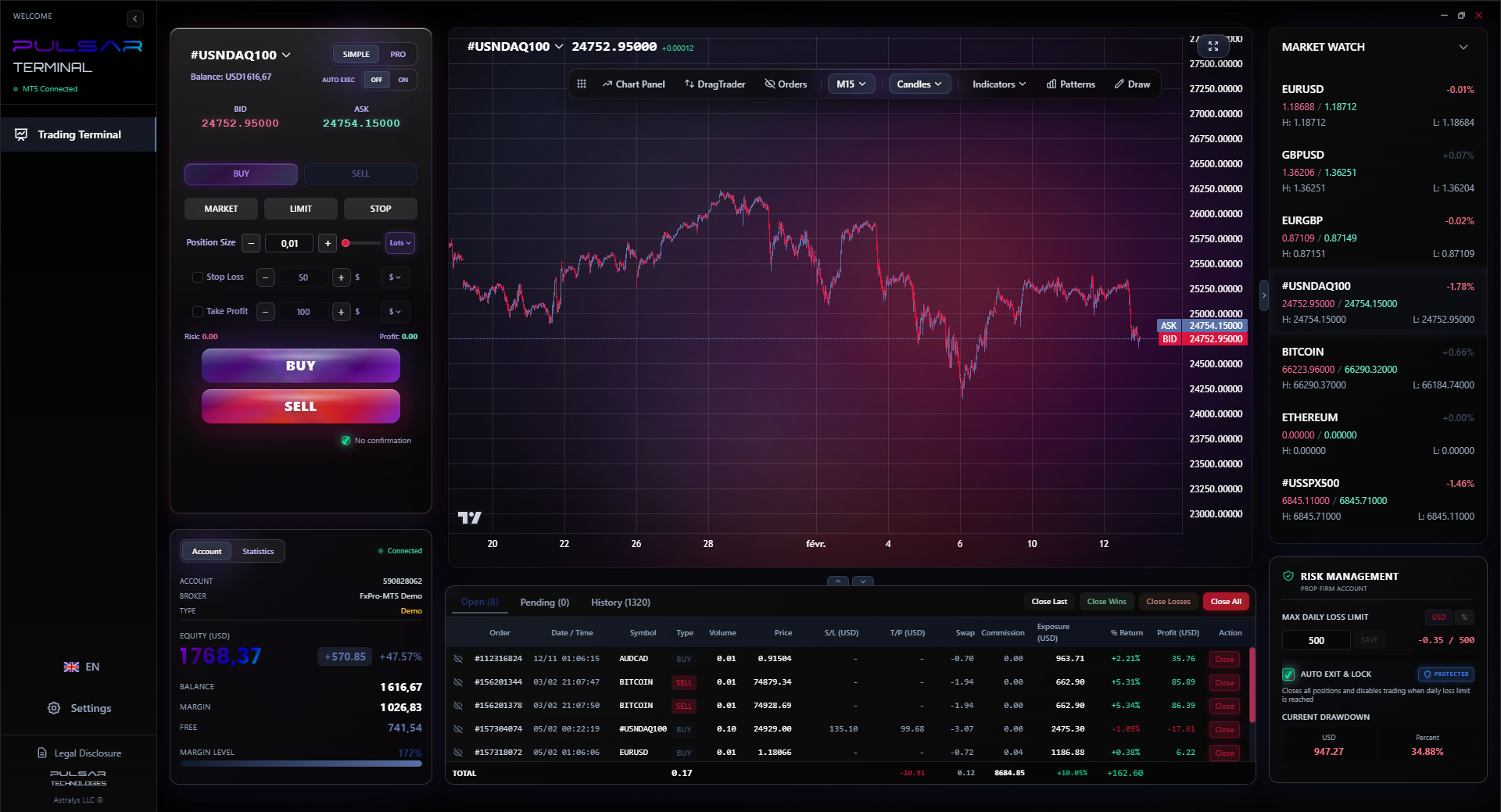
Sticking to a trading plan requires tools that remove emotion, like Pulsar Terminal's automated trade management features on MT5.
Pulsar Terminal
Lo strumento MT5 tutto-in-uno: ordini drag-and-drop, multi-TP/SL, trailing stop, grid trading, Volume Profile e protezione prop firm. Usato da oltre 1.000 trader ogni giorno.
“use amplifies everything, especially losses.”
You can have the best strategy in the world and still blow up your account. The market is a mirror, and it reflects your fear and greed right back at you.
The two biggest psychological traps for new traders in Nigeria are:
1. The 'Make It Back' Mentality. You lose $50 on a trade. Immediately, you jump into another, larger trade to recoup the loss. You're not trading the chart anymore; you're trading your anger. I've done this. It turns a $50 loss into a $200 loss in minutes. The rule? After two consecutive losses, walk away. Close the platform. Go do something else.
2. The 'Naira Hedge' Fallacy. With the Naira's volatility, many start trading forex simply to 'hedge' against the falling Naira. This is a terrible primary motive. It leads to desperate, long-term USD buys without a technical plan. Trade the charts, not the currency in your pocket.
Your mindset needs to be process-oriented, not outcome-oriented. Don't focus on the money you made or lost on a single trade. Focus on whether you followed your plan. A losing trade where you followed all your rules is a good trade. A winning trade where you broke your risk management is a bad trade that will hurt you in the long run.

Example: In Q3 2023, I had a run of 5 losing trades in a row, totaling a 6% account drawdown. It was frustrating. But I followed my 1% risk rule each time. The 6th trade was a winner that made 8%. Because I survived the losing streak, I was there to catch the win. Survival first, profits second.
“use amplifies everything, especially losses.”
Let me save you some time and money by telling you where I stumbled.
Pitfall 1: Signal Services & 'Funded Account' Gurus. If someone is making millions trading, why are they selling you signals for ₦20,000 a month? The business model of most signal groups is your subscription, not their trading. Same with many 'prop firm' coaches. The real path is through self-education and discipline.
Pitfall 2: Overtrading. This was my biggest early flaw. I'd sit at the screen all day, forcing trades where none existed just to feel active. I'd take 10-15 trades a day. Now, I'm happy with 2-3 high-quality setups. More trades don't mean more profit; they mean more spread costs and more chances to make emotional errors.
Pitfall 3: Ignoring Macro News. You might be trading a beautiful chart pattern, then BOOM, the US Federal Reserve makes an announcement and your stop-loss gets vaporized. Know the economic calendar. High-impact news (like US Non-Farm Payrolls, CPI, or CBN Monetary Policy Committee announcements) creates chaos. Either avoid trading 15 minutes before and after, or be prepared for extreme volatility.
Pitfall 4: No Separation of Capital. Do not trade with money for your rent, school fees, or business capital. The stress will destroy you. Have a dedicated 'trading bank' that, if lost, won't affect your life. This mental separation is crucial for clear decision-making.
💡 Consiglio di Winston
The market doesn't owe you anything. That trade you 'should have' taken that would have made money? Forget it. It never existed. Only trade what's in front of you now.
“Trade the charts, not the currency in your pocket.”
Let's turn this into action. Here is your 8-week plan to go from zero to a disciplined beginner.
Weeks 1-2: Education & Paper Trading. Don't deposit a single Naira yet. Open a demo account. Learn the absolute basics: what is a currency pair, what is a bid/ask, how to place a market and pending order. Follow a free structured course like BabyPips 'School of Pipsology'. Practice on your demo account for 2 hours a day.
Weeks 3-4: Strategy & Backtesting. Choose one simple strategy. Maybe it's trading with a moving average crossover. Go back on your demo chart (use the 'bar replay' mode if available) and practice that one strategy over and over on historical data. See how it would have performed. This is called backtesting. It builds confidence in the setup.
Weeks 5-6: Live Trading (Micro Account). Now, deposit the minimum amount with a reputable broker. I'm talking $50-$100. This is real money, so the psychology changes. Your goal is not profit. Your goal is to execute 20-30 trades following your plan and risk management perfectly. The EUR/USD guide is a great place to start for a liquid, predictable pair to practice on.
Weeks 7-8: Review & Scale. Analyze your trade journal from your live micro account. Are you following your rules? Where are you slipping? Only after you have a month of disciplined, rule-following trading should you consider adding more capital. Scaling up is about adding zeros to your position size, not changing your strategy.
Remember, this is a marathon. The goal of your first year is not to get rich. The goal is to learn how to play forex trading without losing your shirt. If you can finish the year with your initial capital intact and a solid, tested plan, you are in the top 10% of beginners. Everything else builds from there.
FAQ
Q1What is the minimum amount I need to start forex trading in Nigeria?
Technically, you can start with as little as $1 with some brokers. But realistically, to practice proper risk management and not get wiped out by a few pips of movement, I recommend a minimum of $100-$200. This allows you to trade micro lots (0.01) and risk 1% per trade meaningfully.
Q2Do I pay tax on my forex trading profits in Nigeria?
Yes. The law states that Capital Gains Tax applies at a rate of 10% on your gross profits. You are responsible for declaring this income to the Federal Inland Revenue Service (FIRS), regardless of whether your broker is local or international.
Q3Is forex trading a scam in Nigeria?
Forex trading as a legitimate financial activity is not a scam. However, the space is filled with scams: fake investment schemes, dishonest signal sellers, and unregulated brokers who manipulate prices. The key is to educate yourself, use only well-regulated brokers, and understand that consistent profits require significant skill and discipline - it's not a 'quick rich' scheme.
Q4What is the best time to trade forex in Nigeria?
The most liquid and active trading session for Nigerian traders is between 1:00 PM and 6:00 PM West Africa Time (WAT). This is when the London session is in full swing and the US session opens, leading to high volume, tighter spreads, and stronger trends.
Q5Can I use my Nigerian bank card to fund a forex account?
Yes, most international brokers accept Visa and MasterCard debit/credit cards issued in Nigeria. However, you will be charged in USD (or EUR/GBP), so your bank will apply its exchange rate and may charge an international transaction fee (often 1-3%). Some brokers like FXTM or HFM offer Naira-denominated accounts to avoid this conversion.
Q6What's more important, a good strategy or good psychology?
Good psychology, by a mile. You can have a mediocre strategy with excellent discipline and risk management and still be profitable. A brilliant strategy with poor psychology (overtrading, revenge trading, no stop-losses) will always fail. The mental game is 80% of trading.
Lezione del Prof. Winston
Punti chiave:
- ✓Risk a maximum of 1-2% of your account per trade.
- ✓The London-New York overlap (1-6 PM WAT) is your prime trading window.
- ✓You owe 10% Capital Gains Tax on all profits.
- ✓New SEC rules (ISA 2025) mean broker regulation is tightening.
- ✓Psychology and discipline are more important than any indicator.
Quanto è stato utile questo articolo?
Clicca su una stella
Analisi Trading Settimanali
Analisi e strategie settimanali gratuite. Nessuno spam.
Sull'autore
Olumide Adeyemi
Pioniere del Trading in Africa Occidentale
Uno degli educatori di trading forex più attivi in Nigeria. 8 anni di esperienza di trading da Lagos. Specializzato in strategie a basso capitale e sfide prop firm per trader africani.
Commenti
Avviso di rischio
Il trading di strumenti finanziari comporta rischi significativi e potrebbe non essere adatto a tutti gli investitori. Le performance passate non garantiscono risultati futuri. Questo contenuto è fornito solo a scopo educativo e non deve essere considerato un consiglio di investimento. Conduci sempre le tue ricerche prima di fare trading.
Potrebbe interessarti anche

Cara Trading Forex Sukses: 7 Prinsip dari Trader Profesional
Cara trading forex sukses dengan 7 prinsip trader pro: manajemen modal, disiplin, journal trading, backtest. Data nyata, bukan janji profit palsu.
Jam Trading Forex Terbaik untuk Trader Indonesia: Panduan Lengkap dengan Tabel Waktu
Panduan jam trading forex untuk trader Indonesia. Tabel 4 sesi dunia, jam emas 20:00-00:00, sesi mana yang harus dihindari. Data akurat + tips dari trader berpengalaman.
Top 5 Sàn Forex Uy Tín Nhất 2026: Review Jujur dari Trader Indonesia
Top 5 sàn forex uy tín 2026 untuk trader Indonesia. Review jujur: spread, deposit, withdraw, dukungan lokal. Exness, XM, IC Markets & lebih.
Scarica Pulsar Terminal
Tutti questi calcolatori sono integrati in Pulsar Terminal con dati in tempo reale dal tuo conto MT5.
Scarica Pulsar Terminal