


I stared at my screen, my profit on a USD/ZAR trade sitting pretty at R18,750.

David van der Merwe
Trader dei Mercati Emergenti ·  South Africa
☕ 11 min di lettura
Cosa imparerai:
I stared at my screen, my profit on a USD/ZAR trade sitting pretty at R18,750. The withdrawal request I’d submitted five days earlier was still 'pending.' My mistake? I’d used my credit card for the deposit but requested a bank wire for the profit. The broker’s compliance team was now asking for a bank statement, proof of address, and a signed form explaining the source of funds. That R18,750 wasn’t just a number; it was a car repair and school fees. I learned the hard way that knowing how to withdraw on forex is as critical as knowing how to trade. Here’s what I wish I’d known.
You can't just send money offshore and bring it back on a whim. South Africa has specific rules, and ignoring them is the fastest way to get your funds frozen. The two big players are the Financial Sector Conduct Authority (FSCA) and the South African Reserve Bank (SARB).
The FSCA licenses your broker. Always, and I mean always, check that your broker is FSCA-regulated. This isn't a nice-to-have; it's your primary safety net. It means they must keep your money in segregated accounts, separate from their own operating funds. If they go under, your capital isn't automatically part of the bankruptcy estate. I once almost signed up with an offshore broker offering insane use, but a quick FSCA register check showed they weren't licensed here. I walked away. Months later, forums were flooded with complaints from South Africans who couldn't get their money out from that same firm.
SARB controls the flow of money across our borders. Every forex withdrawal is an outward payment in their eyes. Your broker and your local bank are both "Authorised Dealers" who must report these transactions. The big rule you need to internalise is the Single Discretionary Allowance (SDA). As of 2026, this has been increased to R2 million per person, per calendar year. This allowance covers your forex trading profits, investments, travel, you name it. If your annual withdrawals exceed that, you'll need special permission from SARB, which is a bureaucratic nightmare.

Warning: Anti-Money Laundering (AML) rules are strict. Withdrawals must go back to an account in your name, matching your broker registration exactly. If you deposited from a joint account but try to withdraw to a personal one, you'll hit a wall. Profits from trading are a permissible reason under the SDA, but be prepared to explain it to your bank if they ask.

💡 Consiglio di Winston
Treat your first withdrawal like a test trade. Start small - withdraw just R500 or $50. It confirms the process works, verifies your banking details, and shows you the true timeline and net fee without risking your entire capital.
This is where your profit can get nibbled away. Every method has a different speed and cost profile. Let's break down the common ones for South Africans.
Bank Transfers (EFT/SWIFT) This is the most traditional route. A local EFT to a South African bank account (if your broker uses a local affiliate) can be surprisingly quick, sometimes within 24 hours. An international SWIFT transfer takes 3-5 business days. The fees are the killer. Your broker might charge $20-$30. Then your South African bank will take a cut for receiving foreign currency. Nedbank, for example, charges a commission on incoming foreign payments. You also get hit with the bank's exchange rate when they convert USD to ZAR, which is rarely the spot rate you see on your trading platform.
Credit/Debit Cards If you deposited with your Visa or Mastercard, this is often the smoothest path for withdrawals. There's a clear audit trail. Processing can take 2-10 business days. The major advantage? Many brokers don't charge a fee for card withdrawals. The disadvantage? Your bank might still levy a currency conversion fee on the incoming funds.
E-Wallets (Skrill, Neteller, PayPal) This is my personal go-to for speed. Withdrawals to e-wallets are often instant or within a few hours. The fees are usually low and transparent. However, you then need to get the money from your e-wallet to your South African bank account, which incurs another transfer fee and conversion spread. It's a two-step process, but the speed on the broker side is unbeatable.
Cryptocurrency A growing option. You withdraw Bitcoin or USDT to your private wallet. It's fast and bypasses traditional banking channels. But you must understand crypto wallets, network fees (which can be high), and the tax implications. The South African Revenue Service (SARS) views crypto as an asset, so disposals can trigger Capital Gains Tax. It's powerful but not for beginners.
The ZAR Account Advantage
This is a pro move. Many FSCA brokers like Exness or IC Markets offer ZAR-denominated accounts. You deposit and withdraw in Rands. This eliminates the currency conversion fee from the broker and often speeds up the process dramatically, as the money moves within the South African banking system. Your profit and loss are still in forex pairs, but your account balance is in Rands. I switched to a ZAR account with my broker two years ago, and my withdrawal times dropped from 5 days to 1 day on average.
“That R955 cost, or about 5.2%, eaten by fees and a poor exchange rate is why I'm passionate about this topic.”
Let's walk through a real example, so you know what to expect. I'm withdrawing $1,000 profit from my USD account to my FNB bank account.
- Log In & Navigate: I go to the broker's client portal or website, find the 'Withdraw Funds' section. It's never on the trading platform like MT5.
- Choose Method: I select 'International Bank Wire' from the dropdown. I already have my FNB account details saved from my deposit.
- Enter Amount: I type in 1000. The system shows an estimated fee: $25. The net amount I'll receive is $975.
- Submit & Verify: I hit submit. Immediately, I get an email with a secure link to verify the request. This is a standard security step. I click it.
- The Waiting Game: Status changes to 'Processing.' This is where compliance checks happen. They verify the withdrawal matches my deposit history and that my account isn't flagged for anything. This takes 24-48 hours usually.
- Broker Approval & Dispatch: Status changes to 'Approved' or 'Completed.' The broker has sent the funds. I get a SWIFT reference number.
- Bank Processing: 2-3 days later, FNB emails me. They've received $975. They convert it at their rate (say, 18.20 ZAR/USD instead of the market 18.50). They deduct their receiving fee (e.g., R200).
- Funds Land: R975 * 18.20 = R17,745. Minus R200 fee = R17,545 lands in my account. My $1,000 profit, at a spot value of R18,500, became R17,545. That's a R955 cost, or about 5.2%, eaten by fees and a poor exchange rate.

Example: That R955 loss is why I'm passionate about this topic. If I'd used a ZAR account or an e-wallet, the cost might have been under R300. That's a real difference. Always factor this into your position size calculator. A 2% risk on a trade needs to cover not just the potential loss, but the cost of cashing out your win.
Delays are frustrating but usually have a cause. Here are the big ones I've encountered.
The 'Source of Funds' Query: This got me that first time. You deposit R10,000, turn it into R25,000, and try to withdraw the R15,000 profit. The broker's AML system sees a large profit relative to your deposit. They may ask: "Can you explain how you generated these profits?" The answer is simple: "Forex trading." But you might need to provide a screenshot of your trade history or a statement. It's a hassle, but it's normal. Keeping a clean trading journal helps.
Mismatched Details: Your broker account is in "J. Smith." Your bank account is "John Smith." Delay. Your deposit was from account ending 4567, your withdrawal request is to account ending 8910. Delay. Consistency is key.
Weekends & Holidays: You submit at 4 PM on a Friday. Nothing happens until Monday morning SA time. If Monday is a US or SA public holiday, add another day. International banks don't work weekends.
Bank Verification Delays: Sometimes, the hold-up is on your bank's side, not the broker's. A large, unexpected foreign deposit can trigger their internal checks. Calling your bank's forex department with the SWIFT reference can sometimes grease the wheels.
The Prop Firm Curveball: If you're trading a prop firm challenge, their withdrawal rules are a universe of their own. They often have specific profit-split schedules and may only process payments on certain days of the month. Read their terms twice.

Pro Tip: Plan your withdrawals like a trade. Don't wait until you need the cash for a bill tomorrow. Initiate the process when you have a 5-7 business day buffer. And always withdraw to the same method you deposited with, especially for the first few times. It builds a trusted history.
💡 Consiglio di Winston
The broker's 'estimated processing time' clock only starts once your request is fully verified and approved by compliance. Your submission date is not the start date. Factor in an extra 24 hours for this internal review.
“Your broker's withdrawal policy should be a top-three factor in your choice, right after regulation and trading costs.”
Let's be clear: your forex trading profits are likely taxable in South Africa. SARS doesn't have a specific "forex trader" category. They typically treat it as either:
- Revenue (Income Tax): If you trade frequently (like scalping), with the intention of making a profit from short-term price movements, it could be seen as a business. Profits are added to your other income and taxed at your marginal rate (up to 45%).
- Capital Gains Tax (CGT): If your activity is more infrequent, like swing trading over weeks, it might be considered an investment. Only 40% of the net gain (after costs like spreads, fees) is included in your taxable income, and then taxed at your marginal rate. You also get an annual exclusion (R40,000 for individuals in 2024/2025).
The line is blurry. I consulted a tax practitioner who specialises in traders. His advice? careful records. I export a full trade report from my broker every month. I log every deposit, withdrawal, and fee. I can show my net profit for the year, minus my allowable expenses (data fees, a portion of home office costs, trading software subscriptions).
When you withdraw, that's not a taxable event in itself. The tax event was when you closed the profitable trade. The withdrawal is just moving already-taxable profits. Keep your broker statements and bank records showing the withdrawals. They are your proof of the money moving into the country, which SARS may want to see if they ever ask about the source of deposits into your local bank account.
Ignoring this is a huge risk. A SARS audit with unexplained income is a path to penalties and interest that can wipe out years of trading gains. Be smart, keep records, and consider getting professional advice for your first tax year as a profitable trader.
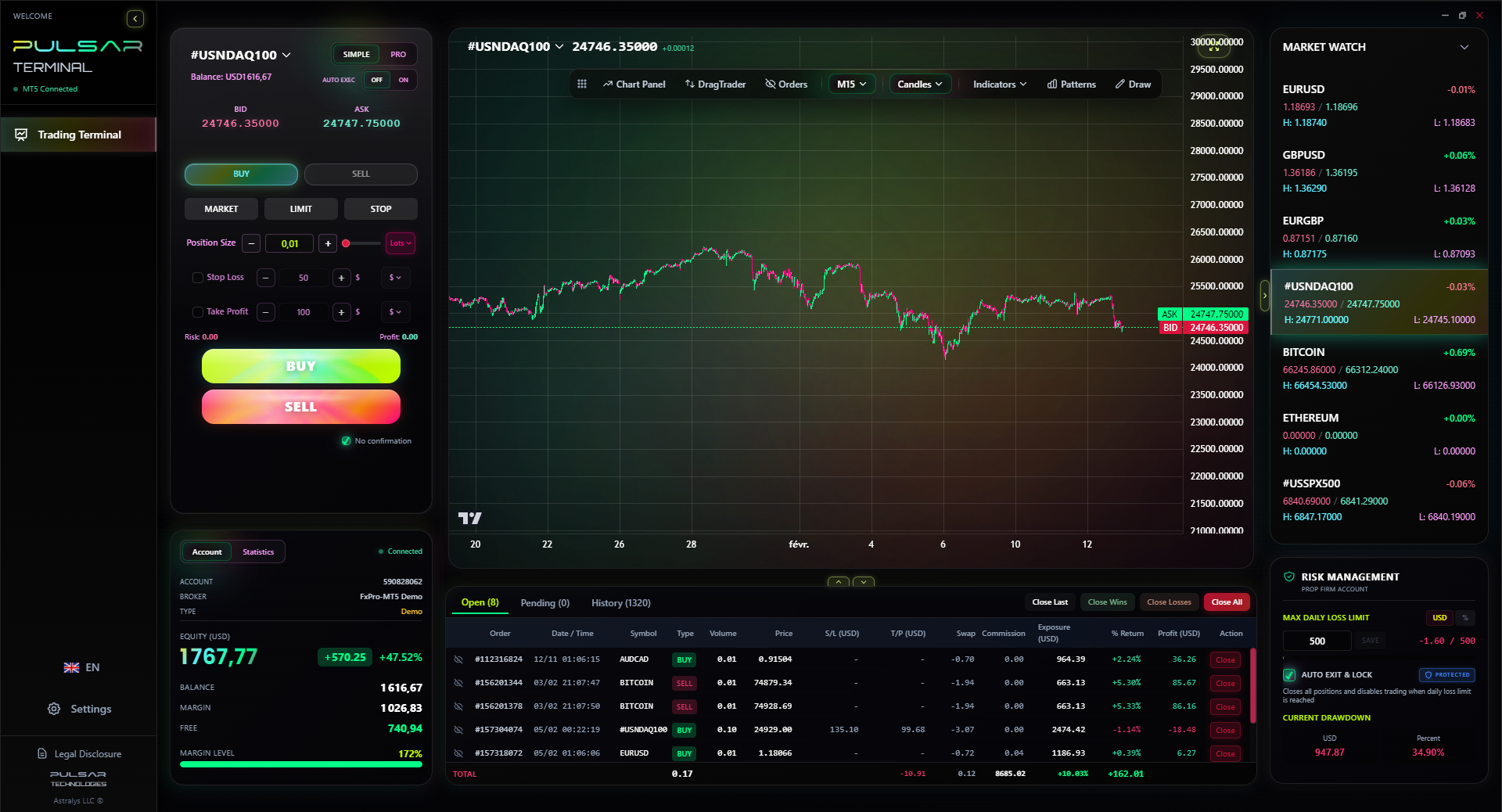
Keeping precise records of every trade, fee, and withdrawal for tax purposes is tedious, but tools like Pulsar Terminal can automate trade journaling directly from your MT5 platform, making SARS compliance straightforward.
Pulsar Terminal
Lo strumento MT5 tutto-in-uno: ordini drag-and-drop, multi-TP/SL, trailing stop, grid trading, Volume Profile e protezione prop firm. Usato da oltre 1.000 trader ogni giorno.
Your broker's withdrawal policy should be a top-three factor in your choice, right after regulation and trading costs. Here’s what to look for.
Fast-Track Options: Some brokers, like Exness and HFM, are known for same-day processing for South African clients, especially for local bank transfers and e-wallets. This is a massive quality-of-life benefit.
Transparent Fee Schedule: Don't just look for "free withdrawals." Dig into the details. Does "free" mean the first two per month? Is it only for ZAR accounts? What's the minimum amount? I once chose a broker with "zero withdrawal fees," only to find they baked the cost into a terrible exchange rate on ZAR conversions.
Local Support: Does the broker have a South African phone number or support team that operates during SA hours? When your withdrawal is stuck, you don't want to wait 12 hours for an email reply from a different time zone.
Method Availability: Ensure they support the method you want. If you love the speed of Skrill, make sure they offer it for both deposits and withdrawals. Not all do.
I made a comparison table when I last switched brokers. It looked something like this:
| Broker | FSCA License | ZAR Account? | Popular Withdrawal Methods | Key Withdrawal Note |
|---|---|---|---|---|
| Broker A | Yes | Yes | EFT, Card, Skrill | Free EFT 1-2 days, local number. |
| Broker B | Yes | No | Int'l Wire, Neteller | $30 wire fee, 3-5 day processing. |
| Broker C | Yes | Yes | EFT, Crypto, Card | Same-day EFT promised, min R500. |
This practical comparison saved me from future headaches. Read the reviews on sites like ours, but focus on the comments about funding and withdrawals from other South Africans. That's the real gold.
FAQ
Q1How long does a forex withdrawal take to reach my South African bank account?
It depends on the method. Local EFT to a ZAR account can be 1-2 days. International bank wires take 3-5 business days. E-wallets like Skrill can be instant from the broker, but transferring from Skrill to your bank adds another 1-2 days. Always allow a full week to avoid stress.
Q2Why was my forex withdrawal rejected by the broker?
Common reasons: 1) You tried to withdraw to an account not in your exact name. 2) You requested a method different from your deposit (e.g., deposited with card, withdrew to bank). 3) You haven't completed the broker's verification (FICA) process. 4) You're trying to withdraw bonus funds before meeting the trading volume requirements. 5) Your account is under investigation for suspicious trading activity.
Q3What is the cheapest way to withdraw forex profits in South Africa?
Using a ZAR-denominated trading account and withdrawing via a free local EFT is typically the cheapest. It avoids international wire fees and gives you a fair, wholesale exchange rate. If a ZAR account isn't available, using an e-wallet (like Skrill) for the broker withdrawal and then cashing out to your bank often has lower total fees than a direct international bank wire.
Q4Do I pay tax on every withdrawal I make?
No. You pay tax on your annual net trading profit (or capital gain), not on each withdrawal. The withdrawal is just moving your already-earned (and potentially taxable) profit. However, your withdrawal records are crucial evidence for SARS to prove your trading income and the funds entering the country.
Q5Can I withdraw forex profits to someone else's bank account?
Almost certainly not. Due to strict Anti-Money Laundering (AML) regulations, brokers are required to send funds only to an account held in the trader's own name. Attempting to do this will cause a major delay and likely lead to the withdrawal being cancelled and your account flagged.
Q6What is the Single Discretionary Allowance (SDA) and why does it matter?
The SDA is your annual limit for moving money out of South Africa for discretionary purposes, which includes forex trading profits. As of 2026, it's R2 million per calendar year. If your total annual withdrawals from all your forex brokers exceed this, you must apply to SARB for special permission, which is complex. Keep track of your total yearly withdrawals to stay under this limit.
Q7My bank is asking for proof of funds for a large forex withdrawal. What do I give them?
Provide a statement from your forex broker showing your trading activity and the withdrawal confirmation. A simple letter from you stating the funds are profits from online foreign exchange trading, supported by the broker statement, is usually sufficient. Your bank is fulfilling its duty to combat money laundering.
Lezione del Prof. Winston
Punti chiave:
- ✓Always use an FSCA-licensed broker for fund security.
- ✓Withdraw via the same method you deposited with initially.
- ✓A ZAR account slashes fees and speeds up access to your money.
- ✓Track your annual withdrawals against the R2 million SDA limit.
- ✓Keep careful records for SARS from day one.
Quanto è stato utile questo articolo?
Clicca su una stella
Analisi Trading Settimanali
Analisi e strategie settimanali gratuite. Nessuno spam.
Sull'autore
David van der Merwe
Trader dei Mercati Emergenti
Trader con base a Johannesburg con 11 anni di esperienza nelle valute dei mercati emergenti. Specializzato in coppie ZAR, trading regolamentato dalla FSCA e analisi del mercato sudafricano.
Commenti
Avviso di rischio
Il trading di strumenti finanziari comporta rischi significativi e potrebbe non essere adatto a tutti gli investitori. Le performance passate non garantiscono risultati futuri. Questo contenuto è fornito solo a scopo educativo e non deve essere considerato un consiglio di investimento. Conduci sempre le tue ricerche prima di fare trading.
Potrebbe interessarti anche

Cara Trading Forex Sukses: 7 Prinsip dari Trader Profesional
Cara trading forex sukses dengan 7 prinsip trader pro: manajemen modal, disiplin, journal trading, backtest. Data nyata, bukan janji profit palsu.
Jam Trading Forex Terbaik untuk Trader Indonesia: Panduan Lengkap dengan Tabel Waktu
Panduan jam trading forex untuk trader Indonesia. Tabel 4 sesi dunia, jam emas 20:00-00:00, sesi mana yang harus dihindari. Data akurat + tips dari trader berpengalaman.
Top 5 Sàn Forex Uy Tín Nhất 2026: Review Jujur dari Trader Indonesia
Top 5 sàn forex uy tín 2026 untuk trader Indonesia. Review jujur: spread, deposit, withdraw, dukungan lokal. Exness, XM, IC Markets & lebih.
Scarica Pulsar Terminal
Tutti questi calcolatori sono integrati in Pulsar Terminal con dati in tempo reale dal tuo conto MT5.
Scarica Pulsar Terminal