


Here's a hard truth: 90% of the glossy, perfect trading examples you see online are useless in Lagos.

Olumide Adeyemi
Pioniere del Trading in Africa Occidentale ·  Nigeria
☕ 11 min di lettura
Cosa imparerai:
- 1What Investopedia Gets Right (And Where It Falls Short for Us)
- 2Building Your Nigerian Forex Foundation
- 3From Theory to Charts: Practical Indicators for Our Market
- 4Choosing a Broker: Nigerian Considerations They Don't Teach You
- 5Developing Your Edge (Beyond the Basics)
- 6Common Pitfalls and How to Avoid Them
- 7Your Path Forward

Here's a hard truth: 90% of the glossy, perfect trading examples you see online are useless in Lagos. The theory on Investopedia Forex is solid, but applying it here? That's a different ball game. I've watched countless traders in Surulere and VI memorize concepts only to get wrecked by local market quirks they never read about. This guide isn't about rehashing definitions. It's about translating that Investopedia knowledge into a survival kit for the Nigerian trading scene, where power outages, currency volatility, and unique broker rules are part of your daily chart.
Let's give credit where it's due. Investopedia is the best free library we have. Their core definitions for terms like pip definition, spread definition, and margin call are accurate and essential. When I started, their explanation of use saved me from a blow-up I saw coming for a friend. He used 1:500 like it was candy, not understanding the margin call mechanics. I stuck to 1:50 for my first year because of them.
But here's the gap. Investopedia teaches a sterile, idealized market. It doesn't account for the 3:30 PM WAT liquidity drop in EUR/NGN pairs, or how your broker's server in Cyprus adds 15 pips of slippage during a CBN announcement. Their scalping strategy page won't mention that most Nigerian-focused brokers have strict rules against it. I learned this the hard way with a XM review account years ago; my 5-pip scalps kept getting flagged because their policy considered it 'abusive trading' on their African client accounts. The theory was sound, the local application was a failure.

Warning: Don't assume a strategy is viable just because it's on Investopedia. Cross-reference it with your specific broker's terms of service, especially the sections on 'trading style' and 'bonus policy'. What's standard in the US can be prohibited here.
The value is in the foundation. Use Investopedia Forex to build your vocabulary and understand mechanics. Then, immediately start looking for the Nigerian layer on top of that knowledge.

Your first job isn't to pick a currency pair. It's to understand your environment. Start with the Naira. You need to develop a gut feeling for USD/NGN volatility. Follow the CBN, not just the Fed. When they make a move, it doesn't just affect the official rate; it sends shockwaves through the parallel market that your forex broker's pricing often reflects.
Start with a Demo, But Do It Right
Everyone says use a demo. I'm saying use a Nigerian broker's demo. Don't practice on some generic platform with perfect execution. Open a demo with Exness review or IC Markets review (both popular here) and trade during Nigerian hours. See the spreads widen when London closes. Feel the lag if you're trading on mobile data from Ajah. This is your reality.
Your First Real Concept: Position Sizing in Naira
Forget trading 1.00 lots because a YouTube guru does it. Your capital in Naira is your lifeblood. The single most important tool you will ever use is a position size calculator. Here's my rule: I never risk more than 1% of my account on a trade. But 1% of what? My Naira balance, converted at my broker's rate. If I have ₦500,000 and USD/NGN is 1400, that's about $357. My 1% risk is $3.57. If my stop loss is 50 pips on EUR/USD guide, I can only afford to trade 0.07 lots. That's the math that keeps you alive. I ignored this early on, risked 5% on a 'sure thing' in XAU/USD guide, and lost ₦25,000 in an afternoon. It felt like a month's worth of hustle, gone.

Pro Tip: Before you learn a single indicator, master the position size calculator. Calculate your risk in Naira for every single trade, no exceptions. This habit is more valuable than any secret strategy.

💡 Consiglio di Winston
The market's job is to make you feel stupid. Your job is to not act stupid. When a trade goes against you, don't argue with the price. Just get out.
“Discipline is the only edge that can't be copied.”
Investopedia has pages on every indicator under the sun. Most are noise. For the volatility and sometimes chaotic moves we see, you need simple, strong tools.
The RSI is Your Best Friend (When You Understand It) The RSI indicator page on Investopedia explains overbought and oversold. Good. Now, for Nigeria, adjust the settings. The standard 70/30 levels are too rigid. I use 75/25. Why? Because in a strong trending market (like USD/NGN during a forex crunch), price can sit at "overbought" for weeks. Selling just because RSI hits 70 is a sure way to lose money. I look for failure swings – when RSI makes a lower high while price makes a higher high. That's a real divergence, not just a level touch.
MACD for Confirmation, Not Entries The MACD indicator is great for spotting momentum shifts. But don't trade the crossover alone. In our market, you get many false signals. I use it to confirm what price is already telling me. If price breaks a key level on the EUR/USD guide chart and the MACD histogram is also rising strongly above the zero line, that's a high-probability add-on signal. I once took a long trade on GBP/USD based solely on a MACD crossover during low liquidity. The signal reversed 20 minutes later, and I took a 35-pip loss. Lesson learned: MACD supports, it doesn't lead.
Keep It Simple My main chart has three things: price action (candles), a 20-period Exponential Moving Average to gauge trend, and the RSI. That's it. More lines mean more confusion, and confusion in Lagos traffic or during a generator switch-over leads to bad decisions.

Investopedia might list 'regulation' as a top priority. For us, it's more nuanced. Yes, regulation by bodies like CySEC (Cyprus) or the FCA (UK) is important for safety. But you must dig deeper.
Deposit and Withdrawal Methods: Can you fund with your Nigerian debit card (Mastercard/Visa)? What about bank transfer? How long do withdrawals take back to your GTB or Zenith account? I use Pepperstone review and their local bank transfer option via a payment processor. It takes 1-3 business days, which is standard. I tried a broker once that only accepted Skrill; converting Naira to Skrill added a 7% fee, killing my edge before I even traded.
Spreads on African Pairs: If you trade USD/NGN or USD/ZAR, check the spreads specifically. They can be massive compared to EUR/USD guide. A broker might advertise "tight spreads" but only on majors. I've seen USD/ZAR spreads hit 50 pips during SA news events.
Customer Support Hours: Do they have 24/7 support? If your trade goes wrong at 10 PM WAT, can you get help? Or are you talking to a bot until London opens? This matters.
Prop Firm Accessibility: Many Nigerian traders are using prop firms to trade larger capital. If this is your path, check if your broker's platform (usually MT4/5) is compatible with the prop firm's dashboard. Some prop firms have specific rules about scalping strategy or daily loss limits that you need to manage carefully to avoid violation.

Example: Broker Comparison for a ₦200,000 Account
| Feature | Broker A (Int'l) | Broker B (Local Focus) |
|---|---|---|
| Min. Deposit | $100 (~₦140k) | ₦50,000 |
| Naira Deposits? | No (Card/ Crypto only) | Yes, via transfer |
| Avg. EUR/USD Spread | 1.0 pip | 1.5 pips |
| USD/NGN Offered? | No | Yes (30 pip spread) |
| Support WAT Hours? | Email only | Live Chat & Phone |
Sometimes, paying slightly higher spreads is worth it for reliable local service and peace of mind.
💡 Consiglio di Winston
Your first profit target should always be to break even. Move your stop loss to your entry price as soon as the trade moves 1.5x your risk in your favor. A breakeven trade is a free education.

“Calculate your risk in Naira for every single trade, no exceptions. This habit is more valuable than any secret strategy.”
Once you have the foundation, the real work begins. This is where you move from being a student of Investopedia Forex to being a trader.
Find Your Timeframe: Your personality and schedule dictate this. If you have a 9-5 in Victoria Island, you're not a scalping strategy trader. You're a swing trading trader. Analyze the daily and 4-hour charts in the evening. Place trades with stops and targets and leave them. Trying to scalp during your lunch break is a recipe for stress and losses.
Journal Relentlessly: Your trade journal shouldn't just be "bought EUR/USD, won 20 pips." It must include:
- Market Context: What was the CBN/Fed news?
- Emotional State: Was I tired? Frustrated from traffic?
- Technical Reason: Was it a support bounce? A breakout? (Refer back to your RSI indicator or MACD indicator setup).
- Outcome in Naira: Not just pips. The actual Naira profit/loss. This keeps it real.
My biggest lesson came from my journal. I found that 80% of my losses happened on trades I entered between 1 PM and 3 PM WAT. That's when I'm post-lunch, sluggish, and the market is in the low-volume mid-day lull. I now avoid analyzing or entering new trades in that window. That single insight improved my win rate more than any indicator ever did.
Build a Routine: The market doesn't care about your plans. You must care about the market's rhythm. My routine: Check economic calendar (CBN & global) at 7 AM. Review daily charts of my 3 watchlist pairs. Plan potential scenarios. Go to work. Check 4-hour charts after 6 PM. Execute only if my plan is met. No impulsive trades. Discipline is the only edge that can't be copied.

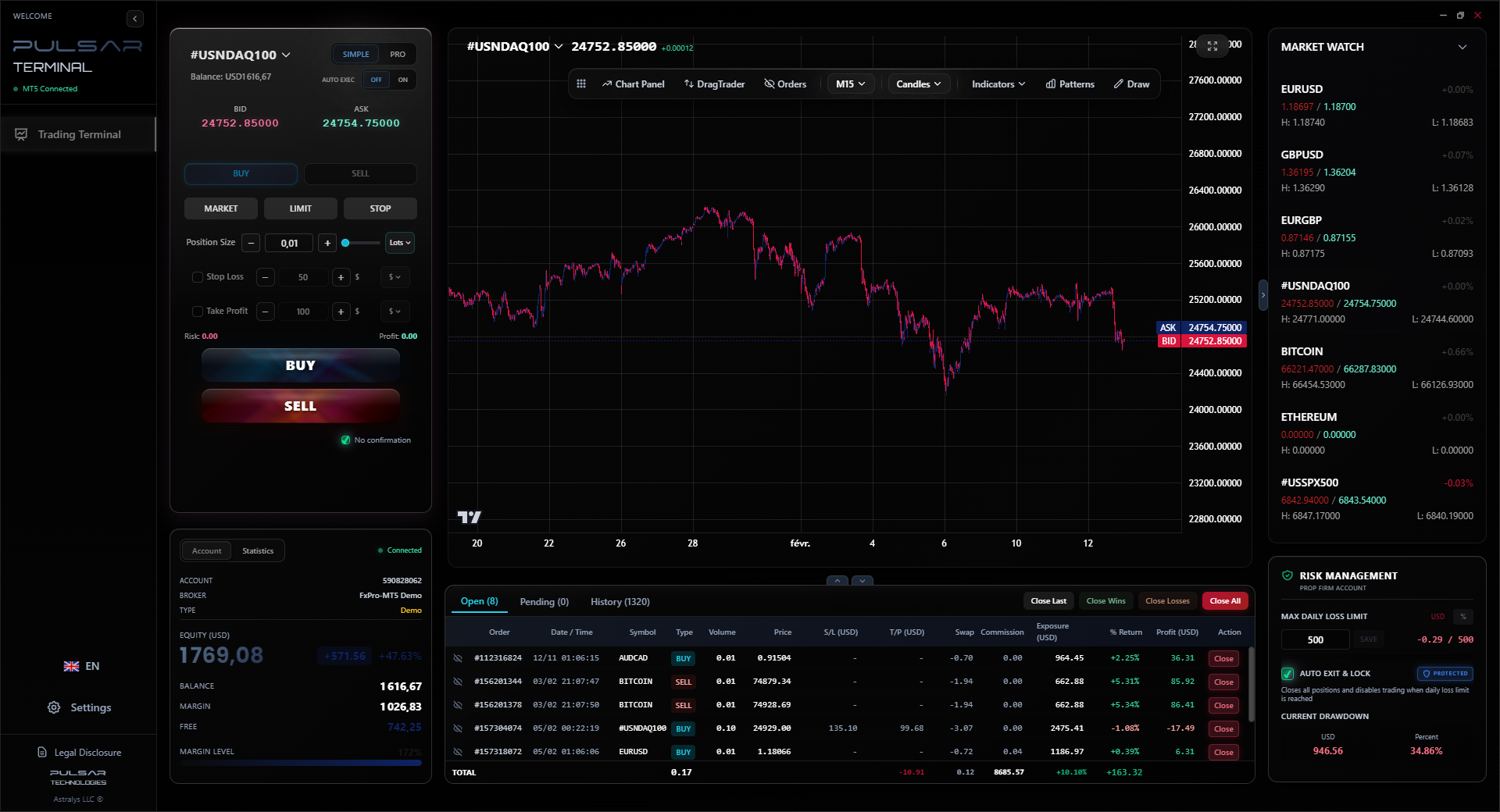
Managing multiple take-profit levels and moving stops to breakeven manually is stressful; Pulsar Terminal automates these risk management tasks directly on your MT5 platform.
Pulsar Terminal
Lo strumento MT5 tutto-in-uno: ordini drag-and-drop, multi-TP/SL, trailing stop, grid trading, Volume Profile e protezione prop firm. Usato da oltre 1.000 trader ogni giorno.
Let's talk about the traps waiting for you. I've fallen into most of these.
The 'Get-Rich-Quick' Mentality: Forex is not a side hustle you do to make quick rent money. It's a skill profession. If you approach it with desperation, the market will smell it and take your money. I funded an account with my last ₦100k hoping to double it for an emergency. I was overtrading, ignoring my stops, and blew the account in 3 days.
Chasing Losses: You lose ₦10,000 on a bad trade. The instinct is to immediately jump into another trade with a ₦20,000 risk to 'make it back fast.' This is the express lane to a margin call. When you take a loss, step away. Close the platform. Go for a walk. The market will still be there tomorrow.
Ignoring the Cost of Trading: The spread and commission are your enemies. If your broker's spread on EUR/USD guide is 2 pips and you're scalping strategy for 5-pip targets, you need to be right over 60% of the time just to break even. That's nearly impossible long-term. Choose your broker and strategy with costs front of mind.
Over-Reliance on Signals/Gurus: The Nigerian 'forex signal' scene is crowded. Ask yourself: If their signals are so profitable, why are they selling them for ₦5,000 a month instead of trading them with their own millions? I paid for signals early on. The stress of rushing to enter their trades, often with no understanding of why, was worse than losing my own money. You will never learn to drive by sitting in the passenger seat.
Pro Tip: The most powerful word in your trading vocabulary is "NO." No, I won't trade without a stop loss. No, I won't risk more than 1%. No, I won't trade today because the chart is messy and I don't have a clear edge. Saying no preserves your capital for the high-probability setups.
💡 Consiglio di Winston
The data doesn't lie, but your memory does. If you didn't write it in your journal, it didn't happen. Your journal is your only true teacher.

“The most powerful word in your trading vocabulary is 'NO.'”
So, where do you start tomorrow?
- Bookmark the Essentials: Save the Investopedia pages for pip definition, spread definition, and margin call. Understand them cold.
- Open a Demo Account: With a broker like IC Markets review or Exness review. Practice for at least three months. Not three weeks. Three full months of consistent, journaled practice.
- Master One Pair: Start with EUR/USD guide. It's the most liquid, has the tightest spreads, and moves predictably relative to others. Don't jump to gold or exotic pairs yet.
- Learn One Strategy: Pick either support/resistance trading or moving average crossovers. Use the RSI indicator for confirmation. Practice it on your demo until you can draw your setup with your eyes closed.
- Fund a Small Live Account: Start with an amount you can afford to lose completely - maybe ₦50,000. The psychological shift from demo to live is massive. You need to feel that pressure in small doses.
Investopedia Forex gave you the map. This guide tried to show you the terrain of Nigeria. The journey is yours. It will be frustrating, humbling, and slow. But if you focus on risk management, continuous learning, and brutal self-honesty, you can build something real. Not just profits, but a valuable skill. Now go look at a chart. Not to trade, just to look. Start seeing, not just looking.
FAQ
Q1Is Investopedia a good resource for learning forex in Nigeria?
Yes, but with a major caveat. It's the best free resource for understanding universal concepts like pips, spreads, and margin. However, it doesn't account for Nigerian-specific challenges: Naira volatility, local broker rules, power/internet issues, and unique market hours. Use it for your theoretical foundation, then immediately seek out practical, Nigeria-focused guidance to layer on top.
Q2What's the minimum amount in Naira I need to start trading forex?
Technically, some brokers allow you to start with as little as $10 (roughly ₦14,000). But realistically, I don't recommend starting live trading with less than ₦100,000. Why? With a small account, you're forced to use high use to see meaningful gains (in Naira terms), which dramatically increases your risk of a margin call. A ₦100k account allows for more sensible position size calculator use and can withstand a few losses while you learn.
Q3Can I use forex trading to hedge against the Naira falling?
In theory, yes. If you believe the Naira will weaken, you could buy a forex pair like USD/NGN (if offered) or standard pairs like USD/CHF. However, this is extremely risky and not straightforward for beginners. The spreads on Naira pairs are often wide, and predicting CBN moves is difficult. For most individuals, it's more speculation than effective hedging. Focus on learning to trade first before trying to use it as a hedge.
Q4Which is better for a Nigerian beginner: swing trading or scalping?
Overwhelmingly, swing trading. Scalping requires lightning-fast execution, near-zero spreads, and constant screen attention - conditions hard to meet with Nigerian internet and broker restrictions. Swing trading on the 4-hour or daily charts fits a normal work schedule. You can analyze in the evening, set your trades, and manage them without needing to watch the screen all day.
Q5How do I know if a forex broker is trustworthy for Nigerians?
Check four things: 1) Regulation: Look for licenses from CySEC, FCA, or ASIC. 2) Local Services: Do they accept Naira deposits via bank transfer? Do they have local customer support channels? 3) Transparent Fees: Understand their spreads on the pairs you want to trade and any withdrawal fees back to Nigeria. 4) Community Reputation: Search for reviews from other Nigerian traders. A good starting point is reading our detailed Exness review or IC Markets review to see how they perform for our market.
Q6I keep losing money on my demo account. Should I still go live?
Absolutely not. A demo account is where you're supposed to lose money - it's play money. If you can't be profitable over a 3-month period in a demo (where emotions are removed), you have zero chance live where fear and greed take over. Your demo losses are cheap lessons. Figure out why you're losing. Is it your strategy, your timing, your risk management? Fix it there first. Going live prematurely is just donating your hard-earned Naira to the market.
Lezione del Prof. Winston
Punti chiave:
- ✓Risk a maximum of 1% of your Naira balance per trade.
- ✓Adjust standard indicator settings (like RSI 75/25) for volatile markets.
- ✓Demo trade for 3 months minimum before risking real money.
- ✓Choose swing trading over scalping with a Nigerian work schedule.
- ✓Your broker's local deposit/withdrawal process is as important as their spreads.
Quanto è stato utile questo articolo?
Clicca su una stella
Analisi Trading Settimanali
Analisi e strategie settimanali gratuite. Nessuno spam.
Sull'autore
Olumide Adeyemi
Pioniere del Trading in Africa Occidentale
Uno degli educatori di trading forex più attivi in Nigeria. 8 anni di esperienza di trading da Lagos. Specializzato in strategie a basso capitale e sfide prop firm per trader africani.
Commenti
Avviso di rischio
Il trading di strumenti finanziari comporta rischi significativi e potrebbe non essere adatto a tutti gli investitori. Le performance passate non garantiscono risultati futuri. Questo contenuto è fornito solo a scopo educativo e non deve essere considerato un consiglio di investimento. Conduci sempre le tue ricerche prima di fare trading.
Potrebbe interessarti anche

Cara Trading Forex Sukses: 7 Prinsip dari Trader Profesional
Cara trading forex sukses dengan 7 prinsip trader pro: manajemen modal, disiplin, journal trading, backtest. Data nyata, bukan janji profit palsu.
Jam Trading Forex Terbaik untuk Trader Indonesia: Panduan Lengkap dengan Tabel Waktu
Panduan jam trading forex untuk trader Indonesia. Tabel 4 sesi dunia, jam emas 20:00-00:00, sesi mana yang harus dihindari. Data akurat + tips dari trader berpengalaman.
Top 5 Sàn Forex Uy Tín Nhất 2026: Review Jujur dari Trader Indonesia
Top 5 sàn forex uy tín 2026 untuk trader Indonesia. Review jujur: spread, deposit, withdraw, dukungan lokal. Exness, XM, IC Markets & lebih.
Scarica Pulsar Terminal
Tutti questi calcolatori sono integrati in Pulsar Terminal con dati in tempo reale dal tuo conto MT5.
Scarica Pulsar Terminal