


Is forex trading easy to learn? That's the question every newbie in South Africa asks, usually after seeing some flashy ad promising quick riches.

David van der Merwe
Trader dei Mercati Emergenti ·  South Africa
☕ 9 min di lettura
Cosa imparerai:
- 1The Learning Curve Myth: It's Not What You Think
- 2South African-Specific Hurdles You Can't Ignore
- 3Real Numbers, Real Expectations: What Learning Actually Costs
- 4The Core Skills You Absolutely Must Master
- 5A Practical Learning Roadmap for South Africans
- 6Common Pitfalls (And How I Fell Into Them)
- 7So, Is It Worth It? A Final Reality Check
Is forex trading easy to learn? That's the question every newbie in South Africa asks, usually after seeing some flashy ad promising quick riches. The short, honest answer? No, it's not easy. But that doesn't mean it's impossible. It's a skill, like learning to code or play a complex sport. The real question you should be asking is: what does 'learning' forex actually involve here in SA, and are you prepared for the journey? Let's strip away the hype and talk about what it really takes, from FSCA rules to the rand's volatility.
Most people think learning forex is about memorizing chart patterns and indicator signals. That's maybe 20% of it. The other 80% is psychology and risk management, and that's the part that breaks most traders. I remember my first 'aha' moment wasn't about a perfect entry; it was about a terrible trade I managed to lose only 1% of my account on, instead of the 10% I would have blown a month prior. That felt like a win.
Here's the uncomfortable truth: the market doesn't care how smart you are. It tests your patience, your ego, and your fear. You can know all about the MACD indicator and still panic-sell at the worst possible moment. Learning the technical stuff? That's straightforward. There are a million videos on scalping strategy. Learning to control yourself when a trade goes against you? That's the real mountain to climb.

Warning: The biggest trap is thinking you've 'learned it' after a few winning trades. Overconfidence is the fastest route to a blown account. The market has a way of humbling you just when you think you've got it figured out.

💡 Consiglio di Winston
Your first R10,000 in trading profits isn't for a braai. It's your 'permission slip' to trade slightly larger sizes. Reinvest your early winnings to compound your learning, not your lifestyle.
Trading from South Africa isn't the same as trading from London or New York. We face unique challenges that add layers of complexity to the learning process.
Regulation and Broker Choice
Your first real lesson is navigating who to trust with your money. The Financial Sector Conduct Authority (FSCA) is our main watchdog. A broker licensed by them (like Exness or XM under their local FSP numbers) is obligated to segregate your funds and adhere to use caps of 30:1 for retail clients. That use limit is a good thing for beginners - it forces you to learn proper position size calculator use instead of relying on dangerous, excessive borrowing.
You can use international brokers, but if something goes wrong, your recourse is a lot trickier. Sticking with an FSCA-regulated entity is a crucial part of your risk management education.
The Rand and Liquidity
Trading ZAR pairs (like USD/ZAR) is tempting because it's 'our' market. But be warned: these pairs can have wild spreads, especially around local market closes or during political uncertainty. I got caught once in EUR/ZAR when a spread that was normally 50 pips ballooned to over 200 in seconds during a news event. My stop-loss was triggered at a far worse price than I'd planned. Learning which pairs to trade as a beginner is key - stick to the highly liquid majors like EUR/USD while you're finding your feet.
Taxes and SARS
This is the most boring but critical lesson. Profits from frequent trading are considered income by SARS and taxed at your marginal rate. You need to keep careful records of every trade, deposit, and withdrawal from day one. Learning to calculate your profit after potential tax is part of the game. I didn't keep good records in my first year, and reconciling it all for my accountant was a nightmare.
“Learning the technical stuff is straightforward. Learning to control yourself when a trade goes against you? That's the real mountain to climb.”
Let's talk numbers, because vague promises are useless. Learning forex has a tangible cost, both in money and time.
The Financial Cost:
- Starting Capital: Yes, some brokers like Exness let you start with $10 (about R180). But is that realistic for learning? Not really. With 30:1 use, that's $300 in buying power. One bad move and you're done. A more sensible learning budget is between $100-$500 (R1,800-R9,000). This allows you to practice proper position sizing without being wiped out by a single pip definition move.
- The Costs of Trading: You're not just battling the market; you're battling costs. On a standard account, you pay the spread definition. On a 'raw' account, you pay a lower spread plus a commission. For example, on a major pair, a 1-lot trade might cost you $7-$10 in total fees. These small leaks sink ships if you're overtrading.
The Time Investment: This isn't a weekend hobby. To get to a point of basic competence, expect to spend 6-12 months studying, paper trading, and trading very small live sizes. It's a part-time job. The stats are brutal: between 51% and 89% of retail CFD traders lose money. The ones who make it past the learning phase are the ones who treat it with serious, consistent effort.

Example: Let's say you start with R5,000. A sensible risk per trade is 1%. That's R50. On a USD/ZAR trade with a 50-pip stop-loss, your position size is tiny. Your potential profit on that trade, if it wins, might be R75-R100. This is the reality of learning - small, managed gains and losses. You're not making R10,000 a day. You're learning to execute a plan.
So, what exactly are you trying to learn? Break it down into these core components.
- Technical Analysis: This is reading the charts. You need to understand support/resistance, trend lines, and maybe one or two indicators deeply (like the RSI indicator for overbought/oversold conditions). Don't try to learn 10 indicators at once. Master one, understand what it tells you and, more importantly, what it doesn't.
- Fundamental Analysis: This is understanding why the market moves. For a South African, this means watching the US Fed, but also the SARB, local CPI data, and political news. A XAU/USD guide will tell you gold often moves on inflation fears and dollar weakness.
- Risk Management: This is non-negotiable. It means always knowing where your stop-loss is before you enter. It means using a position size calculator for every single trade. It means never risking more than 1-2% of your account on one idea. This skill alone will keep you in the game long enough to learn the rest.
- Trading Psychology: This is managing the voice in your head that says "double down to average your loss" or "take quick profit before it reverses." You learn this by journaling your trades and your emotional state for each one.
I learned swing trading early on because it suited my personality better than the frantic pace of scalping. Finding a style that fits you is part of the learning process.
💡 Consiglio di Winston
If you can't explain your trade setup in one simple sentence ('I'm buying EUR/USD because it bounced off the 200-day moving average with RSI oversold'), it's too complicated. Clarity beats cleverness every time.
“The 'system' is your own discipline. The only thing you should buy is books on market psychology.”
Here's a step-by-step plan I wish I had followed from the start.
Months 1-3: Education & Simulation
- Open a demo account with a reputable, FSCA-regulated broker like Pepperstone or IC Markets. Don't chase bonus offers; chase platform stability and low latency.
- Pick ONE major currency pair (EUR/USD is perfect) and ONE timeframe (like the 4-hour chart).
- Learn one simple strategy. For example, trading bounces off key support/resistance with an RSI confirmation.
- Paper trade this one setup exclusively. Your goal is not profit, but consistency in execution.
Months 4-6: Micro-Live Trading
- Fund a live account with your dedicated learning capital (e.g., R2,000).
- Trade the smallest possible position size (0.01 lots, often called a 'micro lot').
- Your only goal is to follow your plan and manage your risk on every trade. The P&L in Rands is irrelevant at this stage.
- Start your trading journal. Note entry, exit, reason, and how you felt.
Months 7-12: Review and Refine
- Analyze your journal. What setups work? Where do you keep failing? Is your psychology breaking down after two losses in a row?
- Gradually increase position size only if your risk-adjusted returns are consistent over at least 100 trades.
- This is where you might explore other instruments or timeframes, but only one new variable at a time.

Pro Tip: Your first R10,000 in profits is not yours to spend. It's your 'risk capital' reinvestment fund. Live off another income source until your trading income is stable and significant for at least two years. This pressure relief is the best psychological tool you have.
Let me save you some pain and money by sharing my classic beginner blunders.
Pitfall 1: Chasing the 'Holy Grail' System. I spent months and money buying expensive courses and EAs (Expert Advisors) that promised 90% win rates. They all fail in live markets. The 'system' is your own discipline. The only thing you should buy is books on market psychology.
Pitfall 2: Revenge Trading. I lost R500 on a bad USD/ZAR trade. Angry, I jumped right back in with double the size to 'make it back fast.' I lost R1,200. That lesson cost me R1,700 total. After a loss, walk away. The screen is toxic.
Pitfall 3: Ignoring the News. I had a beautiful short setup on GBP/USD. Entered perfectly. Then, an unexpected Bank of England announcement caused a 150-pip spike against me in seconds. I hadn't checked the economic calendar. Always know what's scheduled. A tool that can help you visualize where the market might find support or resistance during such events, like the Volume Profile in Pulsar Terminal, becomes useful for planning entries and exits around news.
Pitfall 4: Underestimating the Power of a Margin Call. With high use, it's easy to overcommit. I once had 5 correlated positions open (I didn't realize they were correlated). A single market move hit them all, and my broker's margin call closed everything at a massive, combined loss. Understand correlation and never max out your margin.
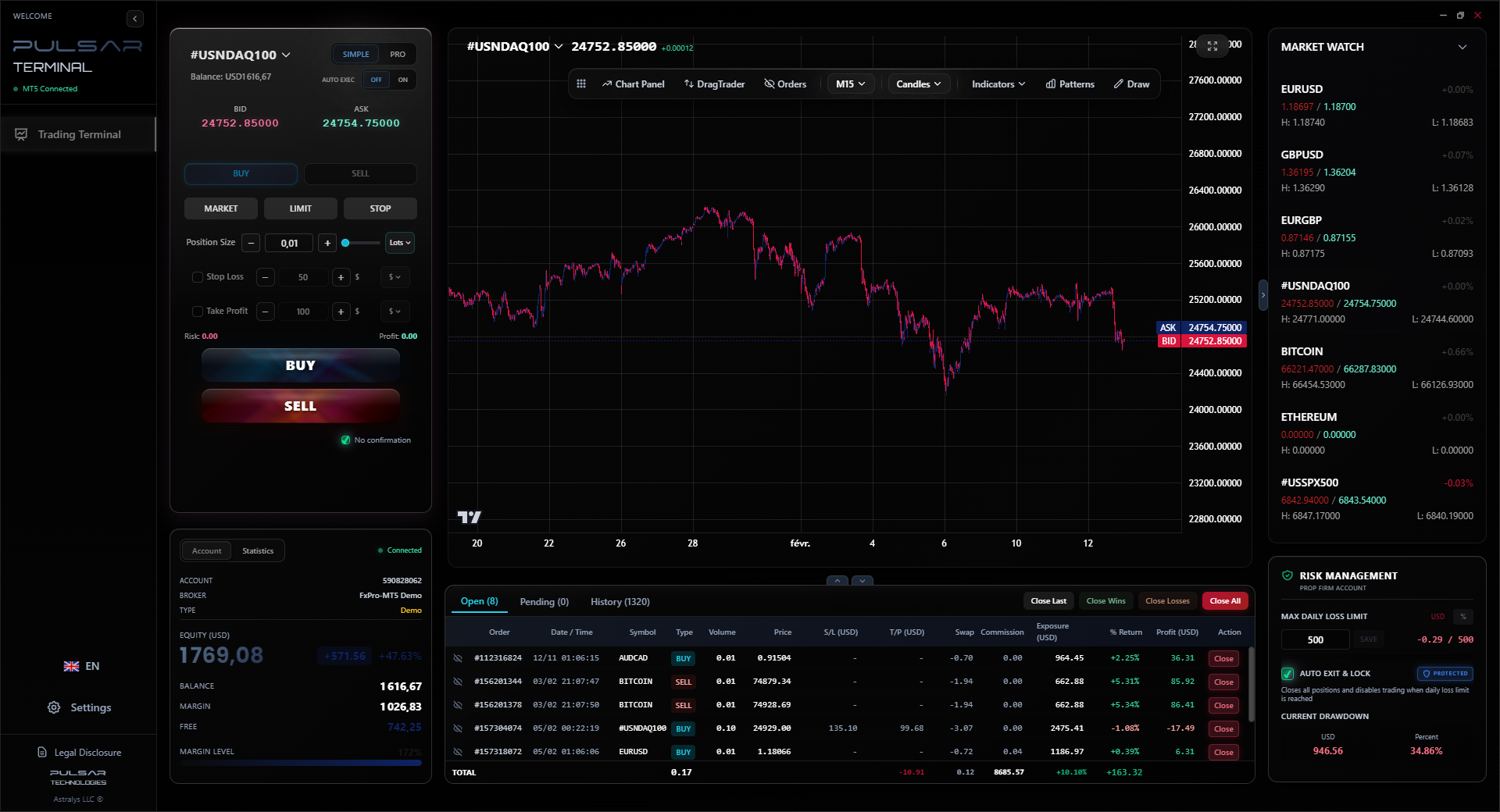
Managing multiple trades and emotions during volatile news is a core challenge, and tools like Pulsar Terminal help by letting you set multi-level take-profits and stop-losses with a single drag-and-drop order on MT5.
Pulsar Terminal
Lo strumento MT5 tutto-in-uno: ordini drag-and-drop, multi-TP/SL, trailing stop, grid trading, Volume Profile e protezione prop firm. Usato da oltre 1.000 trader ogni giorno.
“Protect your capital like it's the last water in the Karoo.”
Is forex trading easy to learn? No. But is the skill worth acquiring? For the right person, absolutely.
It teaches you discipline, analysis, and emotional control like few other pursuits. The potential for financial independence is real, but it's a marathon, not a sprint. The average trader in SA might make $50 (R900) on a good day when starting. An experienced, disciplined trader with a larger account can aim for more, but those 'R50,000 a month' stories are the extreme exception, not the rule.
Your success depends entirely on your commitment to the boring stuff: risk management, journaling, and continuous learning. The market is always changing. If you're looking for a get-rich-quick scheme, walk away now. If you're fascinated by markets, love a challenge, and have the patience to grind for a year or more before seeing real results, then you might just have the right temperament.
Start slow. Start small. Protect your capital like it's the last water in the Karoo. The learning never stops, but the first year is the hardest. Get through that, and you'll have answered the question for yourself.
FAQ
Q1How long does it take to learn forex trading in South Africa?
To reach a basic level of competency where you're not just gambling, expect a minimum of 6-12 months of dedicated study and practice with a demo or micro-live account. Becoming consistently profitable often takes 2+ years. It's a serious skill acquisition, not a quick tutorial.
Q2Can I start forex trading with R500 in South Africa?
Technically, yes. Some brokers accept deposits that small. But practically, it's very difficult. With a R500 account and 30:1 use, your buying power is R15,000. However, proper risk management (risking 1% per trade) means you could only risk R5 per trade. This makes meaningful practice and learning about position sizing almost impossible. R2,000-R5,000 is a more realistic learning budget.
Q3Do I pay tax on forex trading profits in SA?
Yes. The South African Revenue Service (SARS) views profits from frequent, speculative trading as ordinary income, taxable at your marginal income tax rate. You must declare this income and keep detailed records of all trades, deposits, and withdrawals. Consult a tax professional familiar with trading.
Q4What is the best forex trading strategy for beginners?
The best strategy is a simple one you can execute consistently. Many beginners find success with a swing trading approach on the 4-hour or daily charts, focusing on one or two major currency pairs like EUR/USD. Combine clear support/resistance levels with a basic indicator like the RSI to confirm entries. Complexity is the enemy when you're starting out.
Q5Is forex trading a good way to make a living in South Africa?
It can be, but it's a high-risk, high-stress career path that's not suitable for most. A very small percentage of retail traders achieve consistent, liveable profits. You should have at least 1-2 years of savings to cover living expenses before attempting to trade full-time. Most successful traders treat it as a supplemental income source for years before going full-time.
Q6What's more important for a beginner: technical or fundamental analysis?
Start with technical analysis. It gives you clear rules for entry, exit, and risk management on the charts. As you get comfortable, incorporate fundamental analysis to understand the broader context (like SARB interest rate decisions). But as a beginner, mastering a simple technical plan and iron-clad risk management is 95% of the battle.
Lezione del Prof. Winston
Punti chiave:
- ✓Expect a 6-12 month minimum learning period with real study.
- ✓Start with at least R2,000-R5,000 for realistic practice.
- ✓Never risk more than 1-2% of your account on a single trade.
- ✓Your first year's goal is survival, not spectacular profits.
- ✓Taxes on profits are real and must be planned for.
Quanto è stato utile questo articolo?
Clicca su una stella
Analisi Trading Settimanali
Analisi e strategie settimanali gratuite. Nessuno spam.
Sull'autore
David van der Merwe
Trader dei Mercati Emergenti
Trader con base a Johannesburg con 11 anni di esperienza nelle valute dei mercati emergenti. Specializzato in coppie ZAR, trading regolamentato dalla FSCA e analisi del mercato sudafricano.
Commenti
Avviso di rischio
Il trading di strumenti finanziari comporta rischi significativi e potrebbe non essere adatto a tutti gli investitori. Le performance passate non garantiscono risultati futuri. Questo contenuto è fornito solo a scopo educativo e non deve essere considerato un consiglio di investimento. Conduci sempre le tue ricerche prima di fare trading.
Potrebbe interessarti anche

Cara Trading Forex Sukses: 7 Prinsip dari Trader Profesional
Cara trading forex sukses dengan 7 prinsip trader pro: manajemen modal, disiplin, journal trading, backtest. Data nyata, bukan janji profit palsu.
Jam Trading Forex Terbaik untuk Trader Indonesia: Panduan Lengkap dengan Tabel Waktu
Panduan jam trading forex untuk trader Indonesia. Tabel 4 sesi dunia, jam emas 20:00-00:00, sesi mana yang harus dihindari. Data akurat + tips dari trader berpengalaman.
Top 5 Sàn Forex Uy Tín Nhất 2026: Review Jujur dari Trader Indonesia
Top 5 sàn forex uy tín 2026 untuk trader Indonesia. Review jujur: spread, deposit, withdraw, dukungan lokal. Exness, XM, IC Markets & lebih.
Scarica Pulsar Terminal
Tutti questi calcolatori sono integrati in Pulsar Terminal con dati in tempo reale dal tuo conto MT5.
Scarica Pulsar Terminal