


I watched my first major trade blow up because of something I didn't even understand at the time: a swap charge.

Olumide Adeyemi
Pioniere del Trading in Africa Occidentale ·  Nigeria
☕ 12 min di lettura
Cosa imparerai:
- 1The Core Islamic Principles You Can't Ignore
- 2Is a 'Swap-Free' Account Enough?
- 3Building a Practical Halal Trading Strategy
- 4Nigeria-Specific Challenges and Solutions
- 5Common Mistakes That Make Trading Haram (Even with an Islamic Account)
- 6Verifying Compliance and Seeking Guidance
- 7Final Verdict and Your Path Forward
I watched my first major trade blow up because of something I didn't even understand at the time: a swap charge. Back in 2015, I held a GBP/USD sell position over a weekend, convinced the pound was headed lower. By Monday, I was down £120 not from price movement, but from overnight financing fees. For a Muslim trader, that's not just a bad trade, it's a direct violation of the prohibition against riba (interest). That loss forced me to stop and ask a fundamental question: is forex trading even permissible in Islam? The answer isn't a simple yes or no. It's a framework of conditions that, if ignored, turns a potential business into a sinful gamble. Let's break down what makes trading halal, the Nigerian broker landscape for Islamic accounts, and the practical steps to align your strategy with Sharia principles.
Forget everything you've heard from random Telegram groups. The Islamic view on forex trading hinges on four non-negotiable pillars. If your trading violates any of these, it's considered haram (forbidden). This isn't about personal opinion, it's about contract law in Sharia.
First, and most critical, is Riba. This is the prohibition of interest. In conventional forex, you pay or receive swap fees for holding positions overnight. That's interest, pure and simple. It doesn't matter if you're making money from it or paying it, it's prohibited. This is the biggest hurdle for Muslim traders and the main reason Islamic accounts exist.
Second is Gharar. This means excessive uncertainty or deception. Selling something you don't own, or entering a contract with unknown terms, is gharar. Spot forex, where currencies are exchanged immediately, generally has minor, tolerated uncertainty. But when you start dealing with exotic derivatives or binary options where the outcome is pure speculation, you're crossing into forbidden territory. The line between calculated risk (khatar) and excessive uncertainty (gharar fahish) is thin.
Third is Maysir, which is gambling. If your trading is based on hunches, tips, or pure chance without analysis or a sound economic purpose, it's maysir. Islam encourages trade and business, not gambling. Your trades should be backed by real analysis, not just hoping for a lucky break.
Finally, you must avoid Haram Industries. Even if your forex account is swap-free, using profits to invest in companies involved in alcohol, gambling, or pork production is not permissible. Your capital and its growth must be clean.

Warning: Many traders think using high use is just a risk management issue. From an Islamic perspective, if that use involves borrowing money on interest (which it typically does with a standard broker), it's another form of riba. This makes the common 1:500 use offers deeply problematic.
I learned about gharar the hard way early on. I tried trading binary options on USD/NGN, lured by the 'fixed risk.' I lost $500 on three trades. The problem wasn't just the loss, it was the structure. The contract's outcome was a 50/50 gamble on a price being above or below a line at a specific second. A respected scholar I consulted later called it 'structured gharar.' The uncertainty wasn't in the market movement, it was embedded in the contract itself. I stopped immediately.
This is where most Nigerian traders get it wrong. You see 'Islamic Account' on a broker's website and think you're good to go. It's not that simple. A true Sharia-compliant account must address all the principles, not just remove swaps.
A genuine Islamic account should have:
- No Swap/Rollover Interest: Positions held overnight do not incur interest charges.
- No Hidden Interest Fees: Some brokers remove the swap but charge a higher spread or a fixed 'administration fee.' This fee must be transparent, fixed, and not proportional to the holding time or loan amount, or it can become riba in disguise.
- Immediate Settlement (Spot): The account should be for spot trading, not derivatives that involve selling what you don't own.
- No use Based on Interest-Bearing Loans: This is the trickiest part. Most broker use is a loan from the broker. If that 'loan' has any interest component, it's non-compliant. Some Islamic financial institutions argue for 'profit-sharing' models instead of leveraged loans, but these are rare in retail forex.

Pro Tip: When you apply for an Islamic account, ask the broker's support: "Is your use facility provided as an interest-free loan (qard hasan) or is it based on a conventional lending model?" Their answer (or lack thereof) will be very telling.
Let's look at real broker structures for Nigerian clients:
| Broker | Islamic Account Offer | Key Detail for Nigerian Traders |
|---|---|---|
| OctaFX | Always swap-free on all accounts. | Popular here because of Naira deposits via Flutterwave. No time limits on holding positions. |
| XM | Swap-free on request. | Very low minimum deposit ($5), but check their use terms. |
| AvaTrade | Islamic account on request. | Strong education, good for beginners. $100 minimum deposit. |
| FP Markets | Swap-free on MT4/MT5. | Charges a clear administration fee instead of swap. Regulated by ASIC. |
| Exness | Offers swap-free accounts. | Huge popularity in Nigeria for its raw spreads, but you must specifically enable the Islamic profile. |
Remember, the broker's regulation also matters for your protection. I prefer brokers like Pepperstone or IC Markets that are regulated by top-tier authorities like ASIC or FCA, even though I'm trading from Nigeria. It adds a layer of security for my capital.

💡 Consiglio di Winston
A swap-free account that charges a 'fixed admin fee' after 3 days is often just riba with a different name. True compliance removes the time-value of money from the equation entirely.
“Avoiding riba is only one battle in making your trading halal; ignoring the nature of use is how many traders fail the second.”
Compliance isn't just about the account type, it's about how you trade. A swap-free account used for reckless gambling is still maysir. Here’s how to build a strategy that aligns with Islamic principles.
Focus on Spot and Avoid Derivatives
Stick to major, minor, and exotic currency pairs in the spot market. Avoid CFDs on stocks, indices, or commodities unless you've verified the underlying assets are halal and the contract is spot-based. Complex options and futures often contain gharar. Your primary tools should be spot forex pairs and maybe spot metals like XAU/USD (gold).
Adopt a Business Mindset, Not a Gambler's
This changes your entire psychology. You are a risk manager, not a punter. Use proper analysis. I combine technical analysis from tools like the MACD indicator and RSI indicator with fundamental analysis of economic news. Every trade must have a logical basis. Scalping can be particularly risky here; the fast-paced nature can slip into maysir. I found my edge in swing trading, holding trades for days based on clear chart patterns and economic shifts, which feels more like a calculated business decision.
Risk Management is Your Shield
Islam encourages protecting your wealth. Use stop-losses on every single trade. This isn't a suggestion, it's a requirement for responsible trade. Determine your position size using a position size calculator so you never risk more than 1-2% of your account on a trade. I once broke this rule, risking 5% on a 'sure thing' EUR/USD trade. A surprise ECB comment caused a 50-pip spike against me, and I lost $1,250 in minutes. That was a lesson in both poor risk management and the gharar of assuming any trade is a 'sure thing.'

Example: You have a $2,000 account. Your risk per trade is 1% ($20). Your stop-loss on a EUR/USD trade is 20 pips. Each pip on a standard lot is $10, but you're not trading a standard lot. Your position size should be: $20 risk / (20 pips * $10 per pip per lot) = 0.1 lots. This precise calculation prevents emotional over-leveraging.
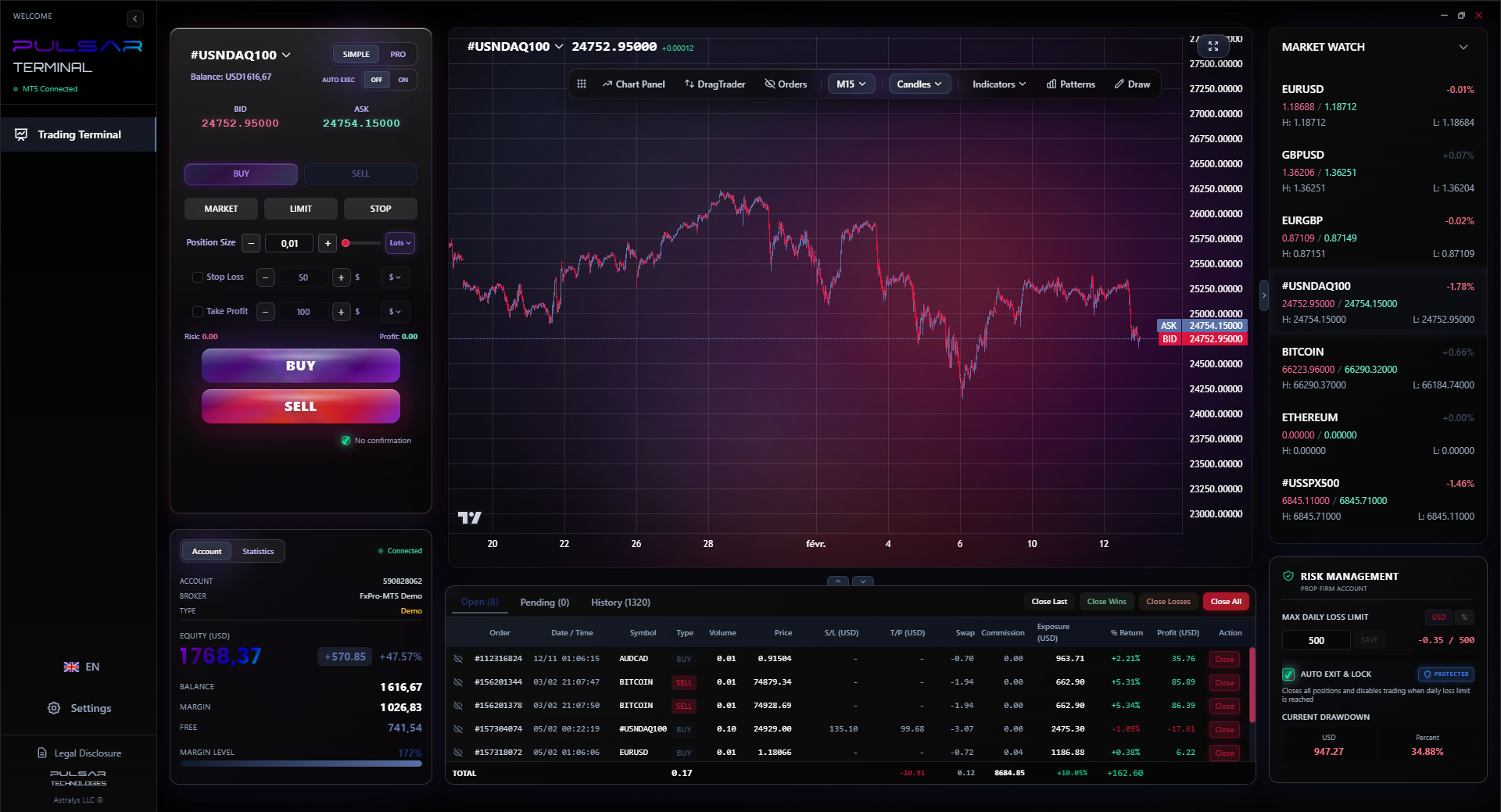
Managing multiple trades and setting precise stop-losses is key to avoiding gharar, and Pulsar Terminal's drag-and-drop order tools on MT5 make executing that discipline faster and more accurate.
Pulsar Terminal
Lo strumento MT5 tutto-in-uno: ordini drag-and-drop, multi-TP/SL, trailing stop, grid trading, Volume Profile e protezione prop firm. Usato da oltre 1.000 trader ogni giorno.
Trading from Nigeria adds extra layers to the Islamic view on forex trading. Our regulatory environment and banking restrictions are unique.
The Central Bank of Nigeria (CBN) doesn't have specific, strong regulations for retail forex like the UK's FCA does. This means you're largely on your own when choosing a broker. The CBN also restricts using the official forex window to fund trading accounts, and many banks block Naira card transactions to international brokers. So, how do you navigate this?
Funding Your Account: Brokers like OctaFX have adapted by integrating with local payment gateways like Flutterwave. You deposit Naira, it's converted, and sent to your trading account. This is often smoother than trying to use your international Visa card, which might be declined. Always check the broker's deposit page for 'Local Bank Transfer' or 'Flutterwave' options.
Taxes: Remember, you're subject to a 10% Capital Gains Tax on your profits in Nigeria. Declaring and paying this is part of conducting lawful, transparent business (which is encouraged in Islam). Keep clear records of all your trades, deposits, and withdrawals.
Choosing a Broker: Don't just pick the broker with the highest use offer (that's likely haram anyway). Look for:
- A clear, accessible Islamic account policy.
- Regulation from a reputable body (ASIC, CySEC, FSA).
- Naira-friendly deposit/withdrawal methods.
- Reliable customer support. I've had good experiences with the support teams at XM and Exness for resolving account queries.
The best trading hours for liquidity if you're in Lagos are between 1 PM and 6 PM WAT, when London is active and New York is opening. This is when spreads are tightest on pairs like EUR/USD, which is good for your execution costs.
💡 Consiglio di Winston
If you can't explain your trade's rationale in two sentences of economic or technical logic, you're likely speculating (maysir). Write down the 'why' before every entry.
“A swap-free account used for reckless gambling is still maysir. Compliance is in the strategy, not just the settings.”
I've seen devout traders carefully avoid swaps but then fall into these traps. Avoiding riba is only one battle.
Mistake 1: Trading on Margin with Interest-Based use. This is the big one. You have a swap-free account, but you're using 1:500 use. That use is almost certainly an interest-bearing loan from the broker. You're not paying overnight interest, but the very facility is built on riba. The solution? Use very low use (1:10 or 1:5) or, ideally, trade with your own capital only. This forces better position sizing and risk management.
Mistake 2: Chasing Bonuses. Many brokers offer deposit bonuses. From an Islamic perspective, these can be problematic if they create an obligation or involve ambiguous terms (gharar). Is the bonus a gift? Or is it a loan that must be 'worked off' through volume? The terms are often unclear. I avoid them entirely. I'd rather know exactly what my equity is.
Mistake 3: High-Frequency Scalping Without Edge. This is where maysir creeps in. Clicking buttons every minute based on noise, trying to catch 5-pip moves. It becomes a game of chance. A true scalping strategy requires a statistical edge, proven over hundreds of trades, not just adrenaline. If you can't articulate your edge, you're likely gambling.
Mistake 4: Ignoring the Underlying Asset in CFDs. You trade a CFD on the US30 index. That index contains companies involved in haram activities like alcohol, gambling, and conventional banking (riba). Your profit is indirectly linked to those businesses. This is a complex area where scholars differ, but the safest path is to avoid such instruments unless you can find a Sharia-compliant alternative index.
My own mistake was in my third year. I had a swap-free account, was trading responsibly, but then started using a broker's 'bonus use' promotion. I didn't read the 80-page terms. When I hit a margin call and my account was liquidated, I realized the bonus had created a different liability structure that felt unjust. The gharar was in the opaque terms I agreed to.
You can't outsource your deen to a broker's marketing department. 'Islamic Account' is a label they use; verification is your responsibility.
Steps to Take:
- Request the Sharia Compliance Certificate: Reputable Islamic financial products have a ruling (fatwa) from a recognized Sharia board. Ask your broker for documentation of who has certified their swap-free model. If they can't provide it, that's a red flag.
- Consult a Knowledgeable Scholar: Don't ask just any Imam. Seek out a scholar with specific knowledge in Islamic finance and modern transactions. Present your exact setup: broker name, account type, use used, your typical trading strategy. Get a personal fatwa for your situation.
- Review the Terms of Service Yourself: I know, it's tedious. But skim the key sections on fees, use, and account administration. Look for words like 'finance charge,' 'interest,' or 'loan.'
- Start with a Demo Account: Before putting real, halal capital at risk, test the broker's platform, execution, and the actual functionality of their Islamic account. See if any unexpected fees appear on the account statement after holding positions for a week.
The landscape is improving. In late 2025, Nigeria's Financial Reporting Council (FRC) moved to adopt AAOIFI standards, which aim to bring more transparency to Islamic finance. This could eventually lead to clearer guidelines for products offered in Nigeria.
💡 Consiglio di Winston
The most Sharia-compliant tool in your box is the stop-loss. It defines your risk (prevents gharar) and protects your wealth - a core Islamic principle.
“Islam encourages protecting your wealth. Using a stop-loss isn't just smart trading, it's a religious responsibility for a merchant.”
So, is forex trading halal? The Islamic view on forex trading permits it as a form of international trade (bay' al-sarf) if conducted as a spot exchange of currencies with immediate settlement, free from riba, gharar, and maysir.
The modern online retail version, however, is wrapped in layers of complexity - use, swaps, derivatives - that often contradict those conditions.
Your path forward as a Nigerian Muslim trader:
- Choose the Right Tool: Open a genuine Islamic swap-free account with a reputable, internationally regulated broker that offers clear Naira funding. IC Markets and Pepperstone are strong contenders with strong platforms.
- Limit or Eliminate use: Treat use as potentially haram. Trade with 1:1 or very low use. This will dramatically improve your risk discipline anyway.
- Develop a Business Plan: Have a written trading plan based on analysis. Trade less frequently, with higher conviction. Track your results like a business.
- Purify Your Earnings: If you have any doubt about past earnings from non-compliant trading, calculate the amount attributable to riba or haram practices and give it away in charity without seeking reward. Then start fresh with a clean slate and a clean method.
Forex trading is a skill, not a lottery. Islam recognizes trade and profit. By intentionally structuring your trading activity to avoid the prohibited elements, you can engage in this market with a clear conscience. It's harder work. It means lower use, more scrutiny of brokers, and constant self-auditing of your strategy. But that's the point. It transforms trading from a speculative casino into a disciplined, ethical business venture. And that’s a foundation for success that goes beyond just the numbers on your screen.
FAQ
Q1Is forex trading haram in Islam?
Not inherently. The exchange of currencies (bay' al-sarf) is permissible. However, the common practices in retail forex trading - like paying/receiving overnight interest (swap), using interest-based use, and excessive speculation - can make it haram. It's only halal under strict conditions: spot exchange, no riba (interest), minimal gharar (uncertainty), and no maysir (gambling).
Q2What is an Islamic forex account?
An Islamic forex account, often called a swap-free account, is designed to comply with Sharia law by eliminating overnight interest charges (swap/rollover fees). However, a true compliant account must also address other issues like the nature of use and avoid all forms of riba and gharar. Not all accounts labeled 'Islamic' are fully Sharia-compliant upon deeper inspection.
Q3Can I use use with an Islamic account?
This is a major point of concern. Most use provided by brokers is an interest-based loan. Even if no swap is charged, the use facility itself may be non-compliant. Many scholars advise using very low use (e.g., 1:5 or 1:10) or, ideally, trading with your own capital only (1:1 use) to avoid this issue entirely.
Q4Which brokers offer Islamic accounts to Nigerian traders?
Several international brokers accepting Nigerian clients offer Islamic account options. These include OctaFX (known for easy Naira deposits via Flutterwave), XM, AvaTrade, FP Markets, and Exness. Always verify their specific terms, use structure, and regulatory status before depositing.
Q5Are profits from forex trading taxable in Nigeria?
Yes. Forex trading profits are subject to Capital Gains Tax in Nigeria, which is currently 10% of your gross profits. Keeping accurate records of all trades for tax purposes is part of conducting lawful and transparent business.
Q6Is scalping allowed in Islamic forex trading?
Scalping as a technique isn't automatically haram. However, it carries a high risk of crossing into maysir (gambling) if it's based on random entries without a proven edge or a business-like strategy. The high frequency can encourage gambling mentality. If you scalp, you must have a rigorously tested, analytical system and treat it as a business, not a game of chance.
Q7What should I do if I've already traded with a conventional account earning swaps?
If you have earned profit from interest (riba) in the past, the required action is to purify that wealth by giving away the amount attributable to the riba to charity, without seeking any reward or benefit from it. Calculate the swap credits you received, remove that amount from your capital, and donate it. You can then start fresh with a compliant account and strategy.
Lezione del Prof. Winston
Punti chiave:
- ✓Swap fees are explicit riba; avoid them with verified Islamic accounts.
- ✓use above 1:10 often involves an interest-based loan facility.
- ✓A 10% Capital Gains Tax applies to all Nigerian forex profits.
- ✓Trade only spot FX & metals to avoid derivative-based gharar.
- ✓Fund accounts via local gateways like Flutterwave for Naira ease.
Quanto è stato utile questo articolo?
Clicca su una stella
Analisi Trading Settimanali
Analisi e strategie settimanali gratuite. Nessuno spam.
Sull'autore
Olumide Adeyemi
Pioniere del Trading in Africa Occidentale
Uno degli educatori di trading forex più attivi in Nigeria. 8 anni di esperienza di trading da Lagos. Specializzato in strategie a basso capitale e sfide prop firm per trader africani.
Commenti
Avviso di rischio
Il trading di strumenti finanziari comporta rischi significativi e potrebbe non essere adatto a tutti gli investitori. Le performance passate non garantiscono risultati futuri. Questo contenuto è fornito solo a scopo educativo e non deve essere considerato un consiglio di investimento. Conduci sempre le tue ricerche prima di fare trading.
Potrebbe interessarti anche

Cara Trading Forex Sukses: 7 Prinsip dari Trader Profesional
Cara trading forex sukses dengan 7 prinsip trader pro: manajemen modal, disiplin, journal trading, backtest. Data nyata, bukan janji profit palsu.
Jam Trading Forex Terbaik untuk Trader Indonesia: Panduan Lengkap dengan Tabel Waktu
Panduan jam trading forex untuk trader Indonesia. Tabel 4 sesi dunia, jam emas 20:00-00:00, sesi mana yang harus dihindari. Data akurat + tips dari trader berpengalaman.
Top 5 Sàn Forex Uy Tín Nhất 2026: Review Jujur dari Trader Indonesia
Top 5 sàn forex uy tín 2026 untuk trader Indonesia. Review jujur: spread, deposit, withdraw, dukungan lokal. Exness, XM, IC Markets & lebih.
Scarica Pulsar Terminal
Tutti questi calcolatori sono integrati in Pulsar Terminal con dati in tempo reale dal tuo conto MT5.
Scarica Pulsar Terminal